Saturday, September 23, 2017

‘Radical Women’ of Latin American Art


Blouin Artinfo


‘Radical Women’ of Latin American Art at Hammer Museum

Limitada (Limited), 1978, by Marie Oresanz (Argentine, born 1936). Black-and-white photograph, 35 X 50 cm.
(Courtesy Collection of Mari e Orensanz; courtesy Alejandra Von Hartz Gallery. ©Mari e Orensanz)
“Radical Women: Latin American Art, 1960–1985” will be on view at the Hammer Museum in Los Angeles from September 15 through December 31.
As a part of “Pacific Standard Time: LA/LA” — an effort by Getty and other arts institutions across Southern California to explore the birth of the Los Angeles art scene— “Radical Women” brings a fresh perspective to the work of a cross-section of internationally influential women artists who helped shape experimental art in Latin America and the United States between 1960 and 1985. The show’s organizers say it aims to address a vacuum in art history, giving visibility and context to the radical and feminist work that was produced during these decades, but that has been underserved in the academic world. Included are an assortment of 260 works in mediums including photography and video by 116 artists from 15 countries. Lygia Pape, Ana Mendieta, and Marta Minujín are among the artists featured, but the show also includes lesser-known figures such as the Cuban-born abstract artist Zilia Sánchez, the Colombian sculptor Feliza Bursztyn, and the Argentine mixed-media artist Margarita Paksa. “The artworks in ‘Radical Women’ can be viewed as heroic acts that gave a voice to generations of women across Latin America and the United States,”says Ann Philbin, the director of the Hammer Museum.

“Human Life Is Punishment,” and Other Pleasures of Studying Latin


“Human Life Is Punishment,” and Other Pleasures of Studying Latin


By 
 

ON LANGUAGE


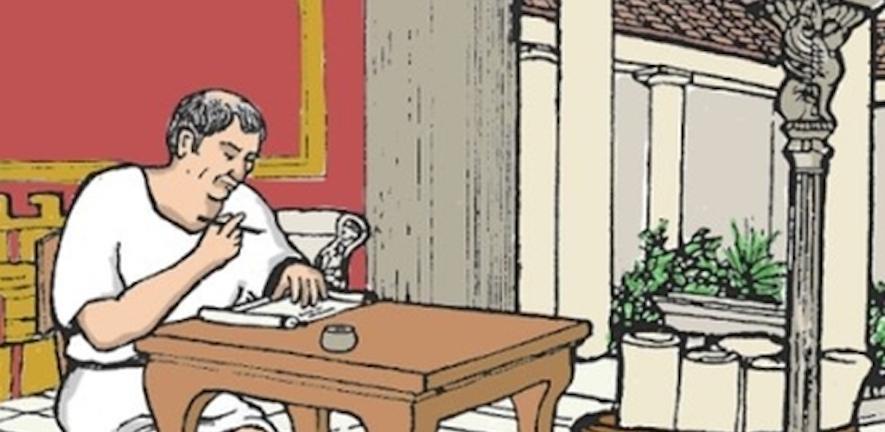
FROM THE CAMBRIDGE LATIN COURSE 4TH EDITION.
The Iowa Writers’ Workshop, where I am currently enrolled, doesn’t require you to do much of anything. Time is largely unstructured here; as long as your writing gets done, you barely have to get out of bed for two years. When I first realized this, I panicked, and then I registered for an undergraduate course in elementary Latin. I don’t even get academic credit for it. I just wanted something in my life, amidst the subjective muck of the creative process, that I could be objectively good at—the occasional dopamine rush of a check mark, an A grade, a scribbled Great job! from an authority figure—and I remembered being good at Latin.
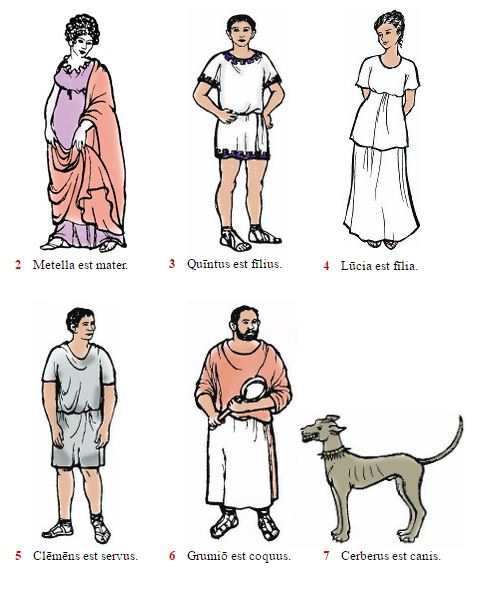
It had been almost two decades since I last looked at a Latin textbook, but I was optimistic that I’d retained a lot. My seventh-grade Latin textbook left a vivid impression on me. It followed the fictionalized adventures of a real-life Pompeian household (vocab words for the final chapter included volcano, to erupt, smoke, ashes, in despair), and to this day, I remember the whole cast of characters: Caecilius, a banker; Metella, his wife; Grumio, their cook; and Cerberus, the dog, who stays by his master’s side to the very end (RIP, little buddy). I’ll never forget the passage in which Melissa, a newly purchased slave girl, is first presented to the household: my translation was “Melissa pleases Caecilius. Melissa pleases Grumio. Uh-oh—Melissa does not please Metella!” It was pretty juicy material, by seventh-grade standards. (I just Googled these names, so I can tell you that the book was The Cambridge Latin Course: Book 1, and that it has a surprisingly robust fandom on Tumblr.)
My middle school required two years of Latin, and the worse I did socially, the better I did at Latin. At the social nadir of my seventh-grade year, on the heels of my thirteenth birthday and my parents’ divorce, my best friend unexpectedly dumped me dramatically in a crowded school hallway. “You’re a BITCH from HELL,” she shouted in my face, “so FUCK OFF!” I had never had such language directed at me before, and over the following weeks, as I reeled from the shock of the incident, I found myself thinking about it in Latin. The verb vituperare, which can be translated as “to yell at,” “to find fault with,” “to reproach,” “to castigate,” et cetera, summed it all up in a way that no English word could. Amelia me vituperavit, I whispered to myself on the subway, in the crowded school hallway, in the cafeteria where I now ate lunch alone. O Amelia, cur me vituperavisti?

FROM THE CAMBRIDGE LATIN COURSE: BOOK 1.
This obsession continued to the point where I eventually composed an entire Latin paragraph asking Amelia why, indeed, she had me vituperavit. Playfully, I coined the word Cerbera, a feminized form of Cerberus: literally, “female dog from hell”. Idne est verum? Num Cerbera sum? In Latin, I was more vulnerable than I allowed myself to be in English, and though I was angry, at the end of the passage, I surprised myself by asking Amelia to be my friend again. The process was very therapeutic.
Then I emailed her the whole thing over AOL.
I don’t know what I had expected, but I was crushed when she wrote back informing me that there was no way she was going to translate all that (somehow, I had lost sight of the fact that she would have to), and that, furthermore, I was “so weird.” We never spoke again.
At the end of that year, I scored 110 percent on the Latin final. Even the teacher, a kind, soft-spoken man named Kai Ashante Wilson, seemed concerned by the fervor with which I’d thrown myself into this dead language. He never played favorites, but on the last day of school, he took me aside and gave me a special present: an illustrated Latin guide for kids, so that I could study Latin on my own over the summer. I was moved almost to tears. But when I got home and opened the book, I realized it was a poorly edited entry in a cheap series designed to teach non-dead languages. Each chapter contained increasingly surreal instructions for achieving oral fluency: visit Latin-speaking communities, the book suggested, and practice conversation with native Latin speakers. I’d make Latin-speaking friends in no time!
I decided not to continue studying Latin in high school. It met at the same time as chorus, and of the two, Latin seemed more dangerous—a seductively solitary pursuit that could, like drugs, swallow up anyone who enjoyed it too much.
The University of Iowa uses a different textbook, Wheelock’s Latin, for the beginner classes. I miss Caecilius and Metella and the whole doomed Pompeian gang, but Wheelock (as we chummily personify the text) has his own pleasures, especially for those of us who spent the bulk of our academic careers studying living languages. Here are some sentences you’re likely to encounter in beginner French or Spanish:
I would like a salad.
This is a pencil.
Where is the library?
Here are some actual sentences that appear, context-free, in the first few chapters of Wheelock:
You are in great danger.
Few men have true friends, and few are deserving of them.
Human life is punishment.
Our translation exercises are epic, portentous, full of grandeur and violence. Wheelock is particularly preoccupied with the idiom poenas dare, which he translates as “to pay the penalty.” People in Wheelock are always paying the penalty for their anger, their greed, their foolishness. “You are all to blame, thunders one sentence, “and tomorrow you will pay the penalty. As with all of Wheelock’s sentences, you can easily imagine it delivered by a Hollywood super villain. Seize him, you fools!

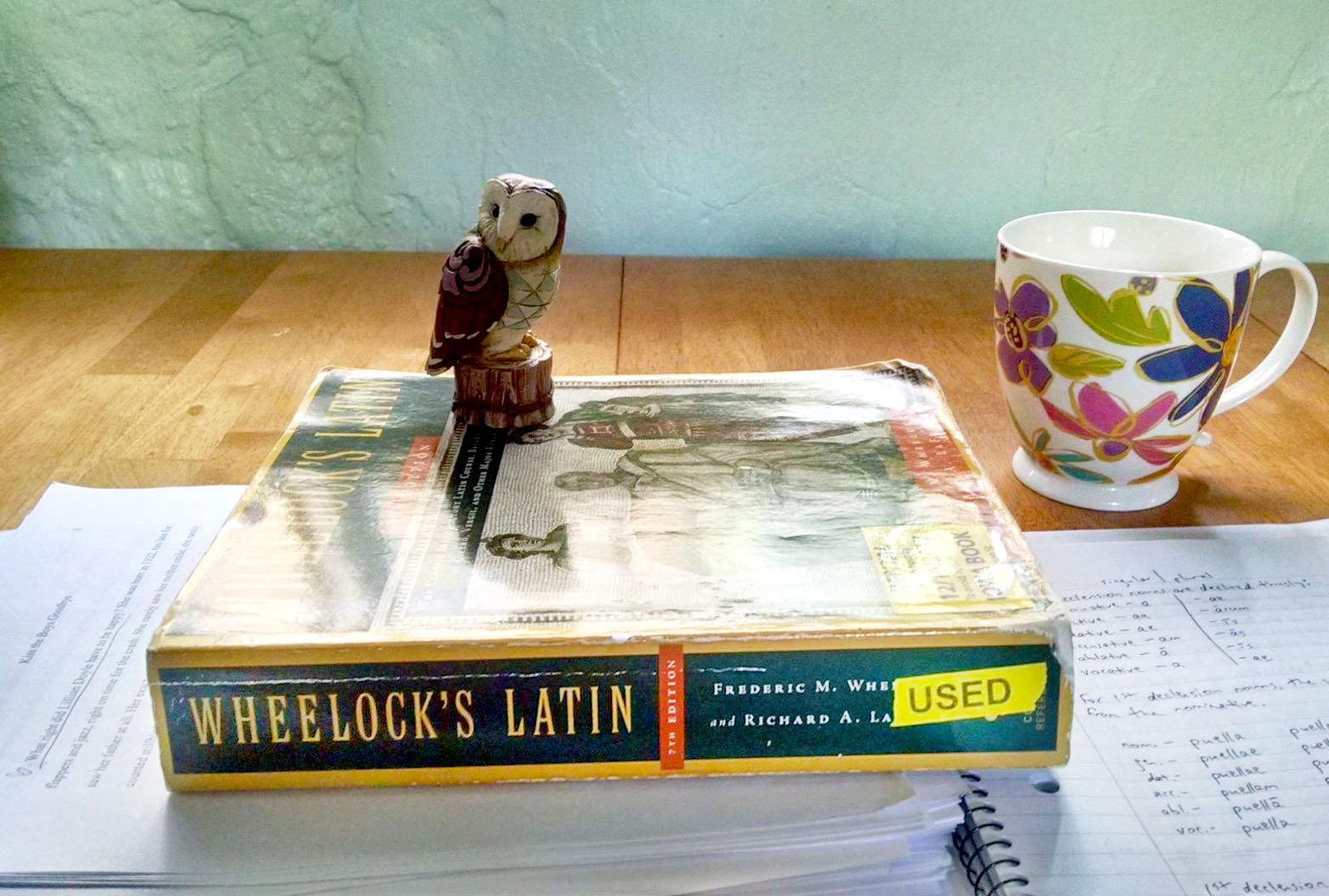
THE AUTHOR’S DESK IN IOWA CITY
My class meets for an hour at ten thirty every morning, and as I labor to decipher our daily Wheelockian pronouncements, I remember why I loved Latin to begin with. Each sentence is a little puzzle, a Rubik’s Cube of words to be rearranged into their proper order based on arcane rules and hidden clues. There’s a creative thrill, too, in the task of transforming Latin into English, the miniature power trip of deciding whether to translate superare as “to rise above,” “to overcome,” “to conquer,” or even—if I’m feeling saucy—“to fucking crush.” The relative sparseness of Latin vocabulary makes me savor the richness of English all the more.
English is constantly on my mind in Latin class. Unlike non-dead languages, Latin places no pressure on the beginner student to outgrow the training wheels of one’s native language. Spontaneous conversation is not the goal, and thank the gods for that. Even at the highest levels, all Latin study is undertaken with an eye toward translation. In this respect, it hardly qualifies as “learning a language” at all; it has more in common with my mother’s addiction to those maddening cryptic crosswords in The Nation. Or, for that matter, her fondness for the crime novels of Walter Mosley and Michael Connelly. Every Latin sentence is a mystery to be solved, and the joy of translation, as with all detective fiction, is the promise that life can be untangled and reorganized into something neat and orderly.
More than anything, though, I love Latin because it has nothing to do with me. It has nothing to do with anything in my life. Classics evangelists who argue for the practical utility of Latin, its historical significance and English vocabulary-building potential, are profoundly missing the point: Latin is fun because all its native speakers are dead and will never have to meet you. Even if you could communicate with them through space and time, and even if your Latin skills were up to the task, what could you possibly say that would mean anything to them? You, personally, have no place in Latin. As far as Latin is concerned, you don’t matter; you don’t even exist. Studying Latin is an exercise in ego death.
I’m realizing now that this must have been what drew me to Latin in the seventh grade, when I wanted nothing more than to flee my own existence. Today, at the age of thirty, I enjoy my existence much more, but there’s still something to be said for starting every day with an hour of structured self-annihilation, especially when one is meant to spend the rest of the day working on a novel. I suspect that Kai Ashante Wilson, my gentle Latin teacher from middle school, would agree: I just Googled him and discovered that he is now a Hugo- and Nebula Award–nominated science-fiction author.
Seeing this news, I laughed with delight—who’d have guessed it?—and felt a new appreciation for the best part of Latin: not studying it, but leaving it behind. At the end of every class, when I pack up Wheelock and step into the bright light of an Iowa City morning, I am ready to inhabit the world again. I am ready to superare it all. I might even be ready to write about it.

Frankie Thomas is the author of The Showrunner, which received special mention in the 2013 Pushcart Prize Anthology. Her writing has also appeared in The Toast, The Hairpin, and Vol. 1 Brooklyn. She is currently studying fiction at the Iowa Writers’ Workshop.

Sample Trees


Sample Trees


Thomas Demand & Ben Lerner

ISSUE 212, SPRING 2015


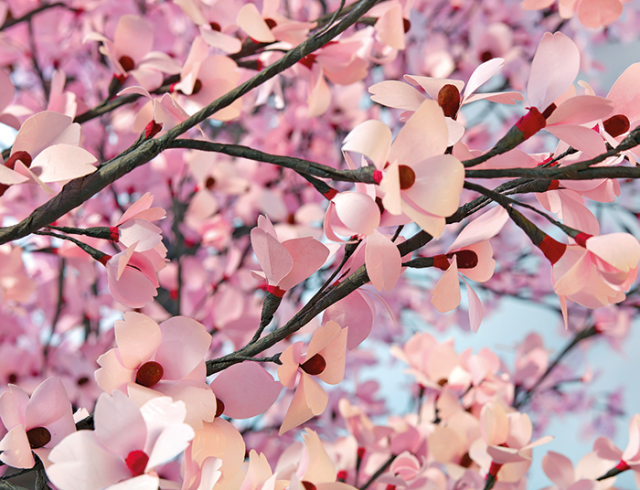
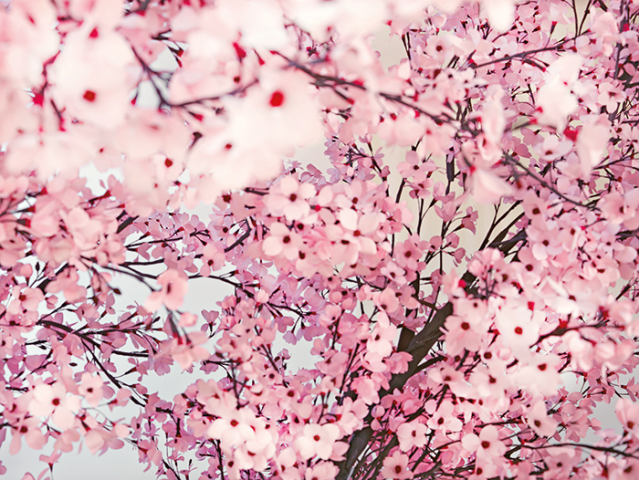
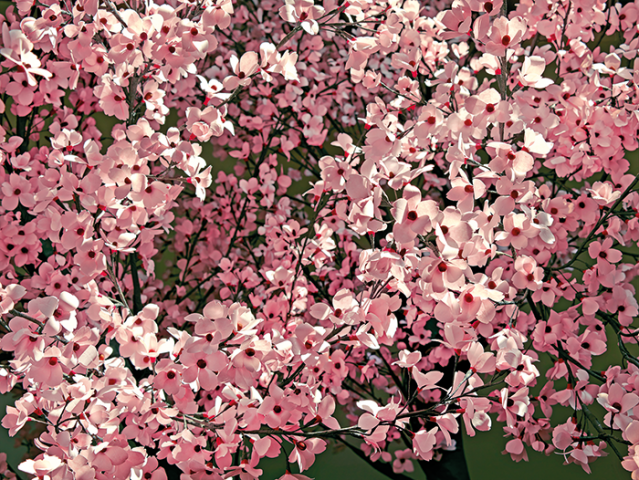
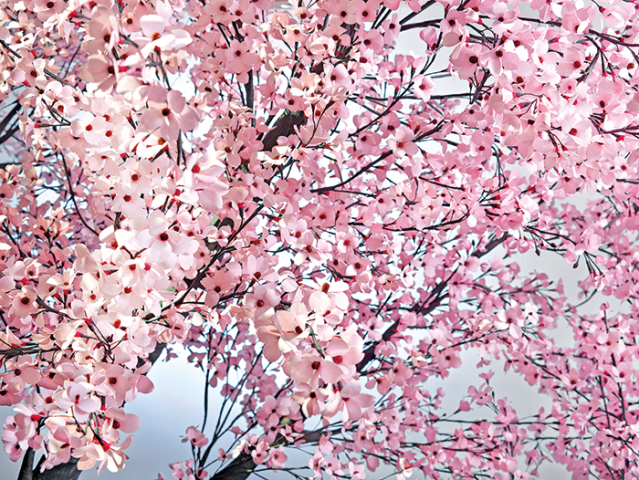
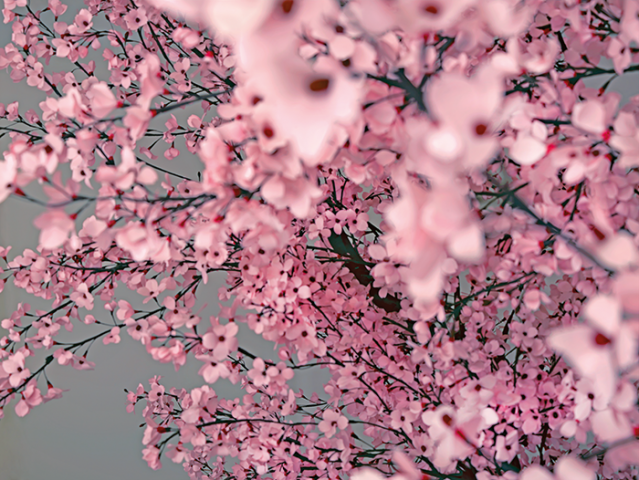
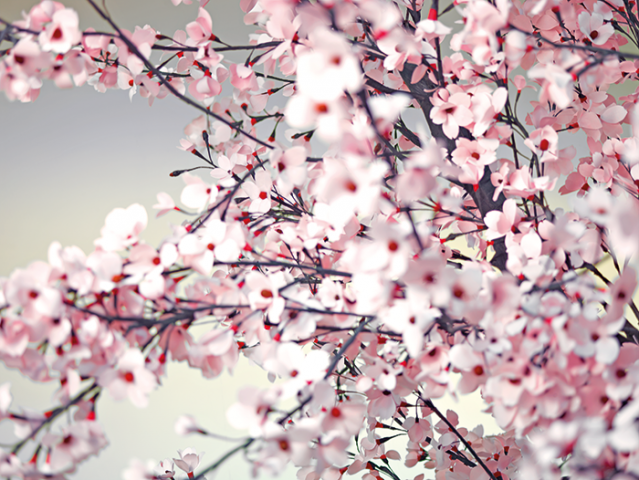
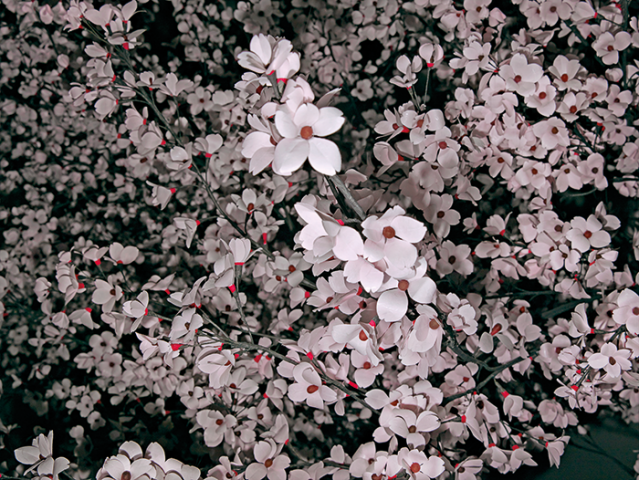
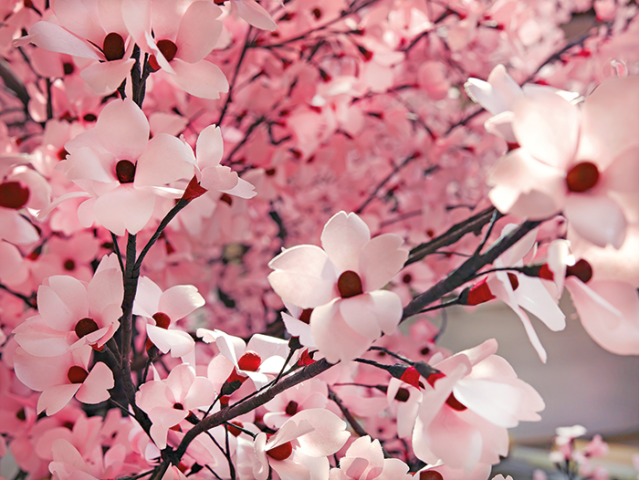
The following images of paper flowers, constructed and photographed by Thomas Demand, are based on a detail from a news photo of Katherine Russell, widow of the Boston Marathon bomber Tamerlan Tsarnaev. These images, and the accompanying poems by Ben Lerner, are part of a larger cycle, Blossom, which will be published in book form this summer.


Traditionally, you drink plum wine
Deepening the evening, a length of cloud
Then confuse a falling blossom with

A butterfly / In the photograph
Of the tradition, flowers in small corymbs
Papery against electric light

Blossoming en masse, in time lapse
You refer to a place where water flows
Over a vertical drop in culture / Poems

Fail to mention fission or decay
In the traditional ways, focusing instead
Then renouncing focus, a shimmering effect

In the middle distance, there is a monk
Likening this world to an echo, smoke
Slowly rising from some pyre, another year  

Gone, frostwork on the grass/glass
The nu suffix expresses completeness
The mu suffix indicates intention, I

Function to measure impermanence
“Like a passing dream on a night in spring”
The petals shed their details


The suspicion that, too rapidly to be perceived
As they pass behind a stand of ornamentals
These clouds are being removed and then replaced

With identical masses of frozen crystals / I
Am the embodied form of that suspicion / I
Have traveled all night to sing it / I

Was robbed and beaten on the road
Between two period styles, my eyes removed
Dipped in something, and replaced

When luminance sensitivity peaks
A shift toward the blue end of the spectrum
Inclines my song to natural satellites

Reflected in transparent fluids and/
Or glimpsed through branches, whether real
Paper or imagined, my song appeals

Not to be recorded, therein its claim
On the tradition, the fission and decay
Of a temple bell across a lonely mountain

Somewhere in LA, a man has captured
And thereby canceled, the transience
Of syllables falling onto man-made lakes


If six flowers bloom on the sample tree
The day of opening is officially declared
Signifying death in battle, the flowers appear

In the letters of young pilots, the ritual
Suicide a season is, the rising sun
Militarizes grasses, I have come

Writes one such pilot, to an understanding
With the petals and associated structures
The corolla of light my body makes  

As it opens in a market or a bus, whorl
Of sepals at the base or finish line
Of a marathon, improvised devices like

kireji, or “cutting word” / In English
There is no equivalent, only the ellipse
Where once there was a season, plums

Bloom prematurely, overtaking cherries
Confusing bees and viewing parties, both
Anachronisms / My vision separated

So that I could watch myself become immortal
Over the Pacific from my body
Where it remains, a shimmering effect


This page is blank except where indicated
This line left blank intentionally
There is a white so white that it appears

Only over many years, a period snow
Sparkling in belated light / Once erased
A poem can start, but how to end

Without beginning, I wrote this right
To left, but intended it to be read
From the margins in, the way birds scavenge

Or, as the film rewinds, the fire spreads
“I have taken considerable delight
In your ability to picture grass (Rasen)

Straw (Stall), trees (Lichtung)
A dead plant (Klause), gold (Bullion)
A rumpled pillow (Raum), dirty water

To name a few of the things that seem
A long way from paper,” but how to figure
The will to capture, abstracted slowly

From Berlin, where, in lieu of falling
Which, in lieu of melting / While
In lieu of passing: “snow” “scars” “time”


The leaves move/are moved in small
Increments between frames, easy to mistake
For traditional wind, the invisible hand

The phantom limb / A bomb or blazon
Breaks the beloved into parts
“Referred pain” is the beautiful phrase

All photographs bring to mind, if I
Can call this ensemble of excitable cells
A locus of sense, a lotus of sentiment

A flower with the rare capacity to revive
After centuries of stasis, or what I call
“Photography” / A big part of my practice  

Is being mistaken for a lily, the silence
Of aquatic perennials an influence
I hope your catalogue essay will acknowledge

With a ragged margin or blank pages
On the perennial verge of being turned
In the sense of soil: lower layers exposed  

To obliterating light / Please refer all pain
Less to the properties of surfaces than eyes
The sleep of color, the sun at night


Socrates speaks of three bees: one that stings
Beyond sensation, one made by a carpenter
And one made by an artist in imitation  

Whereas I perceive a fourth, hovering
In the floral passage between forms
Generating unlikely forces with its wings

Before dying at the onset of the winter
Socrates speaks of three winters, nested
Winters of decreasing size, the smallest  

Turned from a single piece of wood, while I
Think of winter as a kind of knowledge
Autumn gains too late to be of use

To the philosopher queen in her paper nest
Open celled, under eaves or ledges
Presiding over twenty thousand imitations

Socrates says that ignorance is flight
From the knowledge of spring that summer is
Unless I have misread the passage, a mimesis

Made of pale blue filaments / The leaves
Close when touched or captured
By a brief exposure to the negative


As flowers mimic female insects, luring males
As female flowers mimic male flowers
As hemiparasitic shrubs mimic the foliage

Of the host, so I mimic vocal patterns
Facial expressions, and I laugh
When collectors laugh, and when they weep

I place glistening glass beads
Beneath the area where my eyes should be
(My actual eyes are two dark holes

From which no information can escape)
I started as a sculptor, then became
Sculpture, translucent fiberglass and latex

Which my phone corrects to seppuku/
Sepulcher (I’m typing with my thumbs
From the River of Three Crossings)  

In the afterlife, the flowers provide
Sensory signals without nectar, and the bees
Aren’t bees, only sphinx moths, gifted

Mimics that cannot sting (the t is silent)
But exhibit the characteristics of a stinger
Warning colors and false sentiment


research in the Kunsthalle Basel's Photo Archive and make new work from it


Exposed Exhibitions – Fotoarchiv der Kunsthalle Basel Kunsthalle Basel 22.9.–12.11.2017
Pressebilder / Press Images
Download-Link: www.kunsthallebasel.ch/presse/
Werner von Mutzenbecher, Installationsansicht, Kunsthallefilm II / 2017, 2017, Exposed Exhibitions – Fotoarchiv der Kunsthalle Basel, Kunsthalle Basel, 2017. Foto: Philipp Hänger / Kunsthalle Basel Werner von Mutzenbecher, installation view, Kunsthallefilm II / 2017, 2017, Exposed Exhibitions – Fotoarchiv der Kunsthalle Basel, Kunsthalle Basel, 2017. Photo: Philipp Hänger / Kunsthalle Basel
Detailansicht von ausgewähltem Archivmaterial „Raumarchäologie“, Exposed Exhibitions – Fotoarchiv der Kunsthalle Basel, Kunsthalle Basel, 2017. Foto: Philipp Hänger / Kunsthalle Basel Detail view of selected archival material "Archeology of Rooms," Exposed Exhibitions – Fotoarchiv der Kunsthalle Basel, Kunsthalle Basel, 2017. Photo: Philipp Hänger / Kunsthalle Basel
Esther Hunziker, Installationsansicht, Hall, 2017, Exposed Exhibitions – Fotoarchiv der Kunsthalle Basel, Kunsthalle Basel, 2017. Foto: Philipp Hänger / Kunsthalle Basel Esther Hunziker, installation view, Hall, 2017, Exposed Exhibitions – Fotoarchiv der Kunsthalle Basel, Kunsthalle Basel, 2017. Photo: Philipp Hänger / Kunsthalle Basel
Detailansicht von ausgewähltem Archivmaterial „Raumarchäologie“, Exposed Exhibitions – Fotoarchiv der Kunsthalle Basel, Kunsthalle Basel, 2017. Foto: Philipp Hänger / Kunsthalle Basel Detail view of selected archival material "Archeology of Rooms," Exposed Exhibitions – Fotoarchiv der Kunsthalle
Raoul Müller, Installationsansicht, Forget It, 2013–2017 (vorne) und ausgewähltes Archivmaterial „Raumarchäologie“ (hinten), Exposed Exhibitions – Fotoarchiv der Kunsthalle Basel, Kunsthalle Basel, 2017. Foto: Philipp Hänger / Kunsthalle Basel Raoul Müller, installation view, Forget It, 2013–2017 (front) and selected archival material "Archeology of Rooms" (back), Exposed Exhibitions – Fotoarchiv der Kunsthalle Basel, Kunsthalle Basel, 2017. Foto: Philipp Hänger / Kunsthalle Basel
Cécile Hummel, Installationsansicht, Distant Glance, 2017, Exposed Exhibitions – Fotoarchiv der Kunsthalle Basel, Kunsthalle Basel, 2017. Foto: Philipp Hänger / Kunsthalle Basel Cécile Hummel, installation view, Distant Glance, 2017, Exposed Exhibitions – Fotoarchiv der Kunsthalle Basel, Kunsthalle Basel, 2017. Photo: Philipp Hänger / Kunsthalle Basel
Doris Lasch und Astrid Seme, Installationsansicht, Das Imaginäre Museum, 2017, Exposed Exhibitions – Fotoarchiv der Kunsthalle Basel, Kunsthalle Basel, 2017. Foto: Philipp Hänger / Kunsthalle Basel Doris Lasch and Astrid Seme, installation view, The imaginary museum, 2017, Exposed Exhibitions – Fotoarchiv der Kunsthalle Basel, Kunsthalle Basel, 2017. Photo: Philipp Hänger / Kunsthalle Basel
Installationsansicht von ausgewähltem Archivmaterial „Kontaktabzüge“, Exposed Exhibitions – Fotoarchiv der Kunsthalle Basel, Kunsthalle Basel, 2017. Foto: Philipp Hänger / Kunsthalle Basel Installation view of selected archival material "Contact Sheets," Exposed Exhibitions – Fotoarchiv der Kunsthalle Basel, Kunsthalle Basel, 2017. Photo: Philipp Hänger / Kunsthalle Basel
Detailansicht von ausgewähltem Archivmaterial „Kontaktabzüge“, Exposed Exhibitions – Fotoarchiv der Kunsthalle Basel, Kunsthalle Basel, 2017. Foto: Philipp Hänger / Kunsthalle Basel Detail view of selected archival material "Contact Sheets," Exposed Exhibitions – Fotoarchiv der Kunsthalle Basel, Kunsthalle Basel, 2017. Photo: Philipp Hänger / Kunsthalle Basel
Eröffnung, Die neue amerikanische Malerei, Kunsthalle Basel, 1958. Foto: Peter Moeschlin / Fotoarchiv Kunsthalle Basel Opening, Die neue amerikanische Malerei, Kunsthalle Basel, 1958. Photo: Peter Moeschlin / Photo Archive Kunsthalle Basel
Jean-Christophe Ammann, damaliger Direktor der Kunsthalle Basel, 1980. Foto: Christian Baur / Fotoarchiv Kunsthalle Basel Jean-Christophe Ammann, former director of Kunsthalle Basel, 1980. Photo: Christian Baur / Photo Archive Kunsthalle Basel
Ausstellungsaufbau, Carl Burckhardt, Kunsthalle Basel, 1978. © Fotoarchiv Kunsthalle Basel Installation of the exhibition, Carl Burckhardt, Kunsthalle Basel, 1978. © Photo archive Kunsthalle Basel
Installationsansicht, Impressionisten, mit Claude Monets Nymphéas (1914–26), Kunsthalle Basel, 1949. © Fotoarchiv Kunsthalle Basel
Installation view, Impressionisten, with Claude Monet’s Nymphéas (1914–26), Kunsthalle Basel, 1949. © Photo Archive Kunsthalle Basel
Pressekontakt / Press Contact
Claudio Vogt, Kunsthalle Basel, Steinenberg 7, CH-4051 Basel
Tel. +41 61 206 99 11, press@kunsthallebasel.ch


1:56 pm /
The First Art Newspaper on the Net Established in 1996PortugalSaturday, September 23, 2017


Six artists invited to conduct research in the Kunsthalle Basel's Photo Archive and make new work from it
Esther Hunziker, installation view, Hall, 2017, Exposed Exhibitions – Fotoarchiv der Kunsthalle Basel, Kunsthalle Basel, 2017. Photo: Philipp Hänger / Kunsthalle Basel.


1
  
BASEL.- The Photo Archive of Kunsthalle Basel is as exceptional as the institution whose exhibitions it documents. Spanning from the early 20th century—when photography was still a nascent medium for documenting artworks in exhibitions—to today, it comprises more than 25,000 photographs, glass plate negatives, Polaroid images, and transparencies, most of them rarely seen, some already iconic, and all shining a light on more than 100 years of exhibitions that have taken place at the institution. To look at its contents is to see not only which artworks were shown, how exhibitions were mounted, and the artists themselves at work, but also to recognize the role of Kunsthalle Basel, as well as its audience and supporters, relative to some of the most avant-garde art of its time. Celebrating this archive and the process of cataloguing, restoring, digitizing, and making its contents publicly accessible gives occasion for Exposed Exhibitions – Fotoarchiv der Kunsthalle Basel.

The title’s use of the word “exposed” conjures not only presentation and photographic exposure, but also the revelation of ephemeral shows whose histories may have slipped from attention over time. The exhibition opens with a vast timeline that gives visitors a glimpse into the institution’s history through archival materials and photographs. Across from it hang enlarged contact prints, some bearing handwritten annotations. These register the unspectacular views as well as the final selections of what would circulate to represent an exhibition, and as such determine a particular perspective on Kunsthalle Basel’s exhibition history. Most of all, these contact sheets remind us that history is constructed through a subjective and selective gaze.

Six artists from different generations—Cécile Hummel, Esther Hunziker, the artist duo Doris Lasch and Astrid Seme, Raoul Müller, and Werner von Mutzenbecher—were invited to conduct research in the Photo Archive and make new work from it. In their diverse practices, they share an acute interest in archives and photography, and most also have personal connections to Basel and Kunsthalle Basel. Their works are intermixed with the institution’s own presentation of selected materials from the Photo Archive, revealing the radically diverse interpretive possibilities offered by an archive.

Doris Lasch and Astrid Seme [ →  ] focus in their project The imaginary museum (2017) on a political text work by US-American artist Barbara Kruger [ →  ] originally shown at Kunsthalle Basel in 1994. It gains new topicality in today’s political en- vironment, even as Lasch and Seme’s reprise renders its content not immediately accessible. They re-present Kruger’s work in the form of print sheets arranged for the orientation and layout of their artists’ book such that Kruger’s original work is literally deconstructed and only becomes legible again by flipping through the book, available in the exhibition.

Raoul Müller is concerned less with pictorial content than with the photographic archive’s systems [ →  ]. For him, collecting is a central concern. Surfing the Internet, he acquires images and objects related to the keyword “Raoul,” his first name. This personal approach can never aim to be exhaustive, but instead allows the creation of an ever-expanding collection, including material appropriated from the Photo Archive of Kunsthalle Basel [ →  ]. With Forget It (2013–17), the quasi- sedimentary accumulation of the artist’s archival materials, mounted on stacked layers of glass and suggesting an archaeological excavation, questions institutional systems of organization and the archive’s limitations, thereby creating an awareness of its blind spots.

The second room’s distinctive architecture has been little altered over the years. Its trio of windows offers not only particular lighting conditions and a view into the garden, but also was used from time to time to provide access for artworks or even the audience to the space. Here a selection of ar- chival photos permits a comparative view of how artists have responded to these spatial con- ditions over time.

In the very center of the exhibition and protected from daylight are particularly rare and fragile original photographs, shown in a cabinet-like setting. Unknown and unseen up to now, they show exhibitions featuring Aristide Maillol (1933), Auguste Rodin (1948), Claude Monet (1949), and others. They reveal elaborate retouching as well as behind-the-scenes impressions of individual works. The image of Monet’s Water Lilies (1914–26) and the exhibited photographs of Sam Francis’s Basel Murals (1956–58) deal with loss. Both artworks were later destroyed and are therefore only preserved in photographic form. Many photographic documents themselves are fragile and of a transitory materiality. Be it fading Polaroids, solvent-dyed prints, or a negative dissolving due to what is called “vinegar syndrome,” each tells its own story. A case of the latter is visible in a negative from 1958 in which the once chemical- mechanical medium of photography was supposed to record the scientific and artistic formations that were shown as part of the exhibition Kunst und Naturform (1958). Today, the un- stoppable process of decomposition appears on the image itself, almost like a literalization of the historic exhibition’s subjects and theme.

Werner von Mutzenbecher’s newly created video work Kunsthalle Film II / 2017 [ →  ] construes present and retrospective as deeply imbricated. His experimental investigation of Kunsthalle Basel’s empty building, first carried out in 16mm film for the 1969 exhibition Für Veränderungen Aller Art [ →  ], both differs from and corresponds to the current presentation of his work on-site. Mutzenbecher’s reflection vis-à-vis his own filmic archive becomes evident in both digital video and analog film.

Esther Hunziker’s video work Hall (2017) [ →  ] takes up the digitized image material of the institution’s Photo Archive. In her artistic practice Hunziker repeatedly creates archives from which she produces new works. In her video piece, based on thousands of digital exhibition views, she has liberated the displayed artworks from their contexts and assembled them in new sequences. Temporal and spatial weightlessness arises from her slowly evolving superimposition and mutual permeation of the artworks.

Cécile Hummel often works in relation to photo archives and is herself an avid collector of images. In the photographic documents focusing on Kunsthalle Basel conservator Arnold Rüdlinger’s tenure (from 1955–1967), Hummel found records of two ethnographic exhibitions from 1962: Nigeria 2000 Jahre Plastik and Die Kunst Neu- Guineas [ →  ]. In her response to these, Hummel deals with both the quality and the fragility of the photographic documents produced, as well as with the works of art they depict [ →  ]. The latter find their way into ephemeral, fluorescent wall paintings, a reflection on the appropriation of other cultures and highlighting this appropriation’s reproduction and reception history.

“Art history,” the writer André Malraux once said, “has been the history of that which can be photographed.” The intimate linkage between art history and photography makes the Photo Archive of Kunsthalle Basel—its breadth and richness here on display and so intriguingly interpreted by the artists in the exhibition—a crucial tool for understanding how the history of art has been written. Not only that, it also reflects Basel’s vital role as a renowned platform for the artists who have been the true authors of that art history.