Sunday, January 29, 2017

What Was Arte Povera? Hair, Horses, Cabbage, and Italian Artists' Response to the War

THE PHAIDON FOLIO

What Was Arte Povera? Hair, Horses, Cabbage, and Italian Artists' Response to the War

What Was Arte Povera? Hair, Horses, Cabbage, and Italian Artists' Response to the War
Michelangelo Pistoletto
We're all familiar with the stereotypical notion of the "poor starving aritst"—but what does it mean to call art "poor"? In 1967 Italian critic Germano Celant coined the term Arte Povera —literally "poor art"—to describe a circle of diverse artists working in Italy throughout the 1960s and '70s. Celant saw their work as embracing the possibility of "discarding all visually univocal and coherent discourse," as these artists turned away from Italy's rising commodity culture and chose to work rather with the "poor" materials left behind from consumerism. Through new materials like soil, rags, or trash these artists aimed to challenege and disrupt the commercialized values they saw overwhelming both the contemporary gallery system and society's new post-war economy. In this brief essay from Phaidon’s Art in Time, we explore the diversity of Arte Povera’s key figures to celebrate the opening of Marisa Merz’s (the movement's sole female aritst) first major US retrospective, “The Sky is a Great Space” at the Met Breuer.   

 FROM BARNYARD TO THE WHITE CUBE: NEW MATERIALS
Jannis Kounellis, Untitled (12 horses), 1969
Celant trumpeted Arte Povera’s radical new media: ‘animals, vegetables and minerals have cropped up in the art world.’ Jannis Kounellis (b. 1936), for example, tethered twelve live horses to gallery walls for a three-day installation, providing a new slant on equestrian traditions in art and rethinking the value of permanence for artworks.
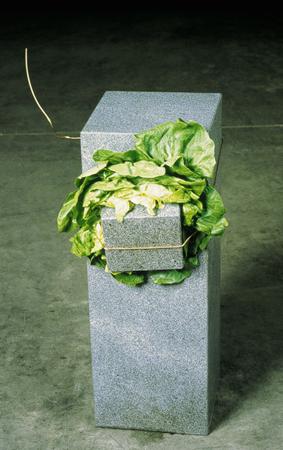

Giovanni Anselmo, Untitled, 1968

Giovanni Anselmo (b. 1934) used a head of lettuce to investigate ‘primary’ energies. In this work, nature’s fundamental forces—tension, gravity and time—are both catalyst and storyline. The inert (granite blocks) is juxtaposed with the organic (lettuce), bound together (but only temporarily) by wire that loosens as the lettuce wilts.  

ACTIVATING THE VIEWER IN A POST-WAR CONSUMER SOCIETY

Michael Pistoletto performing his 1967 'walking sculputre' at the Museo Nacional de Bellas Artes in Havana, Cuba, 2016

Arte Povera puts viewers into new relationships with art: palpably engaged, they became participants, interacting with or activating works. In an installation by Gilberto Zorio (b. 1944), bright yellow sulphur powder becomes black when the viewer draws a magnetic handle over its surface. Iron powder, attracted to the magnet, rises to the surface and temporarily creates a mark that eventually diminishes. Michelangelo Pistoletto (b. 1933) drew viewers into the artistic process by creating an event; he rolled his Globe (1966-68) of compressed newspapers through the streets of Turin on its way to being exhibited. Two years of newspaper were mashed together into a giant sphere that asks us to think about world events and the progression of time. 

AMBIGUOUS COMMENTARY BLURS ART AND LIFE
Marisa Merz, Untitled, 1966

Marisa Merz (b. 1931) and Mario Merz (1925-2005) considered shelter and community, but in different ways. Her indeterminate enclosure, Untitled (1966), is ‘peopled’ with hair-like hanks of fibre ringing its top. His Igloo di Giap metaphorically evokes preindustrial nomadic societies. While not overtly or strictly political, these pieces and others, including sculptures of Italy by Luciano Fabro (1936-2007), provide a lyrical commentary on society and world events. Fabro upended Italy’s familiar boot, now strung up like a carcass of meat- or like the body of disgraced Mussolini.
In describing his own art, Pistoletto might be seen as speaking for the group: ‘all forms, materials, ideas and means are to be used.’ Arte Povera is an art that celebrates blurred, fluid distinctions between art and life, art and craft, past and present. 


How Long Do You Need to Look at a Work of Art to Get It?


How Long Do You Need to Look at a Work of Art to Get It?

One of my responsibilities here at Artsy Editorial is to ponder the art-historical questions that are perhaps best answered either with a raised eyebrow or by saying, “because duh, that’s why.” Today’s entry in this series: How long do you need to look at a work of art to get it?
This is an easy one: Scientists have determined that the exact amount of time one should look at a work of art in order to understand it is four minutes and eight seconds.
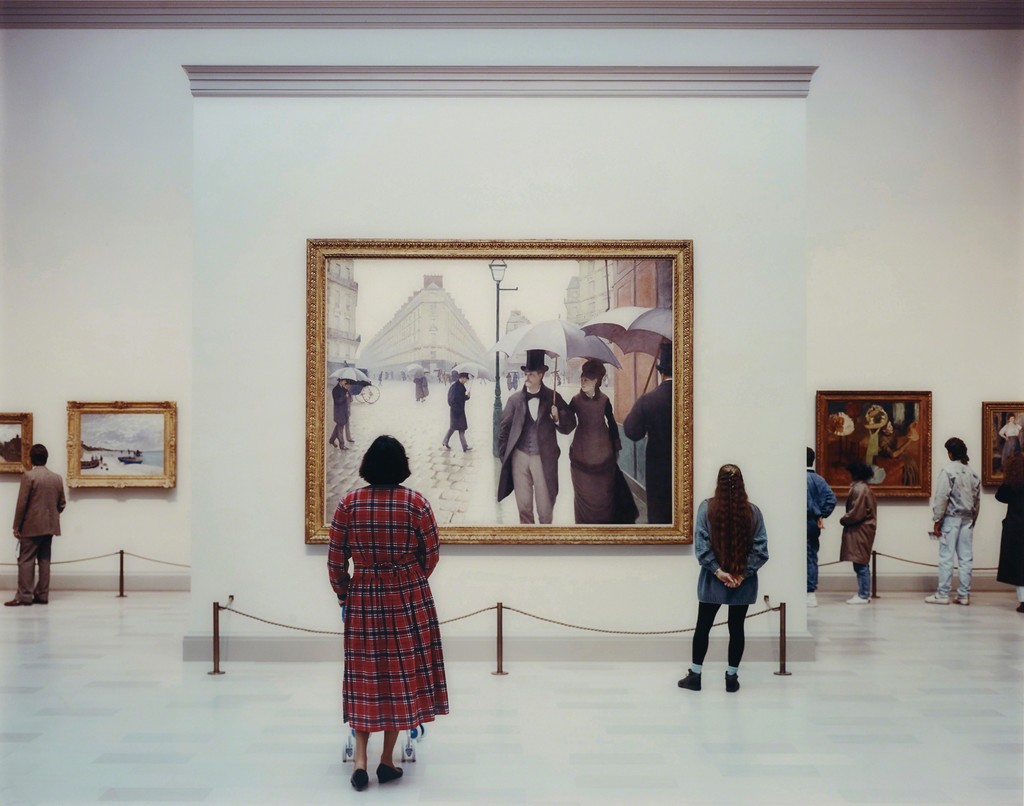
Just kidding. Like almost every question asked in this series, the answer is highly subjective and dependent on the work of art, as well as how well-versed one is in parsing visual images. But it is safe to say that, generally speaking, we’re not looking at works of art for long enough. The exact numbers vary, but studies have determined that the average time a person spends gandering at a piece in a museum is between 15 seconds and 30 seconds. That’s plenty of time to figure out what the image is attempting to represent (or not, if you’re looking at abstraction). But that’s not nearly enough time to fully experience the work.
James O. Pawelski, the director of education at the University of Pennsylvania’s Positive Psychology Center, compared the way in which most people walk through a museum to the experience of strolling through library stacks. “When you go to the library,” he told the New York Times, “you don’t walk along the shelves looking at the spines of the books and on your way out tweet to your friends, ‘I read 100 books today!’” The contention here is that people can go to a museum, spend hours there looking at hundreds of works, and walk out not really having seen anything. When he was teaching, Pawelski would take students to Philadelphia’s Barnes Foundation and ask them to spend 20 minutes in front of one single work. The resulting contemplation, he claimed, not only enhances one’s appreciation of art, but can also have the same beneficial effects as meditation.
Studying an artwork for an extended period of time instead of doing other stuff (20 minutes is almost a full Seinfeld episode) is clearly an important part of understanding what lurks inside it. Art history students who are tasked with such close readings know how much a painting can hold within the frame. But it shouldn’t be taken as a given that this is common knowledge. “People in the art world generally know how powerful it can be to look at a work of art for more than seven seconds,” said Phil Terry, who founded Slow Art Day, an initiative that asks people to really pause and examine the works we find in museums. “I started Slow Art Day because everyone else doesn’t know this,” he added.
If the benefits of long-looking are taken for granted by those in the arts, it shouldn’t come as a surprise that Terry doesn’t come from such a background. One day in 2008, on a trip to New York’s Jewish Museum, he decided on a whim to spend a full hour looking at Hans Hofmann’s painting Fantasia (1943). “It was a mind-blowing experience,” he said. “It totally shocked me how good it was and how much I saw.” The exhaustion that comes from trying to absorb every work in a massive museum retrospective? Nowhere to be found. “I thought I could leap tall buildings I was so excited,” Terry told me.
He founded Slow Art Day that year, and programming began the following year. Major institutions like SFMOMA and smaller museums like the Birmingham Museum of Art have embraced the idea, with the latter even offering regular Slow Art Sundays. Slow Art Day is entirely a volunteer operation, and if you’re looking to participate in the next one, it’s coming up in April.
The need for a program like Slow Art Day is certainly a product of our digital age, one in which there is simply too much content for it all to be consumed thoughtfully, so instead, all of it is consumed quickly. Ironically, sprawling, blockbuster museum shows that exhaustively excavate an artist’s oeuvre can be so large as to leave one walking away with the feeling of having seen very little. And who among us doesn’t know that pain in the lower back that comes from standing for hours in an exhibition? Okay, maybe I’m projecting. But a feeling best described as “museum fatigue” isn’t exactly a new condition. An article published in 1919 even describes the phenomenon, though it critiques how works were displayed rather than the sheer number.
Institutions are clearly not unaware of “museum fatigue,” and they take pains to foster longer viewing times. Sometimes those efforts take the form of educational programs, like Slow Art Day, or websites that provide clear-cut instructions for analyzing art. In other cases, this cultivation of deep looking is hardwired into an institution. Early in the Guggenheim’s history, when it was the Museum of Non-Objective Painting, it was a meditative space, replete with incense, classical music, and paintings hung so low you could sit down and be eye level with them. (Today, though its newer Frank Lloyd Wright-designed building is something of a temple; climbing the Guggenheim’s spiral basically counts as going to the gym.)
Museums (and the art press) are often obsessed with attendance figures. The number of visitors you can get through an institution’s doors is treated as the most important metric of its health—obviously, getting people into museums is a prerequisite to them appreciating the art within. But one wonders if figures tracking audience engagement—average time spent in an exhibition or repeat visits to a show—might actually be more helpful if we’re trying to determine how people are connecting with art. Ultimately though, no one decides how fast you walk through a museum but you. You could spend 10 minutes on one painting, or you could gaze at it for over an hour. Or you could accidentally be locked inside and have an entire evening with the art. The choice is (mostly) up to you.

—Isaac Kaplan


hipĂłcrita do carago!

Banksy and Fellow Street Artists Are Refusing to Fuel the Market for Paintings Taken from the Streets

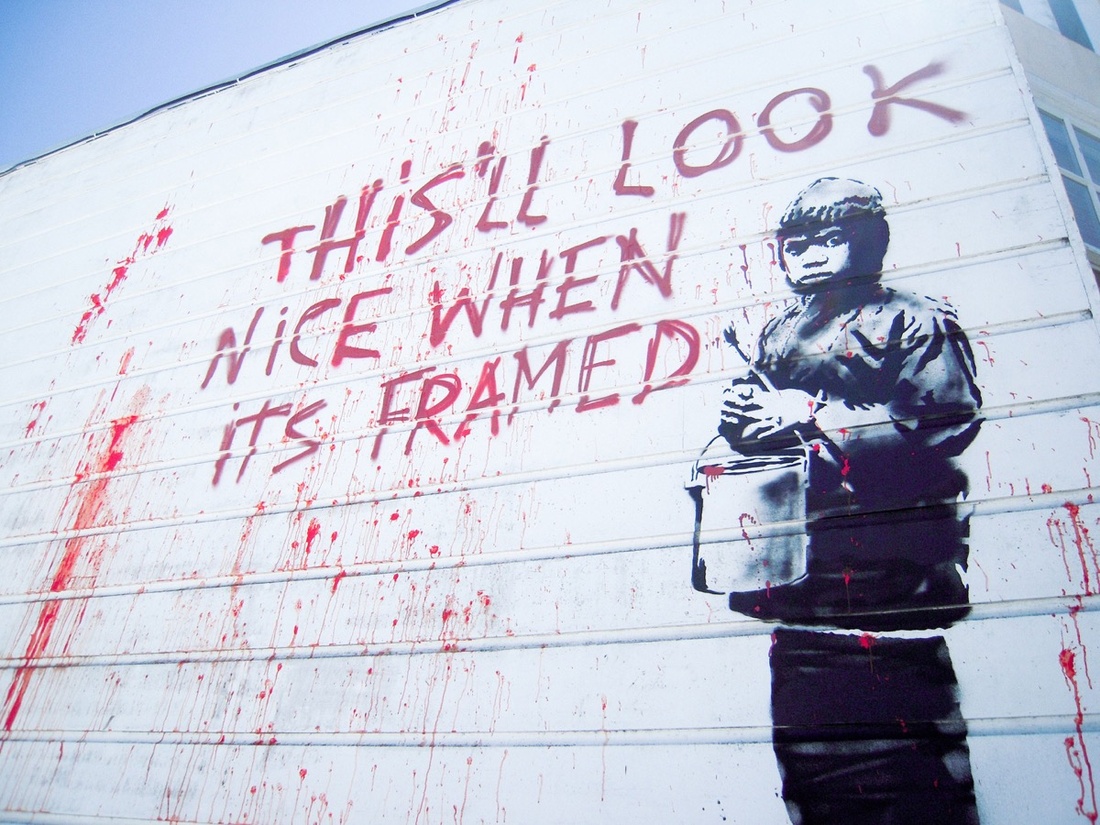
“This will look nice when it’s framed.” Image courtesy of Candy Factory Films and Parade Deck Films.
“What would you do if you were offered a small fortune for a painting the artist didn’t want sold?”
This is the thorny moral question that drives the newly released documentary “Saving Banksy.” It follows the saga of one man’s quest to save an iconic graffiti work by the infamous street artist Banksy from being whitewashed by the city government or being ripped from the streets and sold at auction. In doing so, the film pulls back the curtain on an issue plaguing many street artists and the integrity of their work: the rampant dislodging and sale of street-art works against the will of artists.
“These pieces show up in galleries and at auction, and the public doesn’t generally know that the artist didn’t intend for them pieces to be sold, or that none of the money is going to the artist,” explains the film’s director, Colin Day, shortly after the film’s release in San Francisco. In addition to raising awareness of the challenges street artists are dealing with, the film also aims to “get people to appreciate street art—in its intended form,” says the film’s executive producer, Brian Greif.
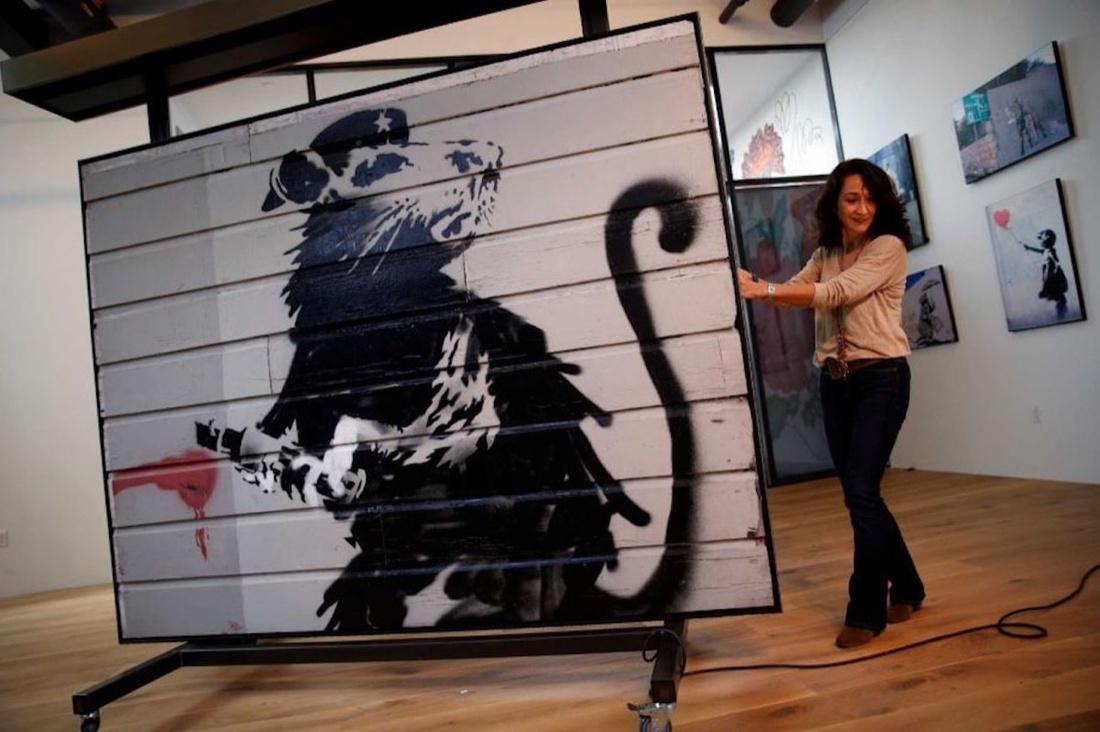
Greif, who is also the story’s protagonist, is a street art collector—albeit a “misguided” one, as the film’s press release admits. His intentions were pure: to remove Banksy’s Haight Street Rat mural from its high perch on the wall of a Victorian hotel in San Francisco in order to rescue it from being whitewashed by the city government. He’d then donate the work, which depicts one of the artist’s signature rats wearing a Che Guevara-style cap and wielding a spray can, to a museum. However, after painstakingly extracting the piece, Greif learns his plan will be impossible to realize. He inadvertently finds himself in the middle of a heated clash between a community of street artists and a group of individuals who remove street art work for personal gain—and being schooled in the complex politics of the sale of street art in the process.
Removal of Banksy’s “Haight Street Rat.” Image courtesy of Candy Factory Films and Parade Deck Films.
“The thing is, artists like Banksy make pieces in their studios that they designate for sale,” explains Greif. “But the works they’re making on the street aren’t intended to be sold, or even saved.” It’s precisely this question of intent that first thwarts Greif’s plans. In one scene, he offers the painting as a gift to SFMOMA. But while John Zarobell, the museum’s assistant curator at the time, admits it’s a strong piece, he explains that he can’t accept the donation without a note from Banksy approving the removal of the painting and its placement within a museum context.
Zarobell also outlines another requirement by the museum: the delivery of a certificate of authenticity from Banksy himself, to ensure that he created the painting. But while the Haight Street Rat was listed on the artist’s website as an original, Banksy’s studio wouldn’t provide the document. It might seem like an odd decision for an artist to block their work from entering a prominent museum collection. So why would he do it?
As Greif explains, if Banksy were to authorize the work it would set a precedent, “that works intended for the street, after they’re removed, still have value.” And that’s not a precedent, as we learn through the documentary, that artists like Banksy want to support. Day elaborates: “There’s kind of a black market that’s emerged for paintings removed from the street, and artists don’t want to encourage it by legitimizing those paintings.” While selling works uprooted from the streets isn’t technically illegal, the process does pose some serious ethical quandaries. Not only do most street artists disapprove of the removal of their works from their original context, but they also don’t see any of the profit made from the sales.
Stephan Keszler is one of several dealers known for ignoring the intentions of artists like Banksy whose street work he sells. He shows up in one of the film’s more memorable scenes—showing a series of Banksy street paintings he maintains “aren’t for sale” at a 2012 Miami art fair. The presentation includes the Haight Street Rat, which Greif had lent in frustration after his unsuccessful attempts to return the work to a public context. However, Grief begins to regret his decision the moment he sees the work on the wall of the fair: “I don’t know how I feel about this. It’s like when you see a deer in the wild, it’s cool, but when you see a deer’s head on the wall, it’s not so cool.”
To confuse matters further, Greif’s piece is hung alongside two works that were originally stenciled by Banksy on a wall separating Palestine and Israel. The artist placed them there, as artist Glen E. Friedman points out in the film, in an attempt to “make a positive impact” in the wartorn region. Friedman goes on to express a frustration shared by numerous artists across the film, when “some fucking asshole takes the shit off the wall and tries to sell it to someone. What sense does that make?” Street artist Ben Eine, a friend of Banksy who accompanied him on the trip to Palestine, echoes the sentiment, referring to Keszler in particular: “In the street-art world he’s considered a shyster, a villain.”
Fully restored rat on display in San Francisco. Image courtesy of Candy Factory Films and Parade Deck Films.
After the fair closes its doors, Keszler ends up selling all of the works he presented—except Greif’s. Despite receiving a $500,000 offer from the dealer, which is a significantly higher figure than those typically drawn by similar works authenticated by Banksy selling at major auctions, Greif stayed true to his pledge to return the work to the public.
These days, Greif still struggles to find public platforms to exhibit Haight Street Rat, but he’ll never sell it. Like Banksy and a dedicated community of street artists, Greif refuses to fuel the market for paintings pulled from the streets. But beyond refusing to engage with operations like Keszler’s, a big question remains: how can activity of this sort be quelled? “Well, it’s a hard question,” Greif says. “If a piece is painted illegally, without the owner of the building’s or the city’s permission, there’s not much that can be done. The building owner legally owns the painting and can do whatever they want with it.” And that might mean selling it to a dealer like Keszler to make a quick buck, or more.
“Again, many of these people removing the works and the collectors buying them don’t know the damage they might be doing to an artist’s career or the work’s integrity,” Greif concludes. “So that’s why we made this film—to inspire more respect for this work, the artists who make it, and their wishes.” As “Saving Banksy” kicks off its tour, Greif and Day are hopeful that their goals, this time around, will become a reality.

—Alexxa Gotthardt


Saturday, January 28, 2017

Brexit Flight to Shift 30,000 Jobs to Poland, Minister Says


Brexit Flight to Shift 30,000 Jobs to Poland, Minister Says

  • Government spoke to 30 companies about moving jobs to Poland
  • JPMorgan said to mull relocating 2,500 jobs to central Europe
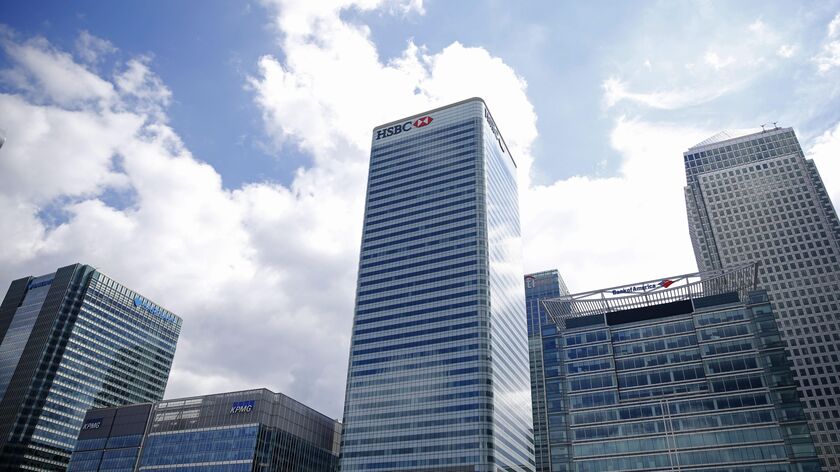
HSBC CEO: London Will Remain Global Financial Center
Poland will attract as many as 30,000 British jobs to its business-service sector this year, its government said, as the biggest eastern European Union member tries to lure companies considering leaving the U.K. after it voted to depart from the bloc.
Following the outflow of more than a million Poles to Britain and other western European countries since the country gained EU membership in 2004, the government in Warsaw is trying to bring them back. Part of that is a multi-year, 1 trillion-zloty ($245 billion) plan to make the economy more innovative and rely on domestic capital rather than investment from abroad, deputy Prime Minister Mateusz Morawiecki said Monday. Poland spoke with more than 30 financial and other companies last year over moving parts of their workforce from the U.K. after Brexit, he said.
“Poles were moving to London, now companies from London are relocating their workplaces to Poland,” Morawiecki told a news conference in Warsaw. The government has received information on plans of “several dozen” investments, including “big ones.”

Poland and other EU nations are jostling for position as Prime Minister Theresa May prepares to trigger the process that will take Britain out of the bloc. While Frankfurt and Paris are vying to coax big banks and their euro clearing operations away from London, lower-wage countries in central and Eastern Europe are wooing companies to resettle their back-office and other operations in the region’s booming shared service centers.

Poland Ready

The average salary in Poland’s financial and accounting industry amounted to about 104,000 zloty ($25,500) a year, according to the 2015 Antal Salary Report. A recruitment survey by Goldman Sachs Group Inc., also from 2015, said that banking salary levels were “flattening out” between eastern and western Europe.
The report said that “several years ago” a financial director at a medium-size Polish company earned 30 to 40 percent less than in Britain, while an accountant earned between a third and half of a Briton’s salary. Now the differences are smaller, it said.
Brexit has already helped staunch the flow of workers leaving Poland for fellow EU members in the richer West. The number now considering moving abroad dropped a third after the U.K.’s June referendum, according to a September poll by Work Service SA, a recruiting and human resources company.
Unemployment in the Baltic Sea country of 38 million people bordering Germany, Ukraine and Russia’s Kaliningrad ex-clave among others, has fallen to a record-low 8.3 percent. In the 2017 Bloomberg Innovation Index, which measures and ranks countries and sovereigns’ overall innovation capacity, Poland moved up one spot from last year to 22nd among 78 nations.
That has helped Poland lead the region in attracting service-center jobs, with the number rising to 212,000 last year and on track to hit 300,000 in 2020, according to a report by the Association of Business Service Leaders. Among the bigger names are International Business Machines Corp and Cisco Systems Inc, both of which have large offices in the city of Krakow.

Financial Services

In financial services, UBS AG has one of its two global hubs in Krakow. Goldman Sachs, which is planning to cut its London staff in half to 3,000 workers, will expand its Warsaw office to “several hundred” people over the next three years, Handelsblatt reported this month.
JPMorgan Chase & Co. may move as many as 2,500 jobs to central Europe, Warsaw-based Puls Biznesu reported Monday. The bank is considering creating back-office positions in Poland as part of a plan to continue to look for alternative places for operations, according to a person with knowledge of the discussions.
“We are always reviewing our options to improve our real estate strategy for back office functions. Any such review has nothing to do with London jobs or Brexit,” Jennifer Zuccarelli, a spokeswoman for JPMorgan, said by phone.
Magda Lau, the Development Ministry’s spokeswoman, declined to confirm Morawiecki’s comment has anything to do with the plan of JPMorgan.
Before it's here, it's on the Bloomberg Terminal.
LEARN MORE