Vaccines are rolling out, slowly but surely, across the world. Does that mean it’s time to think about traveling yet?
The tourism industry would like to say yes. According to the most recent data from the World Travel and Tourism Council, published in early November, the restrictions on travel caused by the coronavirus pandemic were projected to take $4.7 trillion out of global gross domestic product in 2020 alone.
But medical professionals still urge caution—a message that will remain imperative, even after individuals have been vaccinated against Covid-19.
Among their warnings: Vaccines are not 100% effective; it takes weeks to build up immunity (after the second shot), little is known about the ability to transmit Covid-19, even after immunization; and herd immunity will be a long way off. Their consensus is that risks will remain, but freedom of movement can safely increase—allowing for at least certain types of trips—among individuals with protection against the virus.
Yes, you will still need to wear a mask.
Here’s what else you’ll need to know about travel safety in the months ahead, whether you’ve already gotten your shot or are looking for normalcy somewhere on the horizon.
What We Know, and What We Don’t
The Covid-19 vaccines approved to date, both in the U.S. and Europe, have proven to be exceptionally safe, effective, and the strongest tool yet in combatting the pandemic. Still, there are known unknowns, particularly when it comes to possible virus transmission after vaccination.
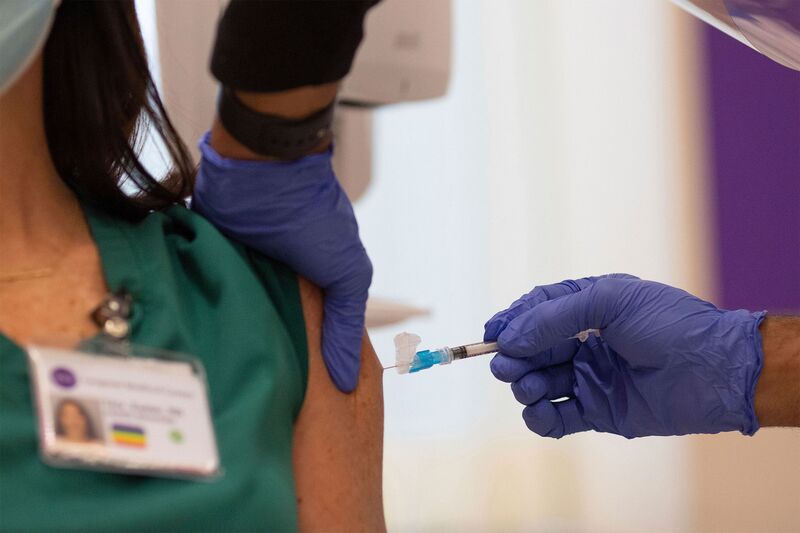
A nurse administers a vaccine at NYU-Langone Hospital in New York.
Photographer: Kevin Hagen/AP
This question boils down to one point: Clinical trials for the currently-approved vaccines, including those from Pfizer and Moderna, did not include regular PCR testing of the study participants. Without any data about their ability to carry the virus, there’s enough conclusive evidence only to suggest that vaccines result in 95% effective protection from symptomatic infection, says Dr. Kristin Englund, infectious diseases specialist at the Cleveland Clinic.
“For the most part, if you’re vaccinated against [a disease]—say chicken pox or measles—you should not be able to transmit that virus to someone else,” explains Englund, adding that there’s no known reason to believe that Covid-19 or its related vaccines should behave differently. “I anticipate that’s what we’ll see [with Covid-19 vaccines as well], but we have to wait until studies prove it before we can lower our guard substantially.”
There are other important unknowns, too. “To see a vaccine that is 95% effective—those are remarkable numbers, much better than we ever anticipated,” says Englund. “But we don’t have the ability right now to know who will have a good response [to the vaccine] and who will be one of the 5%.”
“The general consensus is that it will take somewhere between 70% to 80% [of the population being immune] to eliminate widespread risk—maybe more,” says Dr. Scott Weisenberg, who serves as both director of the infectious disease fellowship program at NYU Grossman School of Medicine and medical director of its travel medicine program. “We’re many months away from that, assuming that the vaccine actually does remove transmission and that people get it.”
In a best-case scenario where everything goes right, Weisenberg believes herd immunity can be achieved in the U.S. sometime this summer—pending the approval of easier-to-distribute vaccines such asthe one by AstraZeneca, which could speed up rollout.
That’s highly unlikely, though.
“Acceptance of the vaccine is a big, key question,” he adds. To his point, the World Health Organization called vaccine hesitancy as one of thetop 10 threats to publichealth in 2019, even before Covid-19 became part of the picture.
But herd immunity can be sliced and diced in many ways.
“You can talk about herd immunity within a state, within a smaller community, or even within a family,” Englund adds. “So if everyone in a room is vaccinated but one, you should be able to offer more protection to that person.”
That’s a notable consideration for family gatherings whose younger members may take longer to qualify for the vaccine than older or more at-risk members. (The currently approved vaccines have not yet been tested or approved for children by the U.S. Food and Drug Administration, which may stymie air travel among multigenerational groups well into 2021.)
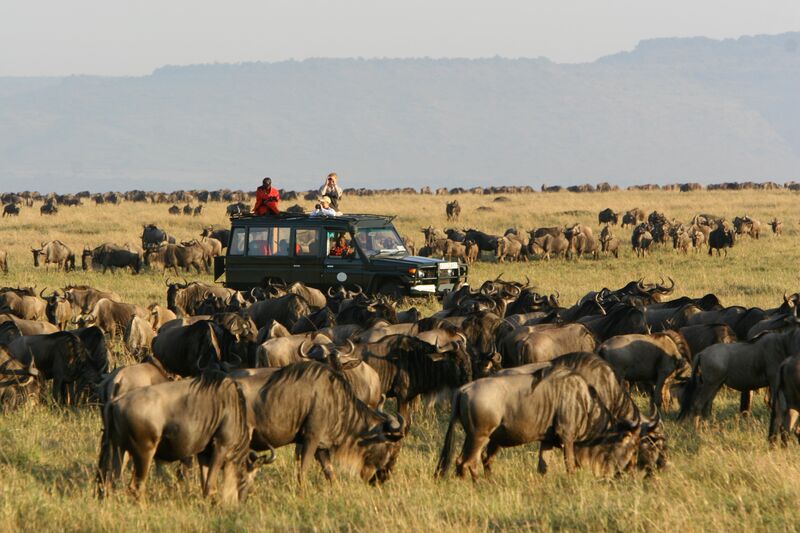
A safari in Kenya might seem like a good, socially distant vacation option, but you’ll want to consider your transfers
Source: Asilia Africa
Decidingwhere to go on your next vacation—and who to travel with—may have more to do with antibodies than such normal considerations as weather and price.
“Definitely look at the current infection rate in that area and absolutely, the vaccination uptake in that population—those are two very important things,” says Englund.
Don’t be surprised if it feels like a counterintuitive exercise, adds Weisenberg.
For instance, in New York City, where 25% of the population is believed to have already contracted Covid-19, herd immunity may require a proportionately smaller number of vaccinations to achieve if the previously infected people retain equivalent antibodies.
“The risk [of picking up or spreading the virus] might actually be relatively low,” says Weisenberg about visiting Manhattan, given the strictness of lockdown measures, the historic acceptance of vaccines inurban areas compared to rural ones, and the high rates of Covid-19 testing among the local population—despite the incredible population density.
Go to Kenya, where you may have a perfectly socially distant safari, he adds, and you may have to pass through places such as Nairobi, where testing is low, and it’s hard to get an accurate picture of real-time risk.
The Evolving Definition of “Safe Travel”
Expect the definition of safe travel to shift week by week, especially while parts of the world bat down the surge of cases connected to holiday travel andnew variants of the virus.
“You have to factor in the issues of going someplace and bringing the virus back to an area where that is consequential,” says Weisenberg. He hopes the U.S. Centers for Disease Control and Prevention will eventually have tiered alerts for destinations, depending on local risk, in the vein of the agency’s measles alerts, but says: “It’s just too widespread right now to isolate that way.”
A good idea might be to look up hospital (and specifically ICU-bed) availability figures before committing to a vacation anywhere, to ensure the local system is not already overwhelmed.
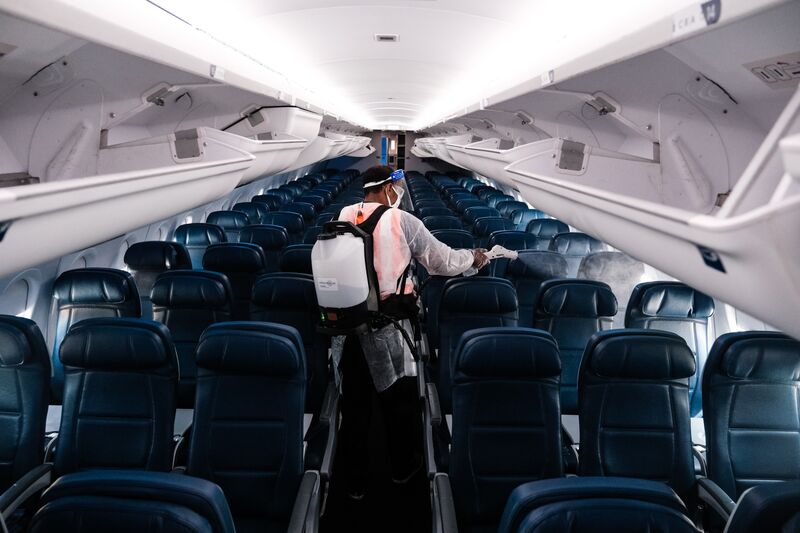
A Delta aircraft being disinfected.
Photographer: Michael A. McCoy/Getty Images North America
Weisenberg also believes that the increasing accuracy of rapid Covid-19 antigen tests will help ensure safety as mobility picks up; it’s noteworthy that the new U.S. requirements for entry include negative test results, even for those who have already been vaccinated.
“I’m going to be getting on a plane; I’ll be honest with you,” says Englund. “I’ll wear a mask, I’ll make sure we have seats where we’re not seated next to someone else, with appropriate space in between, using all of the hand sanitizer.
“We’ll get an Airbnb and spend quality time on a beach,” she goes on, “and if we visit local sites, we’ll pretend we hadn’t been vaccinated—approaching things with the same precautions as we would have pre-vaccine. I don’t think there’s anything wrong with that.”
COMICS HAVE PUT UP HUGE NUMBERS AT RECENT AUCTIONS. A Tintin drawing sold for a cool $3.89 million at Artcurial in Paris on Thursday, a new record for a comic-book artwork, the Guardian reports. The piece in question never actually made it into print, though. Georges Remi created the work, which depicts a giant dragon menacing the sprightly cartoon hero, as a cover for a Tintin book but was told it had too many colors to reproduce affordably. He gave it instead to an editor’s son, whose own children parted with the piece. On the same day, over in Dallas, a copy of the first issue of Batman, from 1940, went for $2.2 million at Heritage Auctions, making it the second-most-expensive comic book ever sold on the block, the Art Newspaper reports. The top slot, for the record, is held by Action Comics #1 (1938), which saw the debut of Superman . It went for $3.2 million on eBay in 2014.
A rejected Tintin cover sold for €3.2m ($3.8m) at auction yesterday (with buyer’s premium), setting a world record for a comic book work of art (est €2.2m-€2.8m). The 1936 watercolour and gouache painting, which shows the boy detective Tintin and his dog Snowy hiding in a porcelain jar, was sold online by the Parisian auction house Artcurial.
The item, designed by the Belgian illustrator Hergé (born Georges Remi), was intended as a front cover for The Blue Lotus volume dating from 1936, which tells of Tintin’s travels in China during the Japanese invasion of 1931.
The sophisticated image was too costly for publisher Louis Casterman to produce in the 1930s. "Casterman turned it down because it was too expensive to print in four-colour at the time," says Eric Leroy, a comic book specialist at Artcurial. Hergé is said to have then given the piece to Casterman’s seven-year-old son Jean-Paul who folded the work and kept it in a drawer (crease marks are visible through the work).
The heirs of Jean-Paul Casterman consigned the painting, which was bought by a private collector following a battle between three underbidders on the phone. “Like all markets, it’s a question of supply and demand and there is practically no supply,” the Tintin expert Michael Farr told Agence-France Presse.
But Nick Rodwell, the head of Moulinsart—the organisation that runs Hergé’s estate—has criticised the sale (Rodwell is married to Fanny Vlamynck, Hergé’s widow). He told Le Monde last year: “I do not believe in this story of a gift offered by Hergé to a child [Jean-Paul Casterman]... The place for this drawing is at the Hergé Museum [in Louvain-la-Neuve]. It is a [part of] Belgian heritage that risks going abroad and may never be seen again.”
Leroy tells The Art Newspaper: “The ownership of the work cannot be questioned. The sellers, as heirs of Jean-Paul Casterman, are indeed the real owners of the work. The Hergé Museum could have been an appropriate place indeed [along with] other major collections or art museums. This cover is so beautiful and precious that it is a real little painting on its own, and we are happy it is joining a private collection.”
Artcurial also held the previous record for the sale of comic book art which was set by another Hergé work in 2014, when a page of drawings depicting Tintin fetched €2.5m (with buyer’s premium). Yesterday a near mint copy of Batman #1 from 1940 sold at Heritage Auctions in Dallas for $2.2m including buyer’s premium, setting a world record for a comic book based on the character.