Tuesday, July 9, 2019

Give Younger Art Collectors a Much Better Tax Break


Recent IRS Ruling Could Give Younger Art Collectors a Much Better Tax Break

A small change may have big tax benefits.
Diana Wierbicki. Courtesy of Withers Worldwide.
An Internal Revenue Service rule change enacted this past summer opened an advantageous tax strategy for art collectors, according to Forbes postthis morning penned by art law specialists Diana Wierbicki and Paul Roy.
Sales of art and collectibles carry one of the highest tax rates, with a 28 percent long-term capital gains rate attached. One strategy that is popular among collectors are what is known as charitable remainder trusts (CRTs). These can be further set up or classified as CRUTs (charitable remainder unit trust) or CRATs (charitable remainder annuity trust).
Under this structure, art (or other property) is transferred to the trust. The CRT is essentially a “split interest”-giving vehicle that allows a collector to make contributions to the trust and be eligible for a partial tax deduction, based on the CRT’s assets that will pass to charitable beneficiaries. A collector can name him or herself, or someone else to receive a potential income stream.
Before August, it was “difficult, if not impossible,” the authors note, for “those under the age of 74 to create” an annuity trust structure because of what is known as a Probability of Exhaustion Test. “Under that test, if the probability of exhausting the entire trust fund before the charity receives it’s share is greater than 5%, the CRAT would not qualify.  (By definition, a CRUT, which pays only a percentage of what’s in the trust each year, can be designed so it won’t run out of assets.)”
Now, the IRS Revenue Procedure 2016-42 offers “an alternative test.” The so-called “revenue procedure” opened the door to long-term CRAT planning for donors under the age 74 by providing a safe harbor provision that can be included in CRAT instruments to satisfy the IRS requirements.
Wierbicki and Roy also note the impact of federal interest rates, and potential hikes ahead, saying: “CRTs are tax-exempt so the tax deferral benefit is greater when tax rates are high. Additionally, charitable remainder annuity trusts for art and collectibles become a more attractive structure as interest rates rise. That’s because higher interest rates translate into a larger tax deduction for donors, which increases the tax benefits of using a remainder trust.”
The future is in Janet Yellen’s hands.

Follow artnet News on Facebook: 
 
Want to stay ahead of the art world? Subscribe to our newsletter to get the breaking news, eye-opening interviews, and incisive critical takes that drive the conversation forward.
  • Access the data behind the headlines with the artnet Price Database.
SHARE
Article topics

Tweaking Their Strategies to Target the Next Gen


Cracking the Millennial Market: How Art Businesses Are Tweaking Their Strategies to Target the Next Generation of Collectors

Art dealers and auctioneers are getting creative to tap into the coveted new demographic.
Customers queue up in front of a Uniqlo store to buy KAWS x Uniqlo collaborative collection on June 3, 2019 in Jinhua, Zhejiang Province of China. Photo by VCG/VCG via Getty Images.
When KAWS’s painting of characters from The Simpsons sold for $14.8 million at Sotheby’s Hong Kong in March, the news seemed to herald the buying power of a new generation of art collectors. Nearly half of the attendees at the sale, which was dedicated to the private collection of 48-year-old Japanese DJ and fashion designer NIGO, were under 40 years old. “The auction room suddenly got a lot hipper, with all these cool millennial buyers in hoodies,” Edie Hu, art advisory specialist at Citi Private Bank in Hong Kong, told Bloomberg after the auction.
Millennials, now ages 21 to 38, offer huge new market potential for auction houses, dealers, and art advisers—and not only for artists like KAWS (who is 45). They are the largest generation in the US labor force, numbering 56 million, according to the Pew Research Center. They’re also the fastest-growing segment of collectors among high-net-worth clients surveyed last year by US Trust, with eight percent more owning art in 2018 than the previous year.
“The majority of collectors are Baby Boomers,” says art advisor Heather Flow. “They will soon transfer their wealth, and their collections, to their millennial kids,” and it will be the largest wealth transfer in world history, with estimates of the impending inheritance ranging up to $68 trillion.
We spoke to a few experts in the field about their strategies for targeting this maturing new demographic of art collectors.
Sotheby's auction in Hong Kong, 2019. Courtesy of Sotheby's.
Sotheby’s auction in Hong Kong, 2019. Courtesy of Sotheby’s.

Find the Right Price Points

Many younger collectors came of age in an anemic labor market, and many of them continue to have less buying power than preceding generations, which has implications for price points.
It took Ellie Rines, who says that two-thirds of the clients at her gallery in New York, 56 Henry, are under 40, a while to nail the entry level for younger buyers. But she now says she’s found that a good price point is around $500 to $700—“the same amount you spend on a nice pair of shoes.” Indeed, despite her large percentage of millennial buyers, they account for only 30 percent of her revenue. Former dealer Patton Hindle’s now-shuttered New York gallery, yours, mine & ours, also often sold work for under $1,000. For Rines, it’s worth it: “I’m very interested in being the first place that someone buys art.”
And it’s not only young galleries dealing in three-digit sales—it’s auctioneers, too. Phillips’s online-only “Unbound” auctions head quite a ways down the price spectrum. Recent sales included a Christo lithograph-and-collotype work that sold for $750 and an Elizabeth Peyton Xerox print that went for just $375.
Elena Soboleva attends a dinner at Faena Hotel in Miami Beach. Photo by Jared Siskin/Patrick McMullan via Getty Images.

Living Online

Many sellers are beefing up their online offerings to meet millennials where they (largely) live. This cohort is exceedingly more likely to buy online than their predecessors: 93 percent of high-net-worth millennials reported having bought art online, according to the 2019 Art Basel/UBS market report, whereas a majority of Baby Boomers never had.
Sotheby’s CEO Tad Smith affirmed that the house is “dramatically” going after millennials. “A great deal of what we’ve been doing over the past few years is to make it really, really easy for people to do business with us through digital technologies,” he told Bloomberg in the wake of the KAWS sale.
Even the highest-end galleries, such as David Zwirner, today offer online “viewing rooms” to complement their brick-and-mortar exhibitions. Last year Zwirner also recruited the millennial social-media influencer Elena Soboleva, known partly for appearing in elaborately color-coordinated Instagram posts alongside contemporary art, as the gallery’s first-ever online sales director.
Younger buyers aren’t shopping online solely because they’re more comfortable there, however. Rather, they seek out the convenience because they’re “high-spending and time-poor” due to their deep involvement with their own businesses, according to the Art Basel report. Sixty percent of those surveyed by US Trust agreed that “as my wealth has increased, demands on my time have increased.”
Scott Nussbaum, Phillips New York’s head of 20th-century and contemporary art, says that the auction house has responded by streamlining its website. “Most people go there looking for something specific, and we’ve made it easier to find it,” he says.
“It’s about respecting people’s time and attention span,” he adds. “We’ve made it possible to leave advance bids immediately, through your phone. Or, you can follow along with a sale live via the app and bid instantly.”
Jeff Koons, Lucas Zwirner, and Luke Syson (left to right) recording the first episode of David Zwirner's podcast, Dialogues. Image courtesy of David Zwirner.
Jeff Koons, Lucas Zwirner, and Luke Syson (left to right) recording the first episode of David Zwirner’s podcast, Dialogues. Image courtesy of David Zwirner.

Trust in the Pod

When those younger buyers aren’t bidding via phone, they often have their headphones on, listening to podcasts. According to a recent LinkedIn study, some 42 percent of people under 35 listen to podcasts, and major art-world players like Sotheby’s, Lisson Gallery, David Zwirner, and Sean Kelly have all bet on the medium.
Zwirner says its “Dialogues” podcast of conversations between artists and intellectuals garnered a quarter of a million streams during its first season.
Unlike Zwirner’s and Lisson’s podcasts, which feature the galleries’ own artists, Kelly says that at his gallery, “we’re not using it as a promotional tool.” Instead, Kelly’s “Collect Wisely” podcast targets art buyers explicitly, and solely interviews collectors, from hedge-funder J. Tomilson Hill to marketing guru Pamela Joyner to young collector Gary Yeh, who graduated from Duke in 2017.
“People love hearing passionate collectors talk about their experience,” Kelly said. Episodes have averaged about 1,500 listeners, but one of the biggest indicators of success in Kelly’s mind is that he hears advisors recommending “Collect Wisely” to their clients.
Hugo McCloud at work in his studio. Courtesy of Sean Kelly Gallery.

All About Identity

Millennials are the most racially and ethnically diverse generation in the nation’s history, according to the Pew Research Center, and that fact has huge ramifications for the art market.
“We’re in the age of identity,” says Evan Beard, a global art services executive at US Trust, Bank of America Private Wealth Management. “A lot of millennial collectors want to own [work by] female artists or African American artists. Biography and identity are hugely important to young collectors.”
Flow concurs. “The younger generation of collectors is diverse and they are global,” she says, “and the senior sales staff interacting with them at galleries should look like them. It’s great to be able to buy online, but having conversations at the gallery with someone similar to them is still key.”
Dealer Mariane Ibrahim, who estimates that her gallery’s millennial buyers have doubled in number to 20 percent in recent years, points out that the young African American collectors among her clientele are changing the emerging art market by building the careers of young African diaspora artists. “They operate in a network, sharing information and investing in artists of the same generation,” says Ibrahim, whose own background is Somali-French.
Sean Kelly stressed that signing younger artists is also key to his continuing success, and recent arrivals to his roster include Hugo McCloud, Landon Metz, and Sam Moyer, all born after 1980. Most of the young collectors recently profiled for a story on artnet News ranked millennial artists such as Amalia Ulman, Austin Lee, Jordan Casteel, Cui Jie, and Loie Hollowell among their favorites.
There’s also reason to expect that women will be the leading buyers in the next generation. “Among the prominent Baby Boomer collectors I know,” Flow says, “90 percent of the children who are taking over their collections are their daughters.”
Data from the US Trust survey points in the same direction. While the percentage of men surveyed who are buying art grew by three percent between 2017 and 2018, the proportion of women more than doubled, from 16 to 36 percent.
“A change is coming,” Flow says.

Follow artnet News on Facebook: 
 
Want to stay ahead of the art world? Subscribe to our newsletter to get the breaking news, eye-opening interviews, and incisive critical takes that drive the conversation forward.
SHARE

When a Collector Promises to Donate an Artwork and Then Flips It


What Happens When a Collector Promises to Donate an Artwork and Then Flips It at Auction Instead? It’s More Harmful Than You Think

Broken promises to museums are on the rise, and the collateral damage is hurting emerging artists and galleries as much as institutions.
Dana Schutz, Civil Planning, 2004. Courtesy of Sotheby's.
Dana Schutz, Civil Planning, 2004. Courtesy of Sotheby's.
At Sotheby’s contemporary evening sale in New York on May 19, artist Dana Schutz briefly plunged the salesroom into pandemonium. Civil Planning(2004), one of her riotously colored dreamscapes, sparked such frenzied bidding that it caused preternaturally smooth auctioneer Oliver Barker to visibly flinch. Minutes later, the painting—consigned by the estate of the late management consultant David Teiger with a high estimate of $400,000—sold for a cool $2.4 million. The price set a new world record for Schutz, elicited a hearty swell of applause from the audience, and secured a windfall for Teiger’s foundation. 
There was only one problem. According to Zach Feuer, Schutz’s gallerist at the time she made Civil Planning, he only agreed to sell the painting to Teiger because of a promise that the collector would immediately donate it to the Museum of Modern Art. 
Elaborating to artnet News about an Instagram post he made after the Sotheby’s sale, Feuer described Teiger calling him two days after viewing Civil Planning with one of the museum’s curators in tow: “He says, ‘Invoice me. I don’t need any special paperwork. This is going right to MoMA.’” Feuer obliged, and Teiger paid $15,000 for the work. But within weeks, the dealer received another call from the collector, in which Teiger said, in Feuer’s recollection, that “MoMA doesn’t really want a Schutz,” meaning he would simply keep the painting for himself. And 15 years later, his foundation reaped a colossal reward as a result. (Inquiries to representatives from MoMA and the Teiger Foundation were not returned by publication time.)
Such a reversal of fortune is not unique in the 21st-century art market. But some say it is becoming increasingly common in an industry where competition for the most sought-after artists is fiercer than ever—and so is the temptation to cash in on that competition’s prizes. Earlier this year, a similar conundrum bubbled to the surface when the late travel-industry tycoon Barney Ebsworth’s living trust consigned at least some of the same 65 significant works he had pledged to the Seattle Art Museum in 2007 to Christie’s.
Among them was Chop Suey (1929), one of the last major Edward Hopperpaintings in private hands, which generated $91.9 million at auction in November. The full extent of Seattle’s loss is not known, as the museum refused to provide reporters from the Seattle Times a full list of works to cross-reference against the Christie’s catalogue last year, and representatives from the auction house, the museum, and Ebsworth’s living trust collectively declined to comment on the matter.
But reneging on pledged gifts is not a phenomenon limited to premier auction consignors. Conversations with current and former gallerists, artists, and advisors confirm that false promises about institutional donations have been further warping the primary market to the advantage of the wealthy and the unscrupulous for years. And a longer look into the trend provides a vivid view of some of the trade’s deepest and most enduring fault lines.
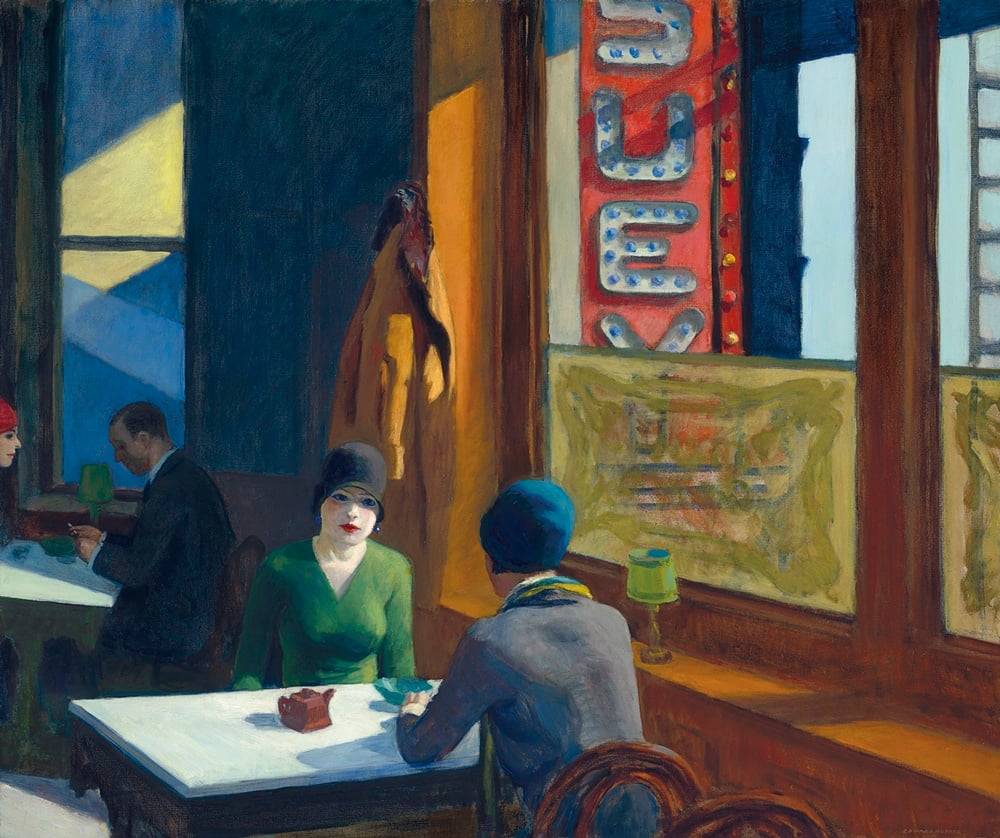
Edward Hopper, Chopy Suey (1929). Courtesy Christie's Images Ltd.
Edward Hopper, Chop Suey (1929). Courtesy of Christie’s Images Ltd.

The Spirit of Competition

As the number of millionaire and billionaire buyers rises and contemporary art becomes more visible in popular culture than ever, the clash over desirable artworks has hit a fever pitch. And that’s where the problem begins. 
I don’t know how you do it when you have 30 people for every painting,” says art adviser Candace Worth of some gallerists’ current dilemma with their most sought-after artists. “My dealer friends call and say, ‘I got yelled at four times today by clients calling up and screaming, ‘How could you not sell me this painting?’”
But finite holdings force gallerists to choose somehow, and the hierarchical pressures of the art world prevent them from defaulting to the first-come-first-served principle powering typical retail markets. Instead, dealers tend to try to protect their artists’ careers by placing in-demand works with esteemed collectorsones whose connections can boost an artist’s prestige, who might collect in depth, and who, at the very least, seem unlikely to flip their new acquisitions at the earliest profitable opportunity. 
In this scrum, the surest way for a willing buyer to stand apart is to promise to donate the work in question to a major museum. Yet this well-known strategy can be abused, and Teiger is hardly the only buyer alleged to have taken advantage of it in recent years.
Lisa Cooley, whose Lower East Side gallery operated from 2008 to 2016, tells a similar story about a collector who leapt to the top of a 200-person waiting list for one of her artists by pledging to donate the piece to a renowned contemporary museum in Australia. “He never said, ‘I want to be able to pick the work,’” Cooley notes. “He just said, ‘Get me a work.’” She eventually convinced the reluctant artist to break from their normal process by prioritizing this client for the greater good of a major institutional placement. 
But some time after the buyer paid and took delivery of the piece, his attitude changed. “My memory is a little hazy,” Cooley says, “but he said something like, ‘Well, it’s not really an A-plus painting, so I decided not to donate it to the museum.’” As a kind of consolation prize, he pledged to include the work in an exhibition that would travel to another Australian institution. Yet Cooley confirmed that this lesser offer would not have pushed him to the front of the line.

The Museum of Modern Art's entrance at 53rd Street. Photo © 2006 Timothy Hursley.
The Museum of Modern Art’s entrance at 53rd Street. Photo © 2006 Timothy Hursley.

Top-Notch Works, Rock-Bottom Prices

An important component of these sagas is the quality of the works at their respective centers. As Worth puts it, “You can’t just pack anything up in bubble wrap and drop it off at MoMA on the third floor.” Institutions, especially those with sterling reputations (and the luxury of choice), rigorously vet proposed gifts before deciding whether or not to accept them. In tales of ghosted institutional gifts, then, the affront isn’t just that collectors went back on their word. It is that they secured the very best work those in-demand artists produced. 
Even more distressing, the galleries and artists involved in these deals frequently permit enormous discounts to incentivize donors to acquire pieces on behalf of favored institutions. Economically, it’s a straightforward gambit: accept (much) less money now to place a work in a major museum, knowing you can then raise prices and expect more buyers because of the artist’s illustrious new institutional affiliation. For artists who have always dreamed of having their work acquired by a revered institution, the calculus can be even simpler. That sincere desire alone can compel them to accept significantly less for their work than they would otherwise.
Another unfortunate example crystallizes these tensions. In an interview with artnet News, one rising artist, who asked not to be named due to the sensitivity of the matter, related that an “established and eager young collector” on multiple American museum boards had recently offered to buy a work of theirs priced “well over six figures” on behalf of a major New York museum whose desire for the piece outstripped its budget. But in exchange for his largesse, the self-styled benefactor demanded a discount of 40 percent, far steeper than the 10 to 15 percent discount the artist was accustomed to accepting in standard deals with private collectors. 
Despite serious misgivings, the artist approved the sale. While the buyer paid and took possession, the artist’s gallery worked with the museum to finalize the terms of the gift. Upon the paperwork’s completion, though, the buyer refused to return calls and correspondence from all parties involved in the transaction, including the artist and the museum’s chief curator. “They were offered a buy-back, another piece in trade, a private commission of the same scale for free, and the option of keeping the piece in their own home after cementing a future gift,” the artist wrote in an email. 
But the buyer was unmoved, offering no explanation other than that “they’d changed their mind” and would hold onto the painting they’d rightfully paid for. “I never would have sold that particular work to a private collection, and certainly not for that price,” the artist explained. “So you’re left feeling like you’ve been hustled.”
Feuer echoed this sentiment regarding the discount he gave to Teiger on Civil Planning: “David didn’t need the money. This was about getting the best thing and potentially winning the deal.”
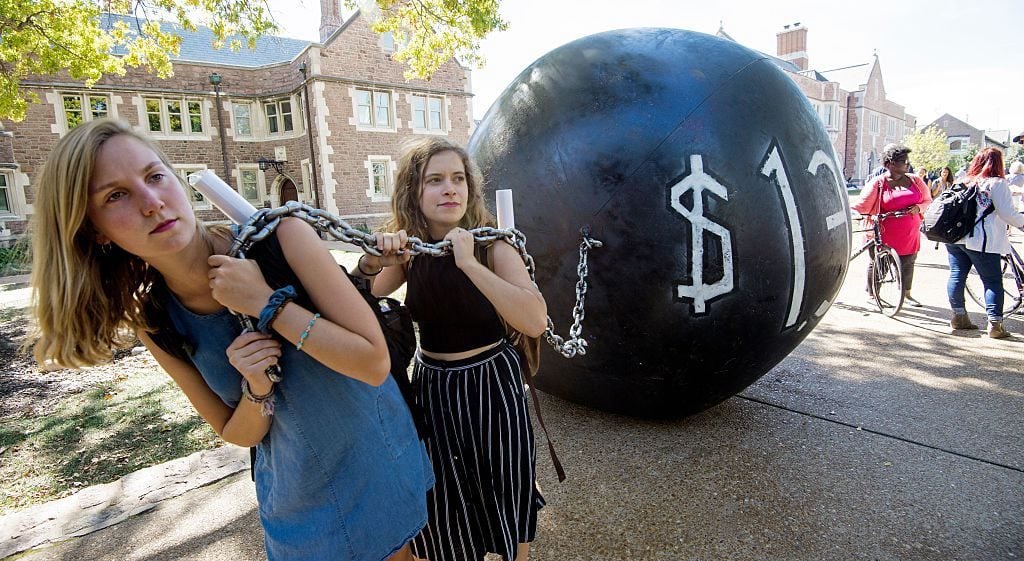
Students pull a mock "ball and chain" representing the $1.4 trilling outstanding student debt outside the second presidential debate 2016. Image courtesy Paul J. Richards/AFP/Getty Images.
Students pull a mock “ball and chain” representing the $1.4 trilling outstanding student debt outside the second presidential debate 2016. Image courtesy Paul J. Richards/AFP/Getty Images.

By Any Means Necessary

Although the perils of ambition are real, these stories are also driven by something much more elemental and relatable: the pressure to simply survive. If young galleries are lucky, they might have one runaway success on their roster—and then, only for a limited time before the artist moves onto a bigger gallery. That means they don’t always have the choice to reject buyers after being burned.
Lisa Cooley, for one, admits that she struck another deal with the collector who reneged on his promised donation to the Australian museum, though with a different artist and sans any dubious pledges. (Cooley says she would have gotten an attorney involved in the deal had the latter come up again.) “Plenty of other people were still selling to him, including major international galleries that don’t put up with nonsense, so I figured it was a one-off thing,” she says of his broken institutional promise. If nothing else, at least he paid quickly, which was more than could be said for most clients. 
Similarly, the artist who granted the 40 percent discount to the deadbeat donor admits that they did so partly “to stay afloat and out of debt.” But they also did it to be a team player. “In the end, the gallerist leaned on me hard, telling me selling this piece would be the difference between the gallery staying open for the next year [and] helping all the represented artistsor closing,” they wrote. “I honestly felt that I had no choice.”
This is a theme with predators,” the artist continued. “Prey on the weak. It’s why so many of these less ethical collectors prey on young galleries and artists. Because of desperation. Because of vulnerability.  Because they can.”
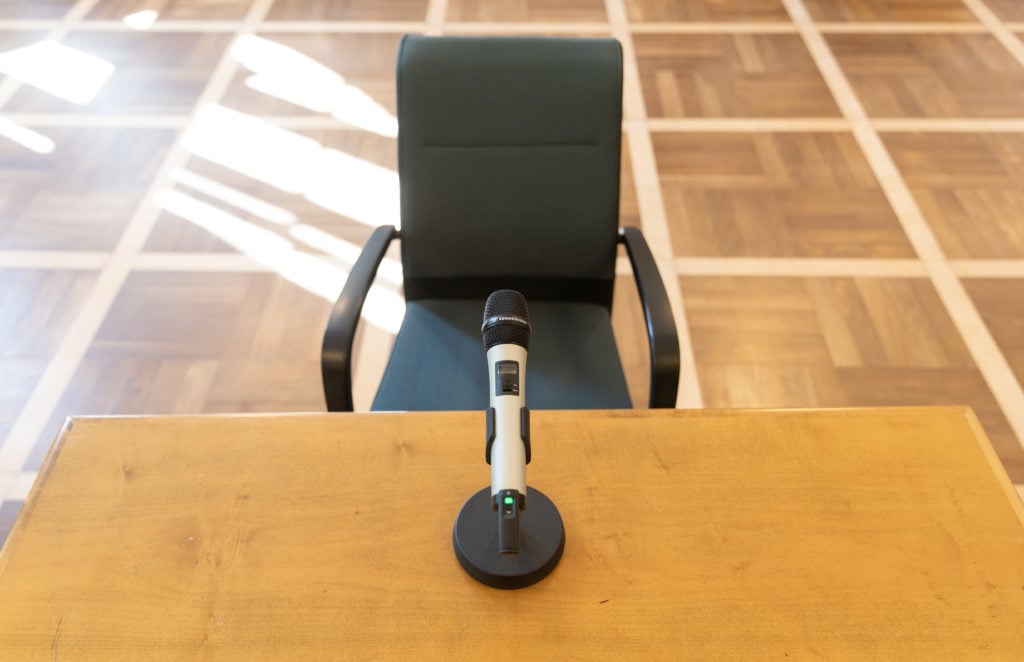
A courtroom setup awaiting a witness. Photo: Friso Gentsch/dpa (Photo by Friso Gentsch/picture alliance via Getty Images)

Accountability Vacuum

Granted, not every donor who reneges on a promise does so out of greed. Sometimes a change in institutional leadership or mission can give a patron reason to reconsider a pledge. Sometimes bad behavior by a museum can make a would-be donor want to avoid guilt by association. Sometimes financial circumstances change drastically enough between a promise and its fulfillment to create an existential threat to the donor (or at least their solvency). 
“You have market crashes, recessions, other business issues for a family,” notes attorney Barbara Lawrence, a partner and chair of trusts and estates at Herrick, Feinstein LLP. Such dire circumstances create an enforceability dilemma, particularly in light of the negative publicity a lawsuit would generate. “The question is, if there is something so extreme that a family needs a promised gift for their livelihood, is a museum going to go after them and be seen as the bad guy?”
Institutions, galleries, and artists alike must undertake this same pragmatic analysis even when a gift vanishes because of blatant misconduct. Chelsea gallerist Julie Saul, for example, had fully finalized the donation of a video to a major New York institution on behalf of a client, only for the client to renege so that she could give the work to her son instead. “She said she never heard back from us about [the gift], but we had a whole chain of emails about it that we showed her,” Saul told artnet News. 
Still, even with this evidence in hand and the knowledge that this episode “makes me look like an idiot” to the museum and her artist, Saul never considered taking formal action against the collector. Museums often decline to sue donors who renege for unsympathetic reasons as well, since being seen as a litigious institution could have a chilling effect on future donations. 
Because these disputes are hashed out behind closed doors, the professional standards and laws surrounding them also remain relatively unclear. Lawrence points out that, although American public policy favors finding institutional pledges to be legally binding, several theories exist for what makes them enforceable. (One theory requires the museum to take an action that shows its “reliance on the pledge,” such as discussing it in press materials.) The Association of Art Museum Directors also has no specific guidance about how to handle disappeared donations in its charter, leaving each member institution to fend for itself. 
For all these reasons, Lawrence defines the choice to take action against a reneging donor as a “business decision.” Is even the best possible outcome worth its cost and potential fallout? And if so, how realistic is that outcome anyway?
This is the sense in which revoked donations can serve as a microcosm of the art market, and arguably the world economy as a whole, in 2019: the most well-off leveraging their advantages against those closest to the abyss, knowing that the latter group has few resources, and perhaps even less incentive, to pursue justice. Accountability, therefore, is in scarce supply for unscrupulous buyers, who know the score full well. And as long as this remains true, emerging galleries and artists would do well to invert the market’s favorite ancient Latin standby: Seller, beware.

Follow artnet News on Facebook: 
 
Want to stay ahead of the art world? Subscribe to our newsletter to get the breaking news, eye-opening interviews, and incisive critical takes that drive the conversation forward.

SHARE

Monday, July 8, 2019

The Statue of Liberty Was Well Traveled Before She Reached Her Final Home


The Statue of Liberty Was Well Traveled Before She Reached Her Final Home

Parisians called her the “Lady of the Park,” and then said, “Au revoir.”

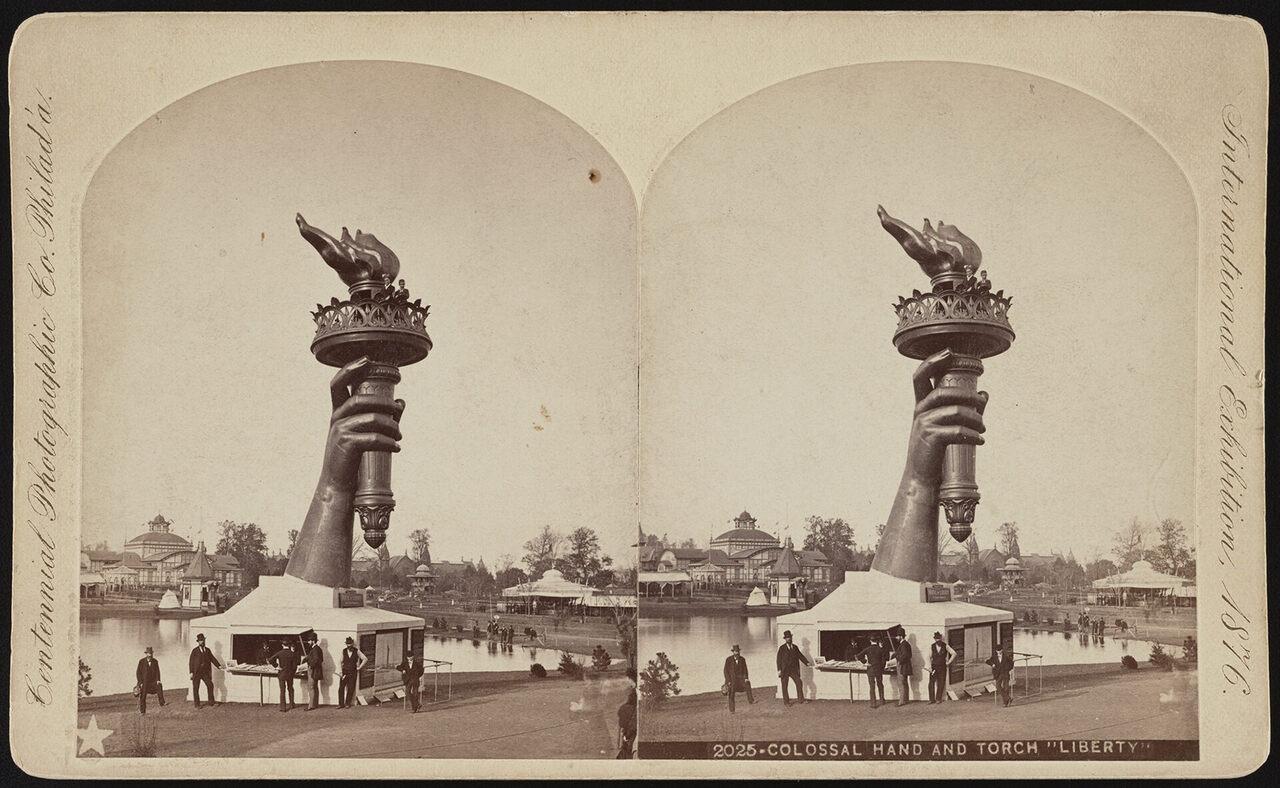
The torch and part of the arm of the Statue of Liberty, on display at the 1876 Centennial Exhibition in Philadelphia.
The torch and part of the arm of the Statue of Liberty, on display at the 1876 Centennial Exhibition in Philadelphia. LIBRARY OF CONGRESS

It was unpleasantly foggy and rainy on October 28, 1886, but New York City was celebrating. That was the day the Statue of Liberty was officially unveiled with much fanfare and ceremony. In the middle of some speech, the statue’s French designer Frédéric-Auguste Bartholdi prematurely pulled the rope that released a large French flag draped in front of the statue’s face. When Lady Liberty’s copper visage was revealed, she officially became the tallest structure in the city—305 feet, 6 inches from pedestal base to torch tip. But that wasn’t the first time she had made an appearance. Before that, she had spent several years at home and abroad, and mostly in pieces.
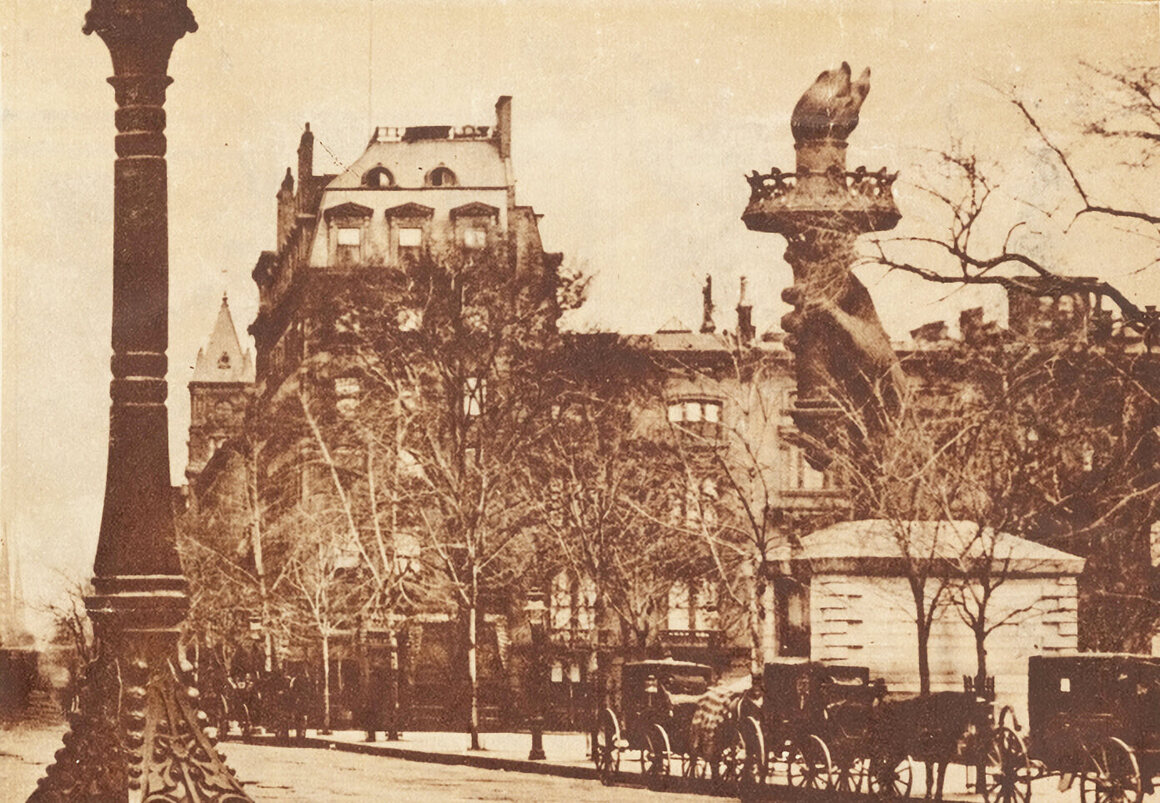
When Bartholdi had artisans begin constructing the sculpture in France in 1876, they started with her extended right arm and the lofty torch. He planned on that part of the statue first, deliberately, to raise attention and especially money, since at the time fundraising both in France (for the statue) and the United States (for the pedestal) was painfully slow. The arm was shown at the Centennial Exposition in Philadelphia, and adventurous visitors helped raise funds by paying to climb a ladder in the statue’s forearm to the torch balcony. “It’s amazing (and even a little unsettling) to see the Statue’s disembodied head or arm today— and certainly no one in Bartholdi’s day had seen a work of art of this size,” says Carly Swaim, vice president of History Associates Inc., who worked on the recently opened Statue of Liberty Museum. The fire-bearing arm was then relocated to Madison Square Park in Manhattan, one of the most fashionable spots in the city, where it served, for blocks around, as an advertisement for the grandeur to come. Her arm stayed there for six years.
The torch was on exhibition in Madison Square Park in Manhattan.
The torch was on exhibition in Madison Square Park in Manhattan. NEW YORK PUBLIC LIBRARY
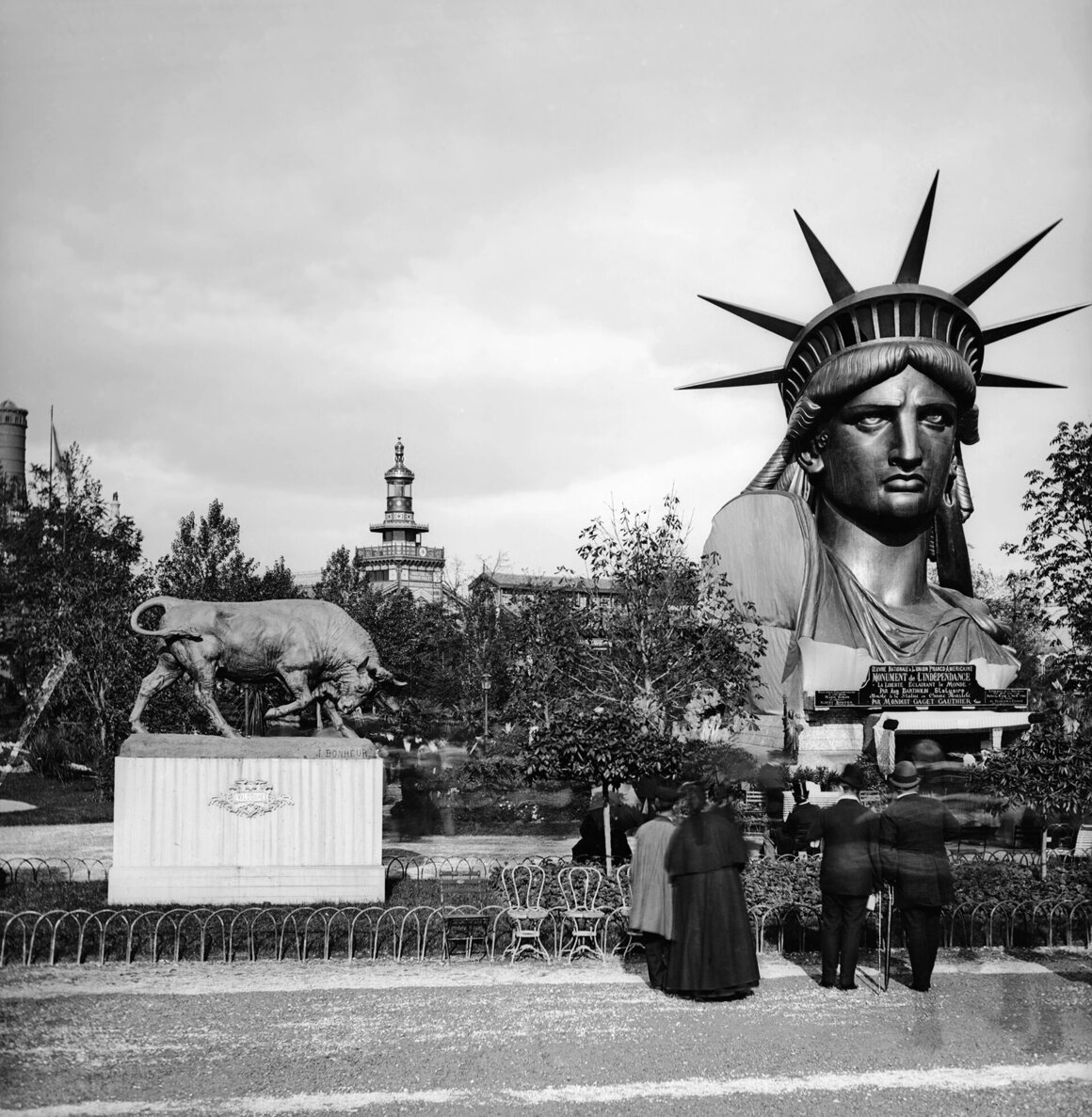
Lady Liberty’s head and shoulders were completed next, and they also had an independent, promotional life. While the right arm was in residence in Midtown Manhattan, her bust went on display at the Paris International Exposition in 1878. Once again visitors bought tickets to explore inside the statue—and they could also purchase entry to observe the bustle of activity at the construction workshops. “Bartholdi was immensely proud of his design,” says Swaim. “He hired professional photographers to document his team’s artistic and engineering prowess, but also to raise awareness and money for its construction … he hoped that these ‘action shots,’ along with many other fundraising efforts, would help the cause.”
The head of the Statue of Liberty at the 1878 International Exposition in Paris.
The head of the Statue of Liberty at the 1878 International Exposition in Paris. LÉON ET LÉVY/ROGER VIOLLET/GETTY IMAGES
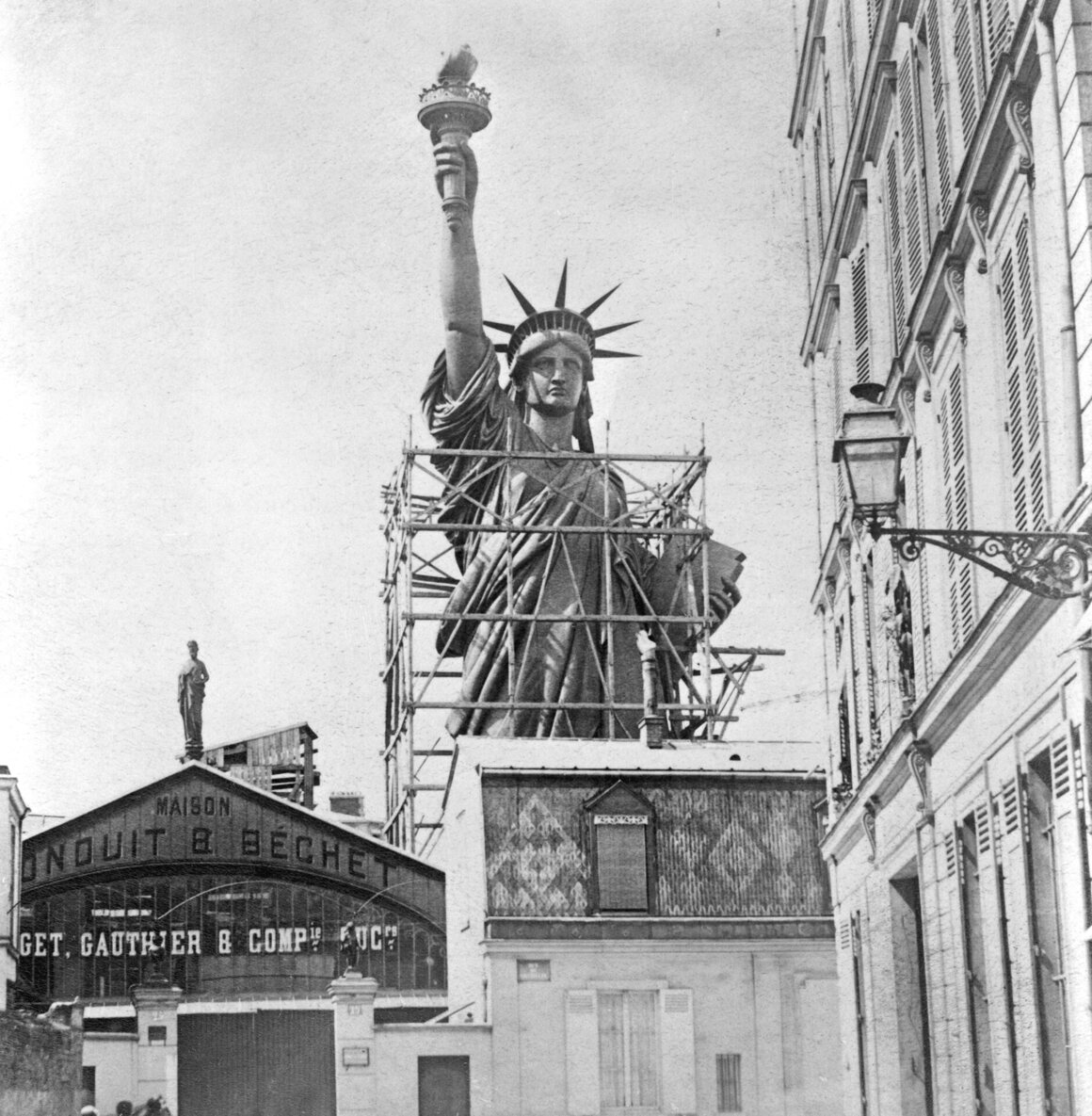
Between 1881 and 1884, the entire statue—after the right arm was sent back across the Atlantic—was eventually assembled in a public park in Paris, to test the structure that would hold her up and together (engineered by Gustav Eiffel; you may have heard of him). The French people lovingly referred to her as the “Lady of the Park.”

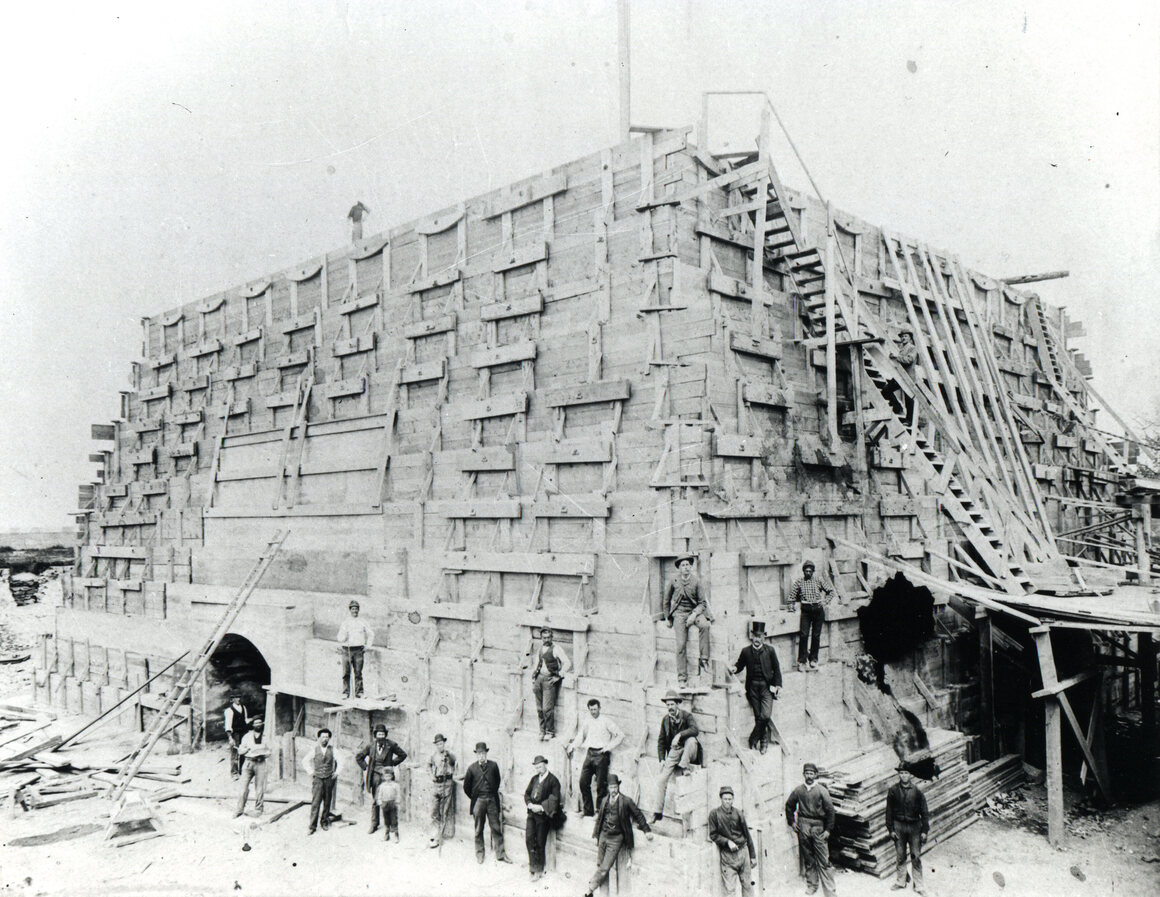
Her structural integrity established, she was dismantled into about 350 copper and iron pieces (ranging from 150 pounds to four tons) that were then packed in more than 200 wooden crates and loaded onto the French warship Isère. She made the crossing in 1885, and then had to wait, still in pieces, while her new home completed the pedestal on the to-be-renamed Bedloe’s Island in New York Harbor. It took another year, but once it was done, construction crews worked quickly to assemble the enduring symbol of American values. It makes some degree of sense—after all, most of them were immigrants.
Men in a workshop hammering sheets of copper for the construction of the Statue of Liberty in 1883.
Men in a workshop hammering sheets of copper for the construction of the Statue of Liberty in 1883. ALBERT FERNIQUE/NEW YORK PUBLIC LIBRARY
Scaffolding for the trial assemblage of the Statue of Liberty—in Paris. Her head and torch are visible at the bottom left and center images.
Scaffolding for the trial assemblage of the Statue of Liberty—in Paris. Her head and torch are visible at the bottom left and center images. ALBERT FERNIQUE/NEW YORK PUBLIC LIBRARY
The Statue of Liberty towering over rooftops in Paris.
The Statue of Liberty towering over rooftops in Paris. BETTMANN / GETTY IMAGES
Construction on the pedestal on Bedloe's Island in 1885.
Construction on the pedestal on Bedloe’s Island in 1885. NATIONAL PARK SERVICE, STATUE OF LIBERTY
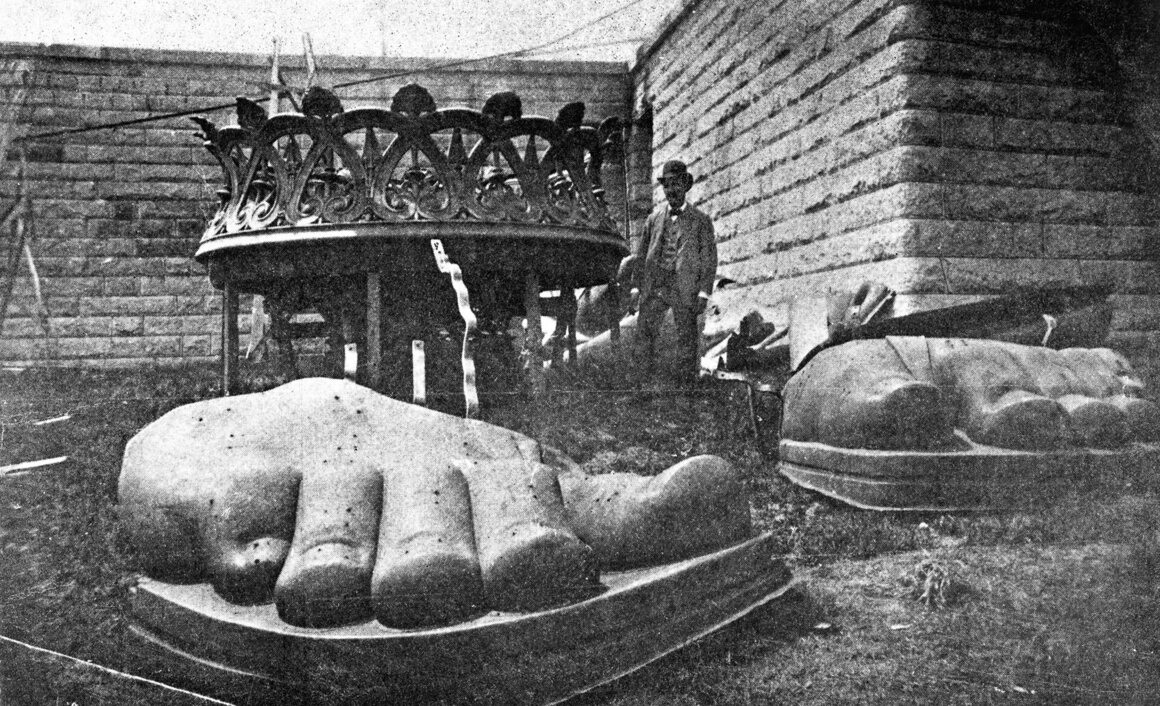
Toes and the base of the torch being prepared for final installation.
Toes and the base of the torch being prepared for final installation. BETTMANN / GETTY IMAGES
The face of the Statue of Liberty awaiting installation in New York in 1885.
The face of the Statue of Liberty awaiting installation in New York in 1885. NPS PHOTO / ALAMY

73ed94ee-f881-4ea1-8e1f-44f98483021c.png