| ||||||||||||||||||||||||||||||||||||||||



10 Principles for Leading the Next Industrial Revolution

It isn’t often that the broad infrastructure that underlies industrial civilization undergoes a dramatic transformation. But just such a change appears to be happening now. As sensors spread through factories and warehouses, software predicts the need for maintenance before it is manifest, power grids and loading docks become intelligent, and custom-designed parts are produced on demand, the label the next industrial revolution is coming to represent this great wave of technological change. The leaders of this revolution are companies making advances in fields such as robotics, machine learning, digital fabrication (including 3D printing), the Internet of Things (IoT), data analytics and blockchain (a system of decentralized, automated transaction verification). Because these technologies all reinforce the others’ impact, they are leading to a new level of proficiency, and new types of opportunities and challenges for business and for society at large.
One key example is that conventional boundaries between industries are eroding. It’s getting harder to tell the difference between, say, a telecommunications company and an entertainment producer, or between a retail bank and a retail store. The relationships among suppliers, producers, and consumers are also blurring, more rapidly than many business decision makers are prepared for.
The foundation of business strategy has long been the classic value chain, which links together raw materials producers, manufacturers, distributors, and (in the end) consumers through a well-established commercial infrastructure characterized by a stable set of transactions. But now, the rise of digital technology enables individuals to connect outside the value chain and deliver more efficient, effective products and services. This will reduce the importance of economies of scale and conventional divisions of labor. Relationships among companies will be more fluid and the price and cost of goods and services more volatile than they are today. There is one certainty, however: Trustworthiness and a clear articulation of purpose, will become more important to business. An enterprise that is continually changing must balance that turbulence with purpose and trust, or people — including employees, suppliers, customers, and regulators — will not be able to make the full commitments that businesses need.
Our research at PwC suggests that the Industrial Internet presents unprecedented potential gains for companies that claim leadership roles. Their ability to realize these gains will depend, in part, on their actions during these early years: the capabilities they build and the extent to which they reframe their business and operating models to make the most of this new technological infrastructure.
How, then, can you lead your company, whether it is large or small, to play a pivotal role in the next industrial revolution? How can you take advantage of your existing strengths while developing the digital prowess and personal skill that you need? How do you balance the technological acumen you require with the managerial skill to become a true market leader in this field? How can you help the broader society meet the challenges posed by this technology — issues related to privacy, employment, income equality, and general well-being, among others — while still ensuring success for your enterprise? The following 10 principles can help senior executives navigate the uncertainties of the next few years in a systematic and profitable way.
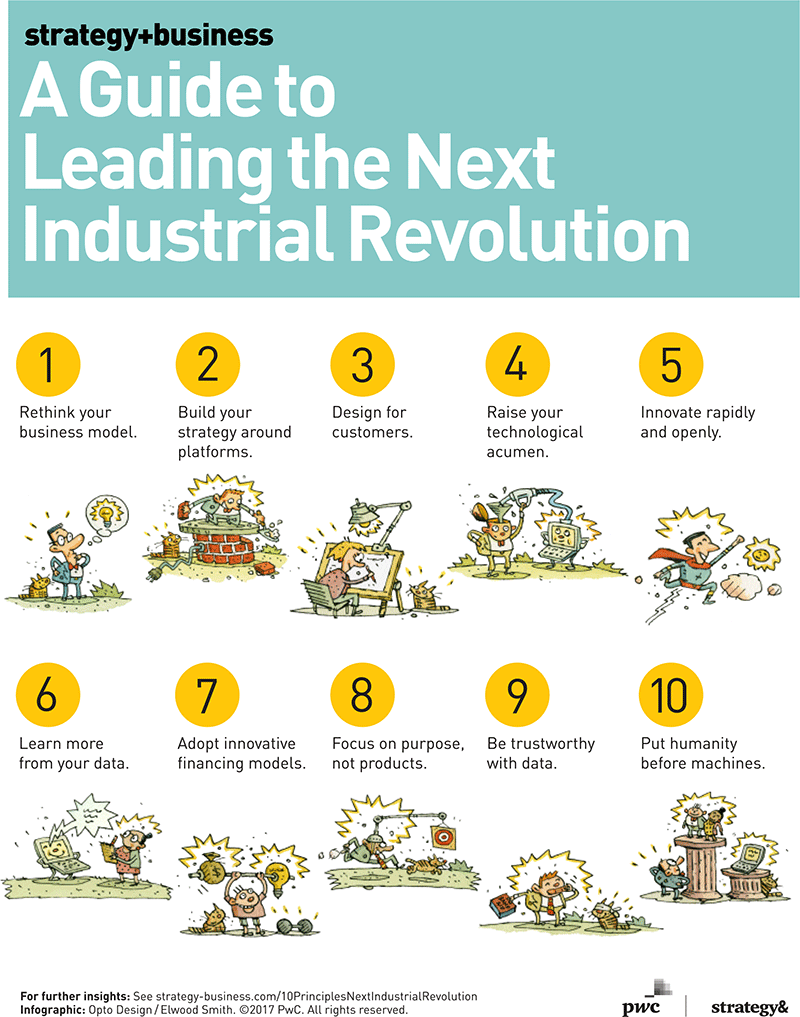
Establishing Your Strategy
1. Rethink your business model. The business world has become accustomed to disruption. In industry after industry, incumbents that cling to old business models lose ground to upstarts that introduce new products and services at much lower prices. The next industrial revolution will accelerate this sequence, especially in manufacturing, by reducing costs and improving efficiency at a broad scale. Companies that are slow to change will lose to those that rethink their business models to take advantage of the new platforms and their new opportunities.
Consider, for example, the electric power utility industry, which has essentially maintained the same business model since it began in 1882: metered power generation, selling electrons to residential and commercial customers. Now power utilities find themselves at the nexus of an evolving technological ecosystem that allows them to offer a variety of new options — and just in time, because the revenues from selling electrons are rapidly shrinking. The new offerings include renewable energy from solar and wind sources; sensor-based energy monitoring systems that use data analytics to continuously improve efficiency; and heating, cooling, and facilities management services. Some power utility companies are recasting their offerings as “gateway hubs” for Internet access and home security. The utilities have the potential to capture several new sources of value, but they will also face unprecedented competition from technology and telecommunications companies.
Automakers, too, are anticipating a dramatic new business model; a few years from now, they may no longer rely on individual car sales. They will provide mobility on demand, through their stakes in shared or self-driving vehicles. Manufacturers of tools, hardware, instruments, and heavy equipment are adding sensors and connectivity to their products, enabling predictive maintenance, security, and frequent upgrades. The healthcare industry is moving toward its own adaptation of the IoT, with wearable sensors providing data that health professionals can use for early diagnosis and better follow-up services. Financial services, engineering and construction, and entertainment and media are all poised for similar changes.
If your company is falling into the trap of thinking that it can make money indefinitely by following its traditional business model, it risks losing out to more flexible competitors. You are not in the same industry that you were in before; soon, that industry may not even exist. Your path to profitability is different. Your opportunities for raising capital have changed. Your capabilities may not apply to the same customers they did before. Your circumstances are probably different from those of any other company, so you need to look freshly at them, without relying on an industry playbook, and rethink your business model accordingly.
To fund new investments in R&D, operations, and customer experience, you may have to cut back legacy activities that no longer apply. This will take perseverance and discipline, but your competitive advantage lies with your role in the infrastructure of the future. Selling or shutting down less essential practices, and focusing your portfolio of products and services more effectively, can make you fit for growth in this new world.
2. Build your strategy around platforms. What the value chain was to the old industrial system, the platform is to the new. A platform is a combination of interoperable standards and systems. It creates a plug-and-play technological base on which a wide range of vendors and customers can interact seamlessly with the same collection of hardware, software, services, and one another. The most successful platforms match customers with vendors, maintain an appealing and effective customer experience, and collect data and rents from people who use the system. A business that controls a popular platform — Microsoft with Windows, Apple with its mobile iOS, Amazon with its “everything store” merchandising system, Facebook with social media, and Google with its search engine — can influence the direction of evolution for a business-to-consumer market. The same will be true of the new industrial operating systems for business-to-business markets. The users of a platform become, in effect, an ecosystem: a group of companies exchanging goods and services, their fates bound together.
RELATED STORIES



These are still the early days of platform building on the Industrial Internet. Companies such as GE and Siemens are staking their claims now. GE has announced its goal to be “the world’s first digital industrial company”; its cloud-based Predix platform combines data analytics, connectivity, cyber-protection, and offerings such as the Digital Twin, a simulation of industrial processes based on digital profiles of more than half a million machines. Siemens is developing its equally ambitious MindSphere platform in collaboration with Microsoft, offering its apps on the Azure cloud starting in 2017.
Other industrial platforms are more narrow, but equally profitable. For example, the Trumpf company, based in Germany, has established a platform called Axoom, which provides laser equipment, welding, and metalworking equipment for the many small companies that build components from metal and plastic, giving them all access to specialized 3D printing tools and software. There will be platforms for specific types of supply chains, and platforms for hospitals, banks, and other types of organizations. As automobiles evolve into autonomous vehicles, they will be designed as platforms, operating within “smart city” platforms that continue to improve the ways in which autonomous vehicles navigate.
Your first step in establishing yourself as a participant in the Industrial Internet is to figure out what role you can realistically play in this platform-based world. Will you be a platform “enabler” like Axoom, GE, and Siemens, a company responsible for building (and owning) the underlying megahubs? Will you be an “engager” of customers, using the platform as a vehicle for providing products and services? Will you be a platform “enhancer,” a developer of new technologies on the platform, selling them primarily to enablers and engagers? Or will you develop a business that combines two or three of these roles?
If you become an enabler, building out your own platform, three elements will help you stay ahead of competitors. First, digitize your own enterprise — the platforms at GE and Siemens began as in-house services for their own operations. Second, continually work on gaining efficiencies, improving the technologies that you already have. Third, build cost reduction into that continuous improvement; use sensors and analytics, for example, to raise the quality and performance of your products and thus lower the costs. These abilities take time and acumen to develop, and they will become core distinctive elements of your platform.
3. Design for customers. Because the next industrial revolution is driven by large-scale digital technology, it’s easy to overlook the way it could affect human relationships. The new infrastructure is a web of connections among people: Producers and consumers, in particular, are much more closely connected than they used to be. Through smartphones and social media, consumers can connect directly to primary producers of the products and services they buy. Through sensors and data analytics, producers can be thoroughly attuned to the needs, habits, and long-term interests of the people who buy products and services. As a designer of the new platforms, or a business leader participating in them, you have an unprecedented opportunity to build a customer-centric enterprise, one that connects with what people genuinely want and need from your company, thus generating commitment that will last a lifetime.
For many large businesses, this represents a dramatic change. Apparel companies, for example, are building new connections between the retail store and the factory, so that retail customers’ preferences rapidly translate into new clothing designs. A few farsighted companies, such as Inditex (Zara) and H&M, have pioneered this approach in their own operations. Now, the platforms of the Industrial Internet make it much easier for any apparel manufacturer to follow suit. Banks, power utilities, and telecommunications providers are making similar transitions: They are cleaning up their user interfaces, offering new types of services, and solving customer problems in faster, friendlier, more responsive, and more effective ways.
When you design for customer-centricity, you translate your desired relationship and mutual commitment into the look and feel of your enterprise. A true omnichannel customer experience connects every touch point: all face-to-face contact, every retail environment, all online activity, anything connected through a smartphone, and all the other myriad connections between you and your customer. In the new infrastructure of your business, there are far more touch points to work with. Customers live in an interactive world. Their behavior is aggregated into data you can consult to make business decisions. Your behavior, in turn, is more evident and transparent to them than it has ever been before.
For example, consider a simple shopping transaction. A customer places an order online for a shirt, trying it on in a virtual showroom, and then picks it up in a local store. Can he or she move seamlessly from the smartphone to the pickup point? Is it obvious how to try it on and pay for it without waiting in line? Is it easy to pay? Does the store, abetted by analytics, show the customer other items that would look good with that shirt?
You will need new levels of design acumen to succeed. People will interact with your company through online automated systems, and perhaps through robots in the physical world. Are these machines appealing or frustrating? Do they draw upon knowledge of ergonomics and human sensitivity? (Does it mimic the sequence and pacing of human interaction?) Equally important, are your systems adaptable? The more easily professionals and customers can change and customize their systems — without having to be an IT professional to accomplish this — the more effective they will be.
Embracing New Practices
4. Raise your technological acumen. No matter what industry you’re in, you live in a programmable world, and software will be key to your competitiveness. Take the German auto industry, for example. For years it has traded on a worldwide reputation for excellence in mechanical and powertrain engineering. But from now on digital excellence will be at least as important. This change is forcing some hard thinking about future industrial strategy, in a country that is known, according to the Financial Times, for relative weakness in IT. “In the future, 50 to 60 percent of the value of a car will consist of digital devices and tools,” said German federal chancellery chief of staff Peter Altmaier, one of Angela Merkel’s senior advisors, at a panel debate in November 2016. “And 20 percent [will be] batteries. If we’re not careful, [German manufacturers will] only be responsible for the windows, seats, and wheels.”
Every company, even if it’s in Silicon Valley, will need to improve its technological acumen during the next few years. This is a matter not just of recruiting people with software expertise, but of raising the skills of everyone at your company. They need not just the technical training to use digital tools, but insight into the patterns of technology — for example, how to create an operations footprint that can take advantage of the Industrial Internet, or how to accumulate the type of data that can foster machine learning.
You will be adopting manufacturing execution systems that link the elements of enterprise resource planning with all the factory operations of a company and its suppliers. Augmented reality will enable operators and decision makers to see data about operations (or anything else) on wearable devices. A schematic might pop up, helping an engineer (or, in another setting, a surgeon) determine where to direct a probe. Digital fabrication will allow a wider range of components and products to be created close to where they are needed, rather than being shipped long distances or going through customs; the costs of this technology are dropping about 10 percent per year. Interoperability among all these technologies is much more common than it was in the past. This allows even the largest enterprise to coalesce around a more coherent global strategy — and when your people have the right kind of digital acumen, they can make the use of systems far more effective.
The industrial infrastructure will make it easier to design your workplace for digital acumen. Set up displays with shop floor or financial data, offering opportunities for employees to discuss their meaning and how to improve them. If your factories have robots, design them as “cobots”: collaborative robots, equipped with sensors that make them responsive to the people who work nearby. The robots handle the rote tasks, such as moving parts into position; the people handle the more fine-grained parts of the operation, where judgment or artistry is required. Tailor office environments to the work needs, learning opportunities, and emotional engagement of the people who work in them, with collaborative workrooms that bring teams together easily with videoconferencing and other digital connections. In general, design your work spaces as opportunities for your people to learn — from experience, from the increasingly intelligent technology around them, and from one another.
As people throughout your company become more comfortable with the Industrial Internet, they will develop a collaborative culture of innovation. They will also better understand the risks of the new world — for example, risks related to accidents, privacy violations, and cyber-attack. This insight will be invaluable, not just within your company, but across the platforms you inhabit.
Because possible points of attack or vulnerability are spread throughout the ecosystem, responsibility for their security needs to be shared broadly, and frameworks for legal liability need to keep pace with technological developments. CEOs and their boards may need to be as good at judging when the world is not ready for their technology as they are at judging when their technology is ready for the world.
5. Innovate rapidly and openly. Innovation and leadership go hand in hand in the next industrial revolution. Many companies will seek disruptive innovation, but a steady stream of incremental innovations can be more profitable. Smaller innovations will be easier to generate and, more important, easier to test in the market. With the tools of the Industrial Internet, you can prototype new products, manufacture them in small batches profitably, distribute them rapidly, and see how your customers respond before rolling them out worldwide. As you continue to develop incremental innovations, they can sometimes snowball into disruption. That’s what happened with the smartphone, which evolved between 2000 and 2007 from a music player (the iPod) into a world-changing device.
Rapid innovation is more effective when you are open to collaboration with those outside your own company’s walls. Draw on a broad group of participants, including the organizations that are connected to your platform. Much of the technology in the Industrial Internet is not just cross-functional, but cross-industry. When whole supply chains and customer ecosystems are automated, integrated, and transformed, innovation follows a similar pattern.
Siemens, for example, is making a billion-dollar investment in what Lak Ananth, the head of the company’s Next47 startup unit, hopes will be “a new era of collaboration between hungry early-stage startups.” The name Next47 echoes the landmark year of 1847 when the company was founded. Areas of collaborative venture capital investment include artificial intelligence, autonomous machines, decentralized electrification (smart grids), connected mobility, and blockchain applications.
6. Learn more from your data. The exponential increase in real-time data — gathered from customers, equipment, and work processes — is giving companies new insights. Gathering and analyzing data are important, but they are only the beginning. It is critical to use the analytic results to recognize important patterns, and to gain insights that help you make the right choices and keep improving on the fly.
For example, getting accurate information about progress and cost on construction sites has always been a challenge. Now, a construction company or investor can use drones to gather photographic images, overlay them with the original site plans, verify contractor reports, and spot discrepancies as small as a centimeter wide. In the agrochemical sector, farming companies also use drones, along with data from weather reports and sensors mounted on their machinery, to fine-tune their planting, fertilizing, and harvesting practices. Industrial companies of all sorts now use data gathered from factory floor sensors to inform maintenance and operational decisions. GE’s chief digital officer, Bill Ruh, estimated that just one performance increase resulting from these efforts, in locomotives, saves one railroad US$200 million per year.
In the military aerospace sector, manufacturers are able to use the data set that is fed back from an aircraft to create immersive and experiential simulation software and training programs that can transform the training economics for fighter and other flight crews. Wear and tear on the airframe can be minimized and the aircraft reserved for the missions that matter, substantially reducing the overall cost to customers of military training and preparedness.
And of course, in all industries, companies are now able to develop highly customizable, on-demand manufacturing, with customers having real-time access to design, supply, and demand systems. Direct feedback and interfaces between manufacturing systems and customers’ own ordering and demand planning systems are shortening lead times and improving capacity utilization planning. One of the great frontiers in data analytics is materials. A plastics maker that notices a customer using a polymer in one way could propose a different approach, based on analysis of what other companies have done with that same polymer.
To make the most of your data, integrate your analytics teams. Schedule regular sessions in which people talk about what they are finding, and how it could affect the business. Ensure that data from all your operations and customer insights is considered. Draw in relevant information from other companies and from the government. In doing this, you balance your proprietary interest in your own data against the fact that open data sharing allows for much more insight. Platforms make sophisticated data sharing of this sort far easier than it used to be. Finally, in addition to any business changes you make, revamp your analytics approach so that your data gathering and synthesis will be still more effective next quarter.
7. Adopt innovative financing models. New large-scale technologies inevitably put pressure on the old ways of raising money for them. As the Industrial Internet expands, the ability to finance major capital projects will remain one of the hallmark capabilities of an industrial company. But the particulars will shift.
Infrastructure projects will closely follow the example of the software industry, where cloud computing has sparked a quiet but pervasive change. Software users no longer buy packages; instead, they subscribe to software-as-a-service, paying rent to the provider in exchange for access and continual upgrades. This approach affects the type of financing that tech companies need, and the ways they manage return on investment.
Larger industrial firms will similarly move from financing the ownership of factories and machinery to financing a pay-as-you-go system, with smaller but more frequent rent charges for more flexible installations. There will be less interest in replacing old equipment, and more interest in continuing to upgrade it, using 3D printing and other forms of digital fabrication to manufacture and customize new components. Industrial companies will take a cue from Silicon Valley and finance more of their investments through equity and venture capital, rather than through debt. Adjustable pricing will also be more common; technology will allow B2B prices to vary based on time of sale, amount of use, and type of application.
Amazon has been a pioneer with innovative financing, particularly in the way it scales up and upgrades its platforms. It consistently innovates in areas such as cloud computing and warehousing, which require large but targeted investment. It has done so by repeatedly raising money from the stock market and making a convincing case that these investments are going to pay off in the long term. It has thus been able to put in money where other companies didn’t have it. GE has had similarly strong financing acumen, drawing its investment capital from the management (and divestment) of multiple businesses. It’s building an enormously expensive platform almost from scratch. The company has a staff of about 28,000 software engineers.
In the end, to fully develop the Industrial Internet (and thus to continue the viability of industrial civilization), it will be necessary to replace or upgrade every aspect of the world’s industrial infrastructure, with capabilities and systems that didn’t exist before. Financing all this will require as much expertise and creativity as the technological innovation, and the technologists understand this. They are establishing metrics for tracking short- and long-term returns, balancing immediate payback and long-range aspiration. They are also embracing new mechanisms, such as blockchain, to ensure that pricing, billing, transfer payments, and subsidies are reliable and free of undue influence. By the time they are finished, the capital infrastructure could be as boldly innovative, and as different from that of the past, as the physical infrastructure that it made possible.
Making a Better World
8. Focus on purpose, not products. As a leader in the Industrial Internet, you will probably develop a wide range of products and services during any given five-year period, potentially in several sectors. Many other companies will use the same platforms to enable their capabilities. To differentiate your company, you need to develop a clear purpose: a value proposition, more effective than anyone else’s, that applies to everything you do. This means looking closely at the reasons people come to your company, the outcomes they expect, and the ways you can deliver. When you are clear about what your company is, and why you sell what you sell, people will trust you to deliver what you promise.
Customers recognize when a company fulfills its purpose. They are interested not in products or services, but in outcomes. Consumers at a premium retailer are buying more than clothing or a coffee drink. They are buying a distinctive experience as well. Instead of thinking of your company as providing a particular type of product or service — electric power, health records management, or automobile components, say — think of it as a producer of outcomes. The customer needs to get somewhere, so you’re not a car company; you’re a facilitator of mobility. Already in many cities, customers are using vehicle sharing apps for short-term rentals (often of electric vehicles), reserving cars where they need them and dropping them off when they are finished. The house is cold, so you’re not just a fuel supplier. Your purpose is to help make the home warm, possibly through energy consultation.
Ask yourself whether your company truly has an outcomes focus or is still stuck in a physical product mind-set. Are you judging success according to the meaningful differences you make to customers in terms of satisfaction, quality of life, and productivity? Could better outcomes be possible for customers if you could produce or provide goods and services in a different way?
9. Be trustworthy with data. You already collect a vast amount of data. As the IoT spreads to wearables, consumables, cars, and every conceivable part of the home, what you know about people will increase exponentially. The Industrial Internet will bring that level of data collection into your workplace. Shared data is the fuel of the next industrial revolution, and just as earning digital trust will be key to success, forfeiting people’s trust will be a surefire route to failure.
You will need not only to manage customers’ behavior, but to prevent outsiders from gaining access to critical information. Strong risk management, cybersecurity, and data integrity systems are essential in helping companies avoid breaches and better manage disruption to operations. Transparency has to be an integral part of your strategy. Without a clear idea of how rules are defined and implemented, for example, stakeholders may question a company’s fairness and honesty.
Keep up with leading-edge approaches to protecting sensitive information from cyberattack or theft. Cloud-based systems built into most digital platforms will make it easier to protect data by enabling companies to track and recognize intrusion in near-real time. As PwC cybersecurity experts David Burg and Tom Archer put it, your company will most likely protect itself in the future “by monitoring activity across all its online systems, studying not just the moves of hackers but the actions of legitimate customers as well. Both types of visits, after all, are forms of repetitive human behavior, opposite sides of the same coin.”
It might seem as if the lack of trust in large businesses and government institutions, endemic throughout the world, will compromise your ability to be trustworthy and transparent. But it actually creates a powerful opportunity to differentiate your company. In PwC’s latest global survey of CEO opinion, many CEOs recognize as much. Just under two-thirds of chief executives (and three-quarters of those who head companies with revenues of more than $10 billion) believe that how their firm manages data will be a differentiating factor in the future.
10. Put humanity before machines. You might think the principle of putting people before machines is so obvious that it goes without saying. But the history of technology is full of examples where the opposite has happened. The Industrial Internet places unprecedented power in every enterprise. As machines become increasingly interconnected, the quality of user experience will spread in viral fashion. If people are shut out — of jobs, creative opportunities, income, and customer satisfaction — then embracing technology will backfire. Business, in particular, will thrive in this new world only if its leaders understand the place of human values.
Set up your enterprise to foster better connections among people, to encourage humane behavior, and to build the requisite capabilities that overcome technological isolation. The most important skills for accomplishing this will be those that can’t be replicated by machines. Your company will need people who can understand the technologies of the industrial infrastructure, such as artificial intelligence and analytics, but who are also adept at working with an organization’s culture. Helping people take pride in their endeavors, as our colleague Jon Katzenbach suggests, will be critically important; so will establishing a diversity of points of view, so that people from different backgrounds can challenge one another’s perspectives.
Most important of all will be a basic attitude of respect for human beings; as technology becomes more proficient at this larger scale, the most distinctive thing about people will not be their ability to solve problems or achieve results, but their empathy, intuitive judgment, and authenticity: their abilities to care, connect, and choose, in ways we can’t predict in advance.
What place will your company occupy as the next industrial revolution unfolds? It depends on your ability to bring all these principles to bear. You will combine your people, your capabilities, and your technological acumen in ways that you never have before. We will soon not just see individual fortunes change, but also see them move forward in ways that provide stability, self-sufficiency, and a high quality of life. In a sense, this represents the culmination of the wave of digital technology that started in the 1950s, and it still has a few years to go before it stabilizes. By that time, we’ll be just about ready to start all over again with yet another “next” industrial revolution —assuming this one works out as well as we hope.
Author Profiles:
- Norbert Schwieters is a partner with PwC Germany. Based in Düsseldorf, he leads PwC’s global energy, utilities, and mining business.
- Bob Moritz is chairman of the PricewaterhouseCoopers International Network.