Before I launch into a brief fair recap, some thoughts on the upcoming auctions and state of art collecting, as insignificant as it all sounds in relation to what’s happening in the world. The suppression of the global appetite for financial risk is intensifying in these near-anarchic times, with violent riots spreading across Hong Kong, Lebanon, Chile, Ecuador, Jakarta, Barcelona, and Paris (in plain view of the Grand Palais, site of last week’s FIAC fair). That’s not even to mention the Turkish incursions into Syria to extirpate the Kurds—with tacit US approval—and impeachment proceedings gaining momentum against the US president as I type.
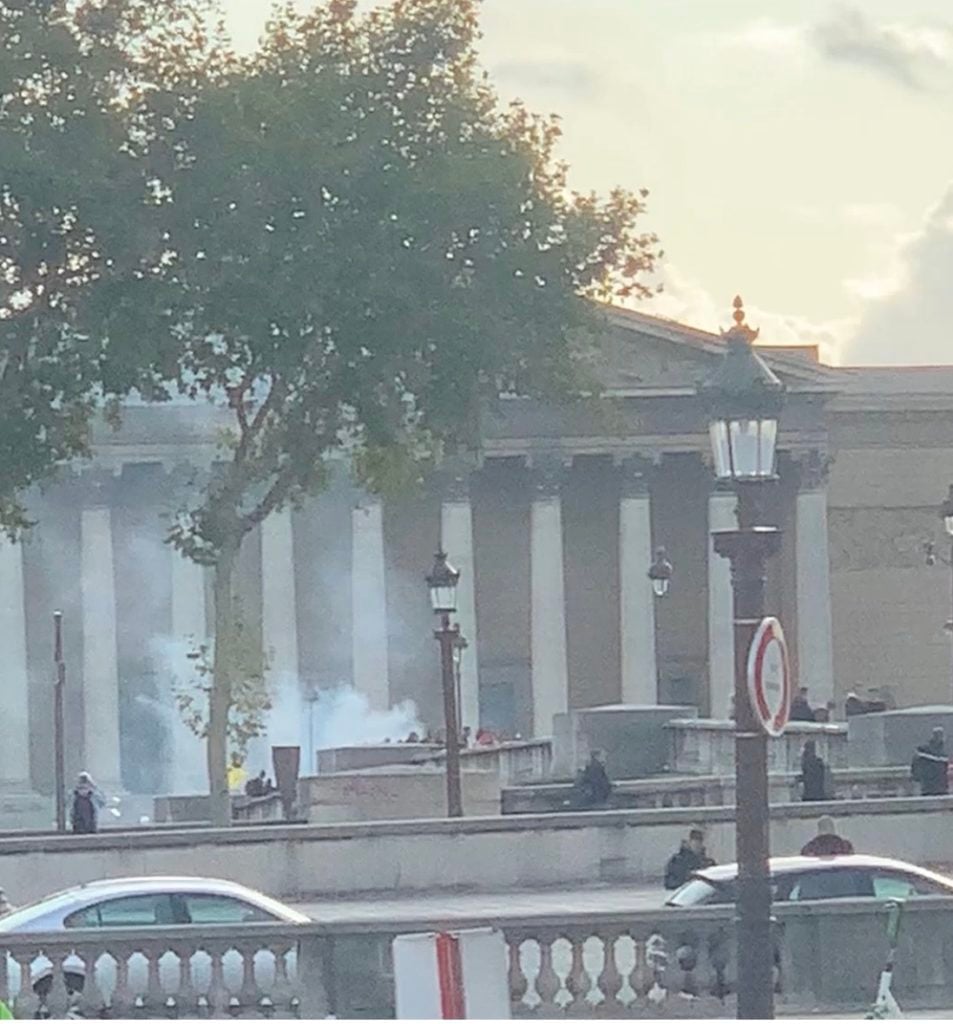
What a riot! Outside the Grand Palais. Sadly, the new normal. Photo by Kenny Schachter.
What does all this chaos mean for the art market? Right before our eyes (which is how most change transpires), the business of guarantees is undergoing a marked transition, with these financial instruments beginning to resemble buy stop orders—investor-ese for the instructions given to brokers to purchase stocks when they hit a specified strike price. In other words, whereas once guarantees were a game where high rollers could make a quick buck (or million), the speculative component is disappearing from auctions as fast as the hair is receding on my head (and growing elsewhere on my body). If you dare to place a bet on an artwork before the sales next month, you’d damn well better like how it looks over your couch.
This will all put a crimp in the overall performance of New York’s upcoming auctions, including the fact that no one with an art collection of note had the misfortune (or good fortune, if you work for a house) to die last quarter. But fear not, in today’s art market—which has experienced more growth in the past 25 years than the previous 250—every time things go quiet, a newbie arrives on the scene prepared to pony up a few hundred million, if not more, to buy contemporary art.
For example, relatively new to the art fray is 43-year-old Alexander Klabin, co-founder of the Senator Investment Group, which has $11 billion under management. The under-the-radar (until now, sorry) hedge-funder is following in the footsteps of Dan Sundheim, the 42-year-old who recently started his own fund, D1 Capital Partners, and who has already sunk hundreds of millions into contemporary art. Klabin’s latest major acquisition was
David Zwirner’s
Gerhard Richter from last June’s Art Basel, which I mistakenly pegged as going to an Asian buyer; with that region’s economic woes, I should have caught that one.
Speaking of players who have seemingly landed from outer space—where he is soon headed
on his friend Elon Musk’s rocket ship—is Yusaku Maezawa, who made quite a splashdown when
he plunked $110.5 million for a Basquiat in 2017 that has apparently fared better than
his Zozosuit, an expensive flop that led the otherwise successful entrepreneur to step down as CEO of his company after selling a majority stake to Yahoo. Rumors are rampant that Maezawa just turned down an offer above his purchase price (but below $150 million) for his Basquiat, though he has been a seller in auctions past. He could well afford to be choosy now that he has pocketed a couple of Yahoo’s billions.
I’ll get to the fairs, promise—but before I do, I can reveal that Pace and
Hauser & Wirth Hospitality Group (my nomenclature, excuse the folly) are in a wrangle for Sonya Rykiel’s former flagship location on Boulevard Sant Germain. Ultimately, both will join Zwirner, Esther Schipper, White Cube, and others who have recently migrated to Paris, or are about to. Once you get past the massive police presence that begins at Charles de Gaulle Airport, Paris is the new London, matching the level of manic hype when I first moved to the UK in 2004.
But don’t be fooled! Paris and London alike are predominantly hubs where out-of-town dealerships set up satellite showrooms to cater to their travel-loving American clients, who unequivocally remain the world’s biggest art shoppers—there aren’t nearly enough indigenous collectors in either country to support the frenetic recent gallery growth. What will be the next international boomtown for galleries and art fairs? Will Maezawa plant the flag when he visits the moon? What’s more disgusting than an ocean floor littered with plastic? Perhaps 20,000 art fairs under the sea. Just kidding, I adore art fairs… really.
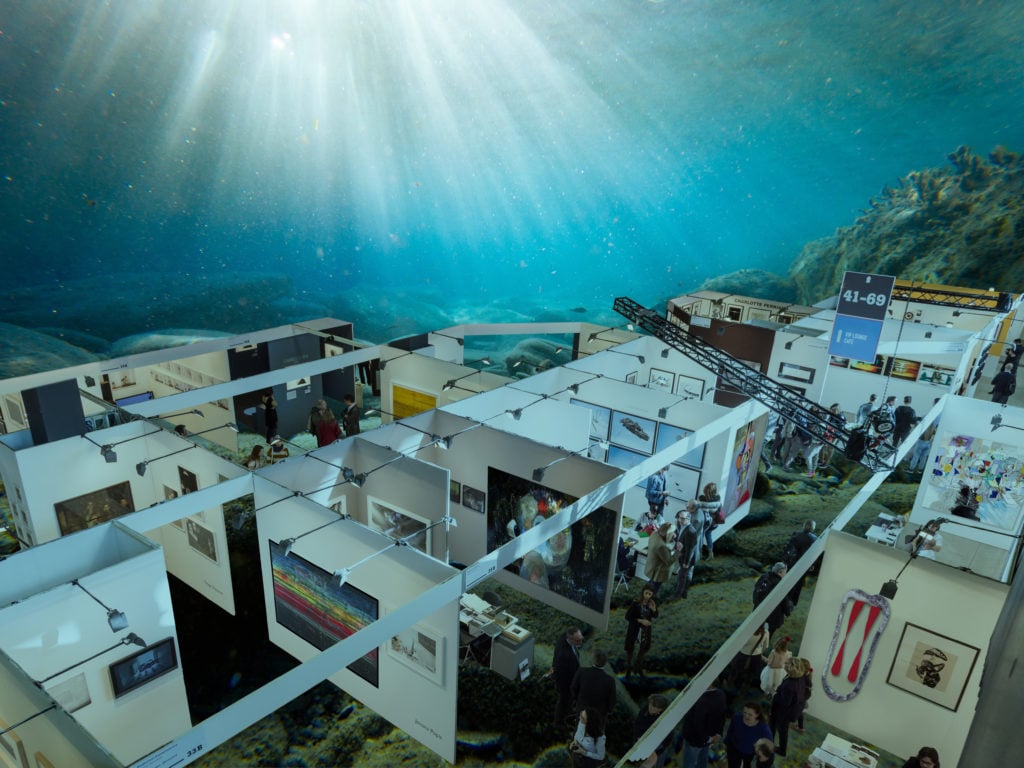
Twenty thousand art fairs under the sea—the horror. Photo illustration by Kenny Schachter.
That’s despite the fact that, more than ever, art fairs are fungible affairs with only vaguely different characteristics varying in place, pace, and space. These days, there’s no longer much of a race to buy the art you covet before someone else does—you can always get it at the next fair the following week. (Apparently, the same can’t be said in the chase for new gallery leases.) Think of fairs as family get-togethers occurring too many times a year that you love to hate, where you see relatives you like (and more you don’t), but usually end up having a decent time and learning something new. That said, much goes in one eye and out the other.
A typical refrain you used to hear at Frieze London was that Frieze Masters was by far the better fair. From its 2019 roster list—which was about 30 exhibitors short of 2018—business clearly wasn’t as good this year (if it ever was, a frequent gripe of participants). Among the names missing this year were heavyweights Lévy Gorvy, Luxembourg & Dayan, Matthew Marks, and Pace. Perhaps to gloss over this fact, Frieze’s website changed format from an outright list to an alphabetized system where you had to pull up individual letters of exhibitors, so it was less apparent overall who chose (not) to participate.
The feedback from those who did do the fair was that it was quieter than last year (i.e. less sales) and peopled by fewer Americans—hardly a good sign, considering that many fairgoers choose either Frieze or FIAC, but rarely both. (Apart from me, who suffers on your behalf.) I’m realizing that the fair business is not defined by a bell curve of success but by something altogether different, for which I have coined the term a “Pickelhelm” (a spiked helmet worn in the 19th and 20th centuries by Germany military, firefighters and police)—meaning, in this instance, that a small amount of galleries do very well, but the majority go from mediocre results to far worse.
On the plane to FIAC I was conveniently seated next to Joe Nahmad of New York’s Nahmad Contemporary, and thought of hypnotizing him when he fell asleep, but he learned from fairs past (with me chasing him around bars at 3 am, trying to coax information) to keep up a defensive posture. I tried peering into his phone but, with typical patchy inflight Wi-Fi, that was futile, too. I did learn from him that despite a secondary slowdown in Wade Guyton’s auction market, the artist’s primary prices have risen from $425,000 to $550,000—not bad for pressing the send button on his computer to his giant Epson. Don’t get me wrong, I’m a fan having exhibited Wade in a group exhibit back in 1997, before he had an oversized printer.
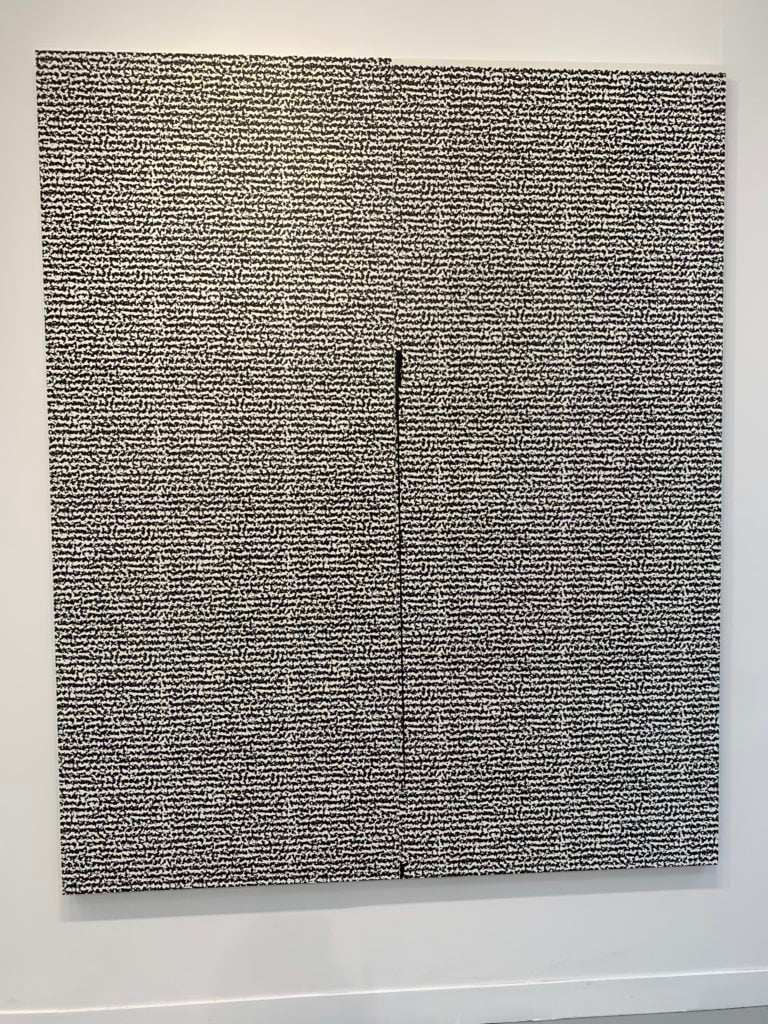
Wade Guyton at Chantel Crousel Gallery, on offer for $550,000 a pop and described as “kind of sold.” Huh? Photo by Kenny Schachter.
Joe also shared that Frieze attendance was off about a quarter from last year, with far fewer Americans, and that the mood this year was sullen (for obvious reasons, if you’ve been to London of late). He had more requests for PDFs in the run-up to FIAC than Frieze, and even made a pre-sale before landing in Paris. I did have a signal long enough
to read about the five-year-old Paris Internationale fair, a model of a lean, not-for-profit, emerging-art-fair success story. Yet of the two galleries featured in the article, one was worse than the other. The artist-run project space 650mAh from Hove, East Sussex, is located in the back of a vape shop (NB: the list of hospitalizations and deaths from e-cigs has been steadily mounting), but, as ridiculous as it sounds, I’m a big fan of the whacky proprietors Ella Fleck and Tabitha Steinberg.
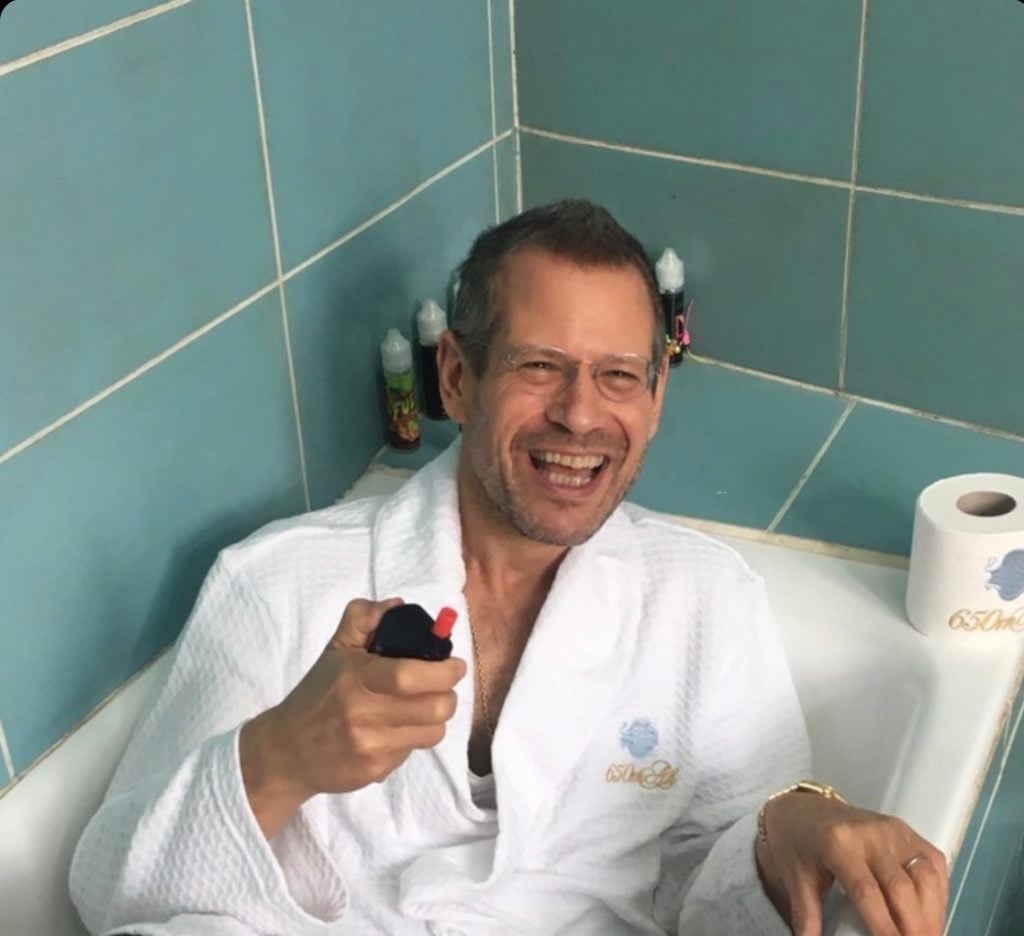
My Hugh Hefner impersonation. Unwinding in the vape lounge of 650mAh projects space at Paris Internationale. Photo courtesy of Kenny Schachter.
On the other side of the quality spectrum, Parisian gallery Goswell Road presented a project founded by transgender artist Chris Korda entitled The Church of Euthanasia, selling t-shirts emblazoned with the following: “Save the Planet—Kill Yourself.” Having just lost a beloved child to suicide, where rates have increased 30 percent from 2000 to 2016 in the USA alone, I think Korda might reconsider the callous insensitivity he preaches, or try practicing it himself. I might have DM-ed him as much mid-flight (it was a long flight). If this is all that remains of an avant-garde, we are fucked indeed.
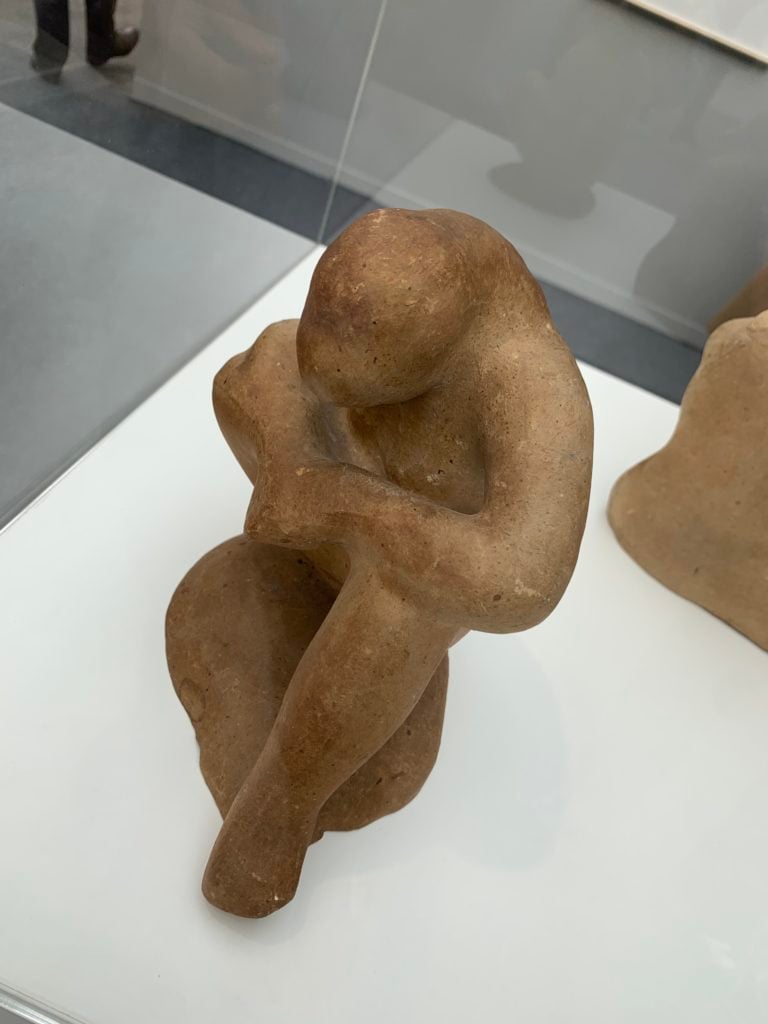
A sculpture by Elie Nadelman at Daniel Buchholtz, I need this! Want to contribute to my Kickstarter fund? Photo by Kenny Schachter.
FIAC had some treasures on view, most of which were available when I was making queries well into the “VIP” opening (there’s a lot of latitude in the definition of that term in relation to an art fair). For starters, the small but voluptuous Elie Nadelman (1882-1946) sculptures at Daniel Buchholtz from only $25,000 (!); a Fontana-esque
Rosemarie Trockel ceramic at Barbara Gladstone for €520,000, which was described as “very unique” when I asked if it was editioned; and Marcel Broodthaers artworks from €100,000 to €120,000 at Konrad Fischer’s booth, where I had the great fortune of having the works described to me by none other than Marie-Puck Broodthaers, the artist’s daughter. The Kathrine Bradford paintings at Canada Gallery, by an artist who only began to flourish commercially when she hit her seventies, were all sold out at $50,000.
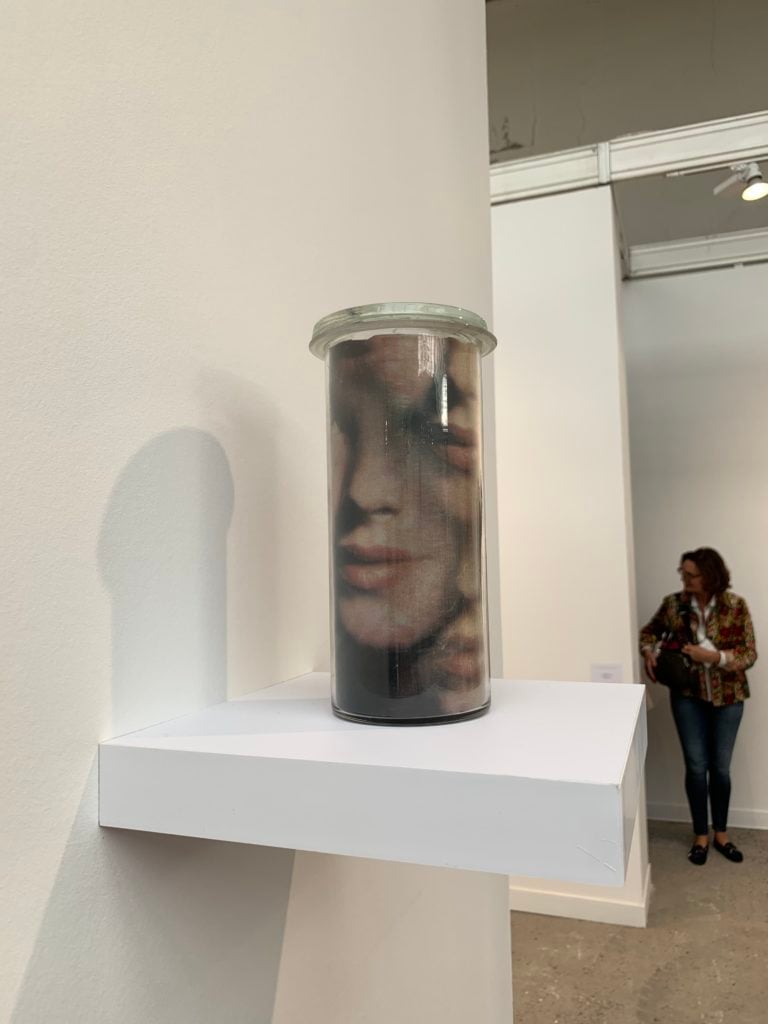
Marie-Puck Broodthaers (in the background) at Konrad Fischer’s booth and her father’s work. Forget the nose and lips, I was all ears. Photo by Kenny Schachter.
FIAC is configured in an upstairs/downstairs layout where the younger material is situated a floor up—meaning you need to choose your battles, because if you start down where the more established works are on offer, by the time you climb the stairs your attention span (mine anyway) has been reduced to a flea’s. Next year I must reverse course and tackle upstairs first… which I say every year. From booth to booth, one is constantly asked: “Did you see anything you like?” I wish they wouldn’t do that, I’m promiscuous and like too much for my own bank balance. Another bit of advice, don’t bother saying hello to any advisors you may know—when they have clients in tow they become mute, unable to acknowledge friends. I spotted one literally pulling the arm of her client dragging him like a resistant five-year-old.
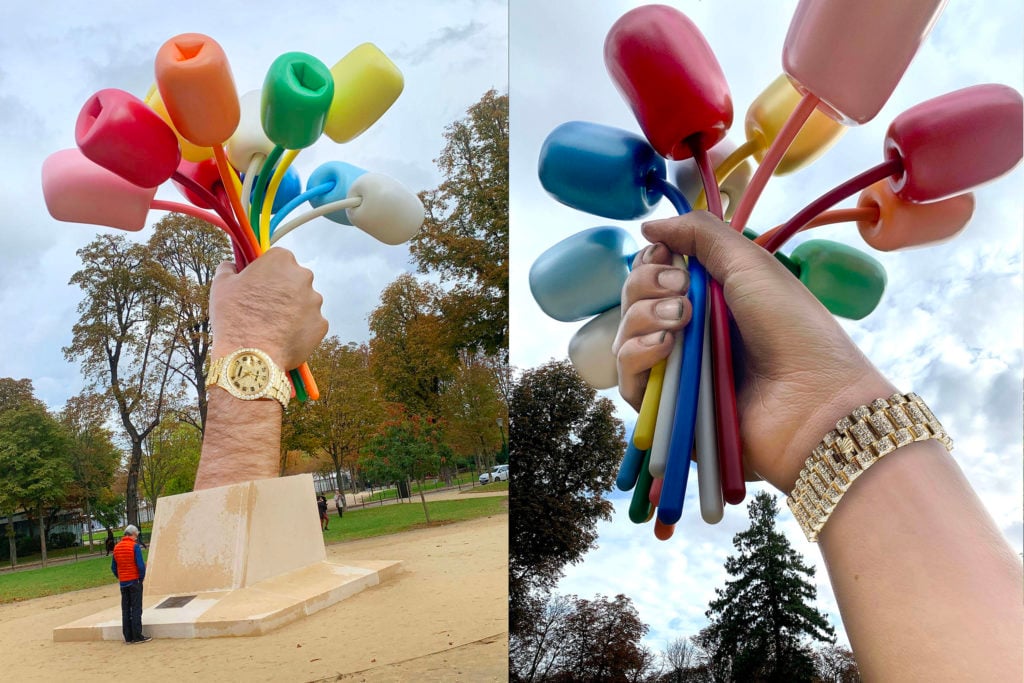
Okay, so there were no surprises, other than just how awful
Jeff Koons’s tulips were, situated just behind the fair. The most egregious part of what just might be the new poster child for lousy public art was the plaque commemorating the donors, including hedge-funder Ken Griffin, rather than the terrorist victims allegedly the subject of the sculpture.
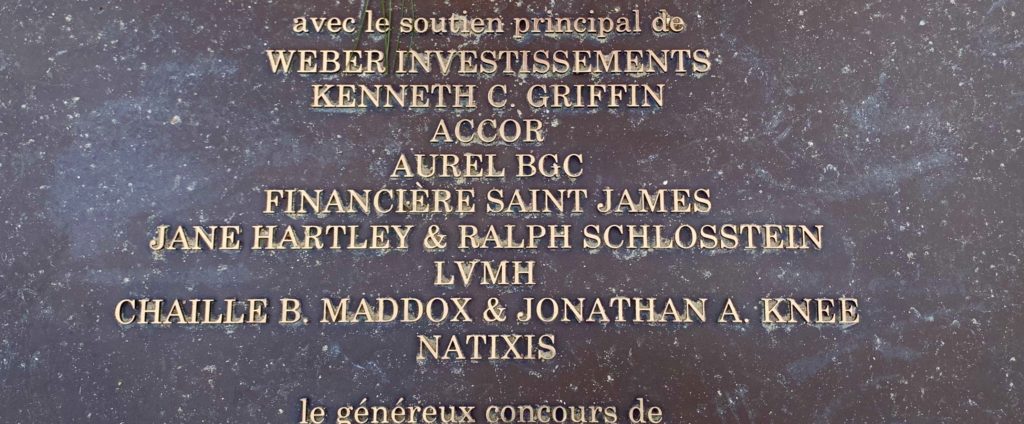
It’s all about the Benjamins. Pathetic. A disgrace. Photo by Kenny Schachter.
The thought occurred to me that the uprisings raging near the Koons, replete with tear gas and water canons, were initiated by Basel to ready the crowd for their upcoming Hong Kong fair. I wanted to protest too—the Koons, with graffiti.
(For 30 years I’ve been confused with
Kenny Scharf—we share the first nine letters of our names—so here’s a little tribute.)
After being serenaded by Parisian sirens 24/7, I couldn’t wait to return to New York for peace and tranquility (never thought I utter that). There is no point pontificating or speculating on the future of art fairs, they just are, and just will be, in whatever guise or incarnation. I think Mick Mulvaney, Trump’s acting chief of staff, put it most succinctly when he admitted to the president’s Ukrainian quid pro quo: “Get over it.”
Follow artnet News on Facebook:
Want to stay ahead of the art world? Subscribe to our newsletter to get the breaking news, eye-opening interviews, and incisive critical takes that drive the conversation forward.
It looks like you're using an ad blocker, which may make our news articles disappear from your browser.
artnet News relies on advertising revenue, so please disable your ad blocker or whitelist our site.
To do so, simply click the Ad Block icon, usually located on the upper-right corner of your browser. Follow the prompts from there.