Thursday, October 18, 2018

How to Delete Facebook and Instagram From Your Life Forever


TECH FIX

How to Delete Facebook and Instagram From Your Life Forever

Lost faith in Facebook and Instagram after data leakages, breaches and too much noise? Here’s a guide to breaking up with the social network and its photo-sharing app for good.
Image
CreditCreditMinh Uong/The New York Times
You may have decided enough is enough: It’s time to delete Facebook.
There have been months — or is it years now? — of bad news about the social network. Last month, Facebook revealed that a security vulnerability exposed up to 50 million accounts to being hijacked by hackers. Through the vulnerability, a hacker could take over your account — meaning anything you ever posted on Facebook, or even apps that you connected with using your Facebook account, could have been infiltrated.
The company said in a statement that it was investigating the incident and would share updates. “People’s privacy and security is incredibly important, and we’re sorry this happened,” the company said Wednesday. “It’s why we took immediate action to secure people’s accounts and fix the vulnerability.”
The breach followed a scandal involving Cambridge Analytica, the voter-profiling firm that got its hands on the private data belonging to millions of Facebook users. And maybe you are just tired of the partisan yammering and updates from the six-degrees-of-friends.
I have some firsthand experience with all of this. After the disclosure of Facebook’s breach, I felt my trust in the social network was broken. So I pulled out my data from Facebook and purged the account. What I found out about the process: The more you have integrated Facebook into your life, the more time-consuming it will be to delete it.
ADVERTISEMENT
To make account deletion as painless as possible, here is a step-by-step guide. I also included steps on breaking up with Instagram, Facebook’s photo-sharing app, for those looking for a cleaner getaway.
Before you commit to breaking up with Facebook, it’s important to handicap the potential collateral damage. Some products and services are deeply integrated with Facebook and could become difficult to use without the social networking account.
Breaking big stories requires support.
Subscribe to The New York Times
The quickest way to test the waters is to deactivate your Facebook account, which is essentially an account suspension that can immediately be reversed. To deactivate, you simply click through your settings and select “Manage Your Account.” Then click the button marked “Deactivate your account.”
When I did that, I noticed I could no longer run Instagram ads to promote my dog’s Instagram account because the advertising tools are directly tied to Facebook. So if you are a business owner who advertises products on Instagram, deleting Facebook would cut off that marketing channel.
Deactivating my account also broke access to apps and websites that I used my Facebook account to sign up for. I found I could no longer easily get into Pinterest because I had used my Facebook account to register for the virtual scrapbooking service. To regain access, I reactivated my Facebook account and then went into my Pinterest settings. Once there, I disconnected the Pinterest account from Facebook and reset my Pinterest password. Then I logged back in to Pinterest with my email address instead.
ADVERTISEMENT
For other apps, like Spotify and ChefSteps, I similarly disconnected the apps from my Facebook account. Then I reset the passwords for those services to regain access with my email address.
Doing all of that was a pain. But the exercise was worth it to ensure I wouldn’t break my accounts for other sites.
Image
Now that I knew I could safely delete Facebook, I started pulling my data out of the social network. That means any personal information that I had collected in my account, including my photos, message transcripts and friends list, and that I did not already have copies of elsewhere.
To help with this, Facebook offers a comprehensive tool called Download Your Information, which can be found in the site’s settings. Using this tool, you can decide what types of data you want to grab.
I requested a copy of all my data. Facebook took about an hour to assemble all the information into one file that measured about 700 megabytes. The file took about 10 minutes to download, and the information was organized into folders for different types of data, like photos, search history and messages.
Pulling your information off Facebook doesn’t mean you are removing it from the company’s servers, though. More on that in a bit.
Image
After making sure I had a copy of all the Facebook data I cared about, it was time to do the deed. In Facebook’s settings menu, I clicked the button “Your Facebook information” and then clicked “Delete Your Account and Information.”
Finally, I clicked on the blue “Delete Account" button. A prompt popped up asking for my password. Then a box showed up warning that deletion was permanent. I wasn’t fazed — and hit the button.
But wait. After hitting delete, my Facebook account was not actually erased, despite all the hoops I had jumped through. The site said that my account was scheduled for permanent deletion after 30 days, and that if I logged in again, I would have the option to cancel the deletion request.
This grace period is here so people can change their minds. In addition, the entire deletion process may take up to 90 days to purge all backups of your data from the company’s servers, according to Facebook. In other words, be patient.
Image
If you also want to get away from Facebook’s clutches by removing your Instagram account, that process is much easier. That’s because Instagram is not nearly as wide-reaching as Facebook; you don’t use your Instagram account to log in to other apps, for instance.
Here are the steps: Inside the photo app’s settings, you can select an option to download a copy of your data. From there, Instagram will email a link to download the file. This process took about 10 minutes for my account. Then you can visit the Delete Your Account webpage and click through the buttons to kill your account.
I confess I did not personally follow through with this. I kept my Instagram account because I like keeping in touch with friends there.
After ending a romantic relationship, have you ever blocked your ex on Facebook so that he or she can’t follow you around? You should do the same after breaking up with Facebook to make sure the site stops tracking your browsing activities.
Be extra thorough about eliminating tracking methods that Facebook and other sites use to follow you. That includes clearing your web cookies, resetting your advertising identifier and installing a tracker blocker. For these steps, follow my previous guide about fighting targeted ads to safeguard your smartphone, tablet or computer.
After I completed these steps myself, there was no sense of closure as I had expected. That’s probably because I knew I might end up reversing the Facebook deletion for the sake of writing instructive articles like this one. I have 30 days to decide.
Brian X. Chen is the lead consumer technology writer. He reviews products and writes Tech Fix, a column about solving tech-related problems. Before joining The Times in 2011 he reported on Apple and the wireless industry for Wired. @bxchen
A version of this article appears in print on , on Page B5 of the New York edition with the headline: Making the Break From Facebook In 6 StepsOrder Reprints | Today’s Paper | Subscribe


Wednesday, October 17, 2018

What Really Happened With Banksy’s Art-Shredding Stunt


Here’s What Really Happened With Banksy’s Art-Shredding Stunt at Sotheby’s, According to Kenny Schachter’s Source

What did Sotheby's know about the headline-grabbing stunt, if anything? Our columnist has a few notions.
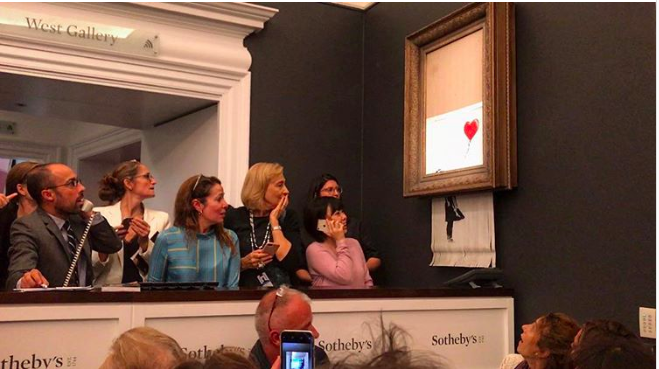
Surprised onlookers react as Banksy's Girl With a Balloon self-destructs at Sotheby's.
Surprised onlookers react as Banksy's Girl With a Balloon self-destructs at Sotheby's.
After last week’s welter of breathless reportage surrounding Banksy’s surprise pantsing of the art market at Sotheby’s London, I had made it a pre-New Year’s resolution never to mention the painting-shredding stunt again. Until, that is, I got a call from my trusty inside source Deep Pockets, who summoned me to meet him at a bar directly from Heathrow, where I was returning from an artist’s talk I’d given the night before in Cologne. (My source never divulges over the phone.) The scoop? He told me the definitive Banksy story, in its entirety.
First of all, if the entire prank—with a crude device concealed within the artwork’s ridiculously oversize frame half-slicing-and-dicing the painting onstage as astounded auction specialists looked on—sounds like a giant PR stunt, know that the consigned artwork was inscribed “Thanks, Jo” (with a heart), and Banksy’s PR representative happens to be named Jo Brooks.
I’m told that someone from Banksy’s publicity team contacted Sotheby’s to sell the painting Girl With a Balloon, but that the consignment came with stipulations, more or less as follows: a. the painting had to be hung in the salesroom during the sale; b. it needed to be sold in the latter half of the proceedings; and, c. it wasn’t to be examined out of the frame. As it’s not the norm to hang a relatively inconsequentially valued painting in the room (the pre-sale estimate was £200,000 to £300,000) during an evening auction, the house replied no.
The consignor countered by offering to pay a seller’s fee of around 5 percent. (That this person wasn’t automatically charged to place the work in the auction indicates that this was not a new relationship, and I’m told this PR liaison acts as a regular, go-to conduit for Banksy to feed art into the auction stream). The response from Sotheby’s came back again in the negative, at which point the consignor raised the ante to around 10 percent, and Sotheby’s acceded—the deal was done. The auction house certainly suspected something was afoot, by the very nature of the dialogue leading up to the sale, but I can assure you that is all they knew.
Like it or not, what followed—a mild protest prank mocking the moneyed, who get to laugh back and make more—is now canonized, one for the books.
Speaking of books, if the auction house did know that there was something in the works and didn’t tell prospective buyers, I thumbed through Elizabeth II’s Fraud Act of 2006, Chapter 35, to confirm that such an act of hanky-panky might very well qualify for “fraud by failing to disclose information.” But because the buyer—a “female European collector” and  “long-standing client,” according to Sotheby’s—agreed to purchase the newly “reborn” artwork, now renamed Love Is in the Bin, there are no victims, save the readers who must be exposed to incessant coverage of the whole charade (which was, yes, undeniably funny and flawlessly executed).
When asked about Deep Pockets’s narrative of the event, Sotheby’s denied everything, with a representative saying that “how the work was handled and presented in the sale/on the night never featured in our discussions regarding commission rates, and there were no stipulations re the frame connected to our consignment agreement.” As for how the frame’s internal weaponry slipped under the auction house’s radar, Sotheby’s said the following:
When we asked the artist’s studio about removing the work from its frame during the cataloguing process, we were expressly told not to. We were told that the frame (which was glued) was integral to the work; breaking it would damage the work, and negatively impact its artistic value. This is not unusual—consider Lucio Fontana’s lacquer frames, or George Condo’s frames that include labels on the back saying do not remove from frame. If you remove the frame you violate the artist’s wishes and destroy the artwork. Our catalogue entry for the work describes that the work as is an ‘artist’s frame’. The certificate we received from the artist’s studio stated that the frame was “integral to the piece.”
As for Jo Brooks, asked whether she had any involvement in the stunt, she replied the narrative was “factually inaccurate.”
In a realm as chockablock with legerdemain as the art world, what matters, at the end of the day, is the the audience enjoyed the show. With his star turn at Sotheby’s, Banksy gave us all a command performance.

Kenny Schachter is a collector, dealer, curator, artist, and, yes, columnist for artnet News. His opinions are his own. Read Kenny’s other columns here.

Follow artnet News on Facebook: 
 
Want to stay ahead of the art world? Subscribe to our newsletter to get the breaking news, eye-opening interviews, and incisive critical takes that drive the conversation forward.
SHARE
Article topics

Erotic Art Auction


Sotheby’s Goes RisquĆ© in First-Ever Erotic Art Auction

The auction house is stepping out of its comfort zone.
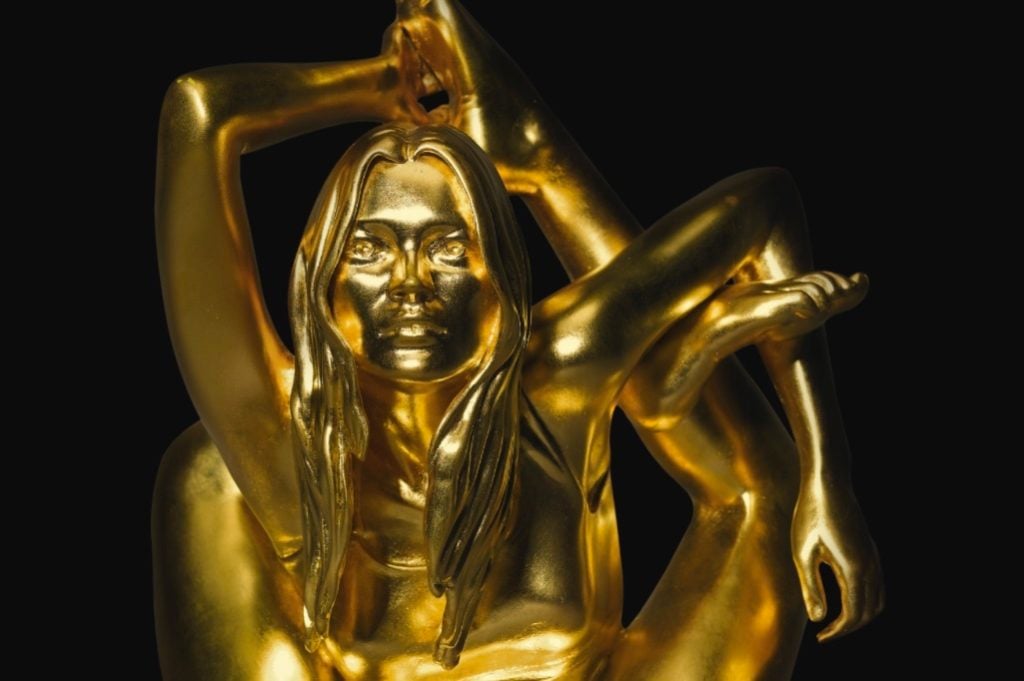
Marc Quinn Siren (2008). Photo: courtesy of Sotheby's.
Sotheby’s is stepping out of its comfort zone by staging its first ever erotic art sale in London later this month.
The auction encompasses a variety of pieces surrounding the themes of love and sex, which span the entirety of art history from antiques to contemporary artworks. Additionally, the venerable auction house tapped Rowan Pelling, editor of the erotic periodical Erotic Review as guest editor for the sale catalogue.
A total of 107 risquĆ© artworks will go under the hammer, including racy sketches, paintings, sculpture, and design pieces, which will be on view at Sotheby’s London headquarters February 11–15, ahead of the February 16 sale.
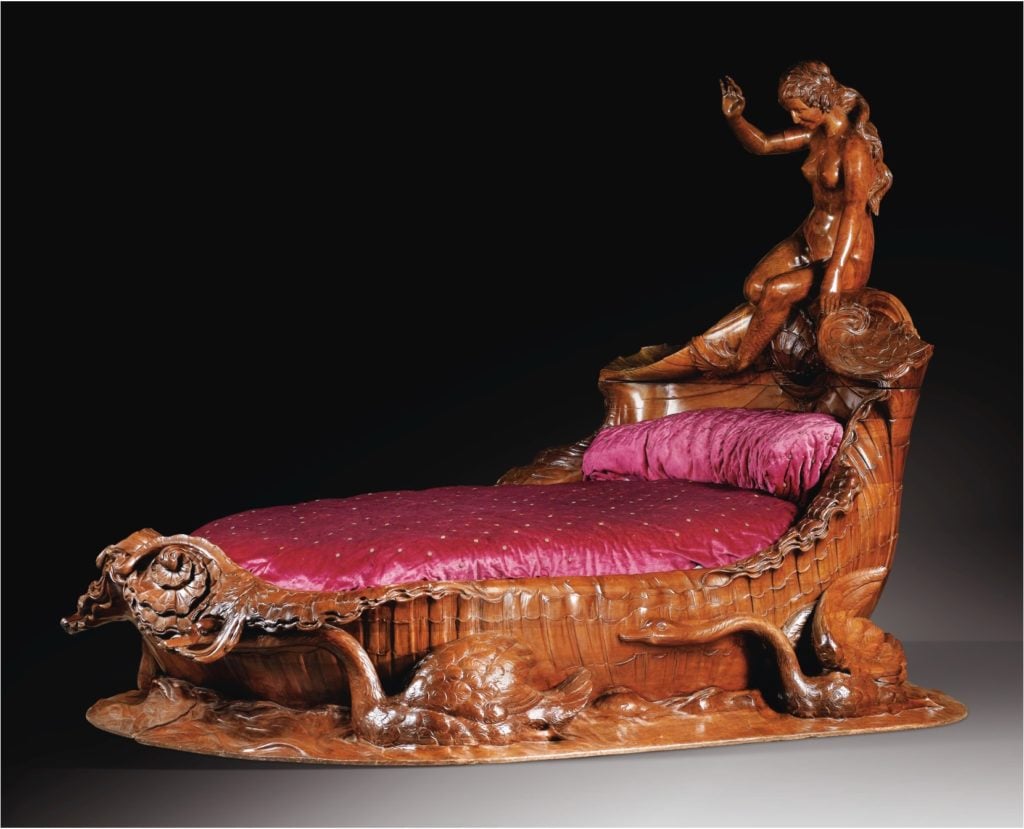
Highlights include a French 19th-century carved mahogany bed, featuring a two-tailed figure of a topless mermaid, which has been estimated at £500,000–800,000 ($624,250–$998,800)—the most expensive lot at the sale.
French, second half 19th century, An exceptional carved mahogany bed. Photo: courtesy of Sotheby's.
French, second half 19th century, An exceptional carved mahogany bed. Photo: courtesy of Sotheby’s.
Demonstrating the broad range and eclectic nature of the sale, the item with the lowest estimate, a phallic Shiva Vase, has carries a pre-sale estimate of just £200–300 ($250–375).
“This sale creates a stage on which we are able to bring together a fascinating array of artworks and objects across many disciplines,” sale head Constantine Frangos told the Daily Mail. The auction is “charting a history whilst also presenting stunning works by artists as eclectic as PicassoMan RayEttore Sottsass, and Marc Quinn.”
Quinn’s Maquette For Siren (2008) a gold statue of Kate Moss in a sensual yoga pose is estimated at £70,000–90,000 ($87,395–112,365). The British sculptor told Sotheby’s that the piece “represents everything that lures people to wreck themselves on the rocks: money, perfection, unattainable images—all these things.”
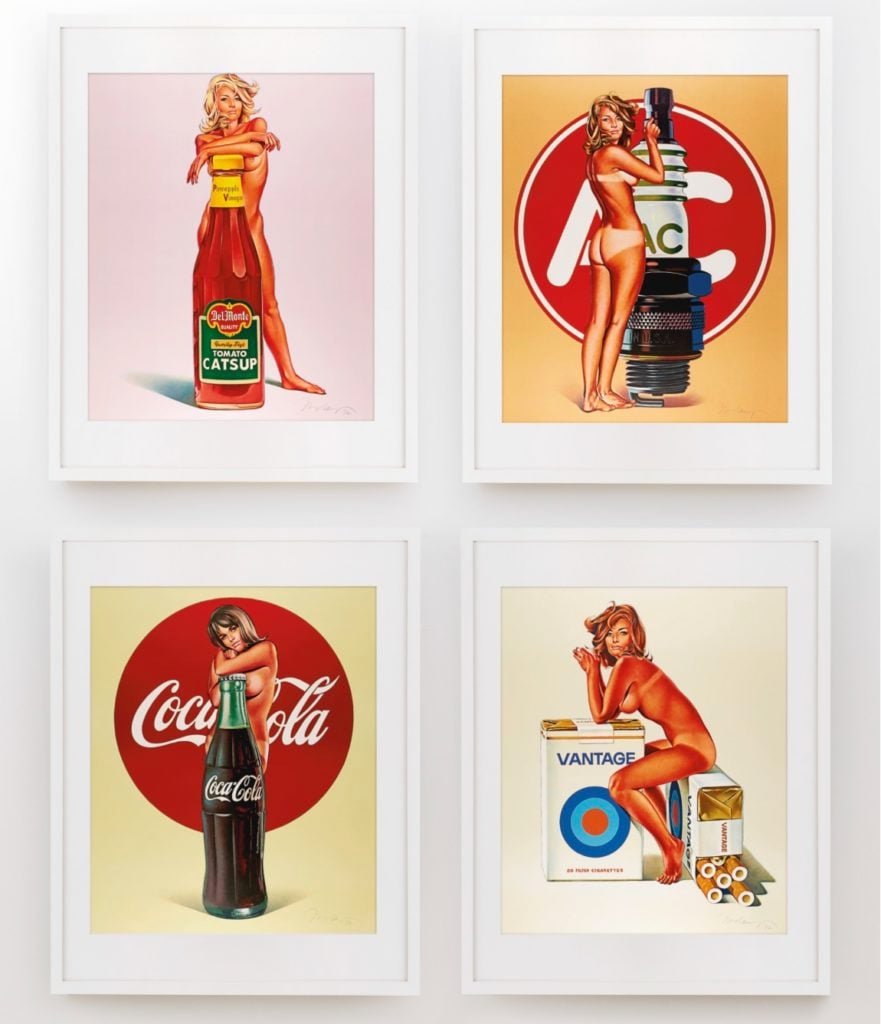
Mel Ramos Tomato Catsup, Tobacco Red; Lola Cola; and A.C. Annie. Photo: courtesy of Sotheby's.
Mel Ramos Tomato Catsup, Tobacco Red; Lola Cola; and A.C. Annie. Photo: courtesy of Sotheby’s.
Also included in the sale are series of four pin-up style Mel Ramos prints, estimated at £5,000–7,000 ($6,243–8,740).
Not to be forgotten are a selection of photographic works by some of the biggest names in contemporary photography. Works by Robert MapplethorpeHelmut NewtonHans Bellmer, and Thomas Ruff are all included in the sale.
“Art has always existed to tell a human story, and sex has always been part of that story—whether it is there to compel, to shock or to seduce,” Frangos concluded. “Indeed, eroticism in art has appeared in whatever for art has taken, an our exhibition will take the viewer on a journey through the centuries.”
Erotic: Passion & Desire” takes place on February 16, 2017 at Sotheby’sLondon.

Follow artnet News on Facebook: 
 
Want to stay ahead of the art world? Subscribe to our newsletter to get the breaking news, eye-opening interviews, and incisive critical takes that drive the conversation forward.
  • Access the data behind the headlines with the artnet Price Database.
SHARE

Mel Ramos, Women and Candy


Pop Artist Mel Ramos, Best Known for His Racy Depictions of Women and Candy, Dies at 83

The artist satirized pin-up girls in his paintings of nude women.
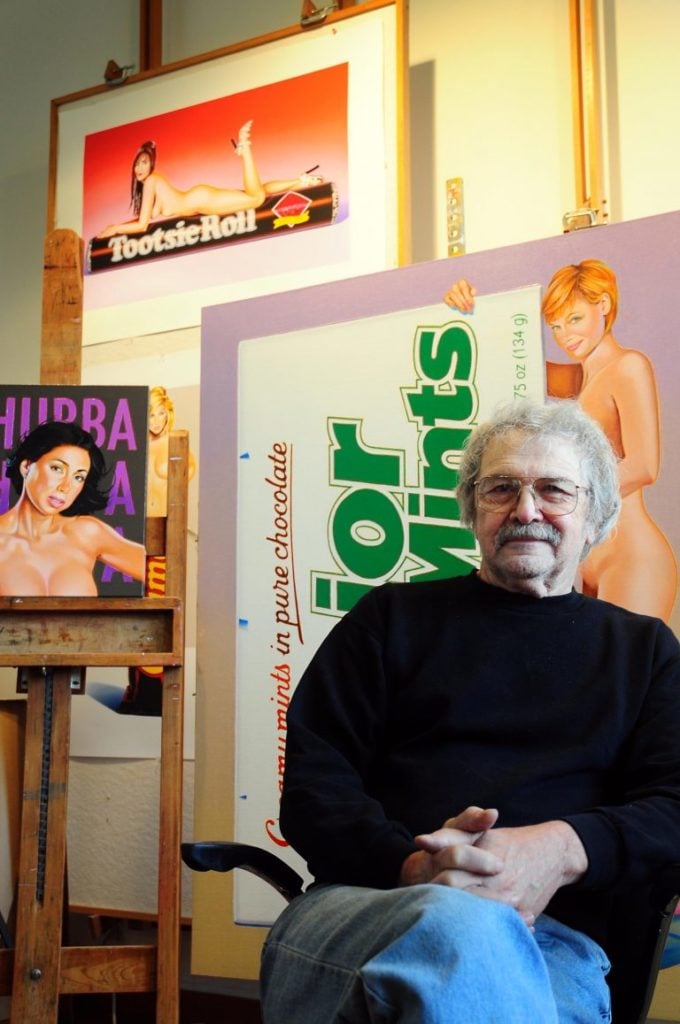
Mel Ramos in his studio in 2012. Photo courtesy of the Crocker Art Museum, Sacramento.
Pop artist Mel Ramos, whose art was known for its striking juxtaposition of naked women with larger-than-life commercial products, has died at age 83. According to his daughter and studio manager, Rochelle Leininger, the cause of death was heart failure.
While he never achieved the same level of fame as his fellow Pop art pioneers, Ramos was an important part of the first generation of American Pop artists. He was one of 12 artists, along with Andy Warhol and Roy Lichtenstein, in the Los Angeles County Museum of Art’s 1963 Pop art show that showcased the burgeoning new movement, with Ramos’s paintings appropriating comic book imagery of female superheroes.
“That was the beginnings of Pop art,” Louis K. Meisel told artnet News. Meisel, who owns the eponymous Louis K. Meisel Gallery in New York, has been Ramos’s dealer since 1971. Ramos originally showed with Leo Castelli, but the gallery wasn’t interested when the artist started focusing on more overtly sexual female nudes, satirizing the traditional commercial pin-up girl.
“I guess that was pretty aggressive back in 1965,” said Meisel, who was introduced to Ramos’s work by Castelli’s former associate director, Ivan Karp. “He called me and said ‘I have a really great artist for you,’ but he didn’t tell me who. Mel Ramos showed up at the gallery in this big fur coat with this big afro haircut and he showed me his work. I took him in immediately and I’ve been representing him ever since.”
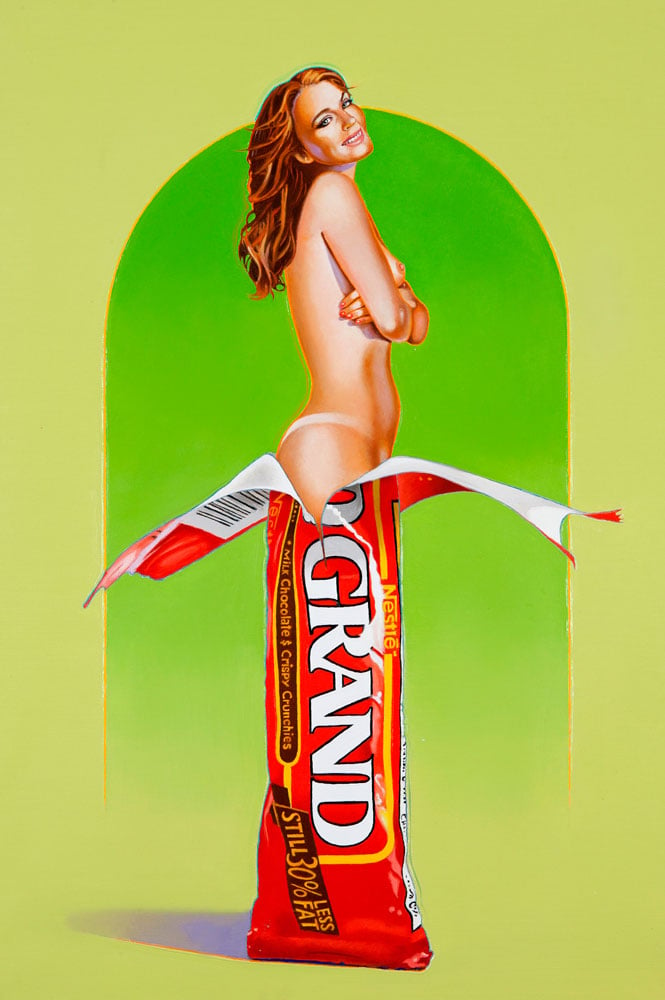
Mel Ramos, 100 Grand (2012). Courtesy of Louis K. Meisel Gallery, New York.
Mel Ramos, 100 Grand (2012). Courtesy of Louis K. Meisel Gallery, New York.
Ramos was “a remarkable human being, artist and teacher,” gallerist Martin Muller told the San Francisco Chronicle. Muller is founder and president of Modernism gallery in San Francisco, which has represented the artist on the West Coast for 38 years. “Riding various political and social trends in the art world over the past decades, he remained focused on the act of painting, with passion, awareness and discipline,” Muller said.
The artist was born in Sacramento on July 24, 1935, and died at Kaiser Permanente Oakland Medical Center on Sunday, October 14. He studied art under fellow Pop artist Wayne Thiebaud at Sacramento Junior College before earning a bachelor’s degree at Sacramento State College in 1957 and a master’s at the school the following year.
Ramos worked as an art professor at California State University, East Bay, from 1966 to 1997, and was still an emeritus professor there following his retirement, splitting his time between Spain and Oakland’s Rockridge neighborhood. Ramos is survived by his daughter Rochelle, his wife, Leta, and his son, Skot.
Mel Ramos, Lucky Lulu Blonde (1965). Courtesy of Louis K. Meisel Gallery, New York.
Mel Ramos, Lucky Lulu Blonde (1965). Courtesy of Louis K. Meisel Gallery, New York.
If there was one thing that kept Ramos from achieving the levels of success enjoyed by his fellow Pop artists, it may have been his lack of production. (According to the artnet Price Database, Ramos’s £1.07 million [$1.69 million] auction record was set at Sotheby’s London in 2012.)
“In a lot of ways, Mel was equal to [Tom] Wesselmann and Lichenstein and, of course, Andy Warhol. The problem is, Andy Warhol left 36,000 works. Wesselmann is close to 8,000 or 10,000. Mel Ramos hand-painted everything tediously,” Meisel explained, noting that Ramos’s full-time job teaching could sometimes leave little time for making new work. “In his most famous year, 1965, he did 18 or 20 works. There are not 1,000 Ramoses in the world, so he hasn’t been as widely collected.”
Ramos’s sexualized imagery also led to criticism that the artist was demeaning women. “In the 1960s and ’70s, feminism came along and there was this problem with nudity,” Meisel acknowledged.
“I got a lot of flak from feminists at one time. Then I was in Europe at a show of 30 nudes at the Louvre. Here were magnificent nudes by Titian, Veronese, and Tintoretto, and I felt validated,” Ramos told the Sacramento Bee in 2012. “I’m no longer defensive about my work.”
Mel Ramos, <em>Senorita Rio - The Queen of Spies</em> (1963). Courtesy of Louis K. Meisel Gallery, New York.
Mel Ramos, Senorita Rio – The Queen of Spies (1963). Courtesy of Louis K. Meisel Gallery, New York.
In 2011, Ramos was the subject of a major survey at the Albertina in Vienna. His first hometown retrospective, “Mel Ramos: 50 Years of Superheroes, Nudes, and Other Pop Delights,” followed at Sacramento’s Crocker Art Museum in 2012.
His work can be found in the permanent collections of such prestigious institutions as New York’s Museum of Modern Art, Solomon R. Guggenheim Museum, and Whitney Museum of American Art. Beyond NYC, the San Francisco Museum of Modern Art, the Norton Simon Museum in Pasadena, and the Hirshhorn Museum in Washington, DC, also hold his works.
The exhibition “Mel Ramos – Superheroes of 1963,” featuring six of the 18 paintings from his first major series of Pop works, of female superheroes, opened at Louis K. Meisel Gallery on October 11 and is on view through November 10.

Follow artnet News on Facebook: 
 
Want to stay ahead of the art world? Subscribe to our newsletter to get the breaking news, eye-opening interviews, and incisive critical takes that drive the conversation forward.
SHARE
Article topics

Tuesday, October 16, 2018

here's the answer to the quiz


here's the answer to the quiz:
...|...

VANTAG PHOTO »» QUIZ 1 » 
» the 100% true story »» THE NAMES TO BE NAMED ARE »
(no more no less... just enough):
1. Arthur Elgort
2. BrassaĆÆ
3. Helmut Newton
4. Horst P. Horst
5. Irina Ionesco
6. Lillian Bassman 
7. Michel Comte
8. Melvin Sokolsky
9. Patrick Demarchelier
10. Russell James
11. Slim Aarons
12. Tatsuo Suzuki
13. Vivian Meier
14. Gosta Peterson
15. Peter Lindbergh
16. Paul Outerbridge
17. Antoin Sevruguin
18. Man Ray
19. Monique Jacot
20. Norman Parkinson


the quiz was here

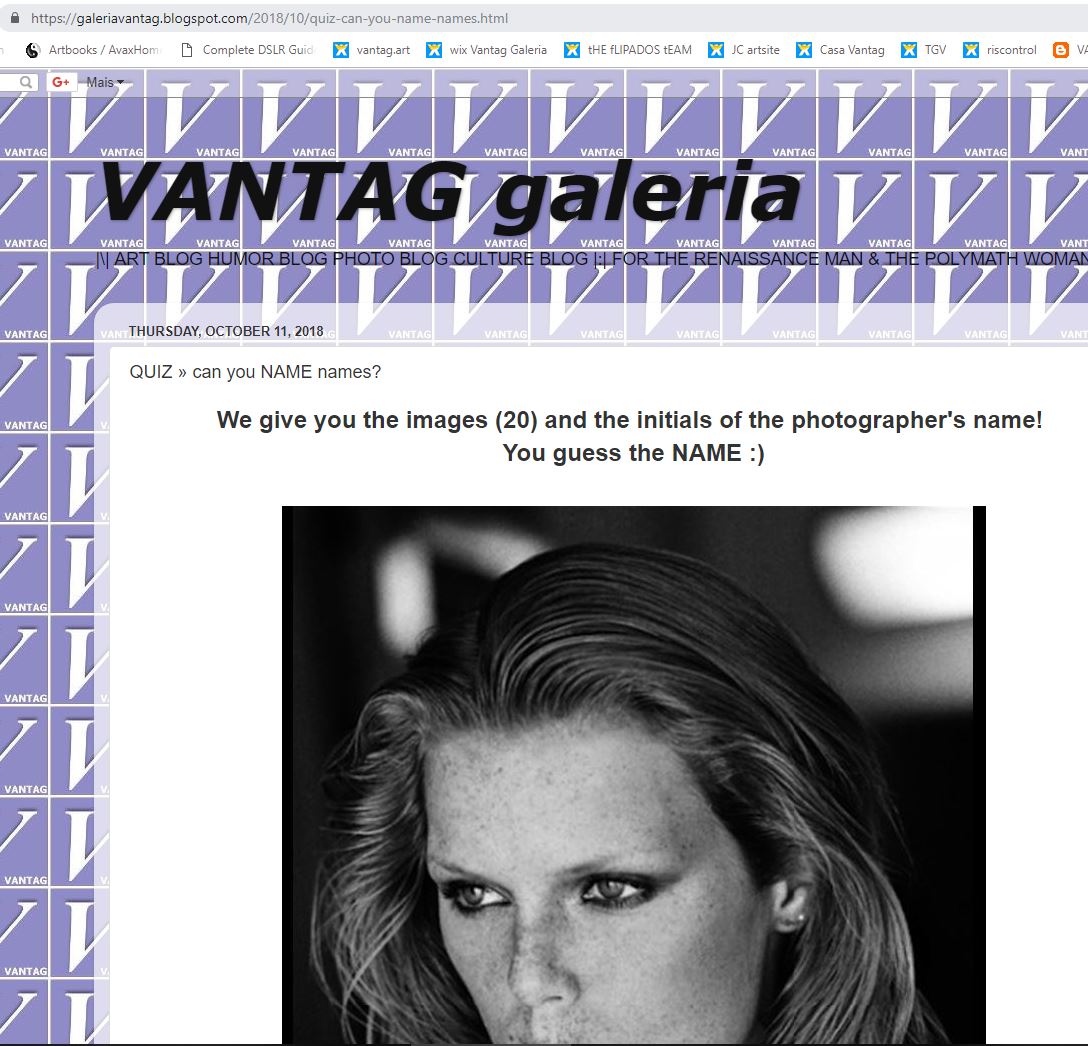
https://galeriavantag.blogspot.com/2018/10/quiz-can-you-name-names.html


UNTIL NEXT TIME « « good photos not shots (unless you mean vodka)