A life drawing class at School of Visual Arts
Photo: Courtesy SVA
One-thousand six-hundred fifty-four.
I'm not teaching this semester, but if I were, that is the one number that I would want everyone to remember.
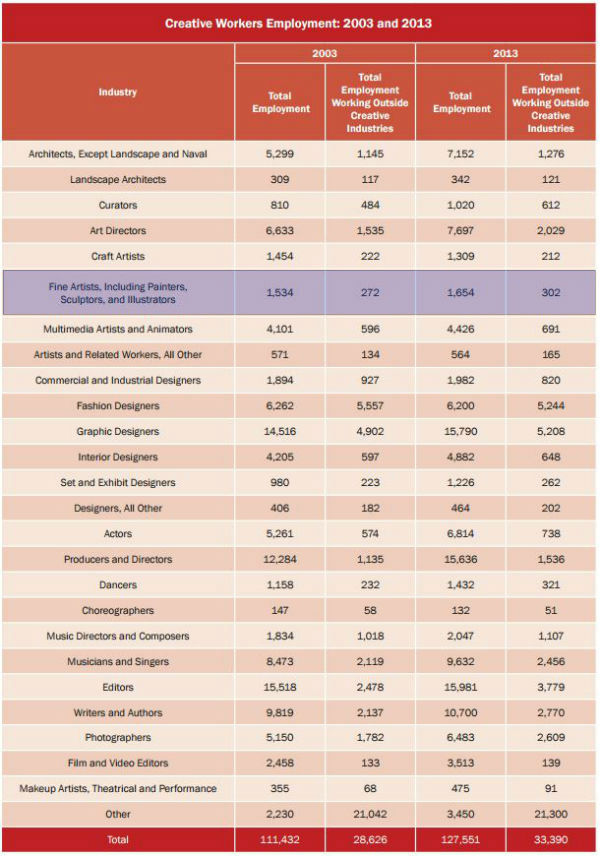
It is the reported number of “fine artists" sustained by the booming visual art industry in New York City (as of two years ago), according to Creative New York, a 2015report on the health of Gotham's “Creative Economy."
The top "Creative Economy" jobs in New York (with "Fine Artists" highlighted)
Image: Courtesy Center for an Urban Future
The School of Visual Arts enrolls about 400 in its "Fine Arts" section (graduate and undergraduate). Pratt Institute has 374. Parsons, the New School for Design, is training about 114 undergraduates and 46 grads. Cooper Union has about 280 students in its art programs, while NYU's Steinhardt school enrolls about 220 art undergraduates, plus a few dozen more in its graduate programs.
That already takes us to more than 1,400 art students, and these are just the programs I can name off the top of my head. It follows that at any given moment in New York there are many, many more artists in the process of being added to the pool than there are successful artists who have “made it" in the entire city.
Already sentenced to over twelve years in prison for a controversial cartoon portraying members of the Iranian parliament as monkeys, cows, and goats, Iranian artist Atena Farghadani has now been slapped with a new indictment: According to Amnesty International Farghadani is being charged with “illegitimate sexual relationship short of adultery,” because she shook the hand of her attorney, Mohammad Moghimi, when he visited her in prison. The Art Newspaper’s Gareth Harris, who reported the news, writes that both Atena and Moghimi will go on trial for those charges. According to Harris, the Iranian Embassy in London had no comment on the matter.
The country’s revolutionary guards raided Farghadani’s home last summer and took her to Gharchak prison, as Artforum.com previously reported here. She was released in December, only to be rearrested a month later when she accused guards of beating and interrogating her for hours at a time. Mounting a hunger strike after being redetained, she suffered a heart attack and was hospitalized in February.
NEWS
Iranian artist could see sentence extended after shaking lawyer’s hand
Atena Farghadani’s gesture has led to new charges including “indecent conduct”
The Iranian artist Atena Farghadani, who was sentenced to 12 years and nine months in prison earlier this year for criticising the Iranian government, now faces further charges according to Amnesty International.
Farghadani was arrested in August last year for drawing a cartoon that mocked members of parliament. In June, a court in Tehran found Farghadani guilty of “spreading propaganda against the system” and “insulting members of the parliament through paintings”, among other charges.
She depicted Iranian parliamentarians as monkeys and goats in protest at plans to introduce two separate bills, which will outlaw voluntary sterilisation and restrict access to contraception.
But she could now face a longer sentence. Amnesty says in a statement: “Atena's lawyer, Mohammad Moghimi, visited Atena in prison after her trial and shook her hand. The handshake led to charges of an 'illegitimate sexual relationship short of adultery' and 'indecent conduct' being brought against both Atena and Moghimi, who will be tried for those charges in due course.”
The statement adds: “Iran has pledged to protect free speech, including through artistic activities, as a signatory of the International Covenant on Civil and Political Rights.” The Iranian Embassy in London declined to comment on the case.
For two decades now, journalist and author Michael Wolff has been a thorn in the side of the media elite. As a media columnist for numerous publications, including New York, Vanity Fair, and USA Today, and author of several books, including a biography of media mogul Rupert Murdoch, Wolff has been sharply critical of the business and editorial decisions of all kinds of media outlets, whether newspapers or film studios, in print, on TV, and online.
In his new book, Television Is the New Television: The Unexpected Triumph of Old Media in the Digital Age (Portfolio/Penguin, 2015), Wolff asks a simple question: Who actually makes money in the media business? In his view, the answer is easy. Companies that produce content for television, regardless of how rapidly change occurs in how it is distributed, continue to make money — lots of money. This is true even as virtually every online media company struggles to earn a profit, on still-meager revenues.
Wolff recently spoke with strategy+business about his new book. Given his acerbic reputation, it’s no surprise that at one point he referred to the management of a top newspaper organization as “real dummies.” Still, Wolff comes across in person as thoughtful and reasoned. He has strong but well-considered views on what’s right about the TV business, what’s wrong with digital media, and what the former can teach the latter — and those views raise critical issues about the present and future of all kinds of media, both online and off.
S+B: In your new book, you argue that the television business, contrary to all expectations, has only grown stronger over the past decade or two. How come the Internet hasn’t killed television the way it did print or music?.....
Erica Jong’s ‘Fear of Dying’ Defies the Sunset of Sex
Photo
“I thought, I have to write about an older woman who is sexual, attractive and wants to reach out for life. That’s not celebrated, sadly. ” ERICA JONG, author of “Fear of Dying”Credit Krista Schlueter for The New York Times
Two words have vexed Erica Jong for the last 42 years. The first is “zipless,” and the word that follows is not printable in this newspaper.
The two-word phrase, immortalized in her 1973 best-selling novel, “Fear of Flying,” which has sold more than 27 million copies, entered the cultural lexicon as a shorthand for casual, consequence-free sex. It turned Ms. Jong into a feminist heroine of sorts and avatar of female sexual liberation, and helped propel and define her career.
It was also meant to be satirical, Ms. Jong said, but was misconstrued as an endorsement of unbridled lust.
“People so misinterpreted ‘zipless,’ ” Ms. Jong, 73, said during an interview at her Upper East Side apartment. “I say in ‘Fear of Flying’ that it’s a Platonic ideal and a fantasy, and I have never had one, but people seem to overlook that.”
Now, decades later, she has exhumed and rebranded the phrase in her new novel, “Fear of Dying,” which is being billed as the “spiritual” sequel to “Fear of Flying” and is being released on Tuesday.
While “Fear of Flying” shocked readers with its frank depiction of the sexual appetite and independence of its protagonist, Isadora Wing, “Fear of Dying” takes on an another, more persistent taboo by depicting — in blunt, unvarnished detail — sex between older adults. Ms. Jong’s new character, a grandmother in her 60s, is lusty and vivacious and searching for carnal satisfaction at a casual-sex site called zipless.com.
“I’ve always wanted to write the books for women that didn’t yet exist, so I thought, I have to write about an older woman who is sexual, attractive and wants to reach out for life,” Ms. Jong said. “That’s not celebrated, sadly, and I would hope that a lot of older women who read this book realize that sex doesn’t disappear, it just changes forms.”
The story centers on Vanessa Wonderman, a former actress terrified of aging and death. She seeks escape from her sexless marriage to a much older man with erectile dysfunction by searching for lovers online. The surreal encounters that follow — an email exchange with a man who introduces himself by sending lewd photos, another who wants her to wear a black rubber suit, an unsatisfying hotel tryst with an old married flame — leave Vanessa reeling and worried that her sex life might be over. (This being an Erica Jong novel, it isn’t.)
Some of Ms. Jong’s fans and peers are calling the novel a long overdue corrective in a cultural landscape that deifies youth and often ignores older women, or relegates them to the role of spinsters or crones.
Photo
Erica Jong, 73, at home on the Upper East Side. Her new book centers on a woman in her 60s who searches for lovers online.Credit Krista Schlueter for The New York Times
“There is this giant void in the culture about women in that age group as heroines, as romantic beings, as sexual beings and as creative beings, and there’s not that void for men,” said Naomi Wolf, author of “The Beauty Myth.” “Women don’t stop being all those things as their lives continue into those decades.”
“Fear of Dying” is landing in the middle of a long-festering debate about the social and cultural obstacles older women face. The comedian Amy Schumer has skewered the frequent sidelining of older actresses in a widely viewed skit built around the farcical — though just barely — premise that an aging actress’s desirability could dissipate in a single day. Sex therapists and gurus have published dozens of manuals and self-help books with titles like “Sex for Seniors” and “Sex Over 50.” There is also the gag book “Sex After 60,” which is blank inside.
But the subject hasn’t been widely explored in popular fiction. “Women were not allowed to have passion at 60,” Ms. Jong writes in “Fear of Dying.” “We were supposed to become grandmothers and retreat into serene sexlessness.”
Ms. Jong started out as a poet, and published two volumes of verse before selling “Fear of Flying” to Aaron Asher, an editor whose roster of writers included Saul Bellow, Philip Roth and Arthur Miller. Mr. Asher told Ms. Jong to expect sales of 3,000 copies, she recalled.
Instead, the novel, about a young poet who travels to Vienna with her husband and attempts to live out her fantasies by having an affair, became a blockbuster and cultural touchstone. John Updike compared it to “The Catcher in the Rye,” and Henry Miller praised it as a groundbreaking literary achievement. The book was translated into 40 languages and was credited by second-wave feminists with paving the way for women’s self-expression.
“What was really distinctive about it at the time was the notion that a woman could break out of the conventions of how a woman writer should write, and write with candor and humor about topics that were taboo for women,” said Shelley Fisher Fishkin, an English professor at Stanford University.
Ms. Jong has since published three memoirs, five more volumes of poetry and eight other novels, including historical fiction and a work about Sappho, but nothing has matched the popularity of “Fear of Flying.” At times, she says, she has felt oppressed by being so closely associated with her brash fictional alter ego Isadora.
“Fear of Flying’ follows me everywhere,” she said.
She has been struggling to write “Fear of Dying” for a decade. At first she tried to make an older, wiser Isadora the heroine. But bringing back that character felt forced. “There was so much baggage around ‘Fear of Flying,’ ” she said. “The weight of those expectations was very frightening.”
Ms. Jong eventually sidelined Isadora to a cameo role as a worldly friend, and created Vanessa, who shares some obvious traits with the author. She used the book to explore the wrenching process of watching her parents’ slow demise, her fear of losing her looks and vitality, the joys of being a grandmother and her relationship with her daughter, Molly Jong-Fast, who, like Vanessa, struggled with drug addiction.
Ms. Jong’s warm, chatty persona and her tendency to blur the boundaries between her life and fiction often results in juicy reading. She once wrote about a one-night stand she had with Martha Stewart’s then-husband, Andy Stewart, at the Frankfurt Book Fair. But the autobiographical tropes can be trying for friends, family members, ex-husbands and former lovers. (Her fourth marriage, to Ken Burrows, a divorce lawyer, has lasted 26 years.) Her sister, Suzanna Daou, confronted her publicly at a 2008 conference about “Fear of Flying,” and has said that the book embarrassed her and her husband by modeling characters after them.
Ms. Jong-Fast, who is also a writer, said she had not read “Fear of Dying” and did not plan to, noting that her having her time in treatment rehashed in fiction “would not have been my first choice.” The scenes from a mother-daughter trip to a rehabilitation clinic appear to be barely fictionalized, and several paragraphs match an account of the episode in Ms. Jong’s most recent memoir nearly verbatim, with identical dialogue and descriptions.
“I don’t read her books,” Ms. Jong-Fast said. “For my mental health, it’s probably better not to.”
A few literary critics have taken aim at Ms. Jong’s self-referential style and habit of recycling material. A caustic review of her 2006 memoir in The Atlantic posited that Ms. Jong was doomed to “eternal self-imitation” after the success of “Fear of Flying,” and skewered her “stunning self-absorption.”
In an advance review of “Fear of Dying,” a critic for Kirkus Reviews said that “spending almost 300 pages with Vanessa is like enduring a trans-Atlantic flight with a seat mate who never stops talking but doesn’t have a whole lot to say.”
Ms. Jong said she had a thicker skin than she did earlier in her career and is more philosophical about negative reviews. “We can’t really control our image in the world,” she said. “But it still hurts if you spend a decade on a book and people don’t like it.”
She has many vocal supporters, among them Susan Cheever; the historical novelist Ken Follett, who said the new novel represented “Erica at her best”; and the novelist Jennifer Weiner, who counts “Fear of Flying” as one of her literary influences.
“ ‘Fear of Flying’ opened a lot of doors and eyes and made people look differently at that nice woman sitting next to them on the train, and I think ‘Fear of Dying’ is going to have the same effect,” Ms. Weiner said.
Ms. Jong also found a fan in one of her comic heroes, Woody Allen, who loved “Fear of Dying” and unexpectedly gave it a blurb.
“I was thinking of his famous quote, I’m not afraid of dying; I just don’t want to be there when it happens, so I thought he should read this,” Ms. Jong said. “The first thing he said when we sent it was, ‘I never blurb anything.’ Then he relented.”