Of all the questions that businesses in the notoriously judgmental art and culture businesses should ask before making any big moves, a good one to use as your North Star is “How do we keep from publicly humiliating ourselves?” For a case of what can happen if you lose sight of this rule, consider the art-research outfit LMI Group and its ongoing, increasingly distressed campaign to get a junk-sale painting attributed as a rediscovered, late-career work by Vincent Van Gogh.
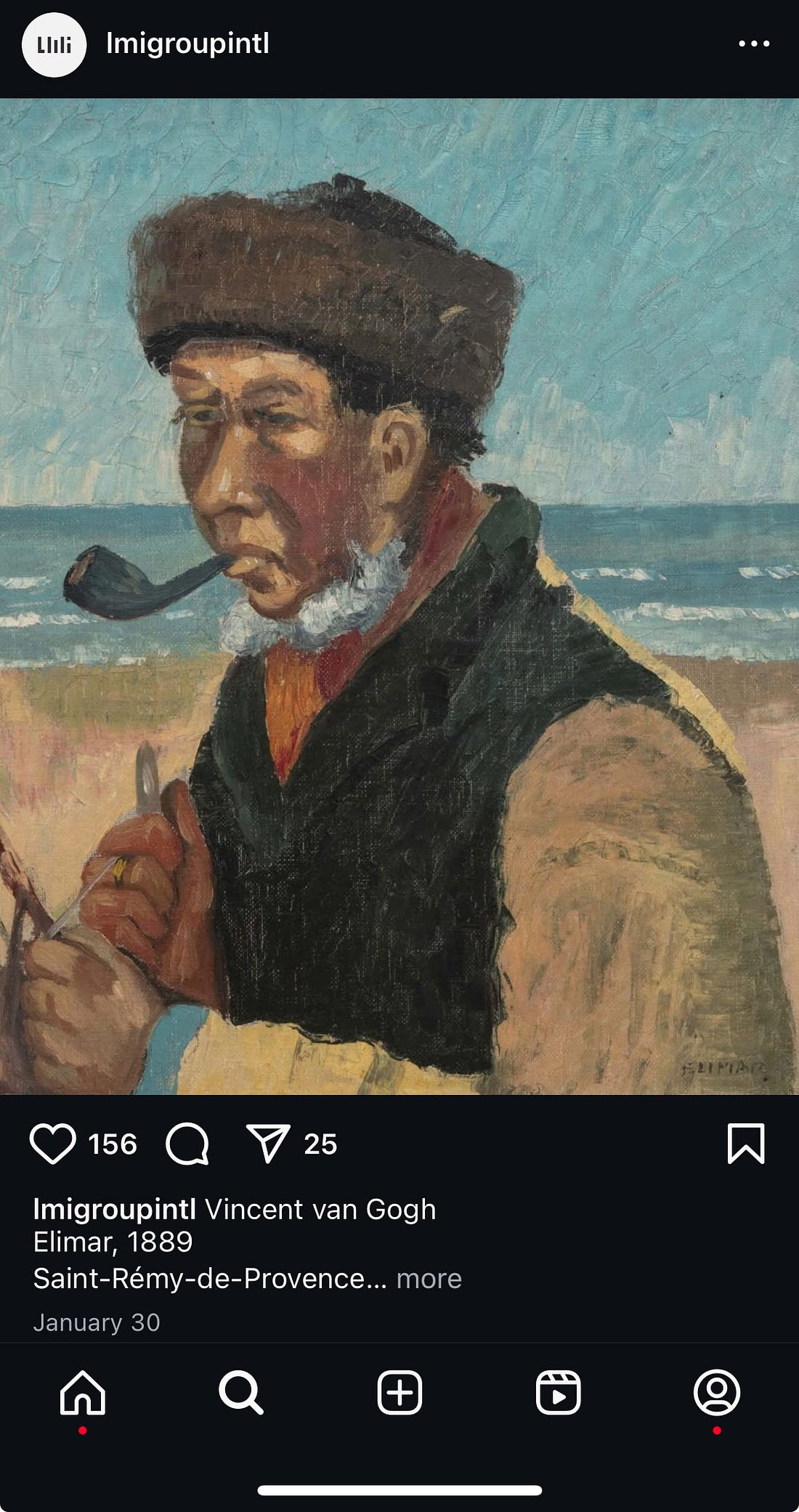
The story, which first appeared in the Wall Street Journal this January, began when an unnamed antiques collector paid $50 to scoop up an unassuming portrait of a fisherman (pictured above) from a garage sale in Minnesota a few years ago. The collector then resold the work for an undisclosed price to LMI, a company that, according to its website, uses “rigorous data science and proprietary technology” to “authenticate, underwrite, and bring to market previously unknown or forgotten works of art from the world’s greatest artists.”
LMI says it spent more than $30,000 compiling a 458-page(!) report featuring purported experts in a range of disciplines arguing that the painting is a long-lost Van Gogh. (I requested the full report but never heard back from LMI.) The company’s leaders, who nicknamed the painting “Elimar” after an inscription painted in the canvas’s lower-right corner, planned to “begin unveiling their find in private viewings to major Van Gogh scholars and dealers around the world” later in January, Kelly Crow of the Journal wrote, with the goal of reinforcing that Elimar is worth at least $15m.
The only minor problem is that Amsterdam’s Van Gogh Museum, the keeper of the artist’s legacy and the ultimate arbiter of what is or isn’t the one-eared Dutchman’s work, almost immediately rejected LMI’s claim—without either viewing the painting in person or bothering to read the research. It later emerged that the museum had already quietly rejected the painting once before, in 2018, when it received an unheralded JPEG via email from the antiques collector LMI sourced the work from.
But the saga hasn’t ended there. After LMI’s original media blitz, a handful of experts on Van Gogh—including Wouter van der Veen, the former scientific director of the French nonprofit Institut Van Gogh—proposed a counter-theory about the painting: that the “Elimar” inscription is the signature of an amateur Danish artist named Henning Elimar, who lived from 1932 until 1989, around 100 years after Van Gogh. This past week, George Nelson at ARTnews reported that LMI decided to push back against that theory with the not-at-all-desperate-seeming strategy of buying what the company claims is one of only two known paintings by Henning Elimar, analyzing it in the lab, and releasing a follow-up report reaching the completely unforeseeable conclusion that it has no meaningful similarities to the would-be Van Gogh.
You will be equally stunned to hear that there has been no indication that any of this has changed the thinking of the folks at the Van Gogh Museum. I’d go so far as to say that LMI has a 0.0% chance of ever getting Elimar attributed at this point, mostly because of three strategic blunders—one made right at the beginning of this saga, one after some internal research had been done on the painting, and one after the Van Gogh Museum denied its petition for attribution. If you want to avoid the same fate should you ever stumble onto a potential long-lost masterpiece in a bargain bin, here are three questions to ask yourself.
1. Would the attribution make a great artist look ridiculous?
I made this point when I first wrote a little item about Elimar a few weeks ago, but it’s worth repeating here because, to me, it’s all that really matters in a case like this one.
Reattribution is ultimately a human choice, and humans respond to incentives. Although more and more executors of artists’ estates have opted out of the authentication business over the threat of lawsuits from buyers unhappy with their verdicts, Van Gogh represents an increasingly rare case where there is still one, and only one, all-powerful authority determining which works get the artist’s imprimatur and which don’t.
No matter how unscientific it might be, this realistically means you can set aside materials science, signature analysis, brushstroke patterns, and everything else that could be a factor in determining the authorship of an orphaned painting. Instead, just think about it from the perspective of the people who will be in charge of making the call—people who have a professional interest in safeguarding and celebrating the legacy of a particular artist by making that artist look as visionary, virtuosic, and important as possible. If adding a rediscovered painting to their guy’s oeuvre is going to make him look worse to the average art enthusiast than keeping it out, I promise you there is almost no evidence in this life or the next that could convince the authorities to bless it.
This is terrible news for Elimar and LMI. You don’t even have to know Van Gogh’s specific vocabulary, style, or subject matter to see the problem. Case in point, I’ve asked multiple reasonable people free of art-world entanglements whether Elimar looks like it was made by one of the greatest artists of the past 150 years, and their reactions pretty much approximate what I’d expect if they walked in on me huffing glue. It’s not hard to understand why. The fisherman’s eyes are catatonic, his left hand looks like an underbaked croissant, and it’s unclear whether he’s sporting a supernaturally voluminous white neck-beard or his Adam’s apple is billowing steam like an uncovered New York manhole. I could keep going, but you get the point.
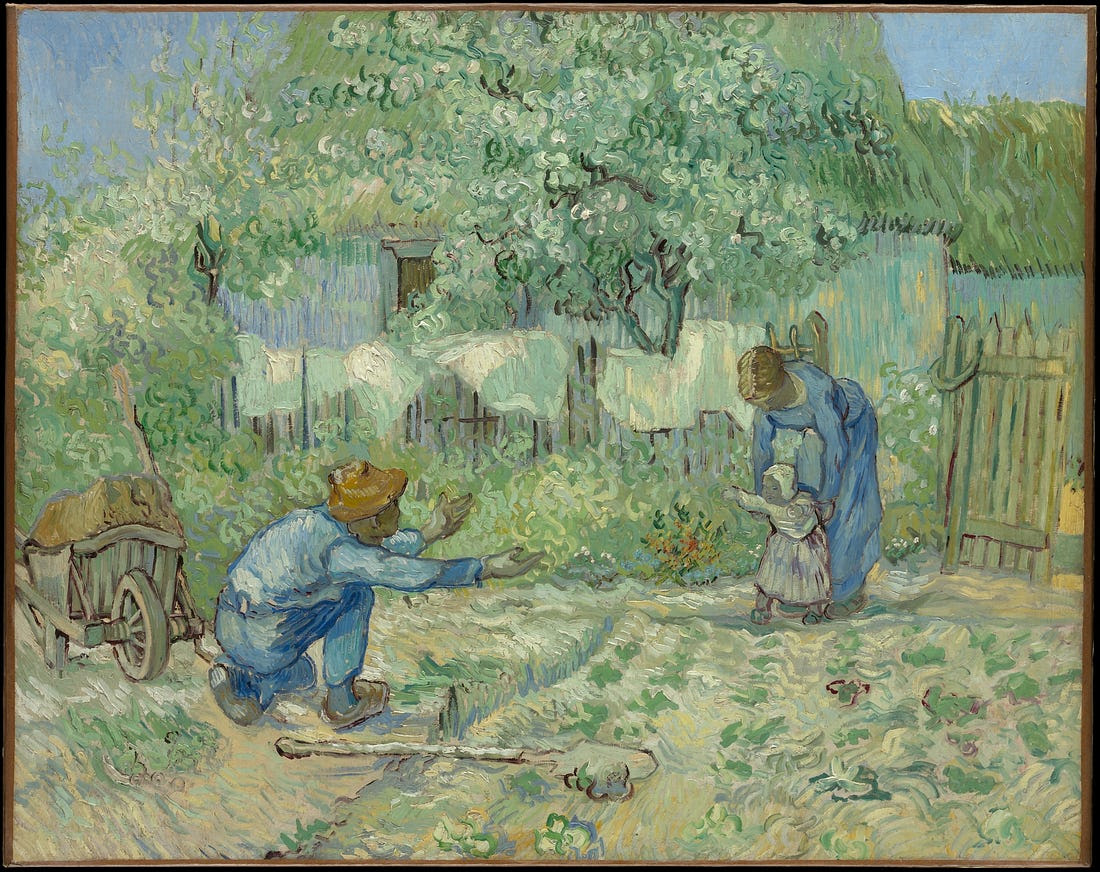
Oh, and for comparison, here’s another work credited to Van Gogh from the same alleged time period and body of work as Elimar. It’s owned by the Met, and I think it’s fair to guess that most people would consider it light years away from the painting LMI has put its reputation behind.
To be clear, I’m not arguing that the Van Gogh Museum is infallible when it comes to judging uncatalogued works allegedly by the hand of its namesake. LMI’s follow-up report rightly points out multiple instances in which the institution has reversed its past decisions on attribution. I’m just willing to bet that none of those cases involved works that look as fundamentally inept as Elimar.
2. Does Occam’s Razor slice up the origin story?
At the risk of being pedantic, Occam’s Razor is the name for the principle that the simplest answer to a problem is probably the right one. With that in mind, let’s review the two main hypotheses around the mysterious Elimar inscription.
LMI alleges that Van Gogh painted the name Elimar in the bottom-right corner of this portrait of a grizzled fisherman because the artist was a huge fan of Hans Christian Andersen, whose 1848 novel The Two Baronesses contains a secondary character named Elimar that, I can tell you courtesy of the search function in Google Books, ages from “a ship-boy” (as well as “the finest boy” and “the wisest child”) to a grown sailor over the course of the story. Although Van Gogh’s signature is absent from the canvas, the brushstrokes forming three of the letters in “Elimar” (the E, M, and A) allegedly look very similar to those in an acknowledged Van Gogh work from 1885, according to LMI’s experts.
LMI also argues that Elimar is one of Van Gogh’s “translations” of other art-historical works, all painted while he was hospitalized late in life and unable to work from nature. (These include First Steps (After Millet), the work in the Met’s collection that I included earlier.) The source material in this case is in all likelihood Portrait of Niels Gaihede, a depiction of a similar grizzled fisherman in a similar pose, made by the Danish painter Michael Ancher in the 1870s or 80s. Rather than title his version of this rugged old seafarer after Gaihede or Ancher, however, Van Gogh allegedly fanboyed out over Andersen and titled it after the character in The Two Baronesses.
Got all that?
Now, here is the alternate theory: that LMI’s painting was made by an unassuming Danish guy actually named Elimar, who signed his name in one of the main places artists tend to sign their names on things they’ve painted. It’s modeled after Portrait of Niels Gaihede, made by a fellow Dane, because painting after more famous works is something amateur artists do a lot.
That’s it. That’s the other theory.
To me, one of these sounds elegantly simple and tethered to reality, and the other sounds like it was either concocted by a nocturnal Reddit addict unwittingly suffering from an undiscovered gas leak in their apartment—or like it came from someone tying themselves in knots trying to reverse-engineer an illustrious pedigree for a painting that probably doesn’t have one.
3. Is it time to cut my losses?
This brings us to the latest turn in the saga: LMI’s acquisition and testing of an undated Henning Elimar painting the company has dubbed Bridge and Stream. Here’s what an LMI spokesperson told George Nelson at ARTnews about the move.
“Throughout the years-long research process of studying the painting [Elimar], LMI Group chased down any plausible lead or connection to ‘Elimar,’ part of the due diligence of the company’s approach to examining orphaned artworks,” LMI told ARTnews. “Because Henning Elimar painted in the mid-20th century, and the LMI Group’s Elimar painting is late 19th century, the team decided it did not warrant further study. However, after the Henning Elimar theory emerged on social media, and was surprisingly embraced by several scholars, LMI decided to pursue it. In one day, LMI was able to track down Bridge and Stream in northern Denmark and brought it back to New York for study, with their findings released this week. To protect the privacy of the seller of the Henning Elimar, we won’t be sharing their name.”
There’s a lot to unpack in this excerpt. First, if you’ve been researching a painting for multiple years and a theory that “emerged on social media” shortly after you began publicizing your find becomes a major threat to your credibility, it doesn’t speak super highly of the research. Second, it always, always, always looks awful to come out after something damaging appears to say, “Yeah, obviously we knew about that, but we just didn’t think it was worth bringing up.” Bro, your report was four hundred and fifty-eight pages.¹ You didn’t think you had space to pre-empt this counter-theory? Third, even though protecting the privacy of the seller is completely valid (and par for the course in the art market), cloaking their name only amplifies the perception that LMI has something to hide in this whole saga.
Having read the follow-up report on Bridge and Stream, I can tell you that most of its objections to classifying Elimar as a painting by Henning Elimar come down to one fundamental fallacy: that a Sunday painter should have the same consistency of technique and decision making as a professional artist. The study rules that the painting “bears no similarity to Elimar in size, technique, style, or subject matter.” Two of these four considerations are, frankly, silly. Most artists paint works of different sizes and subject matters all the time. In fact, LMI’s reports actually go to excruciating pains to make these points about Van Gogh himself!
This leaves us with the differences in technique and style between Elimar and Bridge and Stream. Again, Occam’s Razor is a real problem. Like, maybe work-to-work variations make a lot of sense in the context of someone who’s in the process of learning to paint?
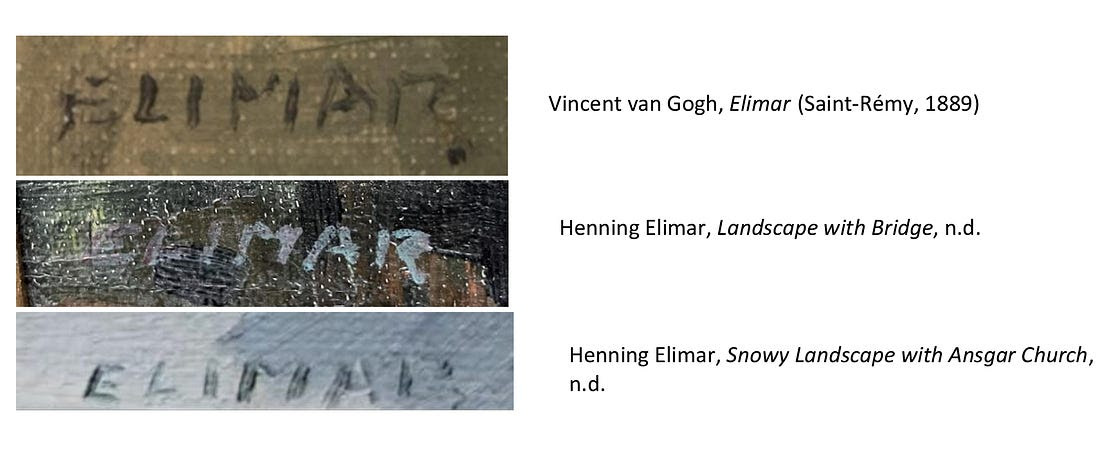
This extends to the contention that Elimar’s inscription and the signature on the latter painting are meaningfully different because they use different colors; one is painted “wet-on-wet” while the other is painted “wet-on-dry”; and the letters are tilted differently. If you’re wondering what they look like next to one another, here’s a composite of both, plus the signature on the other known Henning Elimar painting, Snowy Landscape with Ansgar Church, from LMI’s report:
Personally, LMI’s meticulous dismantling of Henning Elimar’s painting feels like they’re bullying a dead guy for having a hobby. It’s the kind of tack you might take if you’re trying to convince the world (and maybe yourself) that you haven’t spent multiple years chucking tens of thousands of dollars into a blast furnace along with your company’s reputation. But hey, that’s just me…
Sailing into port
I’ll admit that I don’t have answers for everything in LMI’s reports, especially when it comes to chemical analysis. For instance, I can’t rebut the firm’s contention that Elimar “includes none of the materials that science and the market would expect to see in the middle of the 20th century, when any or all of the (known) painters named ‘Elimar’ lived.” On the other hand, conspicuously absent from the follow-up report is any comparison at all between the materials used to paint Elimar and the materials used to paint Bridge and Stream, leaving open the possibility that the supposed temporal incongruences in one might be present in the other, too.
An omission like this circles us back to my overarching point: LMI’s unforced strategic errors have all but destroyed any chance the company had of getting Elimar attributed to Van Gogh. Worse, the rebuttal to its doubters has only made LMI look even less credible than it did after the initial gambit. This means the bar will be that much higher the next time the firm crusades for the legitimacy of a “rediscovered” artwork. But at least their miscalculations can teach the rest of us how to avoid embarrassing ourselves just as badly if we ever end up in a similar situation.
1In one of the more devastating drive-bys I’ve seen lately, Nelson’s story also mentions that Van der Ween, one of the Van Gogh scholars who volunteered the Henning Elimar theory, “told ARTnews that LMI’s findings were ‘full of conjectures, weird assumptions, and useless information.’”










180