Liquid BewitchmentGin Drinking in England, 1700–1850
The introduction of gin to England was a delirious and deleterious affair, as tipplers reported a range of effects: loss of reason, frenzy, madness, joy, and death. With the help of prints by George Cruikshank, William Hogarth, and others, James Brown enters the architecture of intoxication — dram shops, gin halls, barbershops — exploring the spaces that catered to pleasure or evil, depending who you asked.
PUBLISHED
September 13, 2023
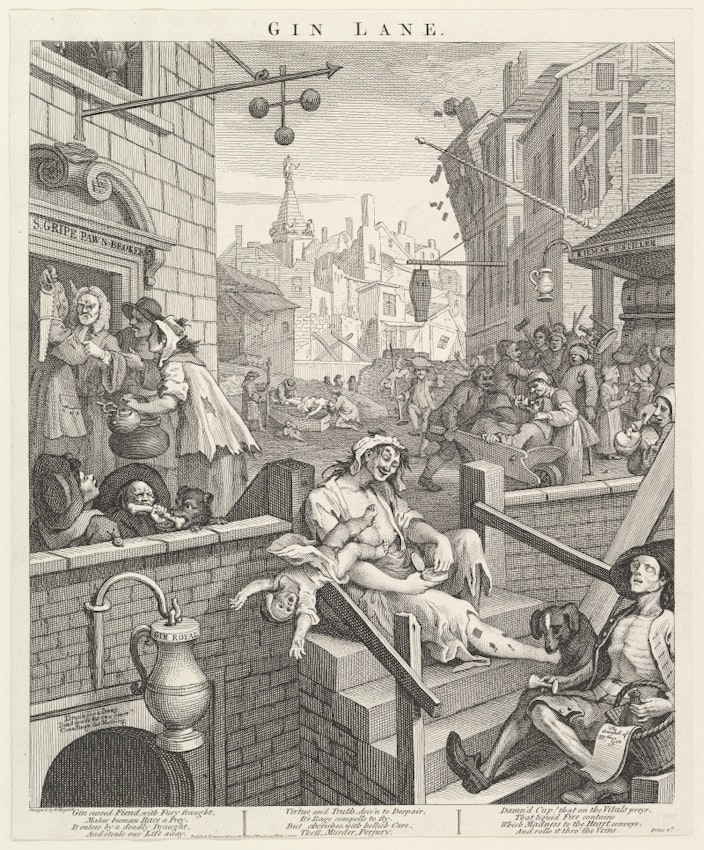
William Hogarth, Gin Lane, 1751 — Source.
In 1751, the engraver and satirist William Hogarth created Gin Lane, his celebrated visual retrospective about the devastating effects of this newfangled spirit on the lives of London’s poor. The print, a companion piece to Beer Street, offers a harrowing panorama of poverty, addiction, insanity, violence, infanticide, and suicide; the only people and institutions who thrive amongst the mayhem and despair are an undertaker, “Gripe” the pawnbroker, and the two purveyors of the “deadly draught”: a cellar gin shop and “Kilman” the distiller. In the words of Hogarth’s most recent biographer, Gin Lane’s “racked scene of dissolution . . . imprints itself indelibly on the mind”.1 Derivatives are beloved of political cartoonists, and so frequent and dependable is its appearance at academic conferences on alcohol history that a “gin lane klaxon” is scurrilously sounded on social media. However grotesquely transfixing the image, its dominance within both the history of alcohol and art has occluded a wider and subtler range of representations of gin and the environments in which it was consumed, which flourished across the eighteenth and nineteenth centuries.2
Gin was one of a wide range of new intoxicants — including chocolate, coffee, opium, sugar, tea, and tobacco — that, in what has been called a “psychoactive revolution”, radically expanded the mind-altering possibilities for European people between 1600 and 1800.3 Spirits (mainly aqua vitae, a rough distillation of wine) had been manufactured in English monasteries, private homes, and apothecary’s shops since the late medieval period, although they were prohibitively expensive and generally consumed medicinally and in small quantities. Brandy, rum, whisky, and especially gin exploded the spirituous marketplace from the later decades of the seventeenth century, with various factors — including grain surpluses, restrictions on French imports, a relaxation of the monopoly on distilling, and increased duties on ale and beer — making gin’s rise particularly meteoric. Originally imported from the Netherlands as genever, by the 1690s gin was produced on an industrial scale by domestic malt distillers, who sold their wholesale product to a network of smaller compound producers. These producers then “rectified” it with a variety of botanical additives, including juniper berries, coriander seeds, orange peel, angelica root, liquorice powder, and turpentine. By 1725, according to the Cumbria distiller George Smith, gin had “gain’d such universal applause, especially with the common people . . . there is more of it in quantity sold daily in a great many distillers shops, than of beer and ale vended in most publick houses”.4
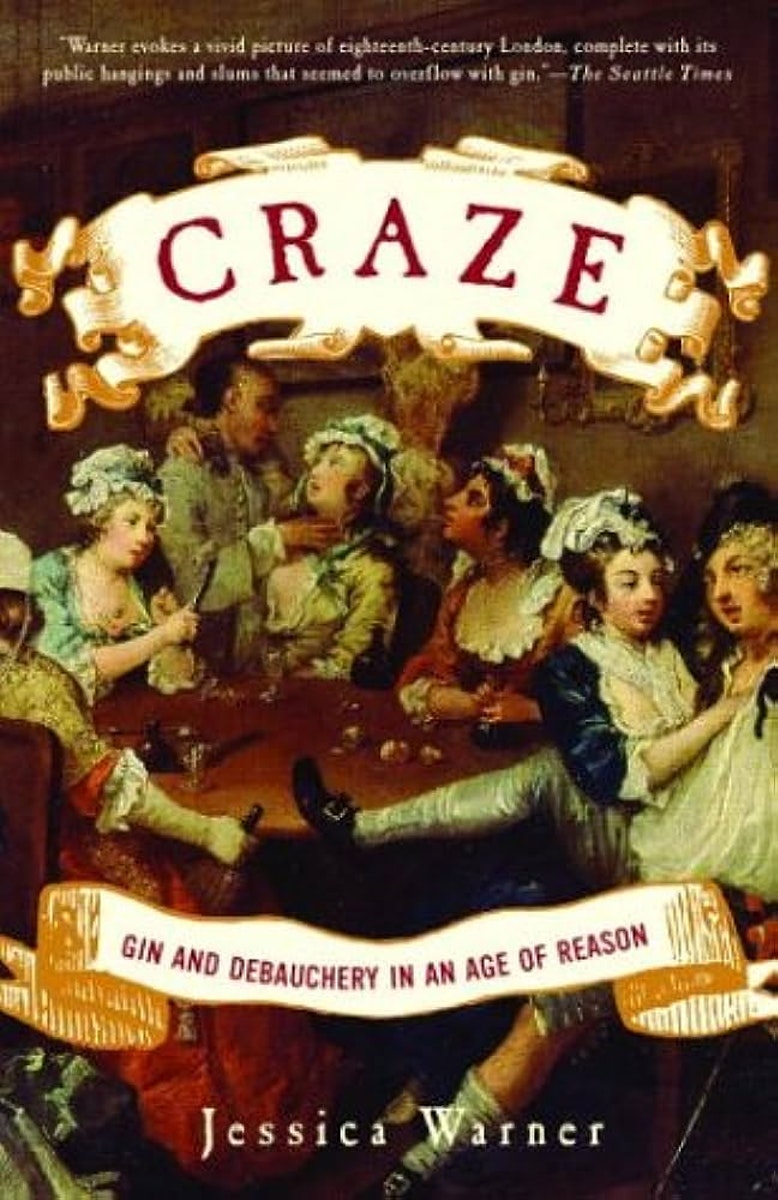
The resulting beverage was orders of magnitude stronger than the traditional alcohols that had hitherto dominated recreation and diets (ales, beers, ciders, and wines), and represented a step change in England’s cultures of intoxication; Jessica Warner has gone so far as to term it “the first modern drug”.5 Put simply, gin hit early modern drinkers differently, offering “not a gradual descent into inebriation” (in James Nicholls’s phrase) but instantaneous and extreme drunkenness.6 From this potency stemmed a range of unusual and frightening side-effects, widely rehearsed by eighteenth-century commentators, including immorality, criminality, madness, compulsive intoxication, and death. As one anonymous 1736 author observed, “by taking a small quantity people were almost in an instant rendered so much intoxicated as to lose the use of their reason, and all command over themselves”, and were “induced to commit the most wicked or extravagant enormities”.7 Likewise, in her 1750 treatise aimed at female gin drinkers, Eliza Haywood warned that whereas conventional beverages made their consumers “sullen, sleepy, or extravagantly gay”, gin made them “bold, obstinate, and filled with an extravagant desire of doing mischief . . . we may say that dram-drinking is the most expeditious way to deprive mankind of their reason . . . by substituting a temporary, and in time a constant frenzy in its stead”.8 The following year, another anonymous writer agreed that “[i]ts baneful influence reaches their [consumers’] very souls; every virtuous principle is eradicated and destroyed”. Moreover, “once they have habituated themselves to drinking drams, they are never satisfied but while the glass is at their noses”.9 A recurring contemporary metaphor for gin’s peculiar physical and psychological effects was bewitchment, the subjugation of normal human will and faculties to an insidious supernatural force.
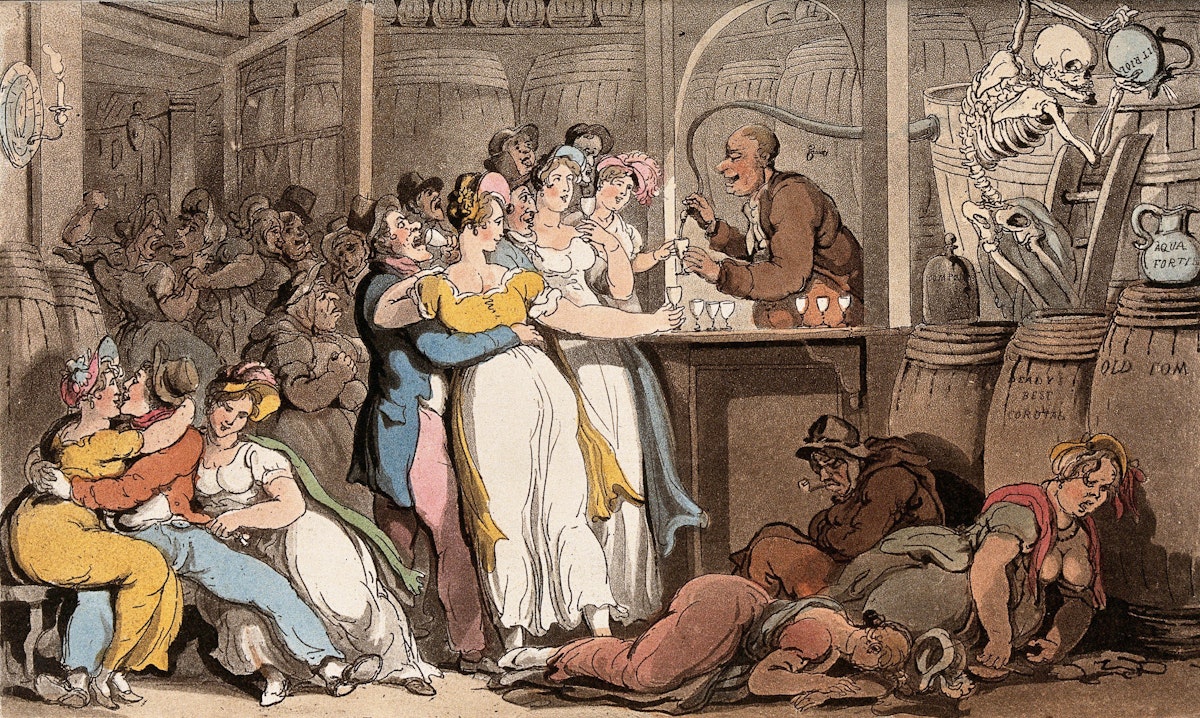
Coloured 1816 aquatint after Thomas Rowlandson titled The Dance of Death: The Dram Shop — Source.
Like other novel intoxicants, gin created an entirely new species of urban space organised around its sale and consumption . As cocoa spawned the chocolate house, coffee the coffeehouse, opium the opium den, and tea the tearoom and tea garden, so gin brought into being the gin or dram shop.10 Described variously by contemporaries as “receptacles for wretches”, “seminaries of mischief”, or “the nurseries of all . . . vice and wickedness”, these unfamiliar environments were mainly a metropolitan phenomenon, and proliferated from the early decades of the eighteenth century. A committee of Middlesex justices convened in 1726 estimated there to be six thousand gin shops in that outlying London county alone, a ratio of up to one in five houses in some parishes.11 As the below mezzotint intimates, gin shops were far more rudimentary than the traditional inns, taverns, and alehouses that had hitherto made up England’s victualling hierarchy, and which, by the Hanoverian period, had become increasingly sophisticated and regulated under licensing laws. All that was needed to begin trading was a supply of the “pestiferous draught” (either distilled on the premises or acquired from a boutique manufacturer). Chairs and tables in these shops were kept deliberately sparse to encourage off-sales as well as “perpendicular drinking”, both guaranteeing rapid churn of a predominantly poor clientele who lacked the funds for lengthy on-site drinking sessions.12
One spatial innovation of the gin shop was the counter or bar, an appropriation from the burgeoning retail sector. Despite conventional wisdom, these were not a feature of established drinking places, in which alcohol was ferried directly from cellars or storage rooms to customers in halls, parlours, and chambers via a battalion of hosts, drawers, pot boys, and tapsters. As the architectural historian Mark Girouard has noted, the counter was a revolutionary “time-and-motion breakthrough” that made for much more rapid and efficient service; it conferred the additional advantages of separating servers from customers, providing a surface for measuring and pouring drinks, and forming a barrier behind which drink, serving vessels, and takings could be securely stored.13
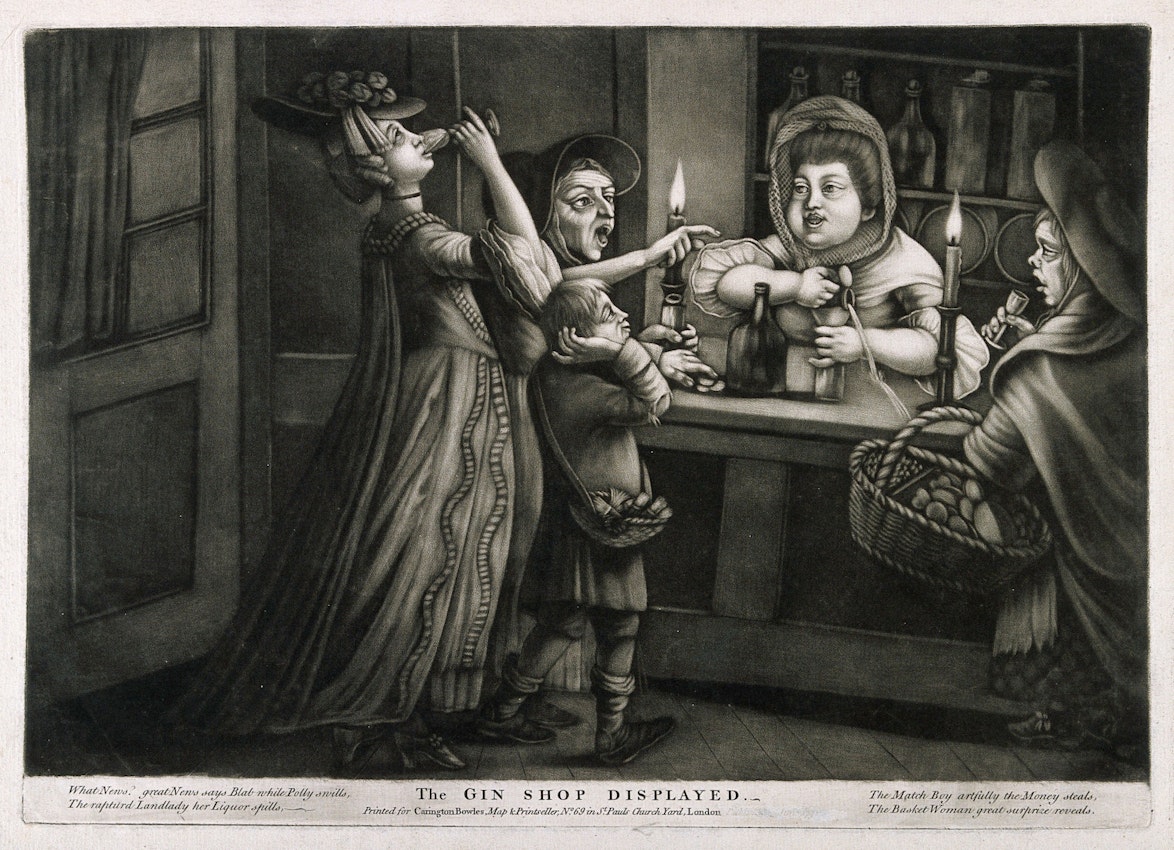
Anonymous mezzotint titled The Gin Shop Displayed, ca. 1765 — Source.
As well as being vended and enjoyed within these specialised settings, gin was a promiscuous and ubiquitous substance that insinuated itself into a variety of preexisting sites and spaces. As suggested by the barmaid missing the pour in the mezzotint above, gin proved impossible to contain.14 The “maddening drench” was incorporated into the repertoires of traditional innholders, taverners, and alehouse-keepers, especially in the provinces, and — mainly because retailers who traded primarily in commodities other than alcohol could sell gin without licence or scrutiny — was sold extensively in coffeehouses, chandleries, groceries, cookshops, pawnbroker’s premises, and tobacconists. Because takeaways and off-sales comprised an important part of the business of dram shops, gin was widely consumed in homes and private residences — such as by the sex worker and sailor in the mezzotint and etching below — and it could even be enjoyed with a haircut or shave. Etchings of gin served in barbershops (like this one) offer a visual counterpoint to the deceased barber in Hogarth’s Gin Lane, who has been driven to the end of a noose by bankruptcy brought on by a lack of business from his bedraggled and gin-addled clientele.
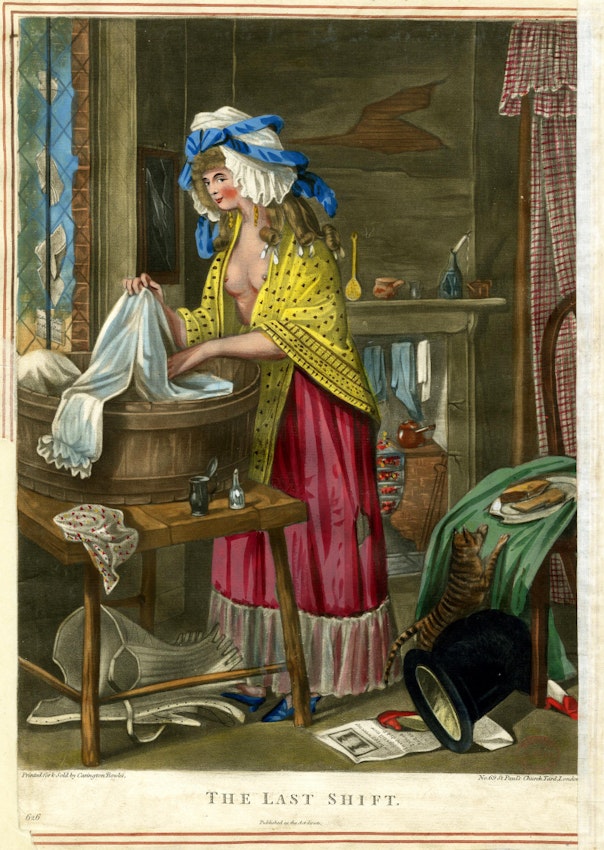
Hand-coloured mezzotint titled The Last Shift, ca. 1792, which depicts a sex worker in her chamber. A small gin tankard is visible next to the washtub — Source.
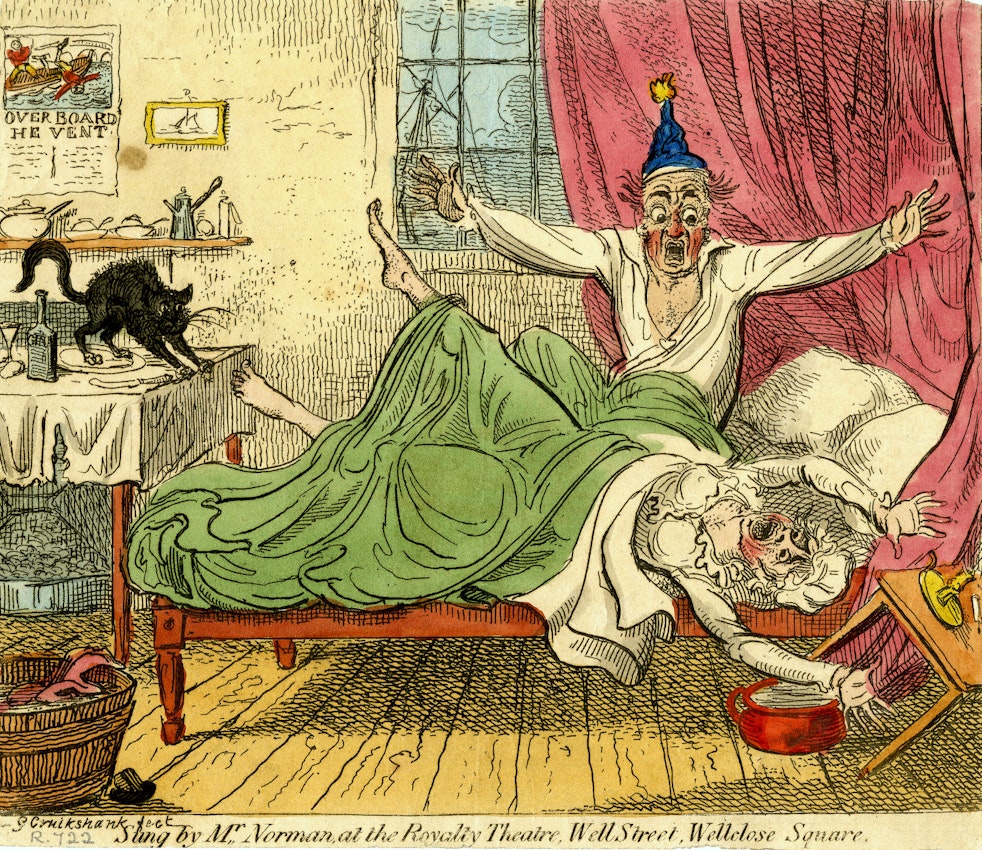
George Cruikshank, Mrs Topper’s Dream, ca. 1812. In this hand-coloured etching depicting a sailor and his wife in bed, as well as coffee and tea paraphernalia, a small bottle of gin can be seen on the table — Source.
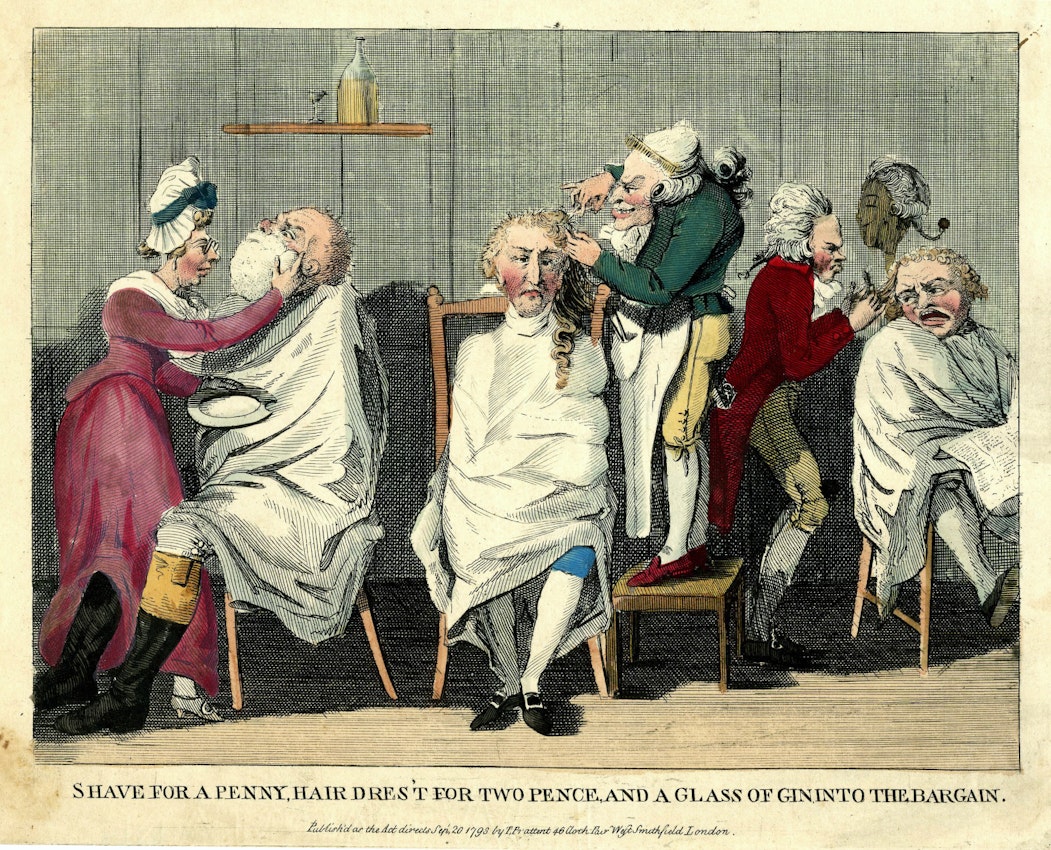
Hand-coloured 1793 etching, whose caption reads “Shave For a Penny, Hair Dres't for Two Pence, and a Glass of Gin Into the Bargain” — Source.
Like tea and saloop (a hot Ottoman drink made from powdered orchid roots), the “infernal combustible” also found itself outside in the open air; indeed, Gin Lane is a nightmarish vision of alfresco consumption. As well as being sold in dedicated shops, gin was retailed from sheds, stalls, and lean-tos in “holes and by-alleys”, was enjoyed on thoroughfares, and — like other comestibles throughout the period — was hawked on the street by mobile vendors, especially during mass entertainments such as executions.15 The best-known depiction of this practice is Hogarth’s The Idle ‘Prentice Executed at Tyburn, which features a street retailer slinging gin from a wagon at a public hanging, although a lesser-known glimpse is provided by James Gillray’s 1795 etching Copenhagen House, which shows a hawker plying gin at a crowded and raucous meeting of the London Corresponding Society. Like coffee, gin was also sold from temporary or “pop-up” venues in parks and during fairs. Frost fairs were a regular occurrence whenever the Thames froze over, and during the 1814 freeze, gin was being sold from marquees called the “Orange Boven” and the “City of Moscow”, the latter topped with a life-size effigy of the Duke of Wellington.
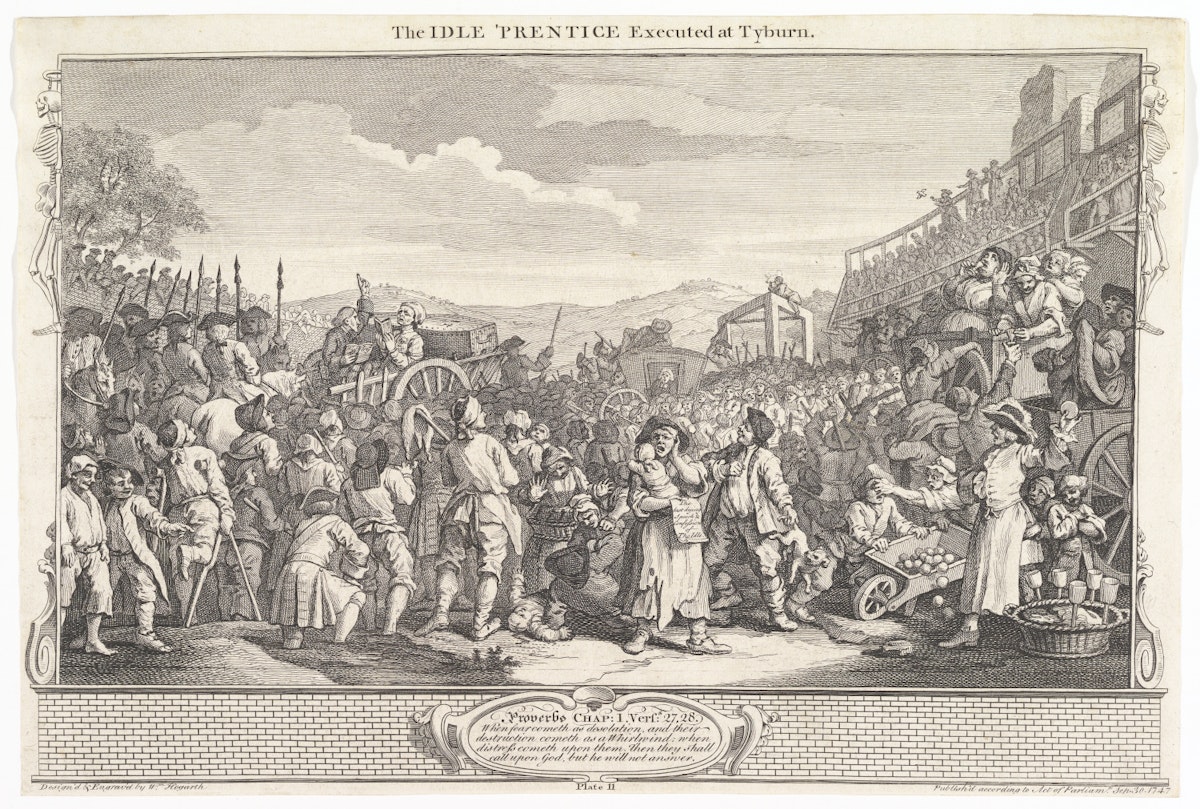
William Hogarth, The Idle 'Prentice Executed at Tyburn, 1747. At the right of this engraving, a street seller dispenses glasses of gin from a cart — Source.
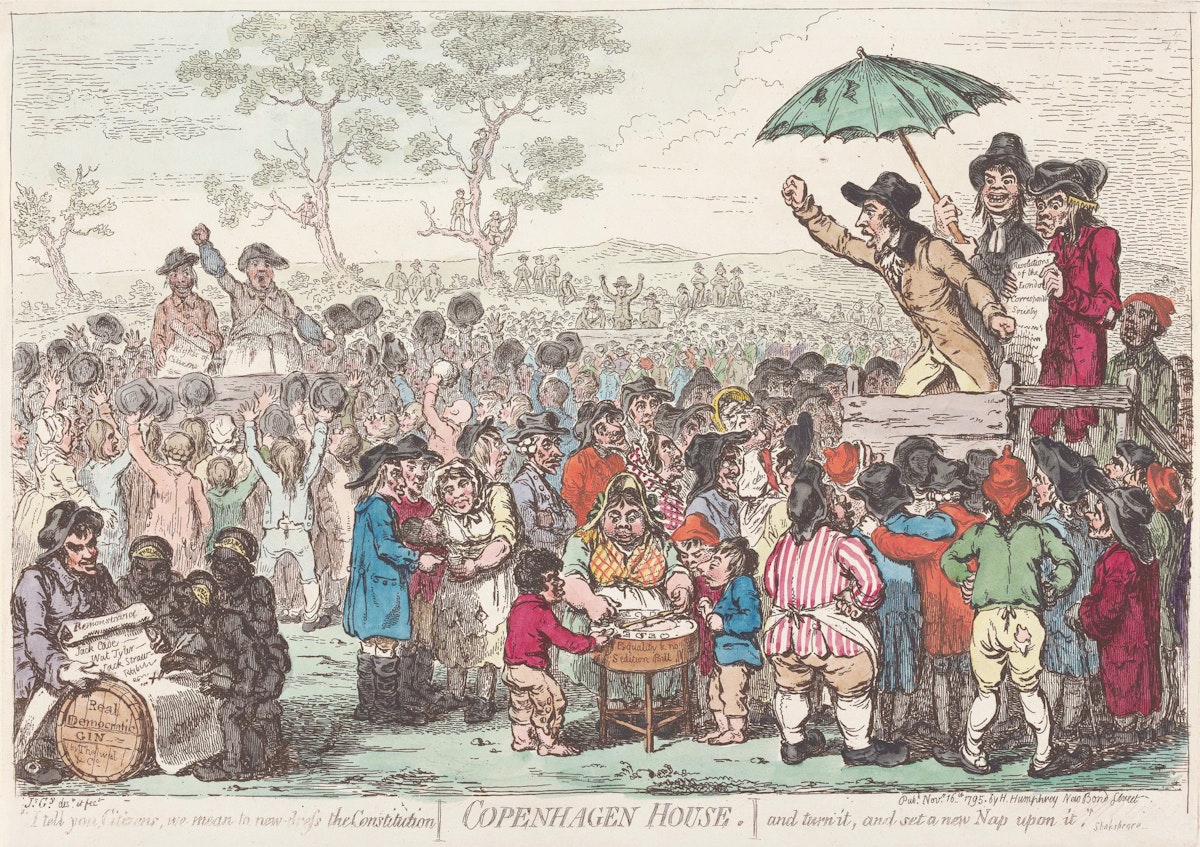
James Gillray, Copenhagen House, 1795. In the left-centre foreground of this hand-coloured etching, a female retailer in a headscarf sells gin at a meeting of the London Corresponding Society, a debating society that advocated for the democratic reform of parliament, inspired by the French Revolution. On the far left, three chimney sweeps, whose brass caps bear the names of their masters, add their own names to a list of well-known political rebels. The gin barrel upon which they sign reads: “Real Democratic Gin by Thelwall & Co.”, a reference to John Thelwall, the radical journalist and political reformer who co-founded the Society. The association with gin here is probably due to its low cost and ready availability to the poor, making it a democratic and accessible form of intoxication — Source.
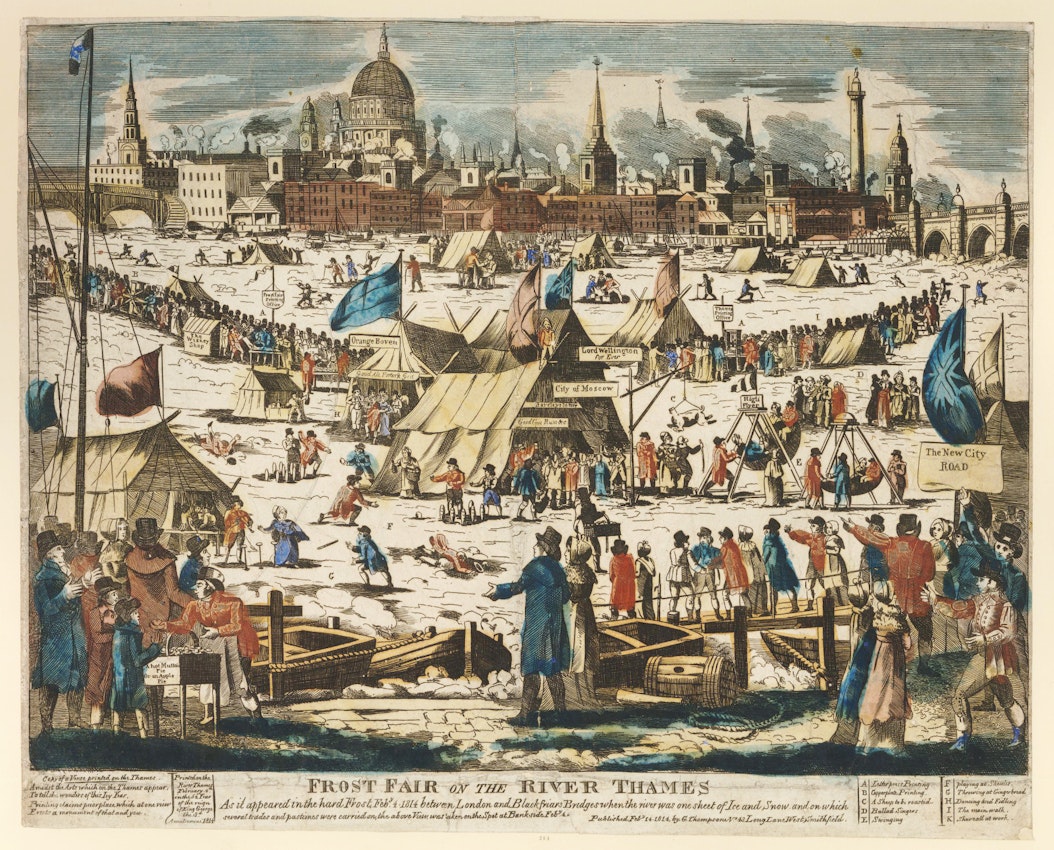
Hand-coloured 1814 woodcut titled Frost Fair on the River Thames. In the centre, gin is being retailed from two temporary tents — Source (CC BY-NC-SA 4.0).
A raft of increasingly effective central government legislation between 1729 and 1751 led to a steady decline in gin drinking and its associated sites and spaces over the later decades of the eighteenth century, although the “diabolical liquor” received a second wind in the early nineteenth century, when reductions in duties engendered a resurgence of consumption and another innovative breed of space: the gin palace. Appearing from the 1820s, and experiencing their heyday the following decade (when the term was coined), these sumptuous locales were characterised by a number of architectural novelties that were again borrowed from the retail sector: the ever-present counter, but now also large glass frontages punctuated by columns or pilasters, rococo detailing and enrichments, gas lighting internally and externally, outsized vats containing gins of various stripes, and extensive textual inscription. The latter underscored long-standing associations between intoxicating spaces and textuality (drinking houses and coffeehouses were key settings for the circulation and consumption of books, newspapers, and other printed materials), and, as we will see below, the extensiveness of labels and legends in gin palaces proved something of a gift for caricaturists. Charles Dickens described a typical gin palace in 1836:
All is light and brilliancy. The hum of many voices issues from that splendid gin-shop which forms the commencement of the two streets opposite; and the gay building with the fantastically ornamented parapet, the illuminated clock, the plate-glass windows surrounded by stucco rosettes, and its profusion of gas-lights in richly-gilt burners, is perfectly dazzling when contrasted with the darkness and dirt we have just left. The interior is even gayer than the exterior. A bar of French-polished mahogany, elegantly carved, extends the whole width of the place; and there are two side-aisles of great casks, painted green and gold, enclosed within a light brass rail, and bearing such inscriptions, as ‘Old Tom, 549’; ‘Young Tom, 360’; ‘Samson, 1421’ – the figures agreeing, we presume, with ‘gallons’, understood. Beyond the bar is a lofty and spacious saloon, full of the same enticing vessels, with a gallery running round it, equally well furnished.16
At the same time as gin was regaining momentum within these deluxe new venues, an organised temperance movement was starting to take shape. Spearheaded by coffee retailers, doctors, evangelicals, and industrialists, and animated by a fervent belief in the deleterious economic, medical, moral, and social effects of alcohol in general and spirits in particular, temperance societies campaigned vigorously against recreational drinking and ultimately for total abstention. This reforming imagination was fundamentally spatial; if, as Brian Harrison notes, their “vision of recreation [was] centred on the home” (and on the sobering intoxicant of tea), then the newfangled gin palace served as both symptom of and metonym for the corroding evils of alcohol.17 And as well as mobilising pamphlets, maps, and songs, temperance reformers also made their case through the medium of images.18
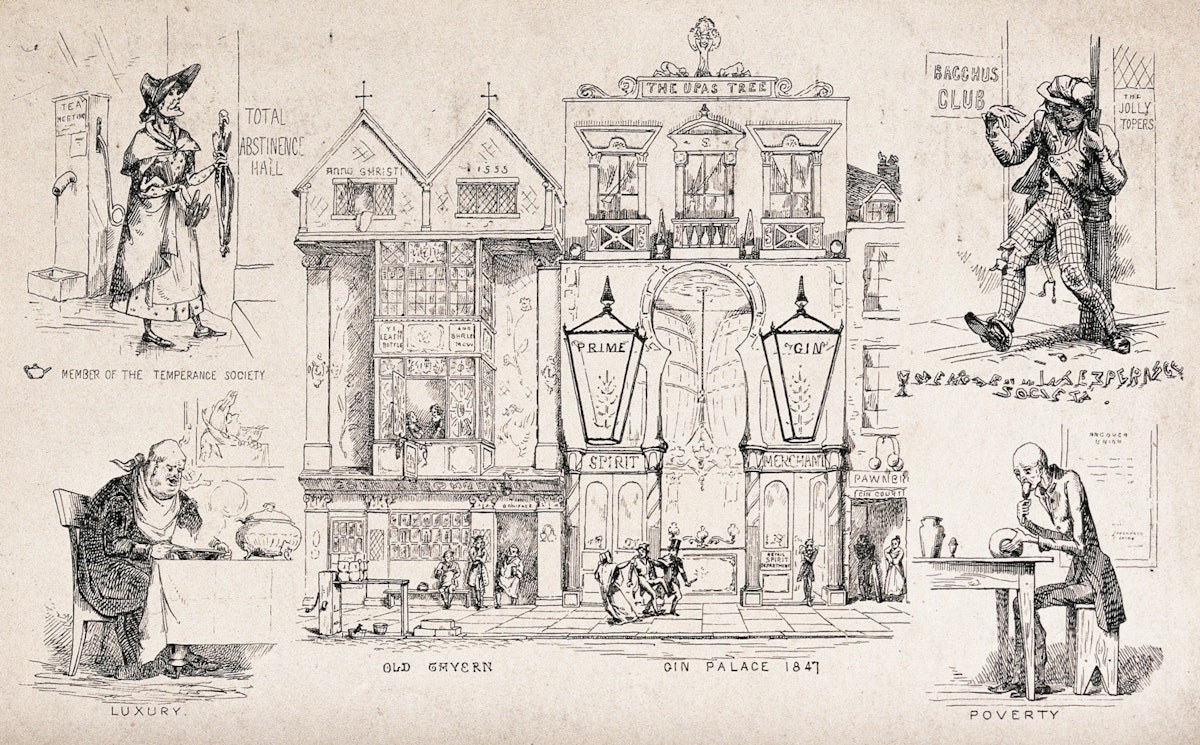
An 1847 print by Luke Limner comparing a traditional tavern with a modern gin palace — Source.
At the vanguard of this visual and spatial temperance strategy was the graphic satirist George Cruikshank. London born and bred, and (like his near-contemporaries James Gillray and Thomas Rowlandson) an inheritor of the visual tradition of Hogarth, Cruikshank was a prolific and successful commercial cartoonist who produced more than six thousand commissions for books, magazines, and pamphlets over the course of his long career. Gin and its palaces featured heavily in the vigorous and immersive scenes of London life in which he specialised. Earlier designs, such as the ones he created for Dickens’ Sketches by Boz (from which the above description is drawn) and Pierce Egan’s picaresque 1821 bestseller Life in London, are broadly benign and affectionate; the premises are attractive, and the customers for the most part convivial, healthy, and respectable. This probably reflects the central and positive role that drinking and gin palaces played in Cruikshank’s own life during this period. While he seems not to have suffered from addictive or pathological drinking, like most nineteenth-century creatives he was a habitual and excessive consumer of alcohol well-known for his love of company-keeping and public sociability.
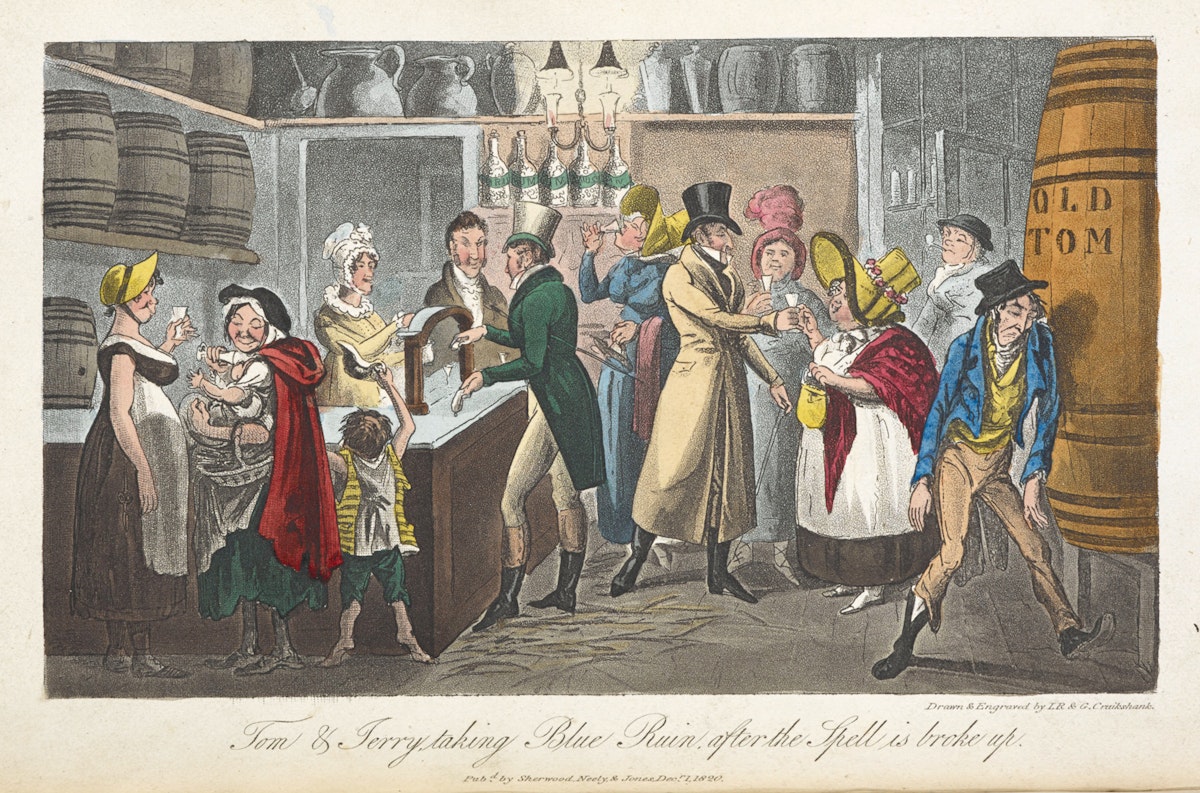
Illustration by George Cruikshank from Pierce Egan’s Life in London, ca. 1820, which depicts protagonists Tom and Jerry in a gin palace — Source.
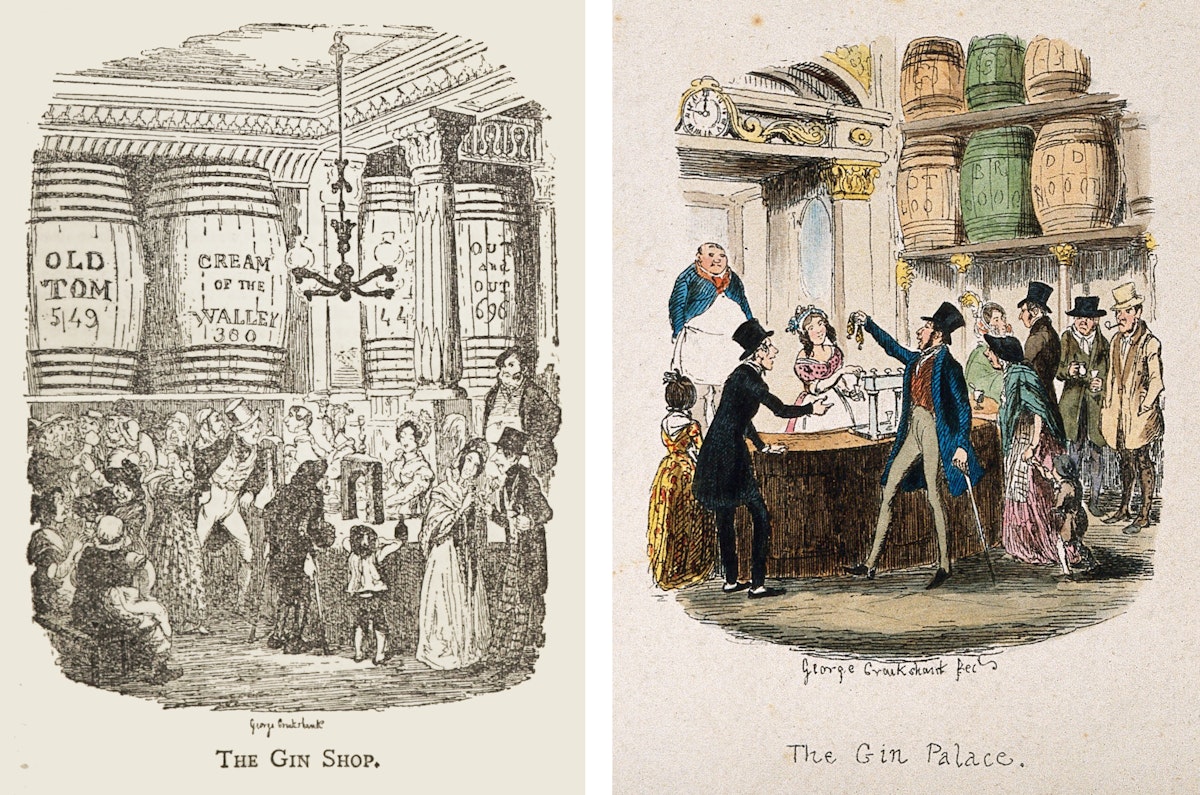
Cruikshank had a dramatic change of science in 1847 when, at the age of fifty-five, he enthusiastically embraced teetotalism. His decision might have been in response to the negative health consequences that he was starting to experience, and was probably also informed by the fate of his father, the illustrator Isaac Cruikshank, a full-blown dipsomaniac who reputedly died of alcohol poisoning at forty-six after winning a drinking competition.19 Whatever his motivations, from the moment of his conversion Cruikshank developed what Richard Vogler has termed “an evangelical preoccupation with the evils of alcohol”, supporting and supplying illustrations for the National Temperance Society, and developing particular disdain for gin and gin palaces, which are reconfigured in his later work.20 In his best-known series The Bottle (1847), which charts domestic and familial disintegration over eight glyphograph plates, “creaming gin” (that “strong cordial”) infiltrates and causes chaos and heartbreak within the home, while the opening plate of his more ambitious, spatially expansive, and compelling follow-up series The Drunkard’s Children (1848) is set within a gin palace. The adult daughter of the alcoholic is framed at the centre of “that fountain which nourishes every species of crime”; she is approached by a shawled procuress, and surrounded by a ragtag clientele that includes imbibing children and babies and an inebriated disabled man. All are dwarfed by giant barrels bearing the ironic legends “Cream of the Valley” and the “Celebrated Double Gin”. Other portrayals from this era depict hopeless and helpless drunkards spilling and stumbling from gin palace frontages.
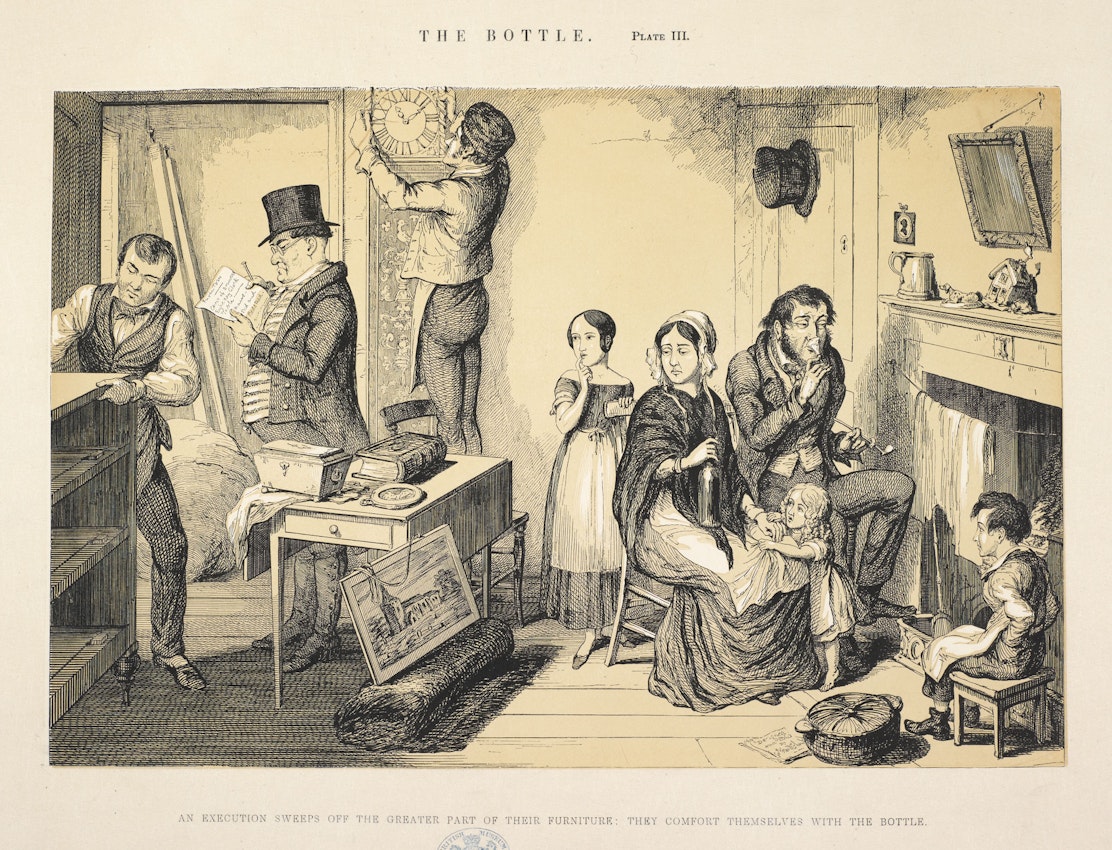
In the third plate of The Bottle by George Cruikshank, 1847, the doomed family console themselves with gin while bailiffs remove their furniture. Things get progressively worse over five subsequent plates — Source.
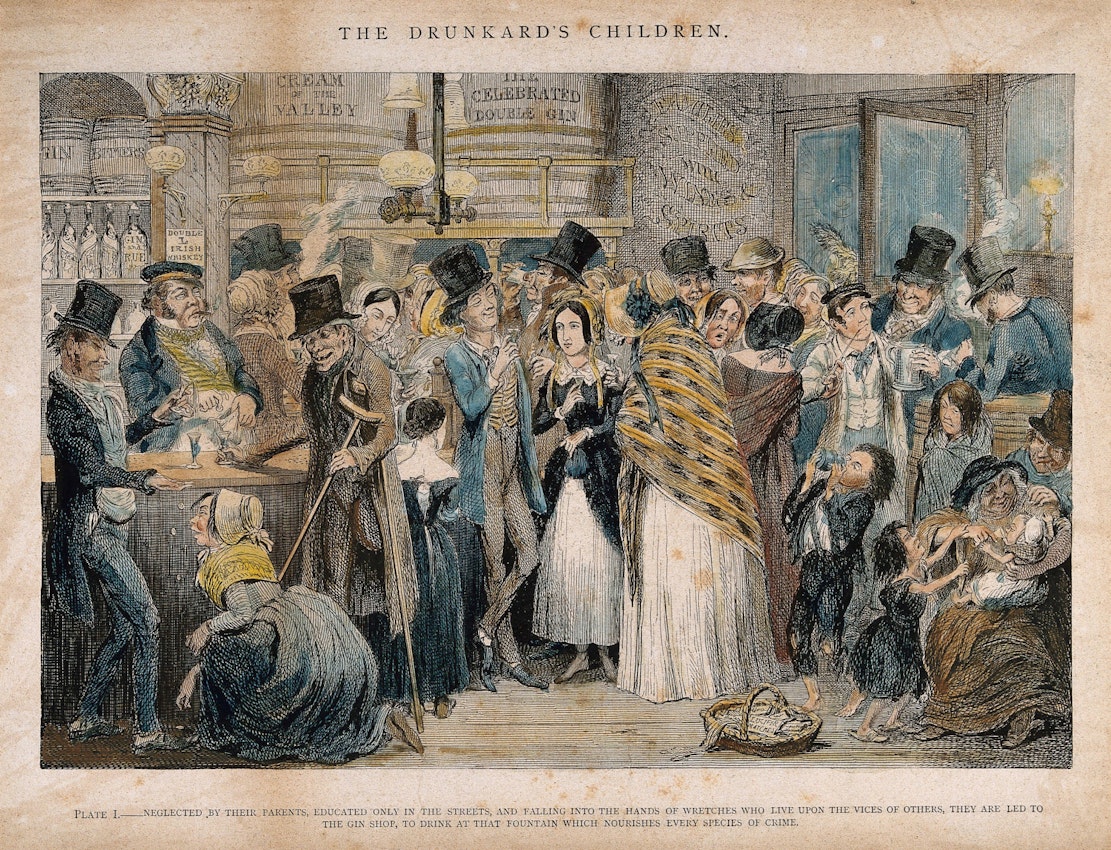
In the opening plate of George Cruikshank’s The Drunkard’s Children, 1848, the ill-fated offspring are depicted in a gin palace — Source.
Challenging received notions of a linear intellectual and artistic trajectory from valorisation to demonisation, Cruikshank’s most striking negative depiction of a gin palace, entitled The Gin Shop, dates from 1829, nearly twenty years before his renunciation of alcohol. Here, prefiguring his later anxieties, he imagines the gin palace as a macabre and treacherous space of death, albeit within a comic rather than social realist idiom. The etching depicts another doomed family huddled in the jaws of a literal gin-trap, encircled by morbid motifs. The gin barrels are styled as coffins, they are served by a skeleton disguised as a barkeep, and they menaced by a second skeleton holding an hourglass and spear. Like gin palaces themselves, Cruikshank characteristically deploys captions, speech bubbles, signs, and other textual devices to drive home his message. The gins are named “Kill Devil”, “Blue Ruin”, and “Deady’s Cordial”, signs point to and portend the “workhouse”, “madhouse”, “gaol”, and “gibbet”, and the skeleton grimly predicts “they have nearly had their last glass”. In a revealing double entendre, underscoring the association between gin’s pernicious effects and the malign supernatural, the “spirit vaults” contain imps dancing around a cauldron chanting an incantation.
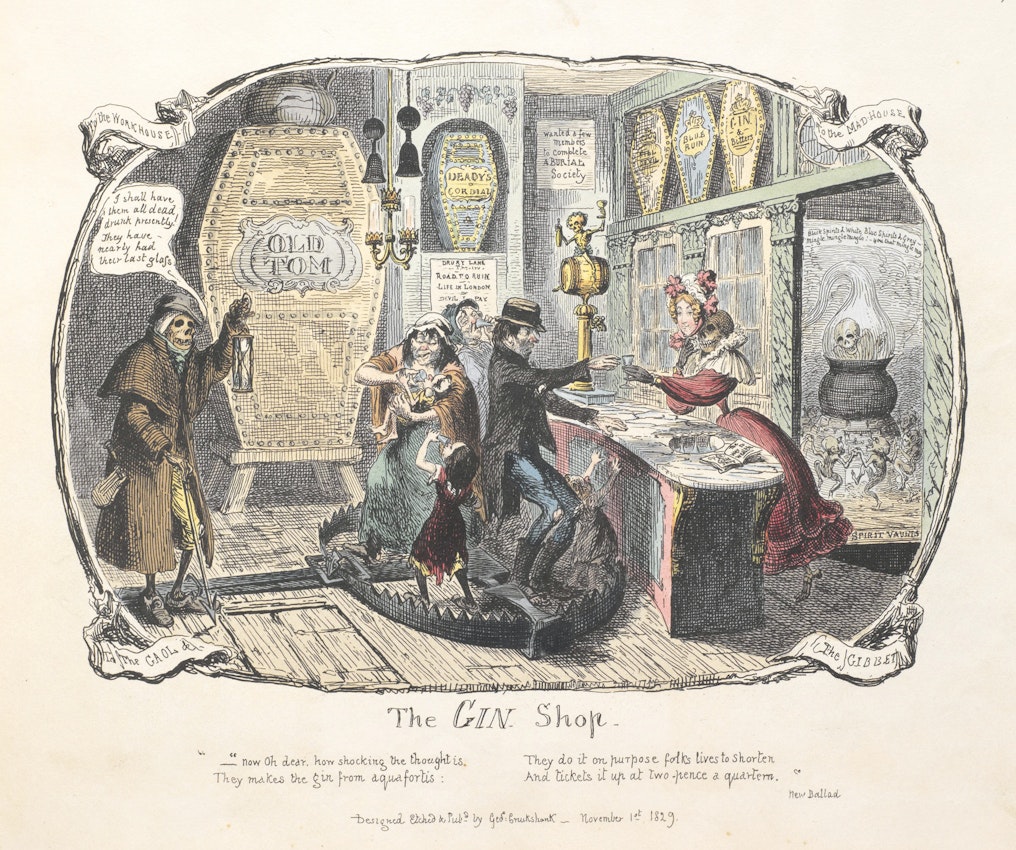
George Cruikshank, The Gin Shop, 1829 — Source.