Monday, August 5, 2019

The complex case of Rui Pinto


The complex case of Rui Pinto

William Bourdon. Courtesy photo.
IN 2016, A MAN WHO CALLED HIMSELF JOHN gave Der Spiegel, a German news magazine, 1.9 terabytes of data, or the equivalent of 500,000 Bibles. The cache included emails, contracts, and other documents that exposed unsavory behavior among the elites of global soccer, the biggest sport in the world and a religion in Germany. 
In the two years that followed, John gave Der Spiegel at least two more terabytes of data: according to The New Yorker, the total haul was almost double the (already massive) leak of documents from an offshore tax firm, in 2016, which prompted the Panama Papers exposé. Der Spiegel shared data with news organizations across Europe so that they could report from it, too; collectively, they published hundreds of articles.
The stories that emerged from John’s data are known, collectively, as “Football Leaks.” They have revealed tax dodging, extortionate agents’ fees, match-fixing, ethnic profiling, and—in one case—a rape allegation against Cristiano Ronaldo, arguably the world’s most famous player. The impact has been explosive, especially in Europe. (In the US, reaction has been more muted.)
But only a handful of people knew who the source actually was. In September 2018, that changed. A Portuguese magazine identified John as Rui Pinto, a 30-year-old Portuguese man living in Hungary. (Pinto maintains that he isn’t the only person behind Football Leaks, but no one else has come forward.)
Pinto’s lawyers confirmed his identity in January. Hungary had just arrested him, and Portugal wanted to extradite him to face charges related to Football Leaks. His lawyers argued that Pinto was a whistleblower, and therefore entitled to protection under Hungarian and European laws. That argument fell on deaf ears. In March, a Hungarian court told Pinto he would be extradited. A few weeks later, he was back on Portuguese soil—in jail.
Pinto is just one leaker to have made headlines in recent months. In the US, Chelsea Manning was sent back to jail (twice) for refusing to testify to a grand jury investigating Julian Assange, the WikiLeaks founder whose seven-year refuge in Ecuador’s London embassy came to an end in April. The Justice Department has indicted Assange under the Espionage Act; it used the same law to go after Daniel Hale, a former intelligence analyst charged with leaking secrets about America’s use of drones, apparently to The Intercept. A number of whistleblowers currently face jail time in Australia, where authorities recently raided a newsroom and a journalist’s home over stories based on leaks. In France, prosecutors subpoenaed journalists from an investigative website and pressed them to reveal the source for a story about the use of French-made weapons in Yemen. In Israel, a former Israel Defense Forces staffer named Anat Kamm went to prison after leaking state secrets; she recently accused the newspaper Haaretzof complicity in the government investigation. 
Sign up for CJR's daily email
Such leaks often have shorthand names—the Panama Papers, the Paradise Papers, WikiLeaks, the NSA Files, Swiss Leaks, Lux Leaks, Football Leaks—and have led to transformative inquiries, resignations, and policy reform. Collectively, they have profoundly changed our understanding of the architecture of global tax evasion (individual and corporate); the surveillance state; war crimes; diplomatic maneuverings; and more.
But this new breed of vast, computerized data drop, which elucidates big, global problems, is something that both journalism and the law have struggled to cope with. Often, it is the leakers themselves who suffer, as their cases grind through courts in their home countries, or wherever they happen to get caught in an improvised international web of law and enforcement. 
To the extent we get to know people like Pinto, we’re encouraged—often by the powerful people they exposed—to view them as morally compromised; as traitors, thieves, criminals. Their reputations and freedom often depend on the application of outdated laws, designed for an analog world. 
A US–based support network, a top French lawyer, and European lawmakers are among those who are currently working to change that. Pinto is one of their top priorities. And his story reveals, in its vast complexity, the broader issues journalists, governments, and the global super-rich face in dealing with the people who expose their secrets. 

IN 2018, GILLES RAYMOND, a French philanthropist, in partnership with others, started The Signals Network, a foundation that aims to provide psychological, legal, and logistical support to what it terms whistleblowers worldwide. The group currently supports a half dozen, including Pinto. “Most of the time, when you think of a whistleblower, you might think of a sad geek who destroyed his life. It should not be that image,” Delphine Halgand-Mishra, the group’s executive director, says. “You can think of whistleblowers as more a power movement, like the #MeToo movement.”
The term “whistleblower” is more heroic than “leaker,” which has pejorative overtones. (The French language does not make a distinction in the same way; it uses the phrase lanceur d’alerte, which translates as one who raises the alarm, to mean “whistleblower.” There isn’t a commonly-used shorthand for “leaker.”) The former implies the valiant exposure of wrongdoing; the latter does not. Leaks, of course, aren’t always benevolent—the recent publication of cables in which Britain’s ambassador to the US criticized the Trump administration, for example, was controversial and clearly political. (He resigned nonetheless.) Sometimes “leaked” information—such as the Democratic Party emails hacked by Russia and published by WikiLeaks ahead of the 2016 US presidential election—has been maliciously stolen, and weaponized to serve an agenda.
Pinto occupies a complicated place in this nexus. He has said he has insider sources. But Doyen Sports Investments—a Kazakh-backed firm involved in soccer transfers whose documents underpin parts of Football Leaks—and the leading Portuguese soccer club Sporting Lisbon have accused Pinto of hacking them. Portugal has charged Pinto with “illegally accessing information,” and with attempting to extract cash from Doyen to conceal the documents he’d obtained from them. Pinto claims he was merely trying to verify the documents, and never intended to cut a deal. Nonetheless, Sam Knight, in a recent profile of Pinto for The New Yorker, wrote that “As soon as Football Leaks appeared, it had the air of an illicit enterprise.” When Knight suggested to Pinto that his “sources” don’t actually exist, Pinto smiled and said that would be a “plot twist.”  
Pinto has also been charged with “violation of secrecy.” That’s troubling: however he got the Football Leaks documents, it’s undeniable that the information they contain has been highly valuable. It’s not just soccer fans who think so: authorities in several European countries have sought Pinto’s cooperation as they investigate the material in the Football Leaks stories. French prosecutors invited Pinto to help them even before his identity was made public; they had even been prepared to enrol him in a witness-protection scheme. According to Le Monde, Pinto passed them 12 million files. State agencies in Germany and Belgium have also been in contact with him. In mid-July, Spanish authorities started investigating Doyen for money laundering and tax fraud. 
But in Portugal the strength of the soccer industry and the sport’s popularity make prosecuting Pinto more attractive than working with him, according to some of his supporters. “Football is the opium of the people in Portugal,” Ana Gomes, a high-profile Portuguese socialist politician who recently stepped down from the European Parliament, says. “In Portugal, you often have the three main news channels at the same time just discussing football. It’s absolutely ridiculous.” (In July, Gomes, along with Halgand-Mishra and Eva Joly, a former French presidential candidate, met with Portugal’s justice minister to discuss Pinto’s case.) 
According to Portuguese newspaper Diario de Noticias, meanwhile, in early June, Portuguese investigators secretly interviewed Ronaldo—whose tax affairs were implicated in Football Leaks, in addition to the rape allegation against him—not as a suspect, but as a “victim and witness” in Pinto’s case.
Gomes says it is strange that Pinto has been kept in prison while he awaits trial given that the most serious allegation he faces is attempted extortion. In late June, Portuguese authorities extended Pinto’s detention by three months. His lawyers have called this continued incarceration “judicial harassment.” 
“I’ve been asking criminal lawyers in Portugal if they know of anyone else who is in preventative prison for that kind of crime, and nobody was able to show me a single case yet,” Gomes told me. “So it seems quite selective.” 

IN MAY, I VISITED WILLIAM BOURDON, one of Pinto’s lawyers, in Paris. I ascended to Bourdon’s chambers in a cramped art-nouveau elevator off of a gated courtyard next to the Louvre, then waited 45 minutes before he swept me into his office. He began by brusquely telling me he had a thousand things to do. 
This year alone, he’s worked on global cases involving Malaysia, Cameroon, Syrian Kurdistan, Colombia, Brazil, and Russia. Last year, the French edition of GQ named him the most powerful lawyer in France, citing his past work against multinationals and corrupt officials. In 2017, Bourdon assisted in the conviction of Teodorin Nguema Obiang, the son of Equatorial Guinea’s president, on charges of embezzling state funds and laundering them in France. Equatorial Guinea subsequently accused Bourdon of “financing terrorism,” and put out a warrant for his arrest.
Bourdon has established himself as a go-to lawyer for whistleblowers and those adjacent to them. He has represented Assange and Edward Snowden, as well as leakers from France, Switzerland, Luxembourg, and South Africa. He is a member of The Signals Network’s board of advisers, and established an organization to support whistleblowers in Africa; he says he’s currently trying to set up a similar group in Latin America. “In countries where the separation of powers doesn’t exist, or where lawyers are threatened, or where you risk death as soon as you speak out as a dissident, it’s obviously suicidal to be a whistleblower,” Bourdon told me.
Last summer, he took up Pinto’s case. “[Pinto] told me: ‘What I want is to clear my name and to clean the football industry,’” Bourdon recalled. (Interestingly, Bourdon’s other clients include Michel Platini, the former president of European soccer’s governing body who is serving a four-year ban from soccer following corruption allegations. Platini has denied wrongdoing. Bourdon says his simultaneous defenses of Pinto and Platini are “perfectly coherent”; Platini, he says, was targeted in a “coup” by world soccer leaders after he advocated good-governance reforms.)
Bourdon sees Pinto as a new type of whistleblower, motivated by indignation, pure and simple. In the sense that they lack institutional ties to the company or companies they’re exposing, Bourdon describes such whistleblowers as coming “out of the blue.” (He used the English words, despite talking in French.) Bourdon says Pinto, in this regard, is a “cousin” of John Doe, the whistleblower at the origin of the Panama Papers tax leak who has said that income inequality drove him to expose the secrets of the super-rich. (John Doe remains anonymous.) In the case of Pinto, “It’s an indignation linked to… an amour déçu,” Bourdon said, referring, literally, to Pinto’s “disappointed love” of soccer. “He’s a soccer fan, and he wants to serve the public interest when the public interest has been very seriously compromised.”
Pinto’s motives and practices are open to question. But should it matter if they’re pure? Whistleblowers should be disinterested and act in good faith, Bourdon said. And their revelations should serve the public interest. 
In some jurisdictions, that’s enough to offer whistleblowers legal protection. But again there are disparities: both within jurisdictions—in many places, employee whistleblowers are protected better than those who come from “out of the blue”—and between them. Sometimes, these disparities feel arbitrary. If Pinto was from England he might have had a better chance of being protected as a whistleblower, Bourdon told me. And yet, Pinto is Portuguese, and in jail.
Bourdon fulfils a clear need, offering support to some of the high-profile individuals who fall between such cracks. “The same whistleblower can be celebrated and receive all the prizes for ‘best citizen’ in a certain European country and be criminalized in another,” he said.

IN 2010, ANTOINE DELTOUR, then an auditor at PricewaterhouseCoopers in Luxembourg, posted an anonymous message in an online forum. The post concerned a practice in the country that allows large corporations to dramatically—and legally—lower their tax burdens. Ed Perrin, a French journalist, found the message and was able to track Deltour down. Deltour leaked a trove of data to Perrin that eventually formed the basis of a transnational investigation coordinated by the International Consortium of Investigative Journalists, the group that would go on to break open the Panama Papers. “No whistleblower wakes up one day and says to themselves, I’m going to become a whistleblower,” Deltour told me. “In fact, it’s the fruit of a long process of indignation.”
As with Football Leaks years later, Lux Leaks was a much bigger story in Europe than in the US. Apple, Amazon, IKEA, and Pepsiwere among the companies implicated in the ensuing scandal. Deltour is a French citizen, but the judicial system in Luxembourg was able to go after him regardless. Even as the story he helped break spurred meaningful discussions about tax reform across the European Union, Deltour went on trial in Luxembourg, charged with various counts of breaching trade secrets and theft.
“The public interest, in the broadest sense, is often different to the public interest as perceived by a particular state,” Deltour told me. In Luxembourg, the financial sector “is a major national interest, whereas for the rest of Europe, we have more desire, more interest in knowing what’s really happening in Luxembourg. In the same way, France will try to defend its nuclear industry, Germany [will defend] its automobile industry, and so on.”
In January 2018, Deltour, represented by Bourdon, was acquitted of the charges against him when a court in Luxembourg overturned an appeals court ruling against him. The verdict carried international significance: according to Bourdon, it marked the first time that whistleblower protections outlined by the European Court of Human Rights—a 47-member supranational body distinct from the EU—were recognized by a domestic high court. (The EU has 28 members, if you include Brexit-bound Britain.)
Yet even within this transformative verdict, there were contradictions. The conviction of Raphaël Halet, a second PwC whistleblower, was upheld on the bizarre grounds that—because Deltour had already informed the world of Luxembourg’s tax practices—Halet’s subsequent revelations were not of sufficient public interest to qualify him as a whistleblower. As Perrin, who was charged in Luxembourg in connection with Halet’s case but acquitted at an earlier date, told me, the judge acted like “an editor-in-chief of a newspaper who says, We have enough information on this topic, we don’t need more.”
In future, things might be different in Europe. In April, a few weeks before I visited Bourdon, the European Parliament, the legislative arm of the EU, voted overwhelmingly to strengthen whistleblower protections continent-wide, citing the current “fragmented” policy landscape. The lawmaker who proposed the directive cited the examples of Lux Leaks and Football Leaks, as well as that of the Panama Papers, as justification. The EU’s executive was expected to approve the measure, meaning that it will become legally binding in each of the EU’s member states. According to ICIJ, nearly two-thirds of those states currently lack such protections in domestic law—including Portugal.
The directive, observers told me, is a step in the right direction. Under its terms, whistleblowers in a range of industries who raise issues that they see at work will be protected from reprisal; under certain conditions, they will have the right to raise issues directly with their governments, or make them public via the media. Motives, the directive says, are irrelevant. 
But the provisions are far from perfect. Bourdon’s “out of the blue” whistleblowers—people such as Pinto, who never had a professional connection to the organizations they’re exposing—are not explicitly covered, and thus will not be as strongly protected as whistleblowers who have or had an institutional connection, such as Deltour. This, too, seems arbitrary, especially given that some punitive European laws, like joint arrest warrants, apply equally. 
Bourdon says this will change as more leaks come from external whistleblowers. For now, however, European law remains flawed. And standardizing it, of course, will do nothing to help whistleblowers in different jurisdictions who expose wrongdoing that is international in scope. In the US alone, there’s no single law protecting whistleblowers, but rather a patchwork of more than 60 different federal laws, plus numerous statutes at the state level, according to a 2017 guide produced by the Government Accountability Project. Other democracies are actively tightening their official and business secrecy laws. If whistleblower rights are advancing in some parts of the world, they appear to be in retreat in others. 
“We need the international community to create a multilateral, international convention for whistleblowers… But for the moment, we’re not there,” Bourdon says. “When you look at the ravages of populist forces, xenophobic forces, anti-democratic forces around the world, we’re not in a very good period” for imposing whistleblower protections.
Last week, Bourdon visited Pinto in jail. Pinto wants to continue to cooperate with those countries that do want to investigate his findings, Bourdon told me over the phone. But, he added, “The artificial criminalization against [Pinto] could be—if it continues—contradictory to his will and wishes.”
Has America ever needed a media watchdog more than now? Help us by joining CJR today.
Jon Allsop is a freelance journalist. He writes CJR's newsletter The Media Today. Find him on Twitter @Jon_Allsop.

Sunday, August 4, 2019

BANKSTERS


What Galleries Should Be Doing to Maximize Profits on the Internet

ART MARKET

Cha-Ching: What Galleries Should Be Doing to Maximize Profits on the Internet

By 
Cha-Ching: What Galleries Should Be Doing to Maximize Profits on the Internet
Image via Sweety High
Find a class curriculum for arts administration, business, or marketing, and we can almost guarantee How to Start and Run a Commercial Art Gallery by Edward Winkleman will be listed on the syllabus. For the past decade, the comprehensive guide has helped fledgling gallerists get off the ground (or perhaps more often, encourage potential gallerists to steer clear of the expensive endeavor all together!). But a lot has changed since the book came out in 2009, not least of which is the proliferation of the internet.
Which is why Winkleman teamed up with Patton Hindle to co-author a revised second edition of the book, which was released just last month. Hindle—formerly Artspace's own director of partnerships, currently working as Kickstarter's director of arts—and Winkleman—the founding-director of the Moving Image Video-Art Fair, and owner of the now-defunct Edward Winkleman Gallery—added a whole new chapter about how galleries can leverage the power of the internet. Read the excerpted chapter below.
...
Over the last decade there have been significant changes in the way the art world operates. While the Internet and e-commerce have revolutionized just about every industry, the art world has been slow to develop with them. However, we are finally seeing significant moves toward innovation within e-commerce and the art market. Several online sites have cropped up to help facilitate sales; social media has drastically altered how dealers and artists communicate; and print magazines are increasingly having to move online to stay viable. In this chapter we’ll walk through several of these changes and how you can use them to your advantage in running a gallery.
ART AND E-COMMERCE
There are several online sites that allow for the sale of artworks to take place through a variety of ways. Artnet (www.artnet.com) was the first of the online players. Founded in 1989, the site continues to exist as a listing site for galleries, an auction price database, an online auction site, and an art news outlet. Galleries can pay a monthly subscription fee of $300–$400 per month to list available works by their artists. Interested clients can click to contact a gallery and request further information and pricing. Additionally, if you’re working in secondary-market sales, you may consider an annual subscription to the price database, which shows all previous auction records for an artist and can help you determine fair market value for a secondary market artwork. This information does not come cheaply though. A day pass will set you back $32.50 for a mere 5 searches, and annual memberships range from $450 per year for 150 searches to $1,175 per year for 450 searches. Pricing for more searches must be discussed with Artnet directly.
Perhaps one of the biggest competitors to the Artnet model is Artsy.net. Founded in 2010 by Carter Cleveland, Artsy began as an art genome project aiming to make art accessible to anyone with an Internet connection. They have since shifted their model to one somewhat similar to Artnet. They offer galleries monthly subscriptions to list their works (ranging from $400 to $5,000), run auctions online with nonprofit partners and Sotheby’s and Phillip’s auction houses, host an online magazine, and also offer art fair previews in advance of a fair opening. Artsy has seen significant growth in its user base and has had significant fund-raising from notable people in the contemporary art world, including Larry Gagosian, Dasha Zhukova, and Marc Glimcher. Its ease of use as a site makes it great for discovering new artists and artworks, which of course can prove a valuable way to reach new collectors.
One of the few actual e-commerce sites within the art world, Artspace.com, founded in 2009, has set itself apart from the listing sites by actually offering the ability to transact online (full disclosure: Patton worked at Artspace as the director of gallery and institutional partnerships for three years). Founded by Chris Vroom and Catherine Levene, Artspace aimed to help galleries, nonprofits, and publishers move inventory that might not easily reach the right collectors as a nonprofit may not have a sales staff, or a gallery may be focused on selling the $500,000 piece rather than the $5,000 or $10,000 piece sitting in storage. Artspace operates on a success-based model, meaning if you don’t sell you don’t have to pay anything. If a work sells, they take a 20 percent commission on works under $20,000 and a 10 percent commission on works over $20,000. Artspace also manages the relationship with the client for you and handles the logistics. This can be an easy, no-risk way to test out offering work online; however, you should note you will not have direct correspondence with the collectors.
Finally, 1stdibs.com has been dominating the design marketplace for years now. Founded in 2001 by invitation only, 1stdibs began as a listing site for furniture and design dealers. It has expanded over the years to include art and also allowed for e-commerce in which collectors can directly transact online. If your gallery model includes design or secondary market prints, 1stdibs could be a great way for your to test out your presence online. Many galleries who were very happy to work with 1stdibs in the beginning, however, have recently begun to grumble about some of their newer policies, which intercede between the gallery and the buyer. This may be worth considering when you’re looking for online platforms to help your new gallery grow.
The 2016 TEFAF market report noted that online sales were the only part of the art industry to see growth in 2016; auctions, gallery sales, and fair sales were all in decline. It’s worth noting that above a certain price threshold you may expect a collector to ask to see the work in person before buying. Online primary market sales still tend to be easiest under the $20,000 price point. But increasingly collectors note that they appreciate the anonymity of purchasing art online, and it can remove some of the stressors of having to either be physically in the same location as a gallery and the intimidation of walking into a gallery.
SOCIAL MEDIA
We’ve discussed this earlier under promotional habits, but it is worth reiterating again here as it becomes very much part of your digital marketing presence. As it stands now, social media is free to use and a way for you to have a direct line to your community. It can be an excellent way to build buzz around an exhibition or artist, as well as to share the gallery’s point of view. Facebook was the go-to tool for many years and still is helpful in listing your exhibitions and inviting friends to help spread the word about an opening. However, engagement on business pages has seen a decline as more and more galleries, artists, and collectors are turning toward Instagram for sharing information. This simply makes sense in a visual industry to be sharing imagery of an artist’s work or and exhibition. You can tease images before a show opens or reveal behind-the-scenes studio visit photographs to help build momentum for an artist’s audience.
Galleries and artists have been able to use social media to sell work, too. Instagram allows your program to have a “personality.” We recommend having fun with it if you’re a smaller/younger enterprise. Bigger galleries may take a more professional approach, using only high-resolution retouched images and consistently posting at specific intervals. Either approach can work well; it simply depends on your gallery mode and identity. With your artists’ use of Instagram, it is important to discuss guidelines as to what is productive or perhaps counterproductive to post. For example, say you have a waiting list for an artist’s work and they post new images; both you and the artist could be bombarded with interest and difficulty in navigating who is next in line. Additionally, before an exhibition, you may not want specific details about the show revealed, especially if you’ve pitched an exclusive to a press outlet or promised specific works to clients. Just the right amount of information can, however, be a motivating and buzz-building tool before an exhibition opens.
EDITORIAL
As mentioned earlier, many of the e-commerce sites offer editorial platforms. With print media becoming tougher and tougher to profitably produce, many magazines are moving online. What this means is more real-time coverage of an exhibition. You should do your research among the major sites: Artnews, Artnet news, Artspace magazine, Hyperallergic, Artsy magazine, Cultured, and Artforum, to name a few, and see which writers are regularly writing about exhibitions near you. As most of these writers are freelance, you should feel free to reach out to them directly inviting them to a show or an artist’s studio; they may have multiple outlets they can pitch to. 
ALTERNATIVE FUNDING MODELS
This area will likely be the most interesting to watch over the next five to ten years. Websites like Kickstarter and Patreon offer new forms of support for creative communities and seek to redefine notions of patronage. Kickstarter was founded in 2009 by three creative individuals—an artist, a musician, and a designer—with the intent of solely supporting creative projects. They coined the term crowdfunding and helped to train a community to understand how anyone can be a patron for micro amounts of money, democratizing the funding process, while simultaneously creating new access and excitement around creative endeavors. To date, Kickstarter has funded over $82.37 million in arts projects alone, and it’s growing. It has quickly grown in the arts community with artists, galleries, and curatorial practices all creating projects to share with their respective communities. Kickstarter serves not only as a funding tool but as a marketing a promotional effort too in this regard. It is an excellent option if you’re looking to raise attention and funds around a project that may not always be the most commercially viable exhibition or artists; however, the work is important and relevant.
Patreon is also changing this landscape through ongoing sustained funding for creative individuals. It began in 2013 and has grown rapidly within in the podcast and gaming community; however, it is used by several artists and arts organizations as a way to provide ongoing interaction with their communities. In turn for a micro pledge amount of money on a monthly basis, the artist/organization will give their subscriber a piece of exclusive content. While the arts interaction on Patreon is significantly lower than say, Kickstarter, as artists, artist collective spaces, and new gallery models appear, the site may be able to offer a way to garner guaranteed monthly income. In fact, at the time of this writing, Kickstarter has recently launched a similar monthly subscription service called Drip. Though it is still in a public beta phase, the majority of creators on it are artists and art organizations. It will be interesting to see how this platform grows. Crowdfunding sites like Kickstarter and Patreon offer the opportunity for a gallery and artist to explore ideas outside of the mainstream market model. They have the chance to reshape how the art world exists now and expand galleries’ and organizations’ ideas of patronage in a substantial way, especially as organizations look to increase their audiences.
LESSONS LEARNED
The Internet has dramatically reshaped the art world, calling for greater transparency with pricing but also delivering access to artists, dealers, and their communities in a new and exciting way—breaking down the old guard of the removed dealer. Having lived and worked through this significant transformation, we urge you to both be open to new models but also to take all of your options seriously, be it selling online or running a crowdfunding campaign. Each of these decisions has the opportunity to affect your core business and make you more accessible but also should be taken with a grain of salt. They will never be a cure-all; rather, they will most likely simply supplement the core activities of your business.
RELATED ARTICLES:
Artspace.com

Art Has Always Been About the Cash: Money, Medicis, and Modernity


ART MARKET

Art Has Always Been About the Cash, You Weirdos: Money, Medicis, and Modernity

By 
Art Has Always Been About the Cash, You Weirdos: Money, Medicis, and Modernity
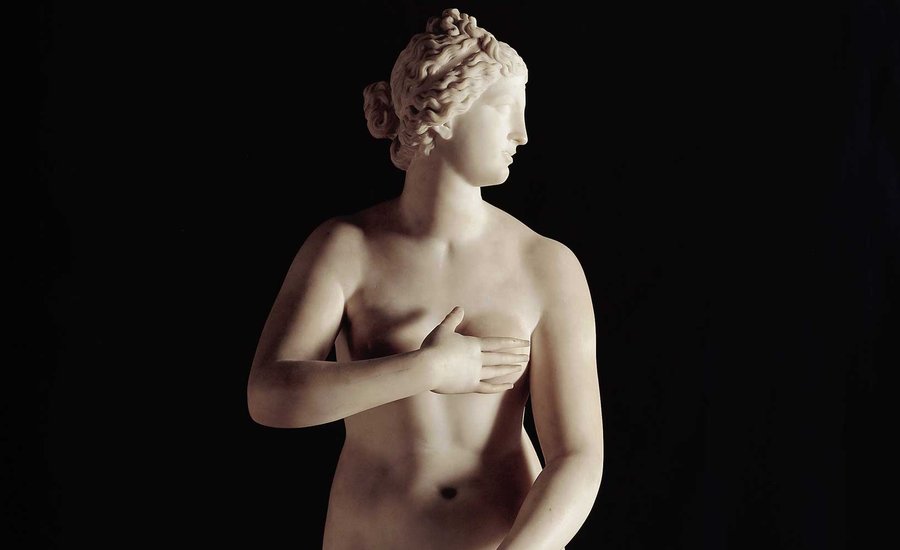
Venus de' Medici via the Boston Athenaeum
Since Trump became our President back in the dark, punishing November of 2016, the art world has been playing a cringey game of catch-up as it attempts to ascertain what role it played or didn’t play in this particular cultural degradation. To a greater extent, creatives have been forced in the intervening years to grapple with the reach of visual protest under late capitalist neoliberalism—what change can a painting or sculpture really effect, anyway?  A new brand of incisive ‘wokeness’ is starting to bubble to the surface of artspeak, however, one that requires authentic interrogation. At the foundation of this treatment lies a “follow the money” ethos, which has led to a variety of high-profile comeuppances for ultra-rich art benefactors. Just ask Warren Kanders, or the Sackler family, not that they’ve experienced any financial hardship as part of the pushback to their, uh, crimes against humanity. Still, is it all too little, too late? Or, perhaps more insidiously, does this new breed of moralizing revulsion amount to a well-intentioned but deeply willful misunderstanding of art history?
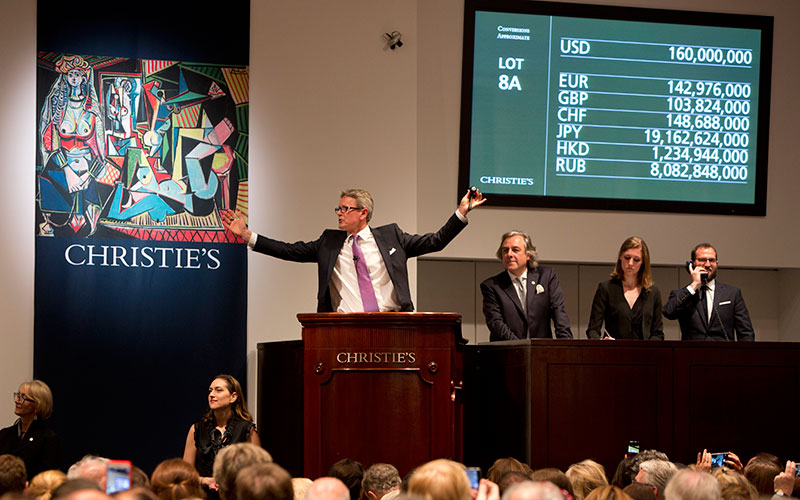
 Christie's market floor via Christie's 
In an unfocused, self-aggrandizing 2018 essay for Vulture, Roberta Smith’s husband reviewed the art market documentary The Price of Everything through the lens of his own rarified Aspen dinner party interactions. After half-heartedly calling out a super-collector for voting Republican (a billionaire? Voting conservative? Shocking.) Mr. Roberta Smith recounted, “Down the table, meanwhile, it got worse. A woman married to one of the world’s largest machine-gun manufacturers babbled about being adamantly against any kind of gun control. The three artists present, two gallerists and I were astonished and began arguing with this the group... but they all gawked at us like we were just dumb clucks who should shut up and stick to art.” Later, he opined, “Probably more than half of all current collectors, advisors, auction people, and others in the art world are Republican. And voted for Trump”.
Which...yeah. Of course. 
The Sackler wing of the Met via Art Newspaper

Why is it surprising that a woman whose fortune relies on the sale of AK-47s is an NRA member, and why is no one asking how she got at that table in the first place? Maybe because art is and has always been a luxury flex, a tool of the state, and a roundabout method of accrual exploited by the the power-hungry and ladder-climbing du jour. None of this is news. Even renaissance masterpieces were commissioned directly by the church or members of the nobility. In her book, Dark Side of the Boom: The Excesses of the Art Market in the 21st Century, Georgina Adam tracks the modern painting trade back to 17th century Dutch Republic, where the absence of monarchical or church patronage created a domestic genre painting open market. In the early 20th century, she  further notes, Baron Joseph Duveen made a huge amount of money selling Old Master works he plucked from broke European aristocrats to American industrialists. The economic liberalization of China and India in the late twentieth century in confluence with the fall of communism in Eastern Europe gave rise not only to new, expanded markets, but also to a glut of private museums, which functioned not just as status symbols, but state-approved means for lucrative real estate development. It’s notable that Christie’s auction house was purchased in 1998 by the owner of luxury retail conglomerate Kering, whose lineup includes Gucci and Balenciaga. Cut to 2019, where Jeff Koons bunnies are selling for 90 million dollars a pop. This is a through-line, not a departure.
 Jeff Koons' "Bunny" 1986 via Forbes 
As such, the notion that art is a necessary public good in danger of corruption by financial black magic feels a little reductive. With this in mind, it seems useful to revisit the rise of the Medici dynasty, the 15th century banking family who were effectively responsible for both monopolizing and transforming Florence into the art and commerce center of the Western world for nearly three hundred years.
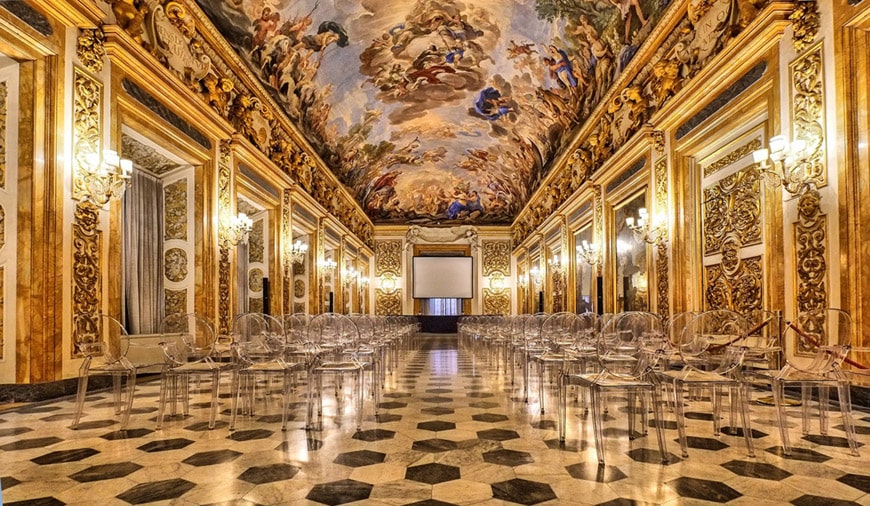
 Medici Palace via VisitTuscany
In the middle of the fifteenth-century Florence, the Medici were at the height of their influence, lead by the visionary Cosimo, who had risen from relative Tuscan obscurity to a business magnate with matrimonial ties to the seated Pope. After his death in 1494, he was hailed by the Florentines as Pater Patriae, or Father of the Country, an identity that was bolstered by literally palatial displays of wealth. He was also responsible for connecting the family to the lay confraternity of the Compagnia de’Magi, a social club of well-to-do Florentines who fashioned their acts of social philanthropy after the three kings, a configuration that inspired one of the Medicis' first acts of artistic propaganda. Either Cosimo or his son, Piero, commissioned a circular panel of the storied Magi adoration by Fra Angelico and Filippo Lippi, an explicit depiction of the family as benevolent religious figures destined for greatness. This heavy-handed allegorical infusion of personal narrative with showpieces fast became a family tradition. Take Lorenzo de’Medici’s childbirth tray depicting Petrarch’s Triumph of Fame, or Lorenzo’s eventual placement of idealized portraits in the opulent Florentine cathedral he bankrolled.
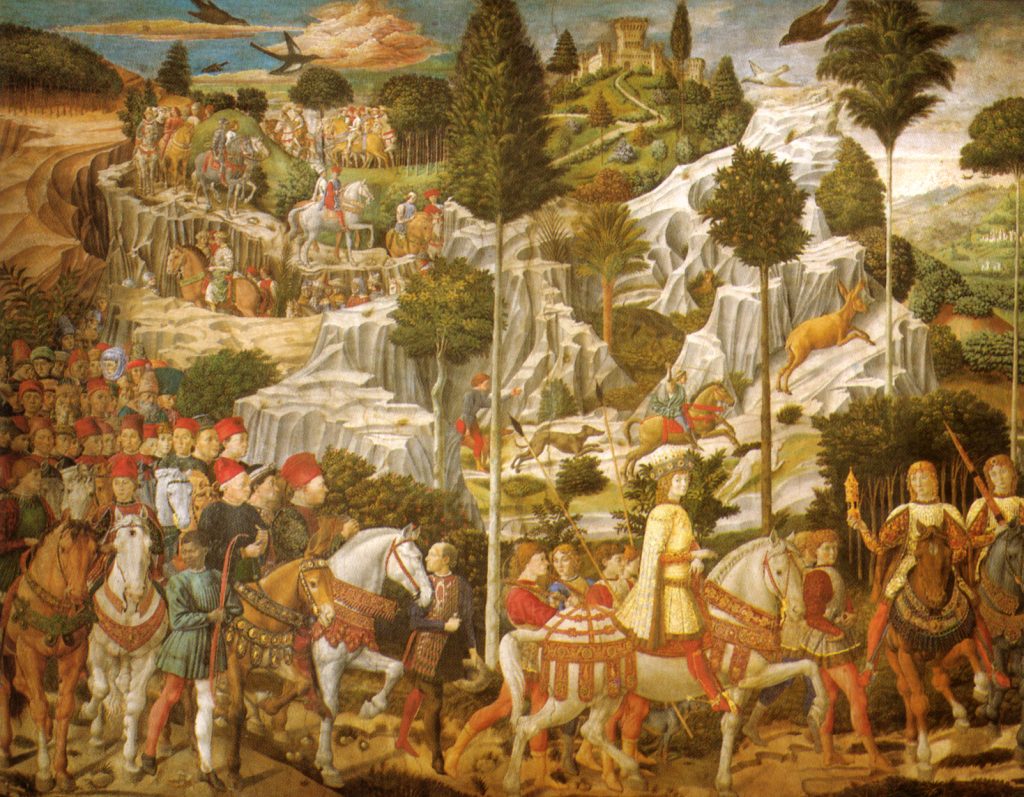
Fresco Cycle , Magi Chapel via Love From Tuscany 
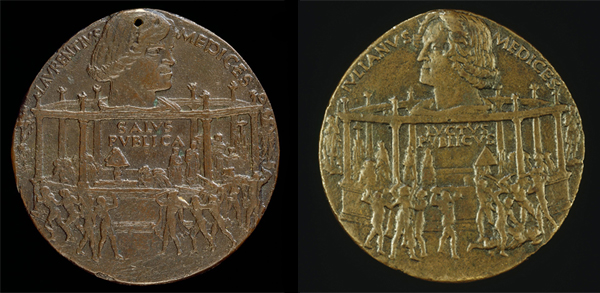
Medals, coins, outdoor statues, and fountains were created ad nauseum in the Medici family image, flooding every imaginable public space in the city. Michelangelo and Botticelli regularly stayed with the family, essentially rendering them in-house talent. Lorenzo, otherwise known as Il Magnifico, (subtle) often used art as a means of promoting foreign policy; bronze reliefs of Alexander the Great and Darius, King of Persia, were sent to then-King of Hungary Matthias Corvinus in hopes of furthering a political alliance. In 1513, Lorenzo’s son, Giovanni de’Medici, became Pope Leo X, stationing the Medici line at the heart of Western culture, a position that amplified an already ostentatious relationship with art patronage. Enter pieces like the foot-washing earthenware bowls depicting the Medicis as gods, or the de’Rossi Sardonyx cameo displaying the Medicis' 'conquering hero' allure. 
Lady in Red by Bronzino, 1525 via IrishTimes
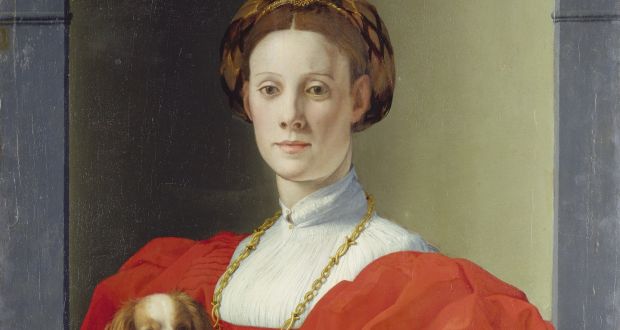
The Medici patronage tradition reached a crescendo in the practices of Cosimo I, the first member of the Medici family to be crowned a Duke. His ascendancy to the rule of Florence in 1537 oversaw some of the most heavy-duty implementation of allegory of the era, like an outdoor cameo featuring Cosimo I and his wife, Eleonora, gazing up at a trumpeting goddess of Fame floating overhead. The cameo is a distinct reference to Imperial Roman frontispieces, making its subtext all the more clear. Cosimo I was not just a duke, but a deity, a supreme leader, and a demigod. The Medicis owned Florence, and their art patronage helped relay the message to any member of the citizenry with functioning eyeballs. In an era where literacy was a privilege few could afford, religious or mythological messaging was not only an essential tool, but an indispensable means of hegemonic consolidation. Parisian curator Nicolas Sainte Fare Garnot has noted, "The Medici needed images, particularly portraits, to establish their power. They used portraits as a propaganda weapon." And weapons, by the way, were a huge part of why the Medicis thrived; in the two brief periods (1492-1513 and 1527-1530, respectively) where Medici rule was interrupted by mutinous troops, it was a series of calculated usurpations and assassinations that placed family members back at the figurative helm. 
Medici Medals via Italian Renaissance Learning Resources
Suffice it to say, it was a Medici who created the proportional model for taxation, despite not holding any official political office at the time. It was a Medici who transformed the way lending, spending, and government involvement in banking functioned. The modern monetary system bloomed not just alongside artistic agglomeration, but directly because of the social capital it afforded those willing to utilize creative production for clout. In summation: Renaissance art was not merely an arbitrarily gorgeous collective outpouring of humanist ethos, it was a project of power, one that created a blueprint for our current deregulated, increasingly criminal art market climate. It's always been about the money, and the money has always been the symptom of larger, interconnected lapses in social ethics. Our role in dismantling these models begs to be tested. 
RELATED ARTICLES:
Artspace.com