Friday, March 31, 2017

Anatomy of a Scene | 'Ghost in the Shell’

https://www.nytimes.com/video/movies/100000005016686/anatomy-of-a-scene-ghost-in-the-shell.html?emc=edit_th_20170331&nl=todaysheadlines&nlid=66671639


Film directors walk viewers through one scene of their movies, showing the magic, motives and the mistakes from behind the camera.
RECENT EPISODES IN 

ANATOMY OF A SCENE


Film directors walk viewers through one scene of their movies, showing the magic, motives and the mistakes from behind the camera.


Thursday, March 30, 2017

Art All the Way to Antarctica

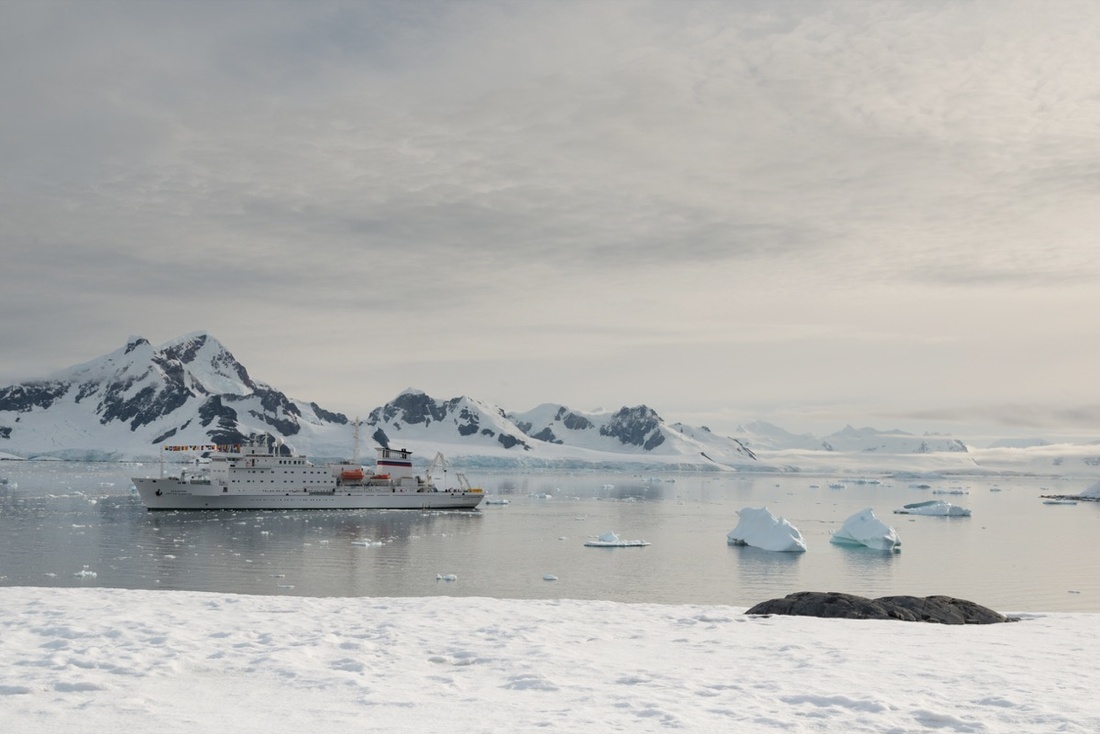
A Boat Full of Artists Made Art All the Way to Antarctica

  • Photo courtesy of Antarctic Biennale.
Antarctica in the 21st century is something of a paradox. This most forbidding of places is fragile, dissolving as we watch—and more susceptible than ever to invasion.
Visitors to the region are made to vacuum their outerwear and inspect their pockets for seeds, crumbs, and other non-native elements before first setting foot on terra firma. People in this austere land, even travelers and wandering artists, are by definition aliens.
Enter the Antarctic Biennale—a head-turning proposition, to say the least. In recent decades, artists like Lita Albuquerque and Werner Herzog have piggybacked onto national science programs for access to the region. Now this expedition, which ended its voyage today, untethers artists from these sorts of science field trips in order to “propose an expanded Antarctic imaginary,” as curator Nadim Samman describes it.
For the past 11 days, artists have been preparing work aboard the chartered vessel Akademik Sergey Vavilov and activating it primarily during shore landings. A selection of the work—much of it in documentary form, most likely—will be unveiled, together with pre-expedition commissions, at the Venice Biennale’s Antarctic Pavilion, on May 9th.
The works of the Antarctic expedition are being positioned as what Samman calls a “provocation” to the Venice Biennale’s nation-centric organizing principle.
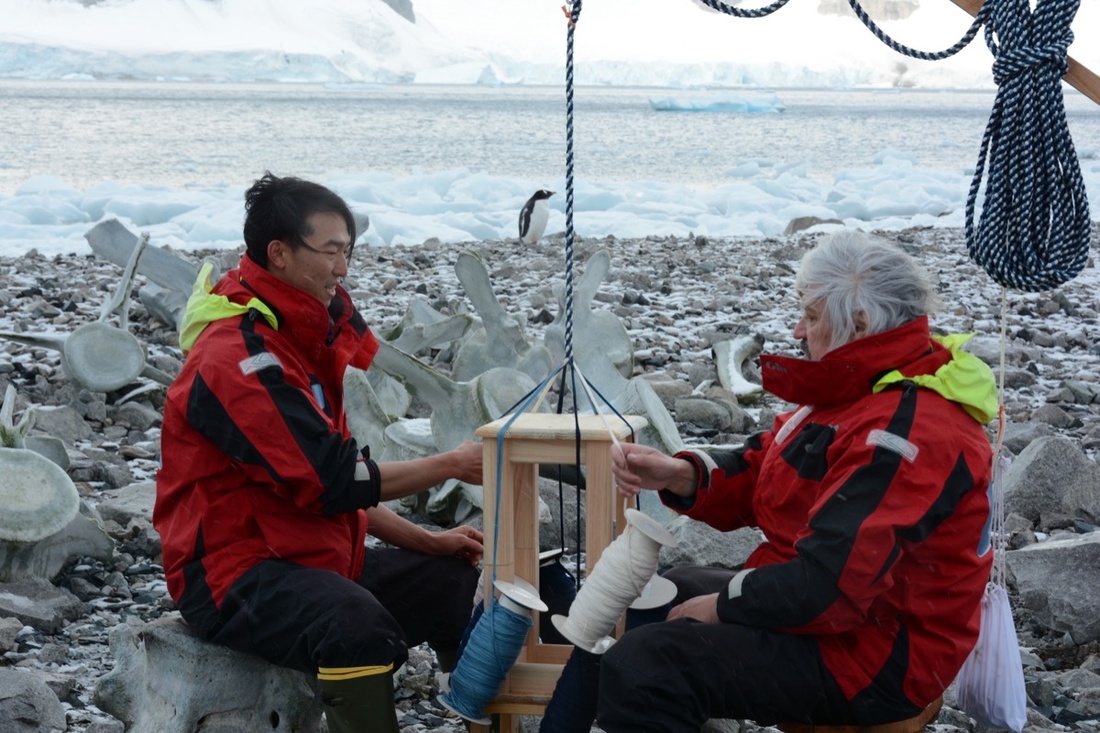
  • Yasuaki Igarashl. Photo by Sho Hasegawa. Courtesy of Antarctic Biennale.
The enterprise is the brainchild of Alexander Ponomarev, a Russian artist with sailor credentials and a flair for spectacle. (He rode a submarine into the Venice Biennale in 2007.) When it’s all said and done, shepherding 16 international artists—as well as an oceanographer, an ecologist, and a designer of Mars research labs—to the edge of the planet might prove to be his magnum opus.
(It’s worth noting that the advisory council for the expedition includes major art-world figures, including the Serpentine Gallery’s Hans-Ulrich Obrist and Sam Keller of the Fondation Beyeler.)
Two years ago, in its first appearance at Venice, the Antarctic Pavilion presented speculative architecture for the Southern continent by the likes of Hugh Broughton and Zaha Hadid. That an actual journey will have taken place this time around considerably ups the ante—especially given the logistical challenges the traveling artists have faced.
There has been no shortage of constraints in this flag-planting mission. International eco-conservation rules limit the range of possible artworks on the expedition to actions, performances, temporary installations, and the recording of sound and image. So far, the weather conditions have been only a little less trying than the red tape, and all but two or three of the participating artists have never been to a polar region before.
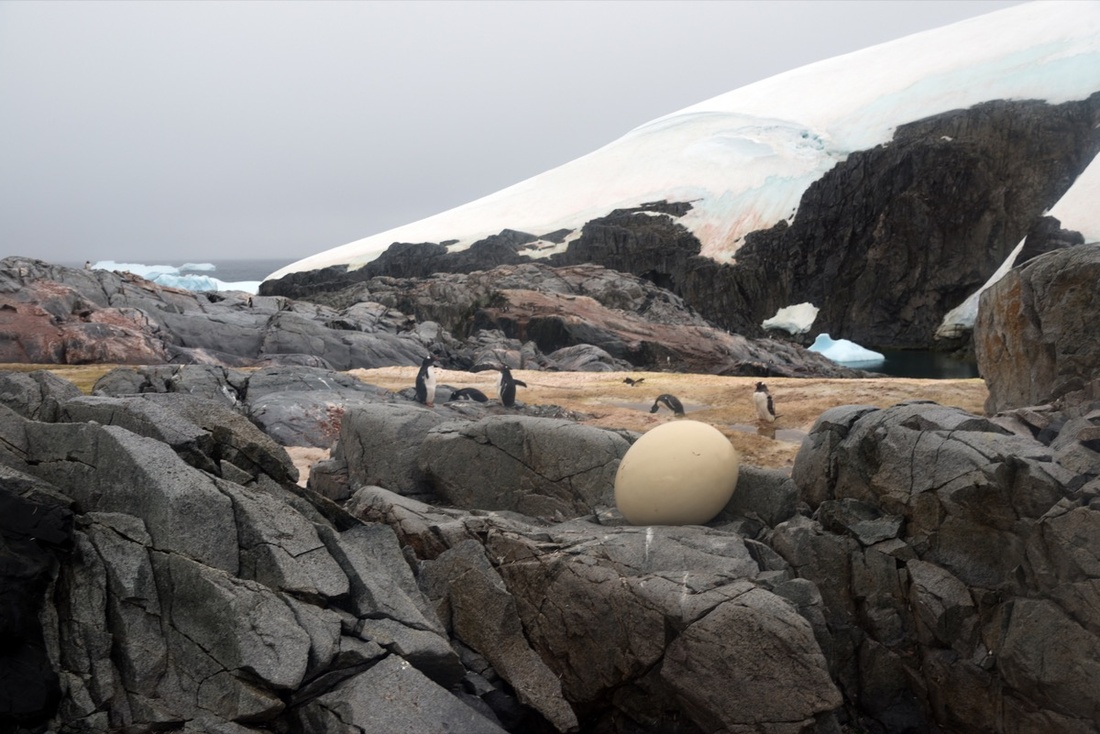
  • Work by Zhang Enli. Courtesy of Antarctic Biennale.
Antarctica is often said to resemble another planet. And the art shown upon our first landing, amid preoccupied Gentoo penguins, suggested three forms of interstellar arrival.
Chinese artist Zhang Enli placed an enormous ceramic egg among the rocks. Andrey Kuzkin dug a hole in the snow, stripped naked, and inserted himself into it head-first so that he appeared to have fallen from the sky. (The performance is part of an ongoing project to plant himself, treelike, into the ground in 99 different locations around the world.)
Meanwhile, in contrast to these origin stories, Argentine artist Joaquín Fargas coaxed a solar-powered robot along the frozen surface. Called “Glaciator,” it’s an awkwardly cartwheeling contraption designed to tamp down snow and thus, in its small way, help combat the glacial melt that’s increasingly linked to our impending apocalypse.
It’s a touching gesture—less quixotic than the slim windmills Fargas created for a previous project in Antarctica, but powered by the same concerns.
  • Work by Joaquin Fargas. Courtesy of Antarctic Biennale.
For her part, the Brazilian artist Juliana Cerqueira Leite has made the expedition vessel her art space, installing motion-stabilized chairs below deck, from which she invited passengers to watch a live CCTV feed from the bow. Inspired by the immobility of the poles on a spinning globe, it’s an expert engagement with themes of subjectivity and mediation.
I thought of the enclosed vessels from which we experience even the most eye-opening journeys. Passengers who’d been seasick in the dreaded Drake Passage days earlier likely related to the work even more.
Other artists have also chosen to craft work on board. French-Moroccan artist Yto Barrada soaked fabrics in dyes made from beets, coffee, and other kitchen scraps, achieving delicately beautiful results. (She’ll decide on the next steps for these textiles later.) And Yasuaki Igarashi set up a station for braiding yarn into nautical rope, which required a second person to work the spindles and recalled the sea journeys of another era.
Preferring to engage with the Antarctic’s great planes of ice, Sho Hasegawa found a patch on land and strapped on electricity-generating skates that he’d wired to a light pen. As he drew the landscape onto film, the air filled with a piano composition (courtesy of Canadian artist Lou Sheppard) that had been extrapolated from coastline data. Fur seals canoodled on the ice nearby.
  • Photo courtesy of Antarctic Biennale.
Hasegawa’s power source turned out to be more foolproof than others. (At the launch of the trip, the solar-heated balloons of Tomás Saraceno’s “Aerocene” project were still awaiting the right conditions for takeoff.) Mobile and adaptable concepts have fared best in this environment—misjudging the realities of Antarctica, it seems, is the surest path to artistic irrelevance, if not a failure to launch.
What has struck me the most is the notion of Antarctica as a sacred space—an area that artists may find almost untouchable for fear of contamination. This preciousness is part of the promise of Antarctica, as both a subject and context for art.

—Darrell Hartman
Cover image: Photo by Eugene Kaspersky.

SHARE ARTICLE


These Artists Dominated the Parisian Art World

Before the Impressionists, These Artists Dominated the Parisian Art World

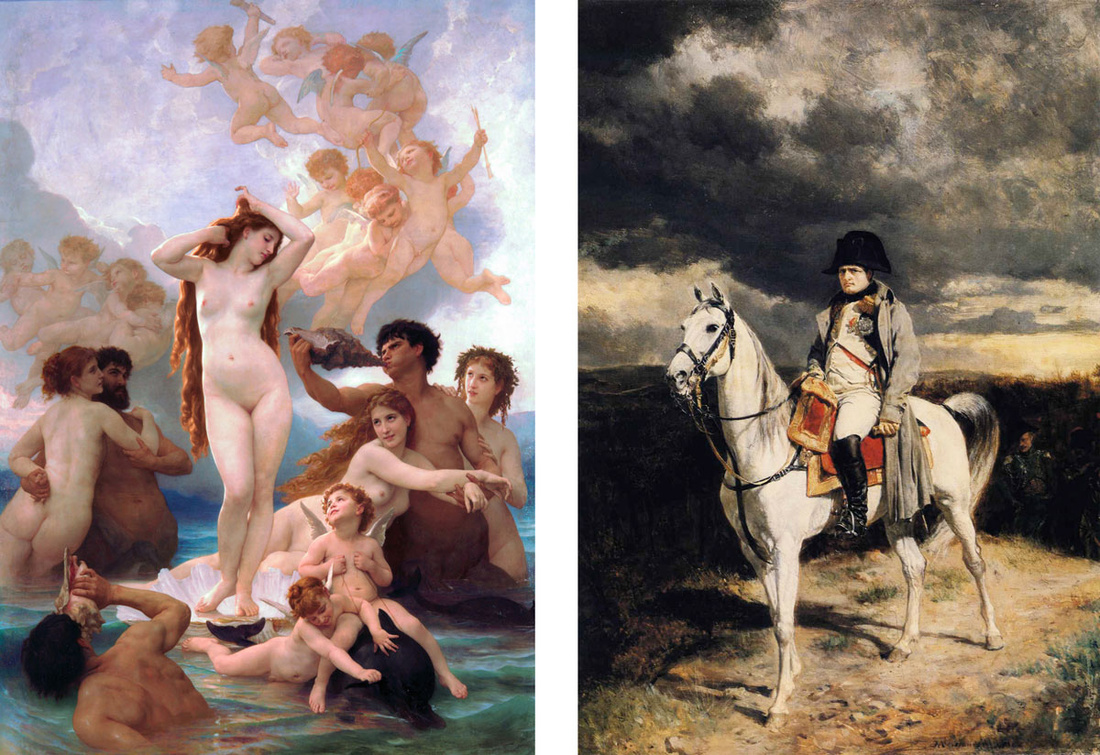
  • Left: William-Adolphe Bouguereau, The Birth of Venus, 1879. Image via Wikimedia Commons; Right: Jean-Louis-Ernest Meissonier, 1814, 1862. Image courtesy of Walters Art Museum, Baltimore.
In around the year 1890, a group of French artists gathered for dinner at the house of a Parisian art dealer and pondered the following question: “Who, in 100 years, will be thought to have been the greatest painter of the second half of the 19th century?” As described in Lorenz Eitner’s An Outline of 19th Century European Painting, they came to an agreement on two names: William-Adolphe Bouguereau and Jean-Louis-Ernest Meissonier.
More than a century later, we know that this guess was way off the mark; the two academic classicists are far lesser-known than their Impressionist and Post-Impressionist counterparts. But the dinner party hypothesis was not unfounded at the time. In the late 19th century, Bouguereau and Meissonier were the superstars of the art world, then centered in Paris. As their fame spread around Europe and across the Atlantic, they sold their work for high prices and graced the collections of wealthy buyers around the world.
Where these artists are mentioned in art history books today, however, it’s often as lofty establishmentarians at odds with the radical inventions of the avant-garde, from Courbet and the Realists to Monet and his fellow plein-air Impressionists. Though artistic styles have gone in and out of vogue throughout history—a continuous ebb and flow—the extent to which 19th-century icons like Bouguereau and Meissonier quickly fell out of favor was particularly pronounced. Who were these artists and why did they go out of fashion?


The French Painting Tradition


If an artist’s success today is determined in large part by the market, in 19th-century France it was dictated by institutions—namely the Académie des Beaux-Arts, a body consisting of 40 elected life members, including 14 painters, 8 sculptors, 8 architects, 4 engravers, and 6 musical composers. Conservative and exclusive, the academy only accepted new candidates for membership upon the death of an incumbent.
French Art History in a Nutshell
Many members of the Academy ran private studios to train students hoping to be admitted to the prestigious École des Beaux Arts, the official art school. There, students followed a rigorous curriculum that emphasized drawing—first after prints and casts, then live models—and included the mastery of composition, perspective, and expression. As the fine arts section of the Institut de France, the national academic establishment, the Academy was also politically motivated, guiding the state on matters of policy, patronage, and purchasing related to art. Most significantly, they chose what hung on the walls of the Salon, the annual exhibitions reviewed by the Parisian journals and attended by the public.
It was this tradition that Bouguereau and Meissonier—and others like Paul DelarocheAlexandre Cabanel, and Lawrence Alma-Tadema—grew out of, and like most successful painters at the time, it was the Salon audience that they had in mind when choosing their subjects. They painted for the middle class, who wanted their art, like literature and theater, to provide a moral lesson or an emotional experience.


Painting for a Salon Audience


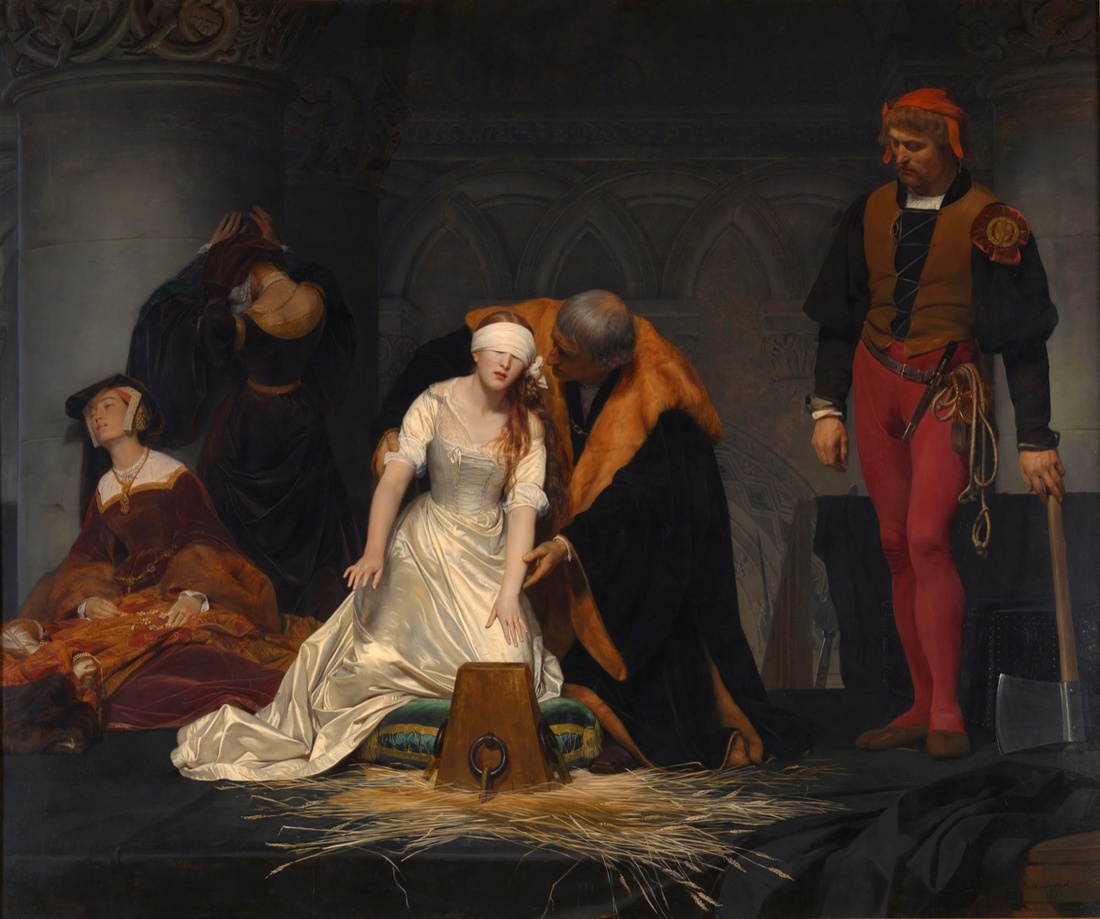
Considered one of the best history painters of his day, Delaroche had a knack of condensing key events in English history—a subject that was then in vogue—into dramatic scenes, such as The Children of Edward (The Princes in the Tower) (1831) and Cromwell Contemplating the Corpse of Charles I (1831). Exhibited in 1834, his painting Execution of Lady Jane Grey (1833) caused a sensation with its dramatic depiction of the blindfolded 16-year-old English queen at the threshold of death after only nine days on the throne. Delaroche is thought to have achieved wider fame in the mid-19th century than Ingres and Delacroix, who are both now glorified in the art-historical canon.
  • Paul Delaroche, The Execution of Lady Jane Grey, 1833. Collection of the National Gallery. Image via Wikimedia Commons.
Another crowd favorite, Meissonier would become a famous painter of minutely detailed historical scenes, which resounded with a public that at that time read paintings like the news. The painter once said, “Perfection lures one on”—which may explain his practice of travelling to battlefields to scrupulously study the grass, trees, and rocks for his “Napoleonic War” paintings. His hard work paid off. In 1871, the famous English art critic John Ruskin paid 1,000 guineas for one of these paintings, which he sold for nearly six times the amount in 1882. Meissonier sold Cuirassiers, a cavalry scene, for £10,000. It later sold for £11,000, then £16,000. For the 19th century, these prices are extraordinary—but just a century later, both the artist’s reputation and market value had collapsed.
The biggest success story was Bouguereau, who was coveted by the nouveau-riche—especially American millionaires—for his highly finished, often sentimental, and undeniably erotic mythological and allegorical scenes, such as The Birth of Venus (1879). Inspired by Raphael’s Triumph of Galatea (1512), Bouguereau’s sensuous nude figures are idealized versions of Parisian studio models (he would later be criticized for the artifice in his work). A recipient of the Legion of Honor, a president of the Institut de France, and a member of the Academy of Fine Arts, he once claimed that “every minute of mine costs 100 francs.” As one critic remarked, “Whoever gets a picture by Bouguereau gets the full worth of his money, in finished painting, first-rate drawing, and a subject and treatment that no well-bred person can fault.”


From Fame to Obscurity


But their successes would not last. While Bouguereau was exalting in classical forms and the painting of “Beauty and Truth,” as he once said, the avant-garde French painter Degas derided these highly finished surfaces as “bouguerated,” and Degas’s contemporary van Gogh dismissed the academic artist as a painter of “soft, pretty things.” As much as he was revered by the public as the standard of refined taste, he was scorned by the avant-garde as a mere technician. The dislike was mutual: Throughout his lifetime, Bouguereau actively worked to exclude the Impressionists from the Salons.
How France’s Violent Revolutions Impacted Some of Its Most Important Artists
The avant-gardists would eventually have their way. The Academy’s rejection of the paintings of CézanneWhistlerManet, and Pissarroprompted the 1863 Salon des Refusés (“exhibition of rejects”), which paved the way for the legitimization of the groundbreaking movements those artists represented and, in turn, the decline of the Academy. In the last two decades of the 19th century, various conservative and reactionary salons emerged as the official Salon was gradually brought to its feet.
By the end of World War I, the contempt the avant-garde felt toward academic artists was matched by the public’s taste. While the Impressionists enjoyed innumerable museum exhibitions and auction house sales throughout the 20th century, the works of Bouguereau and Meissonier fell into relative obscurity in the basements of major art museums. In scholarship, too, they were largely neglected.


Why Are They Still Relevant?

The rise of the avant-garde and the decline of academic artists points to the evolving notion of what constituted “art.” Whereas Impressionism and other movements sought to push the boundaries of painting, continuously experimenting with the medium, Bouguereau, Delaroche, and Meissonier worked within a system of traditional formulas, giving the public what they wanted. Yet as demonstrated by their rigorous processes—from the laborious research taken to hone minute details of a painting to the meticulous preparation of numerous drawings—the academic painters believed in the mastery of a skill. Bouguereau was not only opposed to what he saw as the slapdash methods of modernity; he was also a devout proponent of rigor in art education. Ultimately, the innovators, not the conformists, are remembered.
7 French Art Terms You Should Know
But in addition to the exquisite beauty of their work, the Salon painters offer us a time capsule, reflecting the values of the society they came from—one that yearned for sentimental allegories and grand narratives. They also open our eyes to how museum exhibitions, scholarship, and criticism, as well as shifts in society, shape the narratives of art history—and how these factors slowly but surely determine who is remembered, and who is forgotten. Today, van Gogh might be considered the “greatest painter of the second half of the 19th century,” judging by the countless blockbuster exhibitions and catalogue raisonnés in his name.
In the 21st century, we might ask the same question of the scores of artists seeking recognition in an overflooded contemporary art scene. Who will be remembered? Who will be considered the greatest artist of our era? Yet if we consider the case of Bouguereau, Meissonier, and Delaroche, the answer is that we simply don’t know.

—Demie Kim