Friday, August 16, 2024

Explores the Scope


Peter Fetterman Gallery Explores the Scope and the Power of Photography


https://news.artnet.com/art-world/peter-fetterman-gallery-explores-the-scope-and-the-power-of-photography-2523547


Helming his eponymous gallery, Peter Fetterman has been a champion of photography for more than three decades.


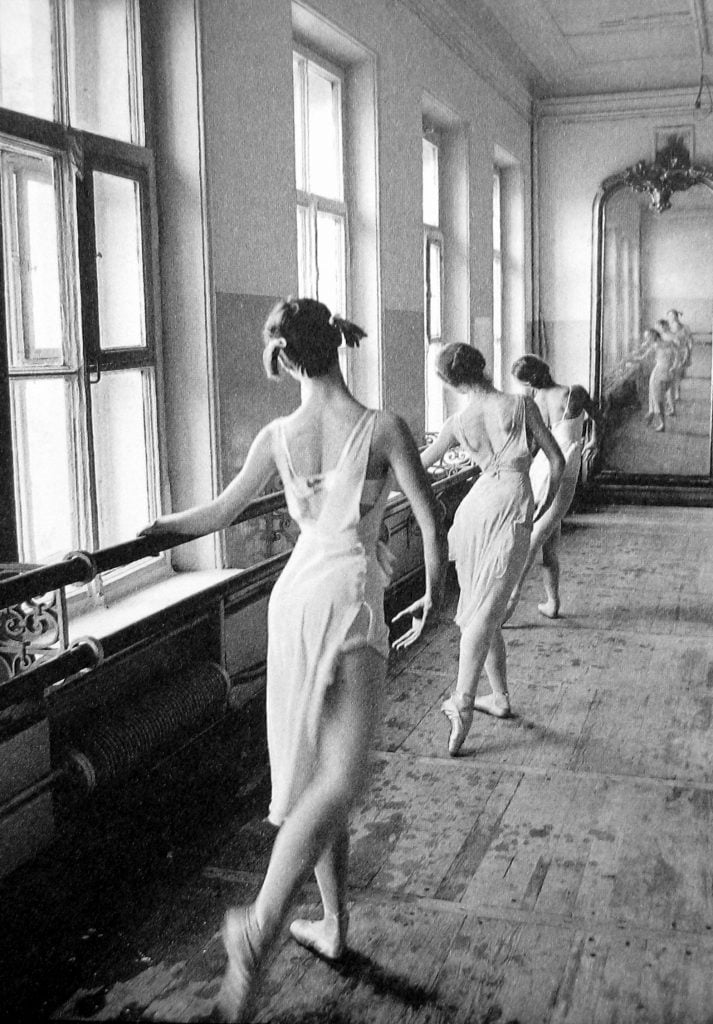
Cornell Capa, Bolshoi Ballet School (1958). Courtesy of Peter Fetterman Gallery, Santa Monica.

--

First established in 1988, Peter Fetterman’s eponymous gallery relocated and was one of the inaugural galleries that opened at Santa Monica’s iconic Bergamot Station in 1994. Since its debut, Peter Fetterman Gallery has remained a cornerstone not only of the West Coast art scene, but a bastion of modern and contemporary photography, with an inventory that reflects the breadth of the medium across the 20th century and holds work by such influential photographers as Henri Cartier-Bresson and Ansel Adams to Steve McCurry and Lillian Bassman.

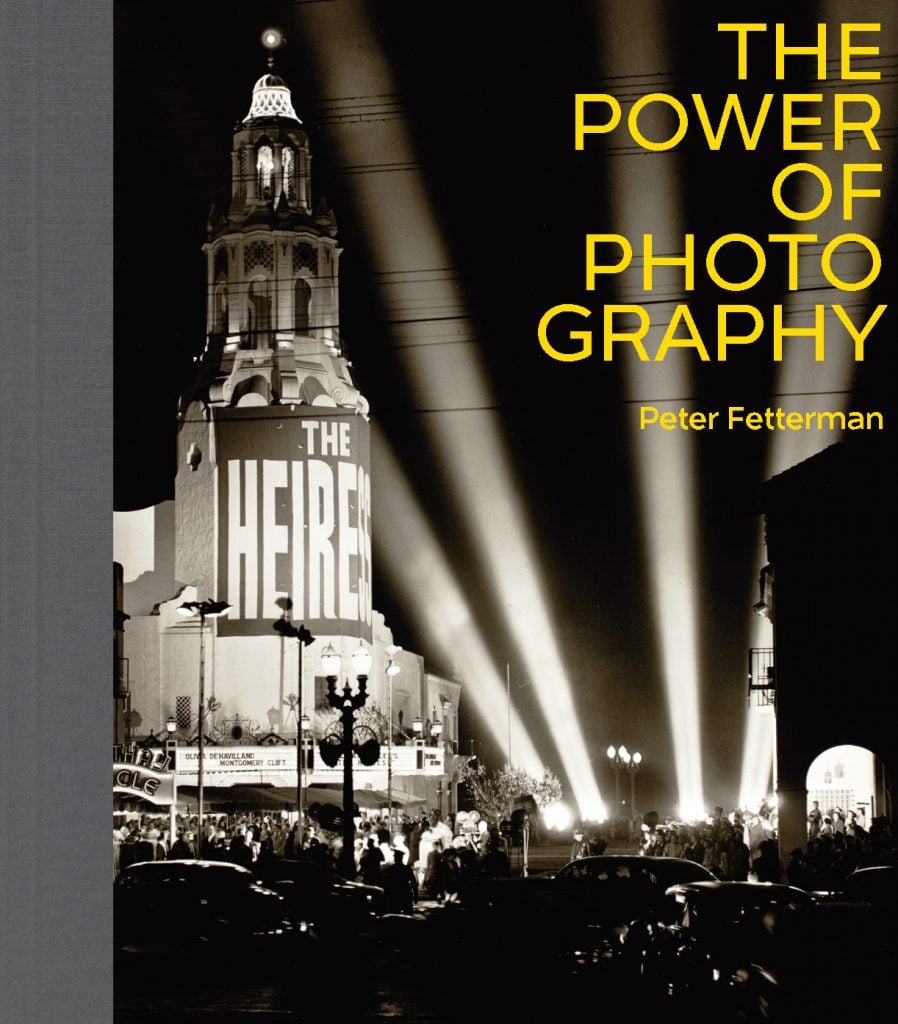
Fetterman’s unwavering passion for photography evolved in the midst of the pandemic, wherein he began digitally exhibiting a new photograph and accompanying text each day, which resonated with audiences around the world. The project ultimately became the foundation for a book, The Power of Photography (2022), produced by the gallery and featuring a carefully curated selection of 120 images alongside commentary by Fetterman. Comprised of photographs from across time and by some of art history’s most influential photographers, The Power of Photography is a testament both to Fetterman’s unparalleled connoisseurship as well as, as the title indicates, the power of photography to transcend time and place.

Book cover of Power of Photography by Peter Fetterman, published in 2022, with a gray fabric binding and a black and white photo of a vintage movie premier with four spotlights pointed up into a black sky, with the title of the book in yellow block letters at the top right.

Power of Photography by Peter Fetterman (2022). Courtesy of Petter Fetterman Gallery, Santa Monica.

The publication can be understood as a form of photo exhibition, within which people can explore and discover the dynamic scope of the medium as well as Fetterman’s singular eye.

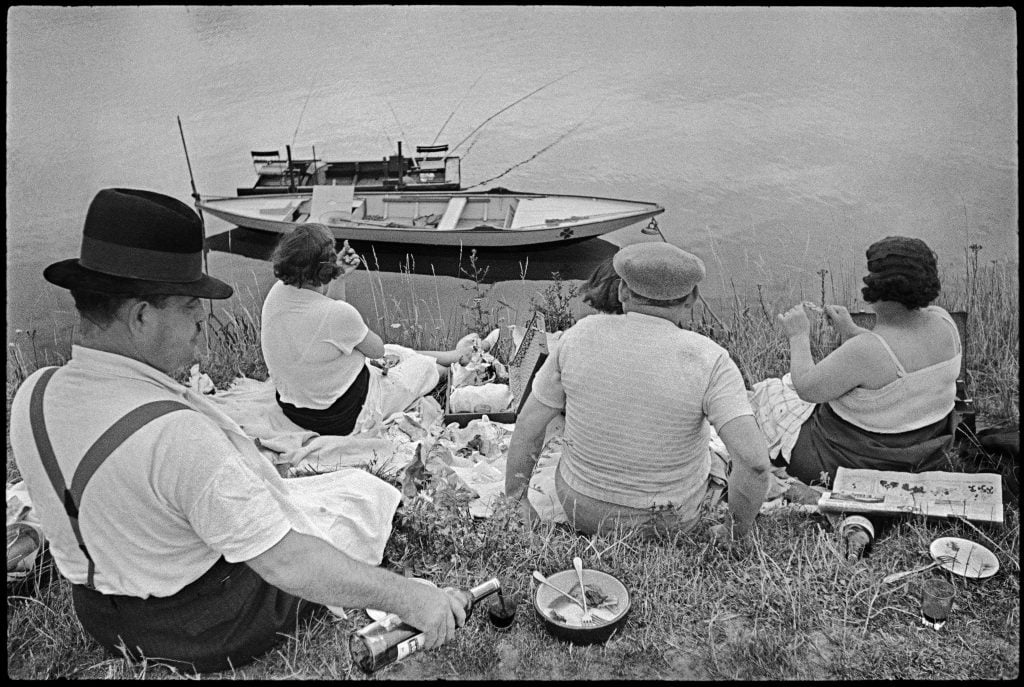
Black-and-white photo of four individuals sitting facing away from the viewer on a grassy edge of a body of water surrounded by picnic items. A small vacant boat is in the water. Included in the book the Power of Photography produced by Peter Fetterman Gallery.

Henri Cartier-Bresson, On the Banks of the Marne, Paris (1938). Courtesy of Peter Fetterman Gallery, Santa Monica.

Opening this month, Peter Fetterman Gallery once again will delve further into the history and context of photography with the wide-ranging exhibition “Her: The Great Women Photographers,” shining a light on women in photography, historic and still working today. On view from August 17 through November 23, 2024, the show will include works by such artists as Bernice Abbott, Sarah moon, and Ruth Bernhard, to name just a few. For avid photography followers and those less versed in the history of the medium, the exhibition promises to illuminate the oft overlooked contributions and pioneering oeuvres of women photographers.

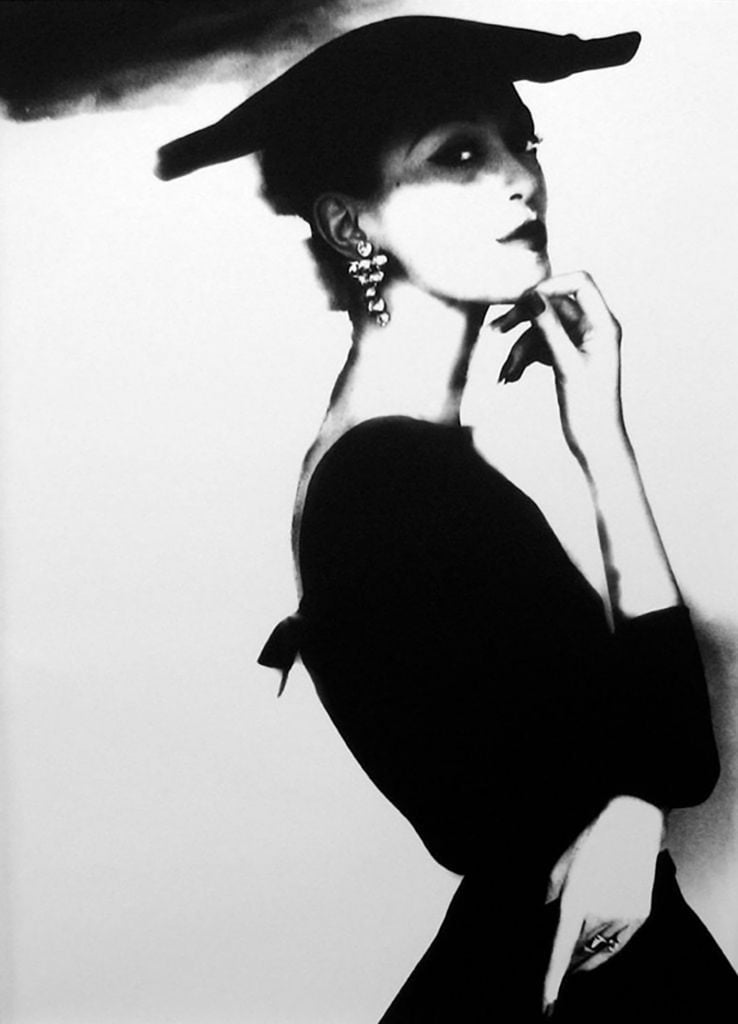
A back-and-white half-portait of a woman wearing a black frock and flat black hat in profile looking over at the camera with her left arm crossed and right hand up under her chin.

Lillian Bassman, Barbara Mullen, Harper’s Bazaar, New York (ca. 1958). Courtesy of Peter Fetterman, Santa Monica.

..


Peter Fetterman Gallery’s exhibition program and publications speak to the gallery’s dedication to photography, offering invaluable insight into the medium’s rich history and a glimpse at its future. Whether visiting a show in person or looking through one of the gallery’s books, such as those described here, viewers can enrich their understanding of photography and its nuances—from early documentary photography to later, more experimental modes.

“Her: The Great Women Photographers” is on view at Peter Fetterman Gallery, Santa Monica, August 17–November 23, 2024.


Wednesday, August 14, 2024

Manet’s Masterpiece Meant to Be a Riddle?

 Was Manet’s Final Masterpiece Meant to Be a Riddle?


https://news.artnet.com/art-world-archives/bar-at-the-folies-bergere-manet-2520568

artnet
Afternoon Briefing
August 14, 2024
Was Manet’s Final Masterpiece Meant to Be a Riddle? Here Are 3 Facts About His Iconic Bar Scene
Art History
Was Manet’s Final Masterpiece Meant to Be a Riddle? Here Are 3 Facts About His Iconic Bar Scene
By Katie White


Was Manet’s Final Masterpiece Meant to Be a Riddle? Here Are 3 Facts About His Iconic Bar Scene

'The Bar at the Folies-Bergère' is ripe with tantalizing clues.


Edouard Manet, A bar at the Folies-Bergere. The Courtauld, London (Samuel Courtauld Trust.) ©The Courtauld.

Edouard Manet’s last masterpiece, The Bar at Folies-Bergère, is also his most enigmatic. Painted in 1882, the year before he died, Manet was already in mounting physical decline and the artist knew his end was near. Which is to say, he painted The Bar with intentionality as a final testament. The same year it was created, The Bar was displayed at the Paris Salon. Manet’s history with the Salon was notoriously complex—he had often been rejected and, when his works were accepted, they were usually critically skewered (take for instance Olympia, from 1863, which people tried to attack). But the legacy of The Bar at Folies-Bergère has been enduring, if sphinx-like in its ambiguity. The art historian Griselda Pollock rightly deemed it “one of the canonical images for modernist art history.” But what does Manet’s final masterpiece mean?

The Basics: What Do We See? 

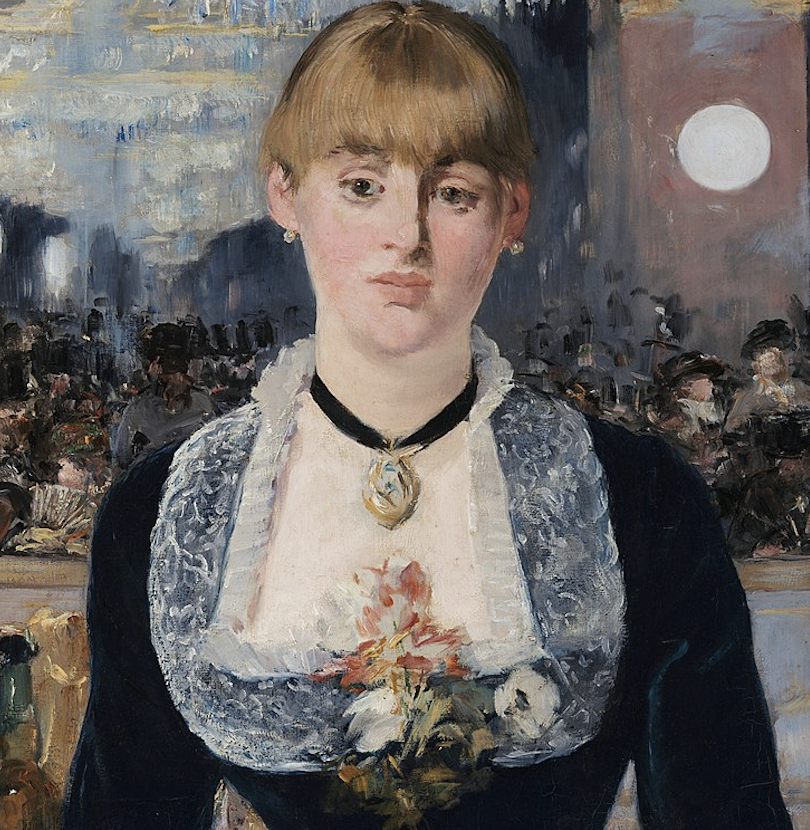
Detail of Manet's Bar at the Folies-Bergère

Detail of Manet’s The Bar at the Folies-Bergère (1882)

We might best approach this painting by asking ourselves what we see. The oil and canvas painting, which is today in the collection of the Courtauld Gallery in London, measures 3 feet and 2 inches by 4 feet and 3 inches. A young woman, a barmaid, stands behind a marble counter filled with drinks and a platter of oranges. She turns her arms outward, wrists leaning against the counter. Her expression is inscrutable. She is pale and sculptural in her presence. In another century, this ambiguous heroine might have been carved out of the marble that now forms her glossy work counter. She looks out, her gaze dreamy but direct, out of the canvas and at her proverbial customer; she is, after all, as the title tells us, working at the bar of the Folies-Bergère, an iconic destination of 19th-century Paris nightlife.

Opened in 1869, the Folies-Bergère was a lively venue for trapeze performances and vaudeville and variety theater, and it was famed for the mirrors that lined its walls, creating a magic lantern-like effect.


...

Behind the barmaid, so much of the composition unfolds in the reflections captured in these mirrors. There we see a crowd of men in black top hats and women with opera glasses, painted in phantasmagoric, Impressionist flickers. The excitement and energy of the patrons are counterbalanced by the cool poise of the barmaid.

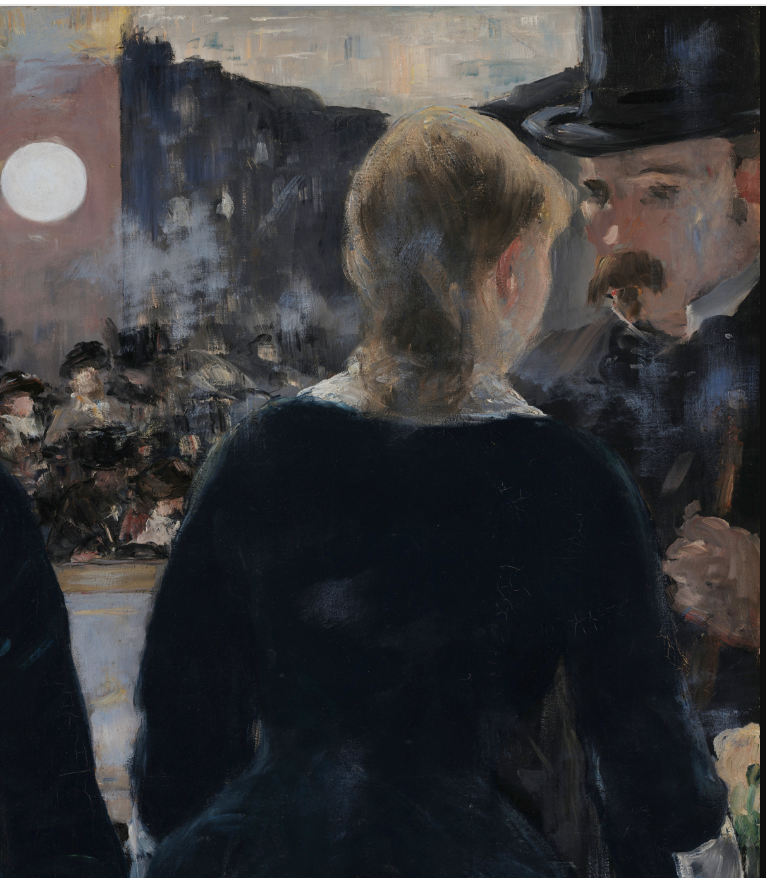
The mirror, however, is also a place of unreality. In the reflection on the right of the canvas, a gentleman in a top hat seems to lean imploringly, seriously, toward the woman at the bar. In this reflection, she, in turn, seems to lean toward him and is positioned much to the right. These reflections don’t match that which we see in front of us: the barmaid’s central, columnar position.

...

Detail of Manet’s The Bar at the Folies-Bergère (1882)

Much has been postulated about this torrent of confused reflections. Famed art historian T.J. Clark set the stage for many further interpretations of the work when he devoted a chapter to it in his book The Painting of Modern Life. In Clark’s interpretation, the painting signaled—in its meaning and its distorted reflections—the dawn of a new social order under capitalism. This new order, Clark argued, upended time-honored roles and social dynamics and offered a paradoxical, topsy-turvy world of mirrors, as disorienting as the reflection in Manet’s painted scene.


Clark, along with many other scholars, surmised that the painting acted as a visual double entendre, that while she was selling the delectables of liquor and fruit on the counter, the mirrored vision hinted that she might also be available to be purchased herself, as yet another consumable entity. Indeed, she might have been a courtesan, the red blossom at her bosom a common indicator of a woman on the market. Manet, too, habitually associated oranges with prostitution, which here are piled high on the counter. The poet Maupassant had described the barmaids of the establishment as “vendors of drink and of love.”

But there’s much more to The Bar at the Folies-Bergère than solicitation and the ever-elusive image, Manet’s parting gift, is still ripe for interpretation.

Here, we’ve parsed the literature to find three insightful facts about The Bar at the Folies-Bergère that might help you see it in a new and exciting way.

1. It’s a Commentary on Consumerism—and the Art Market 
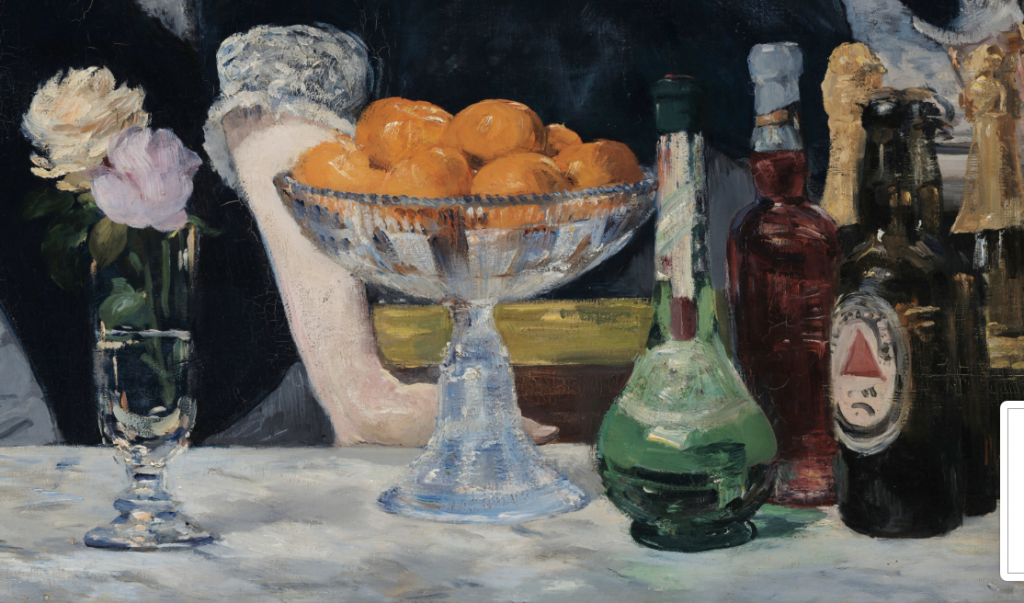
Detail of Manet's Bar at the Folies-Bergère

Detail of Manet’s The Bar at the Folies-Bergère (1882).

Manet paints his viewers on the same side of composition as her male customer, and her eyes meet not his but the viewer’s. This construction is intentional; Manet is positioning us as buyers in the age of nascent consumerism. The Industrial Revolution had set in motion a world with mass-market goods, unlike the one-of-a-kind world that had existed before. The actual consumer exchange, between the sales girl and a customer, is often skated over in historian’s contextual notes. In her essay “Selling, Seduction, and Soliciting the Eye: Manet’s Bar at the Folies-Bergère,” author Ruth E. Iskin points out, however, that Manet places consumption front and center for good reason—and that in doing so he hints back to art’s status as a consumer item.

First, Manet does this by painting a sensuous still-life arrangement tantalizingly near the edge of the canvas; the marble slab of the counter pours to the edge of the canvas, where bottles of beer, champagne, and fruits are rendered with delectable care. It’s important to note that the late 1800s saw the dawn of the department store and a new art of sales display. Fascinatingly, the space of the Folies-Bergère had originally opened as a home goods store, specializing in bedding, with an attractions room in the back, to attract customers. Ultimately the entertaining space proved more lucrative and the whole space was converted into a full-fledged theater.

Meanwhile, in 1882, Émile Zola’s famous novel The Ladies’ Paradise would be published in serialization. The book famously charts the saga of Octave Mouret, the rapacious entrepreneur who steers his department store, Le Bon Marché, ever higher, and Denise Baudu, an intelligent and conscientious shop girl whose perspective eye brings her to the height of the department store’s power. The book was based loosely on the real department store owner Aristide Boucicaut. As the book describes, everything about a salesgirl’s appearance, from their dress to their hairstyle, would have been selected by an employer to appeal to upper-class tastes—and so would have been the case with Manet’s barmaid. These salesgirls occupied a dubious space, as working women positioned above the working class, and became a new, “petit-bourgeoise.” But as the barmaid’s tired expression might convey—she was still very much at work.
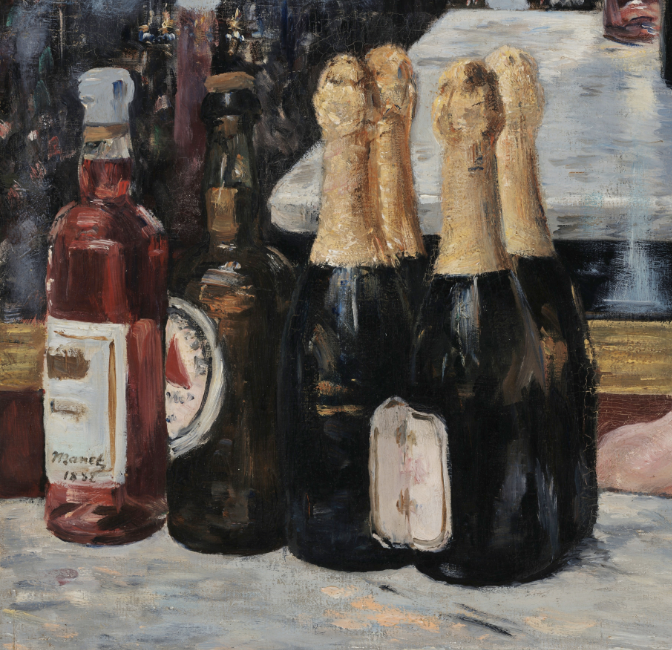
Detail of Manet's Bar at the Folies-Bergère

Detail of Manet’s Bar at the Folies-Bergère (1882) showing his signature on the red liquor bottle.

In this painting, many note the presence of a Bass Pale Ale label on the beer, hinting at the new world of mass-available products. Much the same way that commercial objects began to be displayed more openly, so too, art was being sold in ways a previous generation would have found uncouth. At the Salon where this painting would be displayed, an increasing number of works were being offered directly for sale—something that would have been unheard of decades prior. Artworks, too, were hung in storefront windows. In this way, Manet offers himself as another salesperson and his art as something pleasurable to be consumed for a price. Winkingly, even, he signs his name onto a bottle of red liquor, making his signature a logo of sorts.


2. The Mirror Captures a World of Nostalgia and Fantasy 
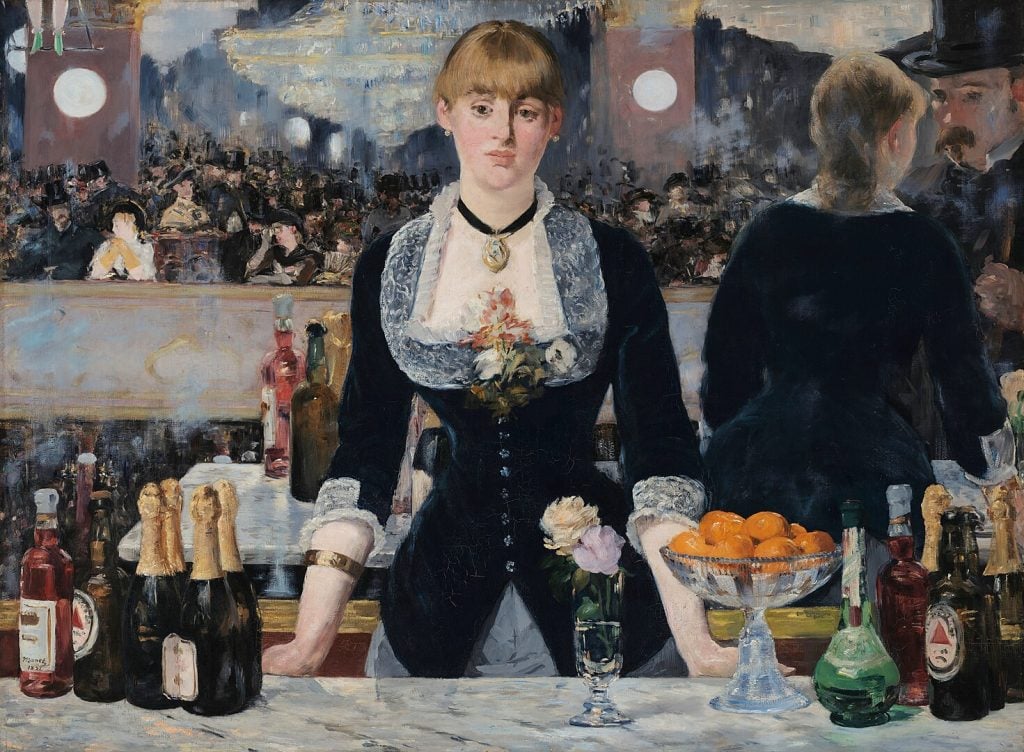
Édouard Manet, A Bar at the Folies Bergère (1882). Collection of the Courtauld Gallery.

Édouard Manet, A Bar at the Folies-Bergère (1882). Collection of the Courtauld Gallery.

What if the scene unfolding in the mirror’s reflection were not a structural device meant to suggest societal change, but an imaginary space of reverie—a depiction of the barmaid’s mental plane? This interpretation is posited by Albert Boime in his essay “Manet’s ‘Un bar aux Folies-Bergère’ as an Allegory of Nostalgia.” Boime suggests that the encounter in the mirror is a kind of after-image, in which the barmaid imagines an encounter with a gentleman who catches her gaze or a recollection of what has already been. Maybe our barmaid is wondering if the wealthy man approaching the counter might change the course of her life. “Bracing herself against the counter, her reveries have been momentarily interrupted by the flaneur who enters into her field of vision. Her somewhat out-of-focus expression is therefore transitional, held in suspension while she sizes him up,” he writes.

In Manet’s scene, the barmaid is not a vapid flirt but a figure preoccupied with her own hopes and ambitions. “Manet has invested her with a solidity and poise out of proportion to her quotidian role in the class relations of production, freeing her momentarily from her public performance and allowing for her subjectivity—and therefore that of his own as well,” Boime continues.
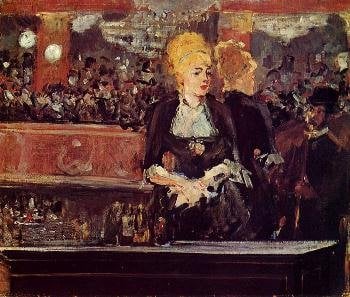
a woman with blonde hair stands behind a bar at a crowed 19th-century theater

Manet’s preliminary sketch for The Bar at Folies-Bergère shows the barmaid was originally positioned toward the right of the canvas.

For Boime, this nostalgic interpretation is bolstered by the realities of Manet’s deteriorating health. Manet was living in a great deal of physical pain caused by long-term syphilis and painted The Bar while seated, unlike any of his earlier masterpieces.

Manet had been, in his earlier years, a consummate flâneur wandering the streets of Paris and observing the realities of 19th-century life. But his ailment forced Manet into a physical stasis not totally unlike the barmaid trapped behind the counter. His thoughts—like her thoughts—became the primary avenue for escape and exploration. As Boime extrapolates: “As a passerby, he [Manet] does not exist except in the imagination of the barmaid; he lives only in the world of reflections, that is, the dream world generated by capitalist spectacle. Indeed, he writes himself out of the script, so to speak, by effacing himself from the main event.”
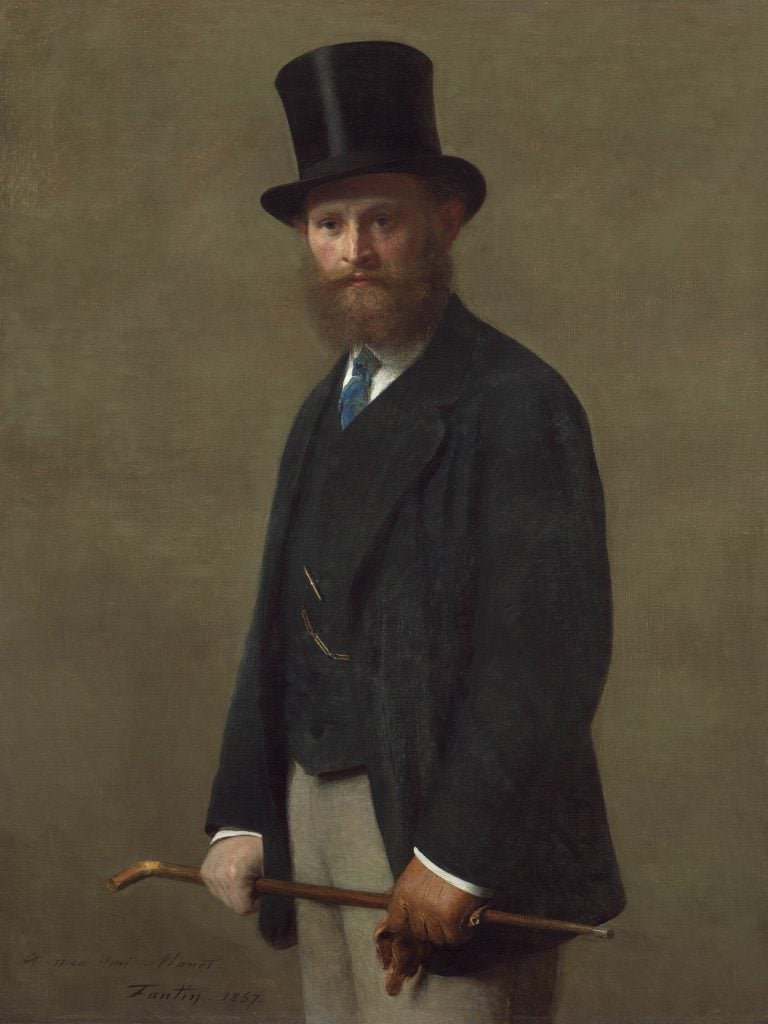
a portrait of the artist Edouard Manet, with a black coat and top hat as well and a medium-length beard

Henri Fantin-Latour, Ã‰douard Manet (1867).

Boime notes that Manet ultimately cedes control of the canvas to the barmaid. In an earlier sketch for the composition, Manet had positioned the barmaid, modeled by a woman named Suzon, to the right of the canvas. In the end, he places her front and center with the man’s reflection off to the side. “She may be considered a flaneuse or female equivalent to the flaneur who gives as good as she gets. Even under the most constraining circumstances, there is a hint of freedom,” Boime concludes.


3. The Odd Detail of the Trapeze Swinger’s Green Boots Is Surprisingly Meaningful
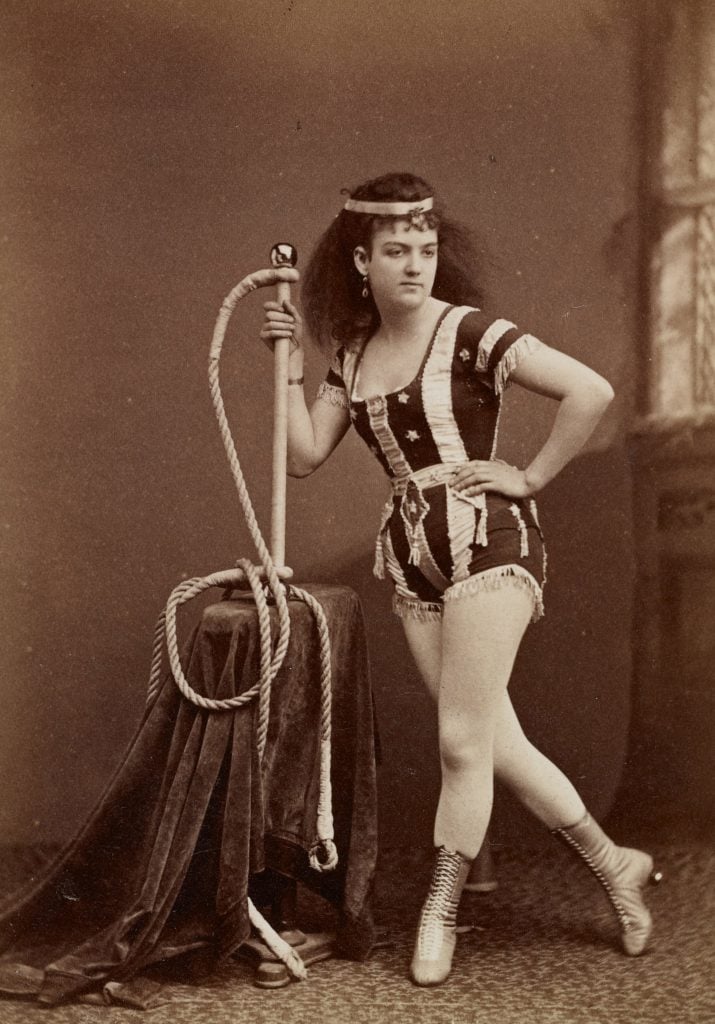
a black and white photograph of a woman in a trapeze outfit with laced boots

Leona Dare was an American trapeze artist and aerial acrobat. Photo by: Bildagentur-online/Universal Images Group via Getty Images.

Here’s a curious detail: on the upper left of the canvas Manet has painted the green boots of a trapeze artist hanging from above. The trapeze artists of the Folies-Bèrgere, particularly the women performers, occupied a particular position of respect in Paris leisure society. American women performers were particularly in vogue. As Boime notes, “Just prior to the period that Manet conceived his picture, a female trapeze artist from Louisiana, Leona Dare was declared ‘cette nouvelle Reine du trapize’ and electrified audiences at the Folies-Bèrgere with her audacious stunts.”

Manet was certainly aware of Dare and her prowess. She was publicized greatly and “her portrait, surrounded by vignettes of her performing stupendous feats while wearing the laced, high-topped shoes glimpsed in Manet’s picture, displays a face of eagerness and assurance quite different from the tentative expression of the barmaid.”
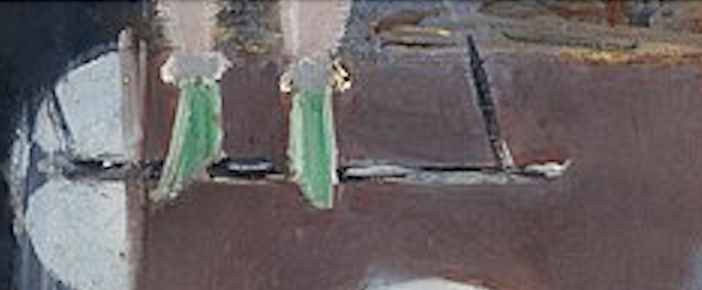
green feet hanging from a trapeze

Detail of The Bar at Folies-Bèrgere (1882).

In some ways, this detail hints at the broad social changes brought about by industrialization and, with it, the role of women. While the barmaid offers one of the shifting identities of this era, a “petit-bourgeois” not so readily definable in her dress as belonging to a particular class, the trapeze artist offers another vision of women’s place in 1882 Paris.

Not coincidentally, by the early 1880s, the Folies-Bèrgere was actively recruiting a female clientele, including many respectable ladies who we see in the audience. In this way, the trapeze artists, the barmaids and servers, and the female clientele formed a nexus of possibilities of women watching and being watched as the turn of the century approached.


22 essential artworks


 For Subscribers

The Norton Simon in Pasadena may get overshadowed by LACMA, MOCA and the Broad, but its 12,000-piece collection is one of SoCal’s best. Our critic offers a shortlist of don’t-miss works.


The ultimate Norton Simon guide: 22 essential artworks at one of SoCal’s underappreciated museums

Detail of Vincent van Gogh's "Portrait of the Artist's Mother," whose colors have shifted toward green over time.
Detail of Vincent van Gogh’s “Portrait of the Artist’s Mother,” one of the gems in the 12,000-plus works at the Norton Simon Museum in Pasadena.
 
(Gerard Vuilleumier / Norton Simon Art Foundation)

Norton Simon (1907-1993) was a hard-nosed industrialist whose Depression-era turnaround of a bankrupt Fullerton bottling plant ultimately grew into the sprawling Hunt‘s food empire. (Ketchup, anyone?) As Southern California flourished, so did his bank account. Along the way, Simon built the most impressive private art collection in America to be assembled after World War II.

The avid collector flirted with several institutions to become permanent home to his staggering holdings, but finally he couldn’t let go. By the time he was strategizing a contentious, ultimately successful takeover of the financially faltering Pasadena Art Museum in 1974, his collection numbered some 12,000 works.

Today, one long arm of the museum building’s unusual floor plan, shaped like the letter H (and handsomely renovated by architect Frank O. Gehry), features an exceptional array of European and Old Master paintings and sculptures. The other long arm holds impressive 19th century and Modern art. Downstairs, in rooms that open onto a garden — a rather noisy one, given the roaring Ventura and Foothill freeways adjacent — are striking displays of Indian and Southeast Asian art.

The only real museum shortcoming is an entrenched habit of exhibiting almost every painting behind glass, which can yield a one-step-removed look to even the most commanding picture. (What I wouldn’t give to see unencumbered the otherworldly radiance of the humble “Still Life With Lemons, Oranges and a Rose,” the museum’s signature 1633 masterpiece by Seville’s Francisco de Zurbarán.) Still, the sustained level of quality throughout is unmistakable. That defies what follows from being a “best of” list, but it has been selected to give a sense of the broad range of notable art on offer.

For Subscribers Only logo

Subscribers get exclusive access to this story

We’re offering L.A. Times subscribers special access to our best journalism. Thank you for your support.

Explore more Subscriber Exclusive content.

Giovanni di Paolo, ‘Branchini Madonna’

1427, tempera and gold leaf on panel

Giovanni di Paolo, "Branchini Madonna,"
(Elon Schoenholz / © The Norton Simon Foundation)

She’s humbly seated, but the nearly life-size Virgin Mary in Giovanni’s ethereal painting seems to float in golden space, the crowned Queen of Heaven held aloft by the delicate flutter of pastel angels’ wings that completely encircle her. Were she to stand up, the hand on her impossibly long right arm might hang all the way to her knees — although maybe not, since the suggestions of legs hidden beneath her cobalt blue robe seem equally attenuated.

Siena, where the Italian painter lived and worked, had been walloped by the Black Death. The devastating 1347 plague wiped out nearly half the once-prosperous city’s population, and it had struggled long and hard to regain its footing. (It wasn’t working.) The elegantly stylized elongations in the “Branchini Madonna,” together with the upward-thrusting format of the wooden panel’s pointed arch, reached back to a church-centered Gothic past in search of a way forward. Originally installed in a family chapel at the city’s Church of San Domenico, Giovanni’s picture is one of many such heartfelt pleas — and an exceptionally extravagant one, imploring divine help.

Dieric Bouts, ‘Resurrection’

Circa 1455; distemper on linen

Dieric Bouts, "Resurrection," circa 1455; distemper on linen
(Gerard Vuilleumier / © The Norton Simon Foundation)

Not many paintings made with distemper, a fragile form of whitewash mixed with powdered colors, have survived for half of a millennium, but one by Flemish artist Dieric Bouts is a significant exception. This forthright but ethereal image of Jesus stepping out from his tomb is from a multipart altarpiece, with other moving and remarkable panels housed in the collections of the J. Paul Getty Museum and London’s National Gallery.

Raphael, ‘Madonna and Child With Book’

Circa 1502-03; oil on panel

Raphael, "Madonna and Child with a Book," circa 1502-03; oil on panel
(Gerard Vuilleumier / © The Norton Simon Foundation)

If you need a Raphael fix in Southern California, this is the only place to go: “Madonna and Child With Book” is an early masterpiece.

Probably painted in Perugia when Raphael was barely 20, and before he moved to the leading Renaissance artistic centers of Florence and then Rome, where he would rise amid rough and tumble, highly competitive creative milieus. “Madonna and Child With Book” is a pellucid image of gentle tranquility. Mary and the chubby infant are enveloped within the contour of a protective royal blue cloak, safe even from the seemingly placid world of nature unfolding behind them. (Notably, a stone fortress dominates that landscape.) The composition’s aura of extreme serenity is a pictorial promise, meant to assuage the premonition of suffering and death revealed in the fragment of the open book’s text: It speaks of inevitable crucifixion.

Despite the momentous implications, however, the most touching moment is found in a tiny detail, easy to overlook. Jesus’ left hand is poised to caress his mom’s little finger, just as any baby might do.

Giorgione, ‘Head of a Venetian Girl’

Circa 1509; oil on panel, transferred to canvas

Giorgione, "Head of a Venetian Girl," circa 1509; oil on panel
(Gerard Vuilleumier / © Norton Simon Art Foundation)

As her shawl slips off her shoulder, this soft and lovely young woman casts a look toward the viewer that telegraphs something between “come hither” and “watch out,” suggesting just who has the upper hand in this seductive visual conversation. Only about a dozen paintings are firmly attributed to the brilliantly gifted Giorgione — another is in the San Diego Museum of Art — a mysterious artist who died at just 33 in the 1510 Venetian plague.

Lucas Cranach the Elder, ‘Adam’ and ‘Eve’

Circa 1530; oil on panel

Lucas Cranach the Elder, "Adam" and "Eve," circa 1530, oil on panel
(Christopher Knight / Los Angeles Times)

So popular were his diverse depictions of the Old Testament’s Adam and Eve that Cranach and his workshop produced around 100 different versions for various clients. Cranach, a pal of Martin Luther, was a signature artist of the Protestant Reformation. These two painted wood panels, with their life-size figures gorgeously restored during a more than two-year effort by the conservation wizards at the Getty Museum across town, are considered among the very best.

Adam and Eve’s cautionary tale of humanity’s fall from grace in the Garden of Eden could provide a patron the public veneer of biblical piety. At the same time — and ideal for an artist whose capacities for sophisticated decorative design were unmatched among German artists in his day — these naked bodies offered something more: They’re delectable to ogle, whether curvaceous Eve or buff Adam, not to mention the imaginative thought of carnal knowledge between them.

Jacopo Bassano, ‘The Flight Into Egypt’

Circa 1544-45; oil on canvas

Jacopo Bassano," The Flight Into Egypt," circa 1544-45; oil on canvas
(Gerard Vuilleumier / © Norton Simon Art Foundation)

Is that angel drunk?

Well, the soldier at the far left is the one who’s chugging from a wineskin, not the angel across the way. But the spectacular winged figure with the heavily lidded eyes at the far right of Bassano’s large canvas is the one who’s immediately riveting. He’s urging on the Holy Family — This way. Faster! — who flees to Egypt presumably to escape certain ruin at the hands of King Herod. The monarch was said to be intent upon massacring all the innocent boy-children of Judea under age 2 to ward off a prophecy that one among them — the one in Mary’s lap — would someday supplant him as king.

The reputation of Bassano, father of a family of skilled if rarely exciting Venetian painters, had long languished until this extraordinary composition resurfaced in the 1960s. Following a long sequence of residence in ponderous rooms in British manor houses and a sleepy Benedictine abbey, it ended up at a 1969 public auction. Simon snapped it up, paying a headline-grabbing $655,118 (about $5.6 million today, adjusted for inflation) — nearly 10 times the estimated price. He had it cleaned to restore the luster, and now it’s a colorfully radiant star of the museum’s collection.

And that drinking soldier? He might just be a symbol of the worldly iniquity that the threatened child on the lam could eventually assuage.

Guercino (Giovanni Francesco Barbieri), ‘The Aldrovandi Dog’

Circa 1625; oil on canvas

Guercino, "The Aldrovandi Dog," circa 1625; oil on canvas
(Elon Schoenholz / © Norton Simon Art Foundation)

Canis lupus familiaris, also known as the dog, has been humanity’s pal for about 15,000 years, following migrations from central Asia to points all around the globe. The big, robust mastiff in Guercino’s portrait is posed on a stately balustrade next to a sturdy classical column. From his owner’s palace perch, Fido totally dominates the landscape spreading out behind him.

That owner was Bologna’s Count Filippo Maria Aldrovandi, patriarch of one of Italy’s oldest noble families. Guercino, a savvy and largely self-taught painter, made the count’s guardian dog into nature’s tamed surrogate for — and defender of — the nobility’s established power.

Rembrandt van Rijn, ‘Portrait of a Bearded Man in a Wide-Brimmed Hat’

1633; oil on panel

Rembrandt van Rijn, "Portrait of a Bearded Man in a Wide-Brimmed Hat," 1633; oil on canvas
(Gerard Vuilleumier / © Norton Simon Art Foundation)

Rembrandt is often acclaimed for the psychological penetration he was uncannily able to achieve in portraits, which often leads to viewers playing amateur shrink. Sometimes, though, his technical virtuosity just generates a good old-fashioned “wow!” Take the exuberant, light-filled, eye-boggling beauty of this otherwise sober gentleman’s neck-collar, a swirling flurry of undulating sheer white ruffles. The roller-coaster ruff surreptitiously animates a fixed human image.

Jean-Antoine Watteau, ‘Reclining Nude’

Circa 1713-17; oil on panel

Jean-Antoine Watteau, "Reclining Nude," 1713-17; oil on panel
(© Norton Simon Art Foundation)

This little panel is the collection’s smallest painting, at just 5½-by-6¾ inches, but the pale young woman luxuriating in a white cloud of bed linens might also be its sexiest. (It was once owned by notoriously randy Russian empress Catherine the Great, who gave it to her lover Grigory Orlov.) Watteau’s voluptuous reclining nude looks back expectantly over her shoulder. What she’s up to was revealed in “The Remedy,” a chalk drawing for the painting acquired later by the Getty Museum, which includes her maid approaching the bed bearing an imposing enema device. At some point in the past, that part of the panel was ignominiously cut off.

Bodhisattva Maitreya

2nd-3rd century, Pakistan/Gandhara; schist

"Bodhisattva Maitreya," 2nd-3rd century, Pakistan/Gandhara; schist
(Christopher Knight / Los Angeles Times)

The ancient silk routes that facilitated commercial trade along a 4,000-mile stretch between China’s Pacific coast and the Mediterranean’s eastern shore were an information highway as much as a road for the physical transport of material goods. Think of them as the (slow) internet of the 2nd century BC, where the possibilities for cross-cultural aesthetic magnificence flourished as traffic among artists and patrons encountered and fostered new styles and tastes.

This life-size princely figure is a knockout example.

Carved more than 1,700 years ago from a warm gray rock in the region of Gandhara (today’s northwest Pakistan), an exquisite fusion of East and West is embodied. An enlightened being who has achieved nirvana but elected to stay behind to help humanity’s suffering, he carries the elixir of immortality in a flask suspended from his waist. Superhuman divinity as a revelation of Buddhist perfection, dressed in a toga related to Greco-Roman nobility and carved in the realist style of classical sculpture, is brilliantly portrayed by an unidentified artist working in Asia.

Bodhisattva Manjusri

800-850, India/Kashmir; bronze with silver and copper inlay

India, Kashmir, "Bodhisattva Manjusri," 800-850; bronze inlaid with silver, copper
(© The Norton Simon Foundation)

Different types of Buddhism recognize lots of different bodhisattvas, or persons on the path to Buddhahood, and telling them apart can be a struggle for the uninitiated. This one gets a lift from the peacock standing behind the elaborately adorned, multi-armed figure; the bird’s sleek head atop a gracefully arched neck turns to look up adoringly at his magnificence. A Sanskrit verse declares that “The gorgeous peacock is the glory of god,” and who would expect anything less to be directed to Bodhisattva Manjusri? He represents wisdom, with feet firmly planted on the purity of a lotus blossom.

Tara

14th century, Nepal; gilt-copper alloy with semiprecious stones and pigment

"Tara," 14th century, Nepal; gilt-copper alloy with semiprecious stones and pigment
(Christopher Knight / Los Angeles Times)

Nearly 3 feet tall, this impressive figure is said to be one of the largest known metal images of a female deity produced in Nepal. Surely, she once adorned a shrine. The object’s scale alone attests to the deity’s popular appeal.

So does her profusion of embellishments, some studded with colored stones, and starting with the convincing illusion of a sheer patterned skirt. Bracelets, armbands, necklaces, lengthy earrings, a girdle, a crown — together they express a personage worthy of extreme admiration. Even the diamond-shaped representation of a third eye on Tara’s forehead, a sign of the unconscious mind experiencing inner awareness, is bejeweled.

The elaborate gesture of her left hand prepares to flick away evil, while the offered open palm of her right hand signals charity. Tara is believed to have been born of a bodhisattva’s tears, and her lavishly ornamented sculptural representation is a beautifully crafted ode to compassion.

Jean-Auguste-Dominique Ingres, ‘Baron Joseph-Pierre Vialetès de Mortarieu’

1805-06; oil on canvas

Jean-Auguste-Dominique Ingres, "Baron Joseph-Pierre Vialetès de Mortarieu," 1805-1806; oil on canvas
(Gerard Vuilleumier / © The Norton Simon Foundation)

It takes a while to notice that the eyes are a bit wonky in Ingres’ portrait of a handsome young aristocrat, 37, and so are his crooked nose and off-kilter mouth. But the fact that such subtle distortion doesn’t immediately destabilize the composition is characteristic of the artist’s exceptional skill. The flattering painting, sleek and elegant, has all the hallmarks of idealized beauty, even though it incorporates highly individualized facial features that don’t conform. The baron becomes a unique and distinctive model, worthy of admiration.

Gustave Courbet, ‘Stream of the Puits-Noir at Ornans’

Circa 1867-68; oil on canvas

Gustave Courbet, "Stream of the Puits-Noir at Ornans," circa 1867-1868; oil on canvas
(© Norton Simon Art Foundation)

My favorite landscape painting at the Simon, this dark, rough, forbidding woodland scene is one of many Courbet executed at the same site over years. The painting is large, nearly 5 feet wide, so was not likely to have been painted on-site but constructed later in the studio from sketches. Ornans, a remote, sparsely populated region of France near the border with Switzerland, where the great Realist artist was born, is represented by a nearly “pure” landscape, absent civilization’s impact or indeed any trace of human habitation.

Slabs of paint applied with a brush-and-palette-knife technique fuse with sheer cliffs beneath a canopy of bare branches, a life-giving stream emerging from the murky depths of a gorge (the title’s puits-noir, or black ravine). The only mark of humanity seems to be the painting itself, a focused meditation on isolation as the ultimate source.

Edgar Degas, ‘Women Ironing’

Begun circa 1875-76, reworked circa 1882-86, oil on canvas

Edgar Degas, "Women Ironing," 1875-76; oil on canvas
(Gerard Vuilleumier / © Norton Simon Art Foundation)

One worker presses down hard on a shirt with a hot iron, head lowered and leaning into her labor as a commercial laundress. Her colleague standing next to her, grasping a bottle of wine amid the laundry’s oppressive heat, assumes the exact opposite stance: She reaches up in a stretch, head tossed back while yawning.

Women at work were a primary subject for Degas’ art, including his famous ballet dancers. This closely observed example is among many he made of low-paid laundry employees. More than 100 Degas works — paintings, sculptures, drawings, pastels, etchings, monotypes — make the French Impressionist among the most-collected artists in the Simon museum. (Goya is another.) A large and changing selection is on regular view, but this exceptional painting is pretty much a staple.

Vincent van Gogh, ‘Portrait of the Artist’s Mother’

1888; oil on canvas

Vincent van Gogh, "Portrait of the Artist's Mother," October 1888; oil on canvas
(Gerard Vuilleumier / © Norton Simon Art Foundation)

To paint this portrait of his nearly 70-year-old mom, Anna Carbentus van Gogh, who was living in Holland while he was working in the south of France, Vincent started with a photograph. He’s thought to have used a common type of 19th century opaque projector to blow up the image to sketch the photographic likeness onto canvas. Then, he built the picture with thick strokes of paint.

Today the portrait’s overall greenish hue casts a somewhat sickly pallor over his elderly mother’s depiction, which seems odd for a vibrant colorist of the painter’s celebrated brilliance. But it wasn’t that way when Van Gogh started out. Look closely, and the muddy color of Anna’s dress and bonnet harbors a considerable amount of red, while a light pinkish tone can be glimpsed in areas of her face.

The artist was using commercial tubes of oil paint, a somewhat new invention, and the dark, vivid red he employed turned out to be an especially fugitive color that would fade in sunlight over time. Paintings conservator John Griswold has said that this painting’s “harmony of color,” once intact, has shifted considerably since 1888. When fresh, it would have enlivened the green background through the stark contrast of complementary colors, while giving a blush tone to her skin. Still, even now her imposing presence is felt.

Edgar Degas, ‘The Tub’

Circa 1889; cast 1919-21; copper alloy

Edgar Degas, "The Tub," modeled circa 1889, cast 1919-21; copper alloy
(Christopher Knight / Los Angeles Times)

The only sculpture Degas exhibited in his lifetime was the wax model of the now widely beloved “Little Dancer, Aged 14,” whose tutu of real tulle fabric and knotted silk ribbon in her hair surprised visitors to the sixth Impressionist exhibition in Paris. (One of at least 25 later bronze casts of the dancer is at the Simon.) But for his own figural edification, Degas made lots of small sculptures, mostly of dancers, horses and bathers, subjects that also populated his paintings. “The Tub” is the most charmingly eccentric — a low, horizontal bronze, rather than a vertical figure rising up against gravity’s pull. The reclining nude woman in a shallow basin crosses bent legs to wash a foot, creating a complicated, crisscrossing composition where, off in the art historical future, you can see Henri Matisse coming a generation later.

Liubov Popova, ‘The Traveler’

1915; oil on canvas

Liubov Popva, "The Traveler," 1915; oil on canvas
(Gerard Vuilleumier / ©Norton Simon Art Foundation)

See that curved row of six yellow dots in the upper right quadrant of Russian painter Popova’s big, gorgeously fractured composition? It’s an abstraction of a necklace, worn by a woman bumping and bouncing while riding in a train.

The splintered design, which features interlocking shapes and colors, shows her grasping a green umbrella in one hand and a newspaper in the other (or maybe it’s on her lap), words seemingly shaken loose from the pages to float in space. The flat surface of the canvas becomes equivalent to a page — a blank place for inventions of “pictorial writing.”

Popova, one of few women represented in the Simon collection, was just 26, but her grasp of the new Cubist visual language that incorporated dynamic movement into static representations is impressive. (From a wealthy Moscow family, she had studied in Paris.) Had she not tragically succumbed to scarlet fever just nine years later, there’s no telling how far her work would have gone.

Juan Gris, ‘Still Life With a Poem’

1915; oil on canvas

Juan Gris, “Still Life with a Poem,” 1915; oil on canvas
(Gerard Vuilleumier / ©Norton Simon Art Foundation)

A poem is pinned beneath an abstract Cubist still life of playing cards, a pipe, a wine bottle and other items laid out on a wooden table, handwritten across a beautifully rendered illusion of a curling, unfolded piece of paper. The poem is a brilliant key to Gris’ clever motif: not only is it a convincing illusion of pinned paper, so is the entire painted composition, which deftly mimics the pictorial assemblage of a paper collage hung on a wall. Poetry comes in many guises.

Emerson Woelffer, ‘Inner Circle’

1949; oil on canvas

Emerson Woelffer, "Inner Circle," 1949; oil on canvas
(© Estate of Emerson Woelffer)

Woelffer spent the last 49 years of his long life working in Los Angeles, but he painted “Inner Circle” while living in Campeche, Mexico, near the Yucatán. It’s a vividly colored gathering of more than a dozen tall, thin, curved and angular abstract shapes — an assembly of what might be described as ancestral spirit figures visually carved into deep jungle-green paint. Totemic forms were a mainstay of Abstract Expressionist painting and sculpture in the years after the horrific carnage of World War II, because a pre-industrial totem signified a dual commitment: an unquenchable life force in the face of mass death, and an urge to start over by looking back to principles preceding those driving the modern world.

Marcel Duchamp, ‘Bottle Dryer (Bottlerack)’

1963 (replica of 1914 original); readymade bottle-dryer of galvanized iron

Marcel Duchamp, "Bottle Dryer (Bottlerack)," 1963 (replica of 1914 original); readymade bottle-dryer of galvanized iron
(© Association Marcel Duchamp / ADAGP, Paris / Artists Rights Society (ARS), New York)

Notorious as Duchamp’s first “readymade,” a sculpture produced just by choosing an existing commercial product, this rack for drying empty wine bottles is a 1963 replica of a 1914 original. The artist’s sister Suzanne threw away the first one when her brother moved from Paris to New York at the start of World War I, apparently unaware that the ordinary store-bought bottle rack was a work of art.

Which raises the question: Can an industrially made commercial object support a distinction between “original” and “replica”? Is the old one better than the new one?

Duchamp designated several new “Bottle Dryer (Bottlerack)” sculptures following the success of his acclaimed 1963 retrospective at the Simon’s predecessor, the Pasadena Art Museum, and the replicas joined others chosen earlier by the artist in the 1920s, 1930s and 1950s — many of them now in American and European museum collections. The sculptures’ physical shapes are not identical, but the confounding conceptual idea is the same. For Duchamp, that was far more intriguing in a fully industrialized world than deciding between an original and a replica. With roots in Genesis 1:27, wherein “God created man in his own image ...,” a secular philosophical conundrum emerges from the original-and-replica “Bottle Dryer (Bottlerack)” sculptures.

Barbara Hepworth, ‘Four-Square (Walk Through)’

1966, bronze

Barbara Hepworth, "Four Square (Walk Through)," 1966; bronze
(Christopher Knight / Los Angeles Times)

The traffic island at the Simon’s entry is dominated by Hepworth’s monumental, 14-foot-tall sculpture, which harnesses the traditional figurative material of bronze for the very different purposes of geometric abstraction. It’s one of six works by the British sculptor in the collection and easily the most commanding.

The construction is a Minimalist marvel. Four thick, square bronze slabs, each pierced by a circular hole, are stacked atop a rectilinear base like a precarious house of cards. Mass and space interpenetrate, as do right-angle construction and spatial curvature. Unlike the ancient bronze tradition in which the outside form is designed to reveal the figure’s purported “inner life,” this sculpture’s inside and outside are inseparably fused. Where one starts and the other ends is impossible to say.