A lot has changed since 2017 and curator Ralph Rugoff’s upcoming edition of the Venice Biennale will greet a rapidly evolving public consciousness when it opens this May. For one thing, the art world has grown tired of the relentlessly multiplying art fairs and biennials. Then there’s the #MeToo movement, which was just beginning to go viral at the end of the previous biennale, and has now ballooned into a global rallying cry. Postcolonial discourses and labor wars have also reached a fever pitch.
At the same time, right-wing movements are also pushing ahead. While the US president remains fixated on building a US-Mexico border wall, Brazil elected a far-right leader, and Brexit is still teetering. Meanwhile, a wave of nationalism is sweeping Europe, including the biennale’s host country of Italy.
Enter Rugoff’s biennale, aptly titled “May You Live in Interesting Times.” Last week, the artistic director unveiled his artist list, a pared-down and gender-balanced roll call of 79 artists and collectives that is decidedly millennial and unabashedly hip. The main exhibition promises a shake-up of the old ways: for the first time, the Arsenale and Giardini will host separate exhibitions, with every artist in the biennale presenting in both venues.
While predecessors have typically taken to lofty themes, the London-based curator seems to be taking a step back, and is instead posing a more wide-angled question: What should a biennale be? We’ve analyzed Rugoff’s choice of artists and curatorial history to bring some insight into what the answer might look like in Venice.

Installation view of Lee Bul, Willing To Be Vulnerable (2015–16) at Hayward Gallery, 2018. © Lee Bul 2018. Photo by Linda Nylind.
Expect the Zeitgeist
When introducing his concept for the 2015 Lyon Biennial, Rugoff said that “a biennale functions as a kind of clock, a way of measuring time.” This time around, the zeitgeist-minded curator is seeking lessons by curating a list made up entirely of living artists.
“A lot of work in historical museums is dead,” Rugoff told the
Guardian in 2015. “There is too much academic work that has very little meaning for our culture. It’s like displaying the remains of a decaying body on a wall.”
And there’ll be no old art found in Venice: At least a third of the 83 individual artists were born in the 1980s and one artist, Augustas Serapinas, was born in the 1990s. (It’s worth noting that Venice is not the youngest biennial happening this year, however; the age at the Whitney Biennialacross the pond averages even younger.)
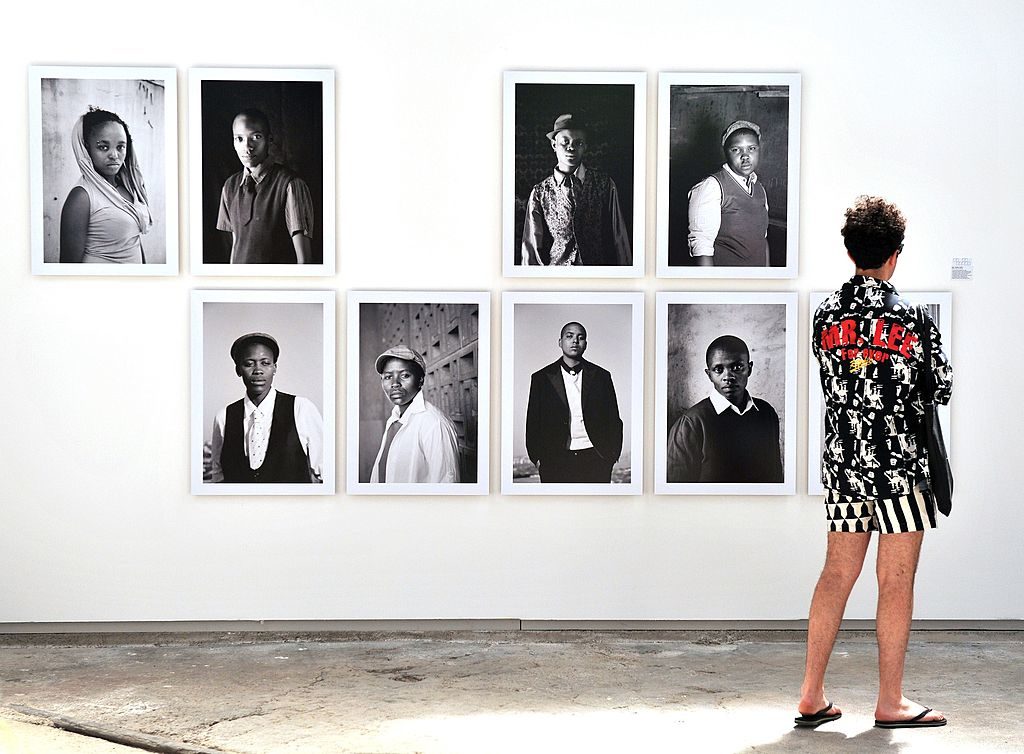
Pictures by South African photographer Zanele Muholi at the 43rd annual Rencontres d’Arles photography festival in France. Photo by Gerard Julien/AFP/Getty Images.
So it’s not surprising that many of the artists speak to issues that have only recently entered mainstream discourse. Jesse Darling’s work tackles issues of identity including gender, sexuality, and disability. Meanwhile, in a world where many are striving to “keep up” with the Kardashians and increasingly unattainable standards of beauty, Japanese artist Mari Katayama’s self-portraits forefront her own non-conforming body and call into question normalized ideals.
Then there is the work of South African photographer Zanele Muholi, who questions and destabilizes existing labels, and contests representations of the black body and LGBTQ people. Her self-portrait, Bona, Charlottesville, Virginia (2015), included in the exhibition, presents an image of the self as a site where cultural images collide.
In keeping with the recurring idea of time, the roster also includes several artists working across time-based media: London-based Ed Atkins, LA’s Ian Cheng, and Canadian artist Jon Rafman. Veteran video artists like Arthur Jafa and Hito Steyerl will also have work on view.
No Break From “Experience” Art
Rugoff has long embraced the growing trend of creating art “experiences.” At the Hayward Gallery in London, he oversaw Carsten Höller’s helter skelter slides, a balloon-filled room courtesy of Martin Creed, and the recently closed group show “Space Shifters,” which included a slew of disorienting, perspective-skewing works of art, such as Alicja Kwade’s steel-and-mirror maze, Weltenlinie, and Richard Wilson’s engine oil-filled room, 20:50.
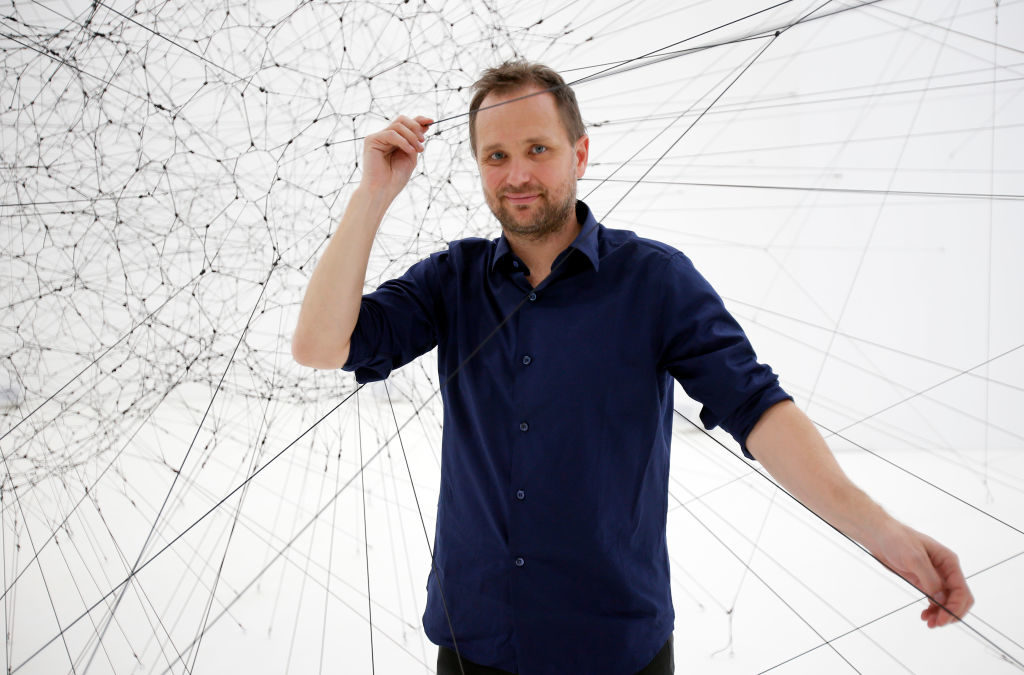
Argentinian artist Tomas Saraceno poses inside his work Algo R(h)i(y)thms at his exhibition ”On Air” at the Palais de Tokyo. Photo by Chesnot/Getty Images.
The Hayward director has been administering this kind of curatorial play in measured doses, which could prove promising for the upcoming biennale, where more than half of the visitors are expected to be under 26 years old.
In Venice, the French artist Dominique Gonzalez-Foerster, who has been making immersive and playful installations since the 1980s, will present Cosmorama: a life-sized diorama from an institutional show in Leipzig that aims to transport the viewer to Mars. Installation artist Tomás Saraceno, who created an incredible web structure at the Palais de Tokyo last year, is also on Rugoff’s list.
A Downsized Biennial
The late Nigerian curator Okwui Enwezor’s Venice Biennial, titled “All the World’s Futures,” seemed to hold the weight of the world on its shoulders. Then came the French-born Christine Macel’s “Vive Arte Viva” in 2017, which felt like PTSD therapy for the previous year with its focus on spellbinding, mystical art.
It doesn’t seem like “May You Live in Interesting Times” will locate itself on this same spectrum. Speaking in London about his plans for the biennial, Rugoff remarked on how the more than 300 existing biennials around the world often recycle variations on similar themes. That may be why he wants to reconsider the very structure of the exhibition. It is, for one thing, the smallest roster in at least a decade—and by a long shot. Rugoff’s biennial is 42 percent smaller than Enwezor’s and 34 percent smaller than Macel’s edition. It comes a little closer to Bice Curiger’s 2011 biennale, which included just 82 artists.
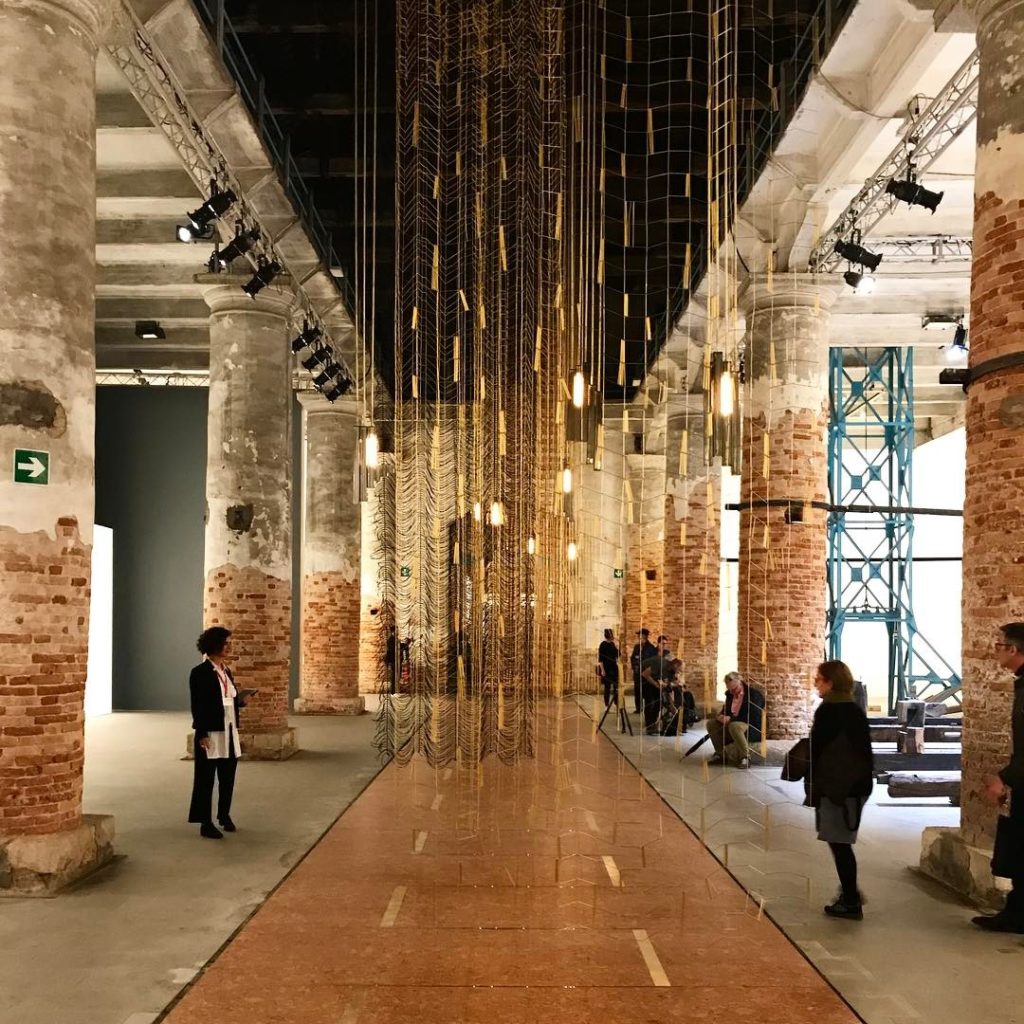
The Arsenale at the Venice Biennale. © Photo: Haupt & Binder.
The move also means that, theoretically, more of the biennial’s €13 million budget could be better distributed to each contributor at a time when there’s a growing awareness of the lack of resources given to artists. Exhibiting artist Otobong Nkanga found a solution for this with her Carved to Flow soap production “company” that she established at documenta 14. The project is ongoing and seeks new kinds of self-sustaining support structures.
Meanwhile, the gender gap appears to be closing, at least in this edition. Rugoff noted that the show will comprise 50 percent female-identifying artists, but he was quick to add that this was incidental, not a quota. He also pointed out that the national pavilions this year are also, incidentally, gender balanced.
Parallel Shows, Parallel Realities
Separating the main exhibition into two shows with the same crop of artists in each reflects the multiple realities that seem to be unfolding in the contemporary landscape. When introducing his double vision for the biennial, the curator acknowledged the appearance of many worlds in a time of “alternative facts,” and said he hopes the exhibition will foster dialogue across divisions. “Art grows out of a practice of entertaining multiple perspectives: of holding in mind seemingly contradictory and incompatible notions, and juggling diverse ways of making sense of the world,” he said in a statement.
Fittingly, he has mysteriously nicknamed his two exhibitions “Proposition A” and “Proposition B,” terminology that evokes—and disrupts—the classical structure of debate, which counters a proposition against an opposition. The curator cites the influence of the French philosopher Bruno Latour, who asked in 2004: “What would critique do if it could be associated with more, not with less, with multiplication, not subtraction?”
Parallel worlds will be a running motif in the biennale, and visitors will be able to project themselves into these different spheres, both through virtual reality and role play. Alex Da Corte will be presenting his much-loved and hilarious 57 Varieties, which debuted at the last Carnegie International. For that video work, he adopts the personas of various characters throughout the last two centuries of popular culture, from Bart Simpson to Bob Dylan to the Pink Panther.
Building Borders and Walls
This November marks 30 years since the fall of the Berlin Wall. Whether that feels like the distant past or not depends on your own perspective. And for the younger artists on the list, the topic of walls might conjure different associations. But in any case, the subject of borders remains a preoccupation across many demographics and it spans both sides of the political spectrum.
Rugoff has said he
is more interested in “pleasure and critical thinking,” than politics in an earlier interview with artnet News—and that he’s not interested in art that pushes a single point of view. Nonetheless, the politically-charged motif of walls will run throughout the exhibition. Mexican conceptual artist Teresa Margolles will take a wall from the Ciudad Juarez in Mexico that used to stand at a high school where teenagers were assassinated in a bout of drug-related violence. The forensic artifact is a heart-wrenching representation of the harm that can come from polarizing social divisions. Meanwhile, the Lebanese sound artist Lawrence Abu Hamdan shows that walls can always be penetrated. His 2018 work Walled/Unwalled, made within the resplendent Funkhaus studios in former East Berlin, looks at court cases that feature evidence obtained by listening through walls.
Painting Preserves Its “Zombie-Like Resilience”
Novelist Umberto Eco’s book The Open Work is “still incredibly cogent and fresh,” according to Rugoff, who has cited it as a cornerstone text. The 1965 book describes the culture of art as one that defies conformism and relentlessly questions its own conventions as well as those of society.
There will be a lot of painting that testifies to this idea, including art’s capacity to question its own conventions. “I’m always interested in how painting, which has been regularly declared dead for the last 60 years, has had this incredible zombie-like resilience and keeps finding ways to reinvent itself,” Rugoff told press in London.
To wit, Julie Mehretu’s work Sing, Unburied, Sing (2018), which will be included in the exhibition, looks at how the medium can share dialogue between two categorically separated methods of image-making: news photography and abstract painting. Beginning with documentary photographs of street protests and conflagrations, including Charlottesville’s infamous white supremacy march and counter-march, Catalonia’s independence rallies, and California’s wildfires, Mehretu blurs and obscures these found images in Photoshop and then overlays them with her characteristic gestural abstraction.
Last year, the double reveal of Kehinde Wiley and Amy Sherald’s presidential portraits seemed to signal the dawn of a new era of black portraiture. Black perspectives in painting will take center stage in Venice, too, by way of Njideka Akunyili Crosby, who will be including And We Begin to Let Go from 2013, and acclaimed painter Henry Taylor, who will show a work atypically depicting only white subjects.
What is painting and what is not? Rugoff gets at the eternal question by showing Avery Singer, an artist whose practice illustrates what the curator calls the “silliness” of categories such as “digital artist.” The painter favors inkjet printers over paintbrushes, and the curator notes that her work on canvas explores digital subcultures as much as an artist working in a purely digital medium.
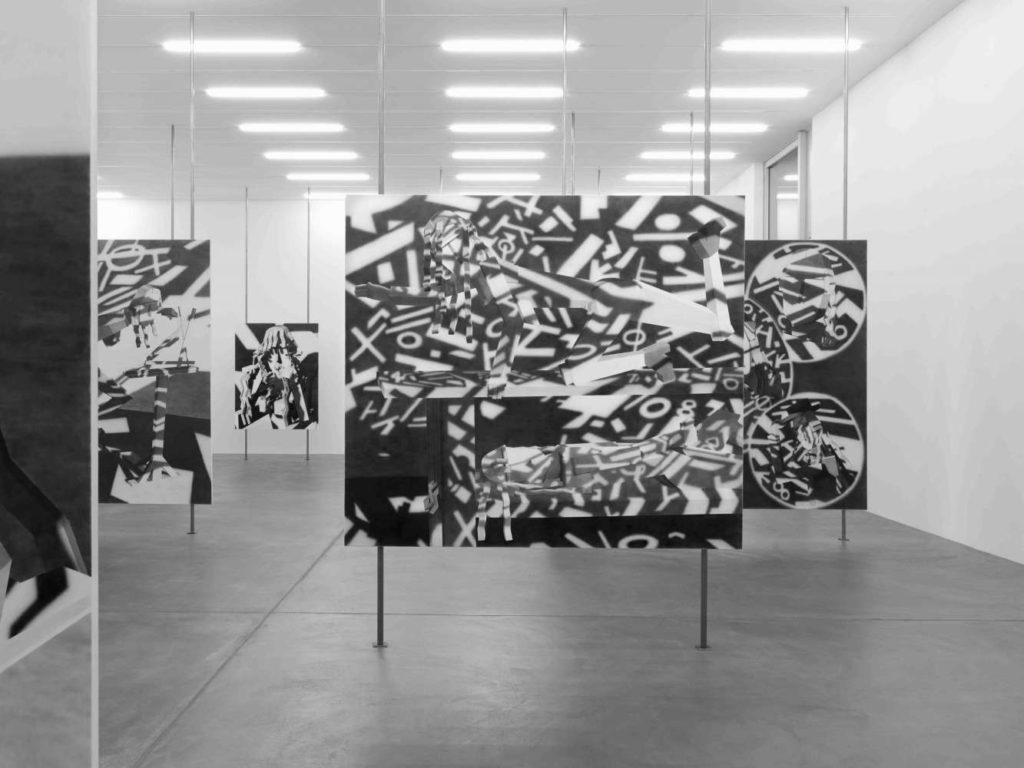
Installation view of “Avery Singer: Pictures Punish Words” at Kunsthalle Zurich, 2014. Photo © Annick Wetter, courtesy of Kunsthalle Zurich.
History in the Making
Of course, when the biennale opens in May, we will learn more about Rugoff’s vision. Its living, breathing roster will offer a time-stamp of the contemporary landscape, a measurement of where the art world finds itself.
What does that look like? Perhaps not all good. Though the gender-balanced selection is encouraging, and though there are enough non-white artists to stand up to allegations of tokenism, a Western perspective still dominates. With Europeans making up 30 percent of the list, and US artists accounting for another 20 percent, can the exhibition really deliver the multiple viewpoints it promises? What might be left out by the exclusion of historic artists? Whether “May You Live in Interesting Times” will prove to be representative of a truly pluralistic world view is an altogether interesting and important question—and time will only tell.
Follow artnet News on Facebook:
Want to stay ahead of the art world? Subscribe to our newsletter to get the breaking news, eye-opening interviews, and incisive critical takes that drive the conversation forward.