Monday, December 24, 2018

How My Eight Highly Specific Art-Market Predictions for 2018 Turned Out


The Gray Market: How My Eight Highly Specific Art-Market Predictions for 2018 Turned Out (and Other Insights)

Our columnist strikes a blow for art-market accountability by facing up to his 2018 predictions a year later.

Art from the Digital Art Museum: teamLab Borderless. Photo courtesy of teamLab.
Every Monday morning, artnet News brings you The Gray Market. The column decodes important stories from the previous week—and offers unparalleled insight into the inner workings of the art industry in the process.
For this week, a special edition…
With January just around the corner, you know what time it is across every province in pundit land: prediction season. But before I join the most courageous, foolhardy, and/or shameless of my keyboard-toting colleagues in guessing what next year has in store for my beat, it’s time to deliver on a pledge I made along with my 2018 prognostications: namely, to go back and assess how those prognostications held up at year’s end.
Below are my eight predictions from this January, with a little added context when the headlines don’t quite explain things on their own. Following each one is my completely subjective evaluation of its accuracy. And if you think this system means I’m less likely to be graded hard than if I turned over the task to someone else, you don’t know me very well.
OK, let’s see precisely how full of crap I was/wasn’t 12 months ago…

1. Five to 10 Mid-Tier Art Fairs Will Fold.

On Review: Close, but not quite.

The highest-profile casualty in this cohort was NADA New York, whose demise was announced in early August. In place of the fair, NADA states it will instead “dedicate additional resources to gallery programming during the March Art Week” in 2019 and beyond. A similar fate met the Singapore Contemporary Art Show, which got crushed by a falling piano (I mean, metaphorically speaking) in January.
Two other fairs may or may not be dead depending on your beliefs about resurrection. Art Stage Jakarta canceled its 2018 edition, allegedly to due to a conflict with the Asian Games, but pledges to return in 2019. The Moving Image Art Fair “postponed” its 2018 edition in April and still has yet to announce new dates over eight months later.
If you’re a skeptic, that brings the body count to four. The total rises to five if we include the “now-you-see-me-now-you-don’t” Basel edition of the Outsider Art Fair, which was canceled less than two months after its announcement early this year.
Also deserving mention here is Art Basel parent company MCH Group’s decisions “not to proceed” with Art SG in Singapore, as well as to sell its stakes in both the India Art Fair and Art Düsseldorf. However, all three of those fairs will apparently soldier on. Asian market veteran Magnus Renrew already swooped in to acquire MCH’s stake in Art SG, and MCH continues to search for buyers for its interests in the other two events as of my writing.
Still, I don’t think that’s quite enough to push this one over the borderline. I’ll take the L (for “loss,” to those of you not listening to enough hip hop).
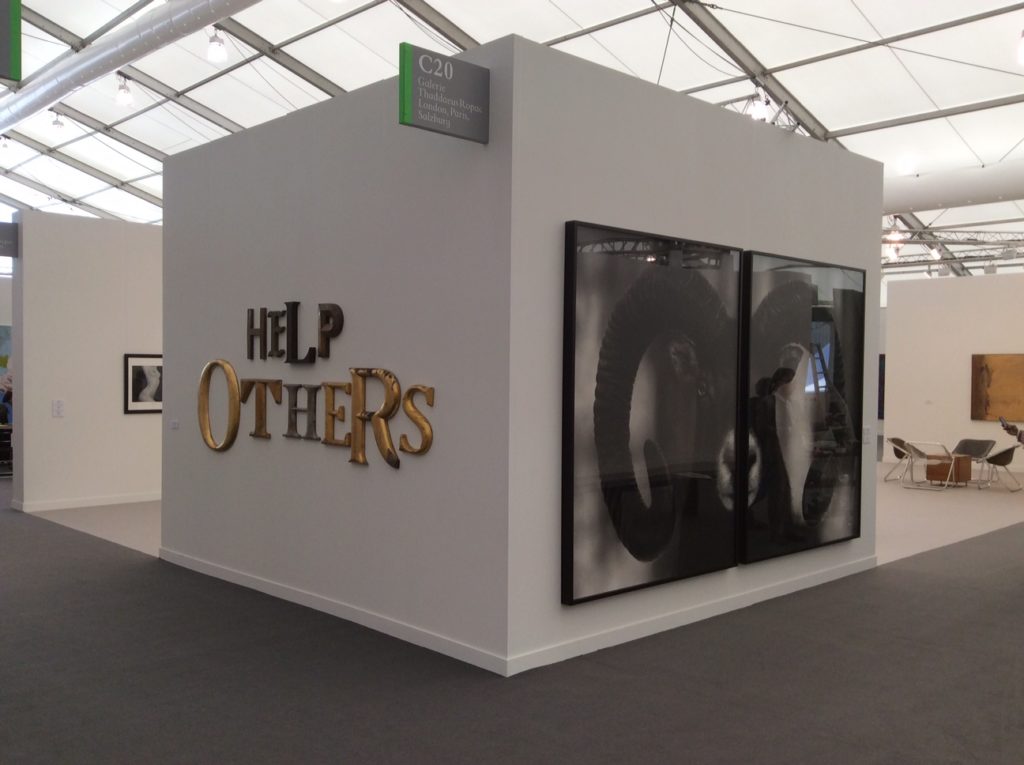
Works by Jack Pierson and Robert Longo at Thaddaeus Ropac’s stand at Frieze New York 2018. Photo courtesy of the gallery.

2. The Major Fairs Won’t Budge on Their Policy of Not Admitting Applicants Without Physical Galleries. 

On Review: One crack in the armor.

Art Basel (all three fairs), TEFAF (all three fairs), and the Armory Show all held their ground on this front. Technically, so did Frieze, as a spokesperson confirmed last week that the brand’s fairs in London, Los Angeles, and New York require contemporary galleries to have physical exhibition spaces and programs for eligibility.
However, Frieze exhibitors exclusively showing 20th-century art are exempt from this policy “to accommodate certain specialist dealers that operate using different models.” And while this has always been the case at Frieze Masters (and therefore excused that particular fair from this prediction), the caveat also applies to the Spotlight section at Frieze New York—a fact that allowed then-spaceless dealer Nicole Klagsbrun to show at the latter in 2018. (Tif Sigfrids also exhibited in the Frame section at Frieze New York while she was between permanent locations, but the Frieze spokesperson confirmed that Sigfrids still had her Los Angeles gallery when she applied and was already in the process of transitioning to her new Athens, Georgia space when the fair opened.)
All in all, then, there’s no seismic shift underway yet, but I’ll accept prognosticating defeat here on a technicality.

3. There Will Be at Least One New Merger Between Midlevel Galleries… and One Outright Acquisition of a Mid-Tier Gallery by a Top-Tier or Mega-Gallery.

On Review: Right neighborhood, wrong block.

There were no official mergers à la the short-lived Feuer Mesler, my model for the first half of this prediction. But as a canvassing of this year’s NADA Miami proved, there were plenty of extended collaborations forged by galleries beneath the sector’s cloud city. Four sellers from around the world also just announced last week that they will launch La Maison de Rendez-Vous, a collaborative space in Brussels, in January 2019. And for a somewhat posher example, Andrew Kreps, Kaufmann Repetto, and Stefania Bortolami established a long-term co-op space at 55 Walker Street in Tribeca. Still, since the allies in both La Maison de Rendez-Vous and 55 Walker are only adding their new collaborative ventures on top of their individual galleries, the projects aren’t quite enough to fulfill my would-be crystal-balling.
I got closer on the prediction’s second half thanks to longtime photography dealer Steven Kasher’s decision to close his namesake Chelsea gallery and join David Zwirner as a director. But even there, Zwirner didn’t subsume Kasher’s gallery as an entity, meaning the space, artist roster, and operations. He just brought in Kasher (and Kasher’s sales director, Cassandra Johnson) to beef up his personnel.
Still, in the spirit of “too early” being the same thing as “wrong,” I’m tempted to make this same prediction for 2019. Stay tuned to see if I’m brash enough to go through with it!
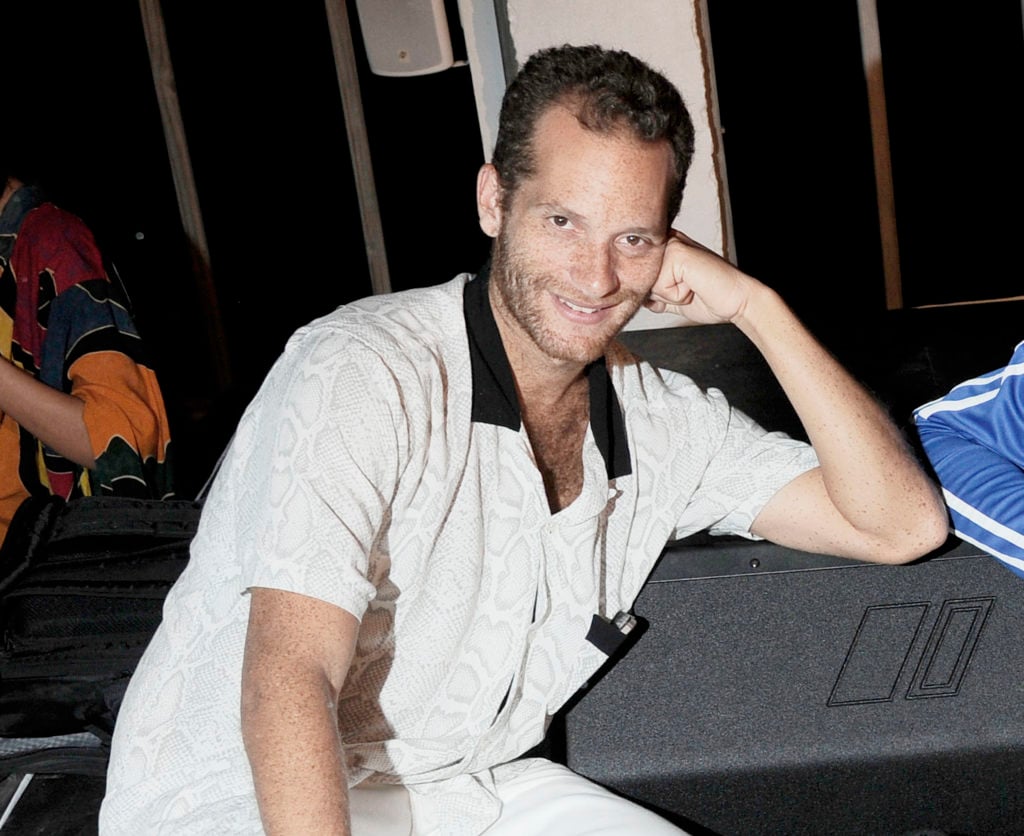
Aaron Bondaroff in Los Angeles. © Patrick McMullan, photo: Nicholas Hunt/Patrick McMullan.

 4. Sexual Misconduct Allegations Against a Sub-Elite Gallery’s Founder Will Force the Gallery to Close.

On Review: Regrettably for all but the wheels of justice, nailed it.

Gallerist Aaron Bondaroff, known as “A-ron the Downtown Don” during his days as an LES brand ambassador/scenesterresigned from Moran Bondaroff in February after three different women accused him of sexual misconduct. (Bondaroff maintains the encounters were all consensual.) His then-partners in the gallery, brothers Mills and Al Moran, told ARTnewsshortly after the story broke that Bondaroff’s ownership stake would be dissolved, ending Moran Bondaroff proper. The Morans soon rebranded and relaunched the gallery as Moran Moran.
Dishonorable mention: Multiple allegations of past misconduct surfaced against legendary British dealer Anthony D’Offay in January. He departed his role as ex-officio curator of Artist Rooms, a touring collection of contemporary art held in partnership between Tate and the National Galleries of Scotland, in December 2017, but the story only emerged in the press the following month. The two museums announced in mid-Januarythat they would “suspend any further contact with Mr. d’Offay until these matters have been clarified.” D’Offay denies the allegations.

5. Christie’s and/or Phillips Will Follow Sotheby’s Lead by Subsidizing the Work of Underappreciated Artists and Movements.

On Review: Dead wrong.

As a reminder, the Sotheby’s Prize is “an annual award of up to $250,000 to support and encourage museums to break new ground” by “[facilitating] exhibitions that explore overlooked or under-represented areas of art history.”
My mistake here was to let my fixation on the art world’s usual “follow the leader” tendencies obscure the appreciably different business models being run by the Big Three houses, especially when it comes to non-auction activity.
Sotheby’s has for years been shaping itself into a protean art-services superstructure, with Art Agency, Partners leading a strong advisory and editorial component that gels nicely with the Sotheby’s Prize. (Sotheby’s/AAP’s own Allan Schwartzman is a member of the prize’s six-person jury.)
Christie’s has no interest in that business at this point. True, the house directly sponsors institutional exhibitions in its various markets, but that’s nothing new among the gavel gang. Christie’s primary business goal is to gobble up as much market share in the auction sector as it possibly can, by any means necessary—not to expand its mission.
Phillips, meanwhile, has steadily and smartly built itself up over the past several years by laser-sighting onto the middle market for 20th century and contemporary art, plus establishing a growing business in timepieces and jewelry (or, as the category was repeatedly described in an unnamed art-market report that went from lulling me to sleep to inexplicably throwing me a beret, a hand-rolled cigarette, and a toasty bottle of red, le haute joallerie).
Long story short: Sotheby’s is the only house that wants to do things like this, at least right now. I should have known better. C’est la vie.
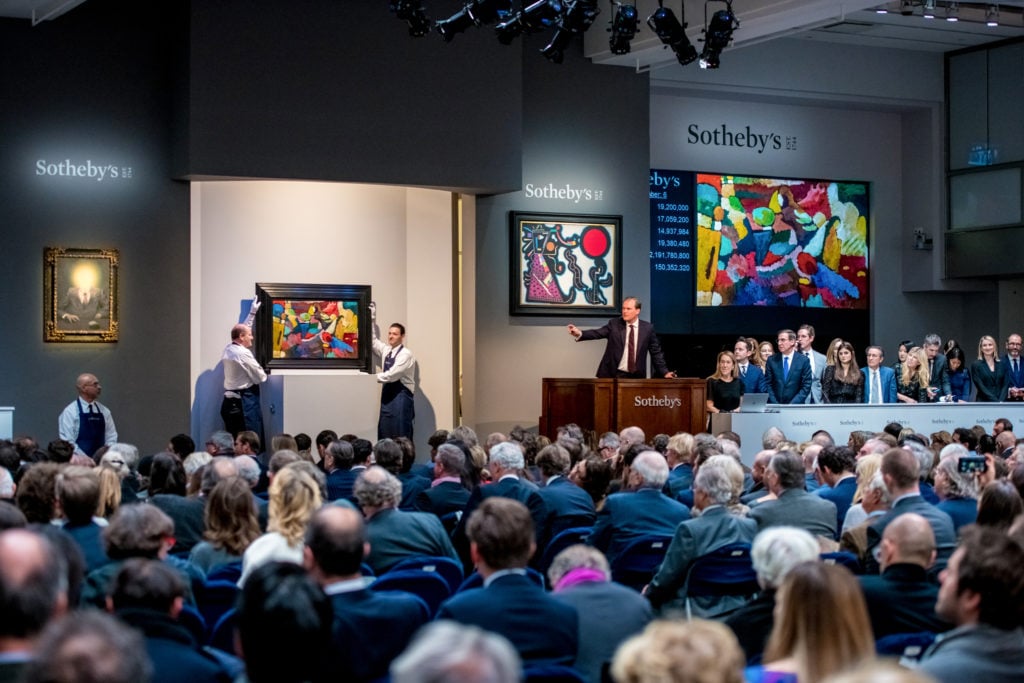
Sotheby's Impressionist and Modern evening sale in New York, November 2018. Image courtesy of Sotheby's.
Sotheby’s Impressionist and Modern evening sale in New York, November 2018. Image courtesy of Sotheby’s.

6. Absent an Economic Crash, Auction Houses Will Continue Handing Out Exorbitant Guarantees.

On Review: Bullseye.

Although I get a demerit for leaving the original prediction a little too open-ended—what exactly qualifies as “exorbitant”?—it’s pretty hard to say the figures don’t fit any reasonable definition of the word.
The Economist recently reported (via ArtTactic) that the evening auctions at Christie’s, Sotheby’s, and Phillips New York this November rang up $537 million in guarantees, while The Art Newspaper relayed at the start of the same sales cycle that “projections from one [third-party] guarantor’s in-house analysis team estimate that auction sales worth $3.47 billion worldwide in 2018 will have been covered by a guarantee.” (Also notable: The same source projected that the houses offloaded $2.5 billion of that risk onto third parties.)
But like strictly hanging out with ugly people to try to make yourself look better by comparison, this strategy is going to backfire sooner than later. Will 2019 be the year? Time will tell.

7. A Hollywood Agency Will Help One or More Blue-Chip Artists Open a Ticketed Fine-Art Fun House—Permanently. 

On Review: Too ambitious by half.

Here’s an unsolicited piece of advice for any aspiring Cassandras and Nostradamuses (Nostradami? Can I do that? Who’s with me?): If you’re going to make predictions, don’t be dumb enough to make them multi-part.
Had I just stuck to the back half of this one, which anticipated a new attraction in the vein of immersive-installation blockbusters like Yayoi Kusama‘s Infinity Mirrored Rooms or Big Fun Art like Meow Wolf’s House of Eternal Return, I might have coasted to safety thanks to the debut of the teamLab Borderless Digital Art Museum in Tokyo.
But in typical fashion, I had to push the limits by proposing UTA Fine Arts, Endeavor, CAA, or one of its lesser competitors would further Hollywood agencies’ love affair with contemporary art by facilitating the project. Way to snatch defeat from the jaws of victory, T.
Anyway, lesson learned. Maybe. I hope… (Heavy sigh) Probably not.
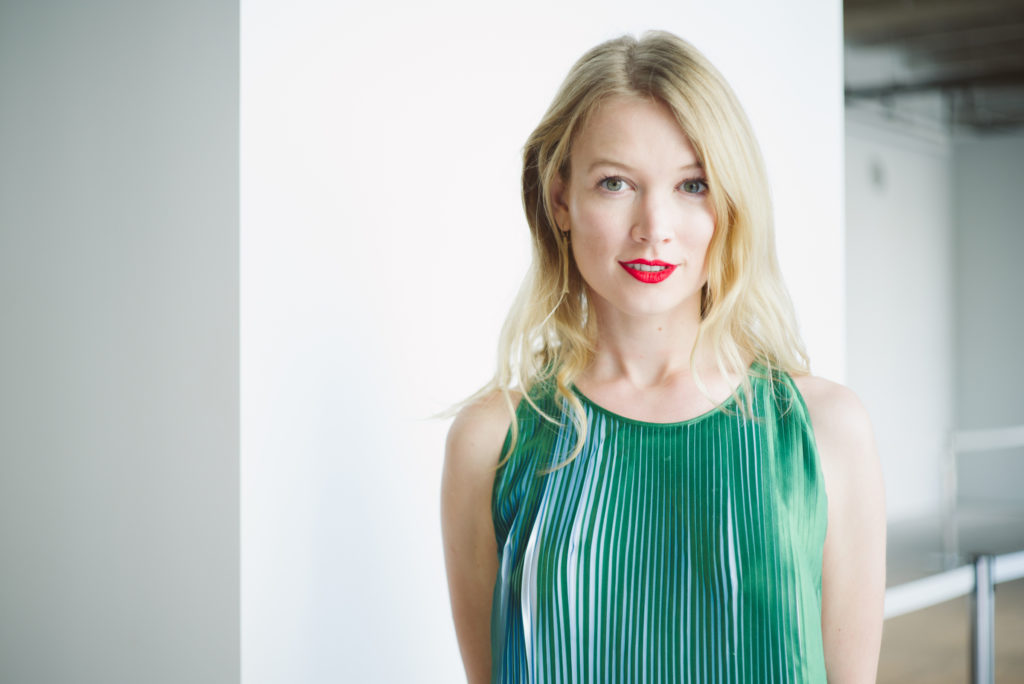
Elena Soboleva, David Zwirner's first Online Sales Director. © Gesi Schilling. Image courtesy of David Zwirner.
Elena Soboleva, David Zwirner’s first Online Sales Director. © Gesi Schilling. Image courtesy of David Zwirner.

8. For-Profit Art Businesses Will Make Fewer Than Five Structural Investments in Tech. 

On Review: Finished strong! (I think)

Since this feels like a case where the headline could use a little context, I wrote at the time that my definition of a “structural investment in tech” was:
An initiative that transforms—even in some boring day-to-day aspect—how the entity in question does business. Something worth formally announcing, even if wonks like me are the only people who get excited about it at first. Think: A gallery hires a developer to create a virtual-reality “back room” accessible by key collectors; an art fair strikes up a partnership with a leading cybersecurity firm; an auction house curates a selling exhibition exclusively showcasing time-based or interactive new media.
Now, it’s entirely plausible that I just missed a couple of meaningful press releases. But otherwise, the only four relevant events in this arena were Sotheby’s acquisition of Thread Genius, a machine-learning startup tasked with building the house a Netflix-style recommendations engine for artwork and objects; David Zwirner’s hire of Elena Soboleva as online sales director, a newly created position geared toward maximizing the gallery’s digital viewing rooms; Gagosian’s launch of its own temporary, high-end online salesroom in sync with Art Basel this June; and Paddle8’s merger with the Native, a Swiss tech company, to reshape its business around blockchain technology and other millennial-baiting strategies.
Some people might also advocate for the inclusion of Christie’s collaboration with blockchain title registry Artory, in which the house agreed to input provenance info for all works in the Barney A. Ebsworth collection into Artory’s encrypted, decentralized database. But given the extremely limited scope of the collaboration, I think this is more a pilot program than a structural investment—and therefore, not enough to qualify.
All of which means that, in 2018, it still turned out to be a good gamble that mainstream players in the art market would be slow to embrace innovation. It calls to mind a quote from the legendary NFL coach Chuck Noll: “If you don’t like change, you’re going to like irrelevance even less.”
Words to live by in the new year? We’ll all find out soon enough.
That’s all for this edition. ‘Til next time, remember: Hindsight may be 20/20, but it’s irrelevant if you never actually turn around to look.

Follow artnet News on Facebook: 
 
Want to stay ahead of the art world? Subscribe to our newsletter to get the breaking news, eye-opening interviews, and incisive critical takes that drive the conversation forward.
SHARE

Surprising, Macabre, and Illuminating Books for Art Lovers


9 Surprising, Macabre, and Illuminating Books for Art Lovers to Read Over the Holidays

From tales of great but irate artists to a mini compendium of teeny-tiny artworks, these books will thrill on the beach or by the fireside.
Beach reading, perhaps? (Photo by Lisa Maree Williams/Getty Images)
Given that this year’s holiday calendar has resulted in a blissfully long break for many people, now is the time—maybe, depending on how accelerated your lifestyle has become in the modern era, the only time—to delve into a great art read. The artnet News team’s picks range from novels where art is a subplot to rip-roaring dramas about artist protagonists to biographies of real-life muses.
Happy holidays, and happy reading!

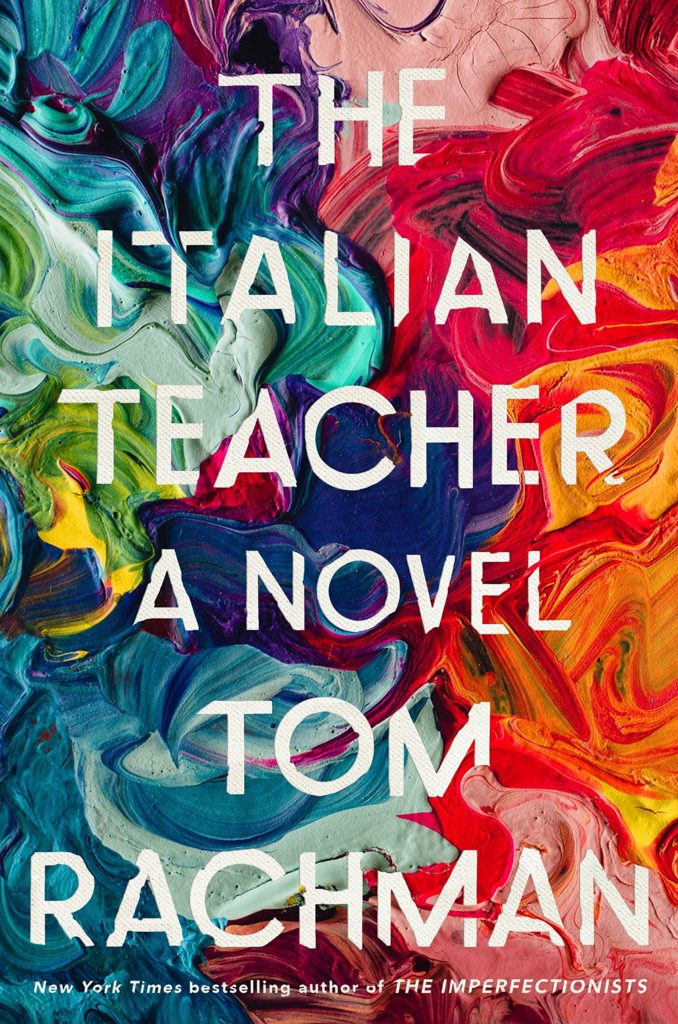
The Italian Teacher by Tom Rachman (2018)

The Italian Teacher by Tom Rachman (2018). Courtesy of Viking.
A case study on the artist as tortured genius, The Italian Teacher doesn’t tell the story of the great Bear Bavinsky, a celebrated portraitist of naked women who eschews the market, holding out for a place in the world’s great museums rather than on the walls of monied collectors. Instead, it follows the artist’s son, Pinch, as he struggles to carve a place for himself in his larger-than-life father’s shadow.
Bear became an overnight sensation thanks to a 1953 Life magazine story—not so much for the critical praise heralding him as “tomorrow’s action painter, conjoining twentieth-century dynamism with classical forms,” but for the reflection of his female model’s nipple, unwittingly included on the magazine cover.
Distrustful of the market, which adored his expressionistic “life-stills”—portraits that honed in on a single body part—Bear becomes increasingly reluctant to show anyone his work. Then a series of events leaves Pinch to take control of his father’s legacy, in the unlikeliest of ways.
—Sarah Cascone

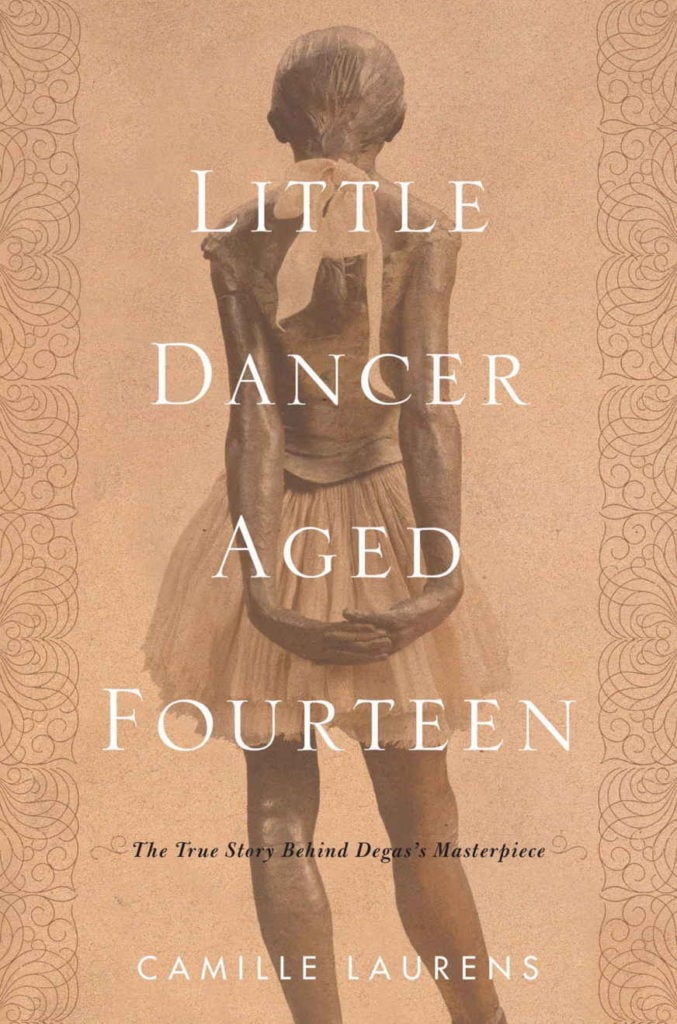
Little Dancer Aged Fourteen: The True Story Behind Degas’s Masterpiece by Camille Laurens (2018)

"<em
At the “Impressionist Exhibition” of 1881, Edgar Degas debuted a tiny statue of a teenage ballerina to mixed reviews. Since the work has now become one of the most famous sculptures in the world, it’s difficult to appreciate just how revolutionary it was to audiences at the time, achieving near-uncanny-valley status with the realism of its wax skin, human hair, and cloth garments. Even more shocking to the aesthetes of Paris, however, was the subject itself: one of the “little rats” of the opera, young girls in training to join the corps de ballet.
In this book, author Camille Laurens takes a deep dive into the seedy world of the Parisian ballet, uncovering the sad, hard lives of the mere children working long, hard hours with little chance of escaping the vicious cycle of poverty and, all too often, prostitution. It was one of those little strivers, Marie Genevieve van Goethem, who achieved immortality as Little Dancer, Aged Fourteen.
Marie’s life, small and seemingly insignificant though it might seem, is just as much the subject of the book as the work she inspired, with Laurens tracking down every possible mention of her in the historical record. Sadly, however, very little information about Marie has survived, offering only tantalizing glimpses into the real girl who lay behind the proud, bold sculpture that found a place in the art history text books.
—Sarah Cascone

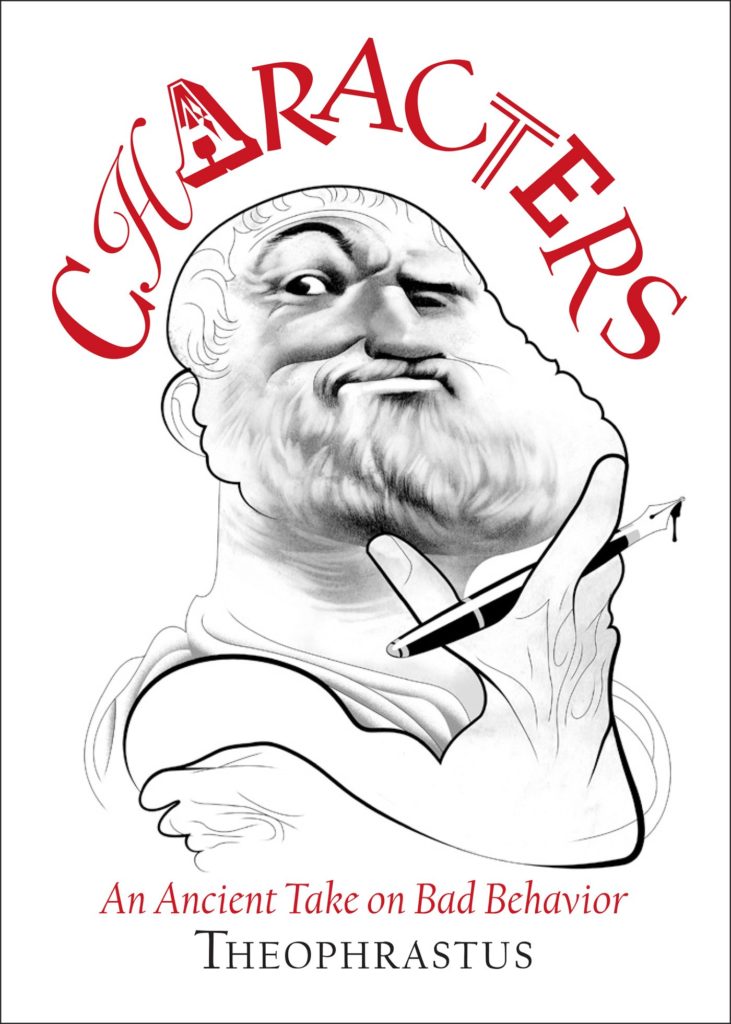
Theophrastus’ Characters: An Ancient Take on Bad Behavior by James Romm (2018)

"<em
Artist Andre Carrilho breathes life into an ancient Greek classic with his delightful illustrations of Theophrastus’s ancient text, which breaks down common human flaws into 30 characters. Each drawing perfectly captures the inherent ugliness of such societal archetypes as the busybody, the social climber, the coward, and the flatterer.
The text is remarkably timeless, demonstrating that mankind’s faults resonate across 23 centuries—and there are also constant reminders that this wasn’t written about the ugly Americans of the 21st century but ancient Athenians (with helpful annotations by classicist James Romm). Take, for instance, the instantly recognizable miser: “at a communal supper, he keeps count of how many glasses each man has drunk, and then the initial libation he pours to Artemis is smaller than that of any of his fellow diners.” What a jerk.
—Sarah Cascone

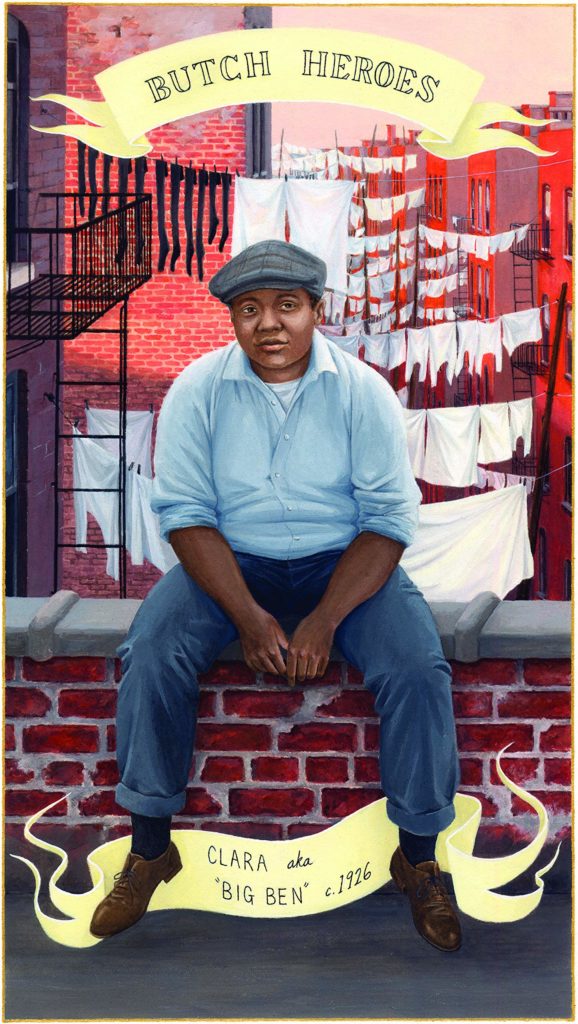
Butch Heroes by Ria Brodell (2018)

"<em
In the works since 2010, Butch Heroes is equal parts art project and history book, with the artist and author Ria Brodell uncovering the personal lives of 28 historical women who refused to conform to gender norms, reaching back as far as the 15th century for incontrovertible evidence that gender fluidity existed long before there was a name for it. This research, Brodell explains in the book’s intro, “requires reading through the lines because so much of queer history has been explained away as illness, romantic friendship, opportunistic cross-dressing, or fraud.”
Sadly, many of the tales Brodell has unearthed have unhappy endings—most of these non-conforming women made it into the historical record by attracting the attention of legal authorities, who never knew quite what to make of them. But while Catharina “Anastasius” Linck, who married a woman, was beheaded for sodomy in Prussia in 1721, there was also D. Catalina “Antonio” de Erauso who fought for Spain in the New World, successfully petitioning the pope to live as a man and receiving a government pension in the 1600s.
Appropriately, Brodell has memorialized her subjects with poignant portraits, painted in the style of Catholic holy cards of the saints, recognizing and honoring their inherent dignity as she writes LGBTQIA individuals back into the history books.
—Sarah Cascone

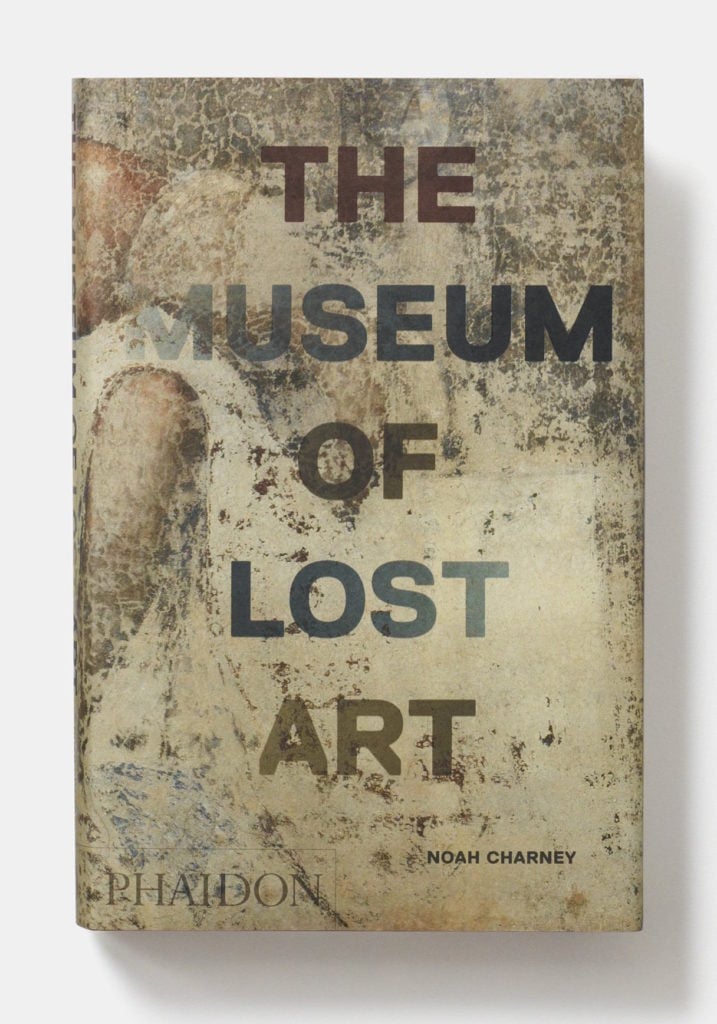
The Museum of Lost Art by Noah Charney (2018)

The Museum of Lost Art by Noah Charney (2018). Image courtesy of Phaidon Press.
The conceit of Noah Charney’s latest book is a rather elegant one: over millennia, so many great artworks have been lost or destroyed that, were they to be somehow recouped, they would easily fill a museum to rival the world’s foremost institutions. From infamous cases of art theft, like the 1990 Isabella Stewart Gardner Museum heist in Boston, to wartime looting and devastating fires, various acts of art historical loss are rehashed with gusto in this book.
It reads like a little bit of a laundry list of artworks at times, but Charney does draw out some interesting stories from the annals of art history that even the dedicated aficionado might not be familiar with, making it clear that our understanding of artistic heritage has been shaped by forces beyond our control.
Did you know, for instance, how close we came to losing Diego Velazquez’s Las Meninas to in 1734, when the Royal Alcázar palace in Madrid went up in smoke? Such narrowly averted disasters make you wonder how well lost masterpieces would stack up to the existing canon, and invites speculation as to how modern technology might someday begin to replicate art historical treasures heretofore presumed to be lost forever.
—Sarah Cascone

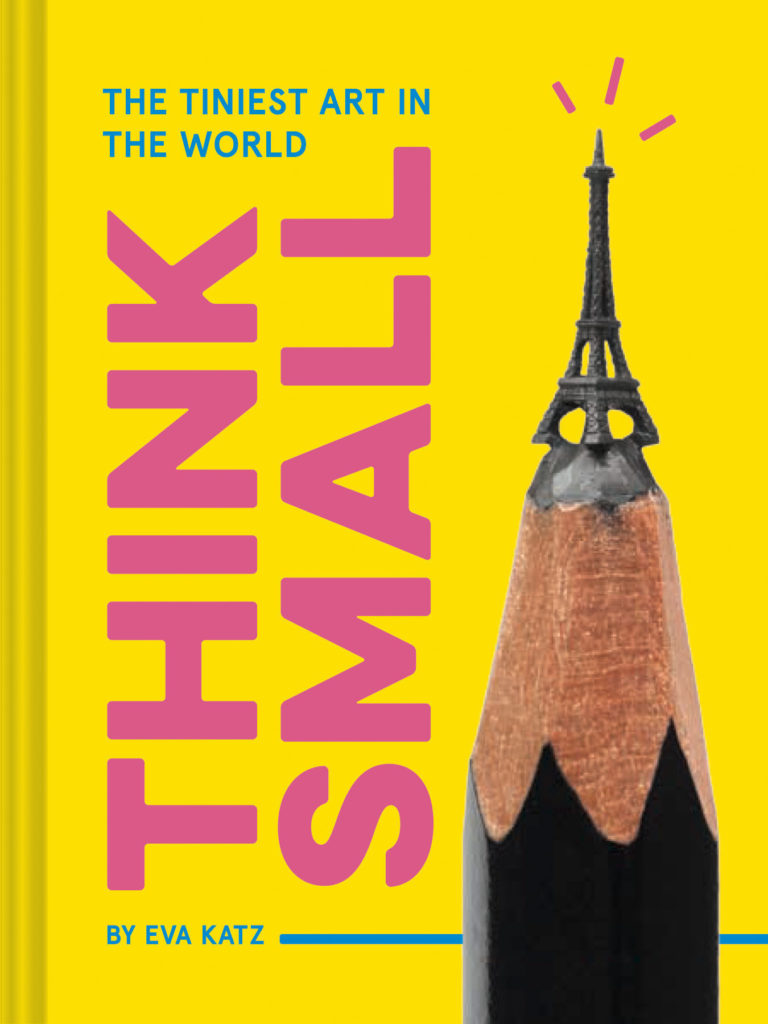
Think Small: The Tiniest Art in the World by Eva Katz (2018)

"<em
Marvel at the extreme dexterity and patience of 24 contemporary artists who painstakingly labor to create artworks at miniscule scale in this adorably tiny coffee-table book. From Hasan Kale, who somehow turns halved almonds and matchstick heads into canvases, to Salavat Fidai, who carefully carves pencils into tiny lead sculptures, each diminutive piece offers mind-blowing demonstrations of craft, skill, and artistic vision.
—Sarah Cascone

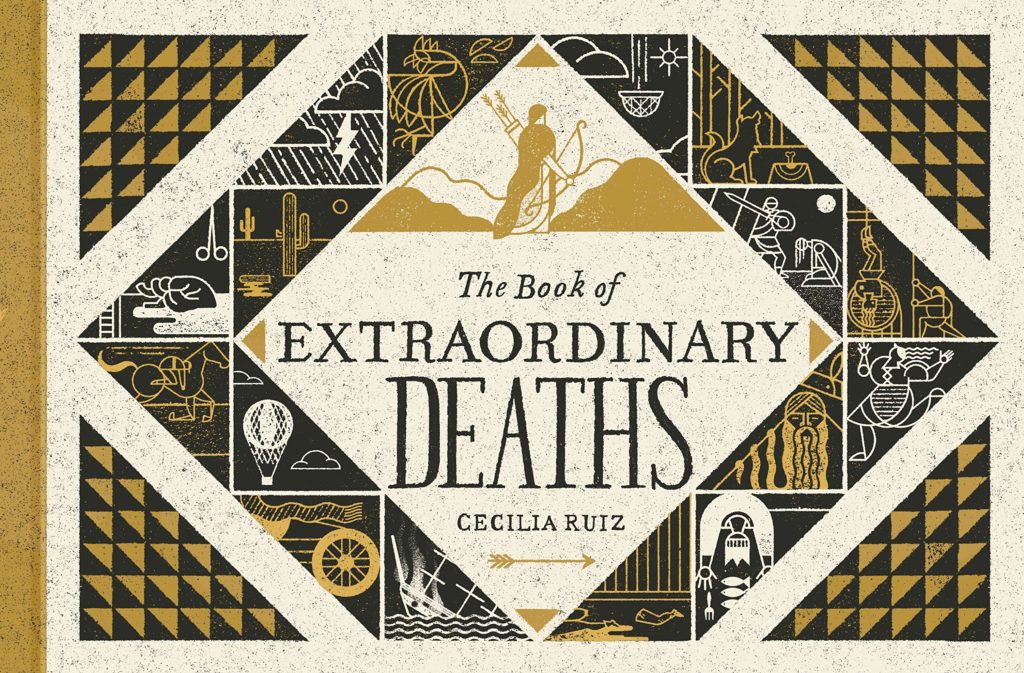
True Accounts of Ill-Fated Lives: The Book of Extraordinary Deaths by Cecilia Ruiz (2018)

"<em
This quirky, playful, amusingly macabre artist’s book is exactly what it sounds like. Cecilia Ruiz has collected history’s most bizarre demises and illustrated them.
There’s George Plantagenet, who in 1478 is said to have chosen to die by drowning in a barrel of wine after he was sentenced to death for plotting against his brother the king. Of more recent vintage, in 2011, cock-fighter Jose Luis Ochos died when one of his roosters stabbed him with a metal spur used in the illegal sport. And, in ancient history, the lawmaker Draco allegedly gave a brilliant speech to the citizens of Athens, who then accidentally suffocated him under a pile of coats, hats, and other gifts thrown in admiration.
A beautifully ironic tribute to the absurdity of human life—and death—True Accounts is morbid in all the best ways, and should serve as the perfect antidote to those currently overwhelmed by Christmas cheer.
—Sarah Cascone

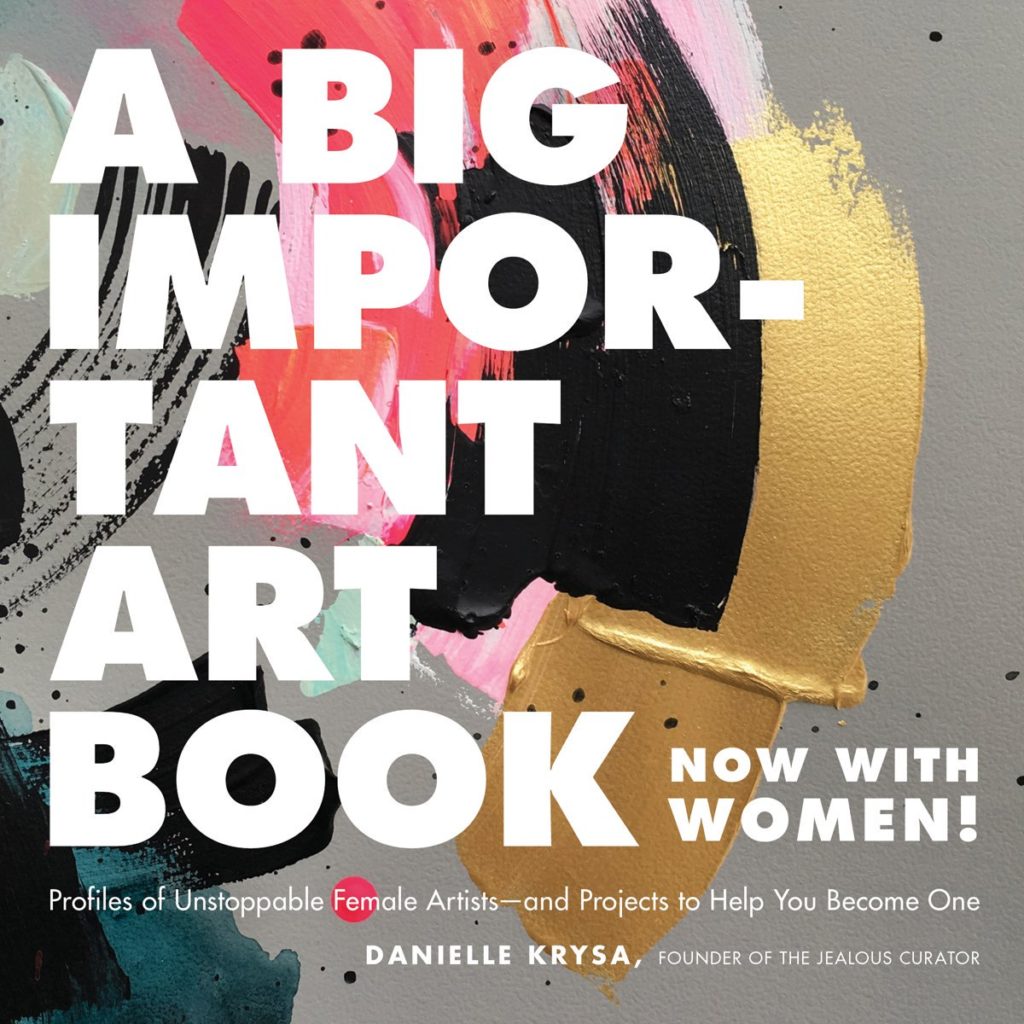
A Big Important Art Book, Now With Women! Profiles of Unstoppable Female Artists—and Projects to Help You Become One by Danielle Krysa (2018)

"<em
There are a lot of things to like about A Big Important Art Book by Danielle Krysa, founder of contemporary art website the Jealous Curator. I suspect that the book’s informal, chatty writing style may be hit-or-miss with readers—I found it annoyingly cutesy, but I guess all art writing doesn’t have to feel formal, and it might even make it more accessible for a broader audience.
In any case, we need projects like this to help level the playing field for women artists and to correct centuries of gender imbalance in the art world. Secondly, there is no way you won’t discover a new artist in this book: even for a journalist who often spotlights the work of female artists, only a small handful of the 45 contemporary artists featured here ring a bell.
Krysa has done an admirable job of sitting down with her subjects, sharing the stories of their lives, their artistic inspiration, and their working methods. I didn’t necessarily need to read the artists’ statements, which almost inevitably veer into the realm of incomprehensible art speak, but I’ll definitely keep an eye out for the work of Seonna Hong, Naomi Okubo, and others in the future.
Another thing Krysa has done well is the illustrations, with gorgeous photographs of each contemporary practitioner’s work—which makes the lack of imagery for the historical women artists highlighted in each section all the more galling. I was more familiar with the careers of those women, but I still would have appreciated the juxtaposition of Ruth Asawa’s elegant wire-basket forms with British sculptor Ann Carrington’s works made from found materials like buttons and barbed wire.
—Sarah Cascone

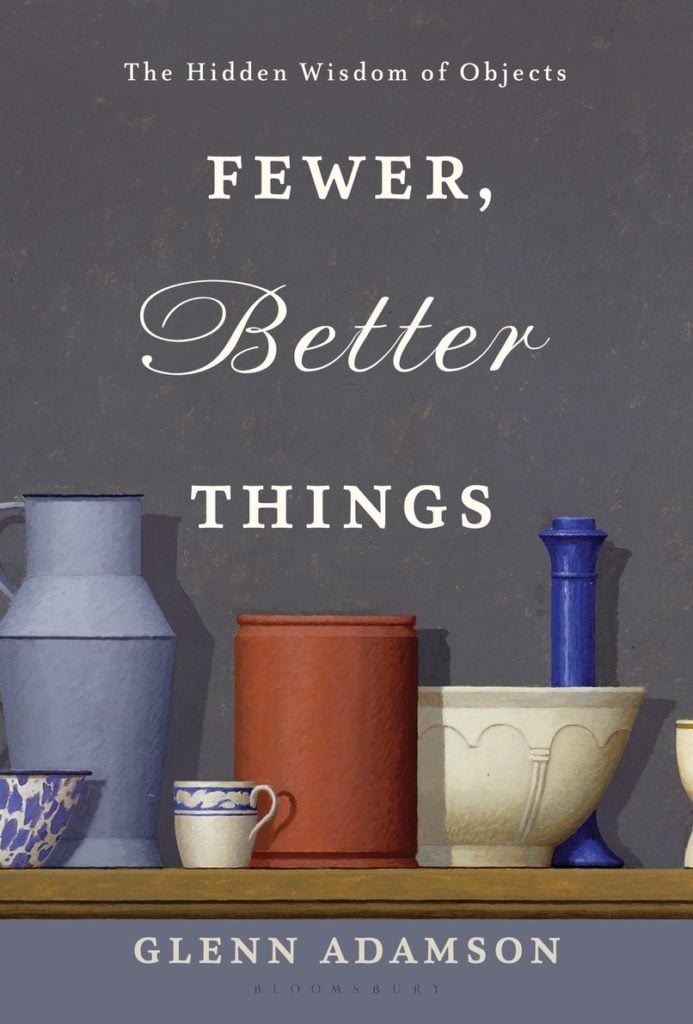
Fewer, Better Things: The Hidden Wisdom of Objects by Glenn Adamson

"<em
Glenn Adamson, former director of New York’s Museum of Arts and Design, may have just become the Marie Kondo of the art world with his new book, which makes a case—seemingly antithetical to the ethos of collecting—for owning fewer things and becoming more in touch with our possessions.
The book is a celebration the history of craft, even as it bemoans our increasing dependence on smartphones and other plugged-in devices. (Adamson also highlights the environmental impact of our consumerist culture.) His hope is that, as we pare down our cluttered lifestyles, we can become more in tune with the pleasures of everyday materiality. Consider, for instance, a street in Manhattan, which Adamson considers in extraordinary, exquisite detail:
“Look down, and you’ll see pavement of hot poured and rolled asphalt. It is punctuated by steel manhole covers, which are round, because a square or rectangular cover turned at the wrong angle would drop right into the hole. To make them, a design first had to be carved in wood or machined in aluminum. The resulting pattern was then set into fine and densely packed san, leaving a very detailed impression, into which the foundry workers poured molten iron….”
It’s hard to imaging engaging with our world this way on a regular basis, but it’s a useful exercise that will make you take a long, hard look at everything you own, consume, and possess.
—Sarah Cascone

Follow artnet News on Facebook: 
 
Want to stay ahead of the art world? Subscribe to our newsletter to get the breaking news, eye-opening interviews, and incisive critical takes that drive the conversation forward.
SHARE

Bloomberg’s Multimillion-Dollar Art Shed + Funding 52 Emerging Artists


There Is a Dystopian Cultural Vision Hidden in Michael Bloomberg’s Multimillion-Dollar Art Shed

The half-billion-dollar art center drops a manifesto, making big claims for its mission.
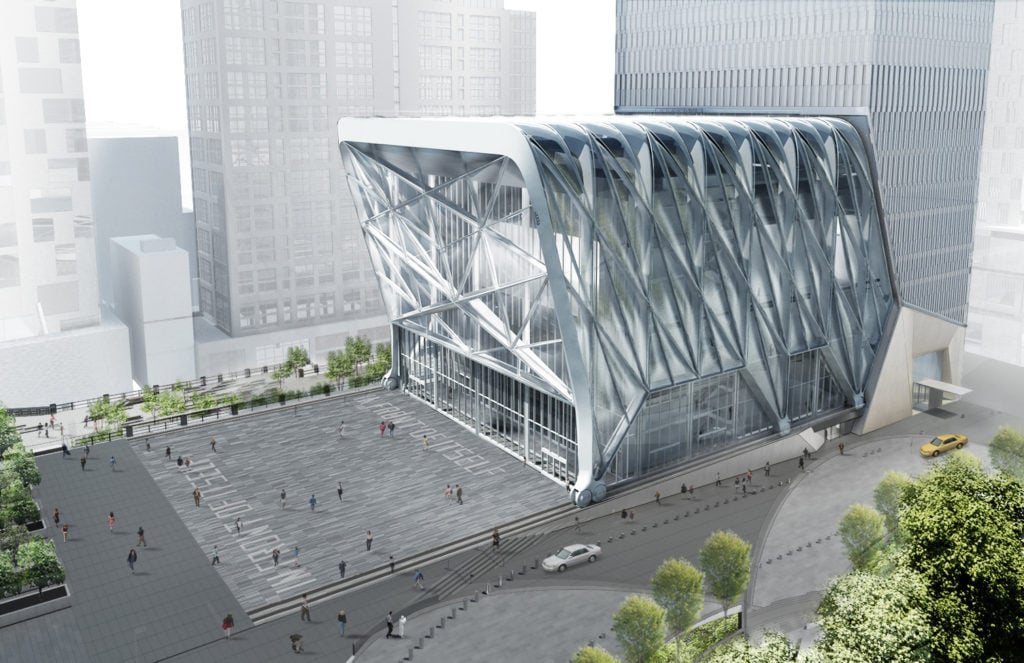
The Shed and Lawrence Weiner's IN FRONT OF ITSELF (rendering). Image courtesy of Diller Scofidio + Renfro in collaboration with Rockwell Group.
The Shed and Lawrence Weiner's IN FRONT OF ITSELF (rendering). Image courtesy of Diller Scofidio + Renfro in collaboration with Rockwell Group.
The Shed is nothing if not designed to catch attention. And for what it is costing, let’s face it, it better catch attention: the state-of-the-art kunsthalle-cum-bandstand is being built for the modest cost of a half billion dollars—including $75 million personal donation from Michael Bloomberg, on top of the $75 million the city appropriated for the project under his mayoralty, back when it was still called the Culture Shed.
The Diller, Scofidio & Renfro/Rockwell Group-designed final structure won’t open on the High Line until next year. Created as a transformable, mixed-use space and under the direction of Alex Poots, who helmed the Park Avenue Armory as it became a locus for large-scale spectacle art, the Shed boasts that it is the first cultural venue that has been conceived, from the ground up, to commission and host new work from all the arts, from “Kanye West or Björk or Kenneth Branagh, Steve McQueen, Matthew Barney or FKA twigs,” as Poots puts it.
Groovy as that sounds, a sense of superfluity has hovered over an initiative that the Shed’s board chair Daniel L. Doctoroff calls “America’s largest cultural startup.” Along with Thomas Heatherwick’s immense staircase-to-nowhere folly, to be sited nearby in Hudson Yards, and the Barry Diller-backed leisure island in the Hudson River just down the waterline, the Shed would seem to be a testament to an urban program now given over to buying big new toys. Why New York needs a Shed is not clear, and at times even the people presiding over the whole thing haven’t been that clear.
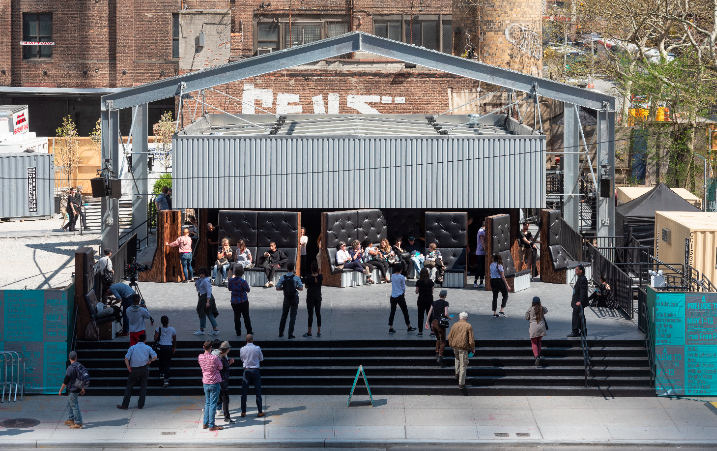
The Prelude to the Shed. Image courtesy the Shed.
And so, for the last two weeks, something called the Prelude to the Shedwelcomed curious crowds to a temporary pop-up structure in the shadow of the Shed’s construction site, with the goal being to get people excited. The Prelude amounted to a quirky structure, designed by architect Kunlé Adeyemi, made of mobile black leather benches that could be locked together as walls to form a black-box theater or broken apart to create an open-air stage—a teaser for the protean spirit that the Shed aspires to conjure, in much more high-tech form, when it is completed nearby.
Event programming included performances by Azealia Banks—famous for her offbeat anthem “212” and on-again, off-again fervor for Donald Trump—as well as a live work, This Variation, choreographed by the artist Tino Sehgal. The latter involved a cluster of dancers chanting in unison and dancing in the darkened, closed Prelude space, then opening up the moving panels/benches, their rhythmic sounds periodically giving way to moments of personal confession. (New York‘s Justin Davidson has an account of the experience.) All this was meant to show off the kind of media-crossing experimentation that the Shed hopes to capture, and it was cool.
From my point of view, however, the most important event of the Prelude was this: the Shed has put out a manifesto.
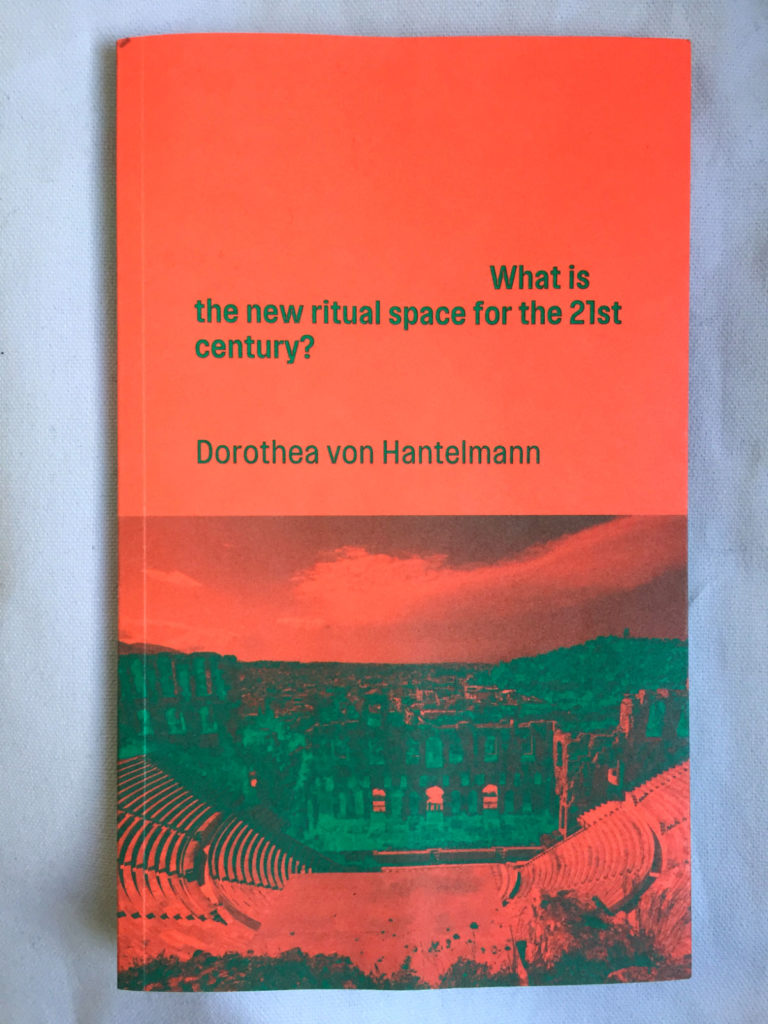
It is 50 pages long, penned by Bard College Berlin curator and scholar Dorothea von Hantelmann, and it was offered to all takers at the pop-up. Lest there be doubt that this pamphlet holds an answer to the lingering “why” hanging over the entire enterprise, it opens by asking grandly: “If the theater was the ritual place of Greek antiquity, the church that of European medieval times, and the museum that of modern industrial societies: What is the new ritual space for the 21st century?”
For those who are still asking, “How can New York afford the Shed?” the manifesto, in essence, boldly asks back, “How can New York afford not to have the Shed?”

The Reformatted Gesamtkunstwerk

So what is the mission of the Shed?
Societies of antiquity, von Hantelmann argues, were held together by the cultural ritual of the theater, which allowed people to come together in one space, and at one time, to visualize their community. But modernity brought a new sensibility that was serviced by the modern invention of the museum, which, von Hantelmann maintains, created a new cultural style more appropriate to the spirit of liberal individualism. Objects that were once experienced as part of acts of ritual togetherness were now placed in a context where individuals could wander among material treasures in their own, distracted, singular, secular, skeptical ways.
The Shed Manifesto. Image courtesy Ben Davis.
Now, in the culturally fractious second decade of the 21st century, society’s lack of ritual cultural connections has become an increasingly pressing problem. Thus, von Hantelmann argues, present conditions point to—nay, they demand!—a bold new kind of cultural space, one that goes beyond the museum’s spaces of individualistic contemplation. Because, she writes, “a format that historically served to propagate the mentality of a dualist, anthropocentric, and colonizing Western modernity can only to a certain point now serve to overcome that mentality.”
In the pamphlet’s final section, “Towards a New Ritual,” von Hantelmann explains the kind of new cultural form she has in mind:
[E]ven though it has claim to the discursive power of the visual art world, and also connects to the idea and social function of the museum as a site of long-term value production, this new ritual will not place visual art, and maybe not even a modern conception of art, at its center. A party can be treated with the same rigor and aesthetic sensitivity that is currently attributed to a painting or a theater piece… What used to be an exhibition of ‘works’ (in the sense of separated, distinct entities) would now become an interplay of gatherings responding to a given, often fleeting, set of circumstances, such as the time of day, the number of visitors, and the social fabric of the participants.
The Shed is thus figured as some kind of teleological next stage of cultural evolution, taking the modern museum beyond its flirtation with performance. (“The sheer bringing together of different art forms under one roof does not mean that they necessarily connect,” she writes.) It is offered as a new and higher synthesis between the communal virtues of ritual and the individualistic virtues of contemporary art.
You gotta respect the sheer audacity of this account—though I also think it is firing some pretty heavy philosophical artillery at a straw man.
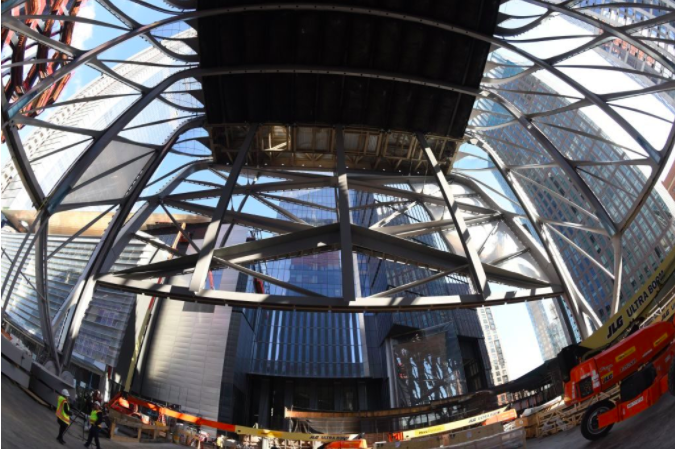
The Shed, under construction at Hudson Yards March 6, 2018, in New York. Image courtesy Timothy A. Clary/AFP/Getty Images.
One only arrives at the intellectual vantage point where the institutional gesture of treating a party as art represents the overcoming of “dualist, anthropocentric, and colonizing Western modernity” if you have abstracted the symbolisms associated with “collective” vs. “individual” experience to the point where these themes float free of any concrete history or politics that might be meaningfully overcome.
I mean, think of it: The 19th-century European cultural world von Hantelmann references was at least as obsessed by experiences of cultural togetherness as it was by models of “liberal,” individualized contemplation. The opera, in particular, was wildly popular as a cultural ritual of collective social symbolism, where high society went to see and be seen (indeed it was a ritual that proposed its own sort of synthesis of the arts, in Wagner’s invocation of the Gesamtkunstwerk, and thus probably a more crucial precedent to wrestle with than the modernist museum). It’s just that it was specifically bourgeois cultural togetherness.
And in some way, one thinks, the Shed’s luxe intermedia aspirations have to be seen as a logical development of this basic dynamic, not some kind of break beyond it.

The Buried Foundation of the Shed

Von Hantelmann philosophical apologia for the Shed is so abstract that one could go on mentioning things her broad-brush account of social aesthetics paints over. But let’s just look at the one positive model that the Shed Manifesto actually does mention, in its final paragraph, as a “ritual that is specific to and appropriate to its own time.”
In fact, everyone involved with the Shed—from architects Diller, Scofidio & Renfro, to super-curator Hans Ulrich Obrist, who helped organize the Prelude festivities, to von Hantelmann—mention the same role model as a presiding spirit and legitimating influence: the unrealized 1964 idea of a Fun Palace for London, by the renowned experimental architect Cedric Price (1934-2003).
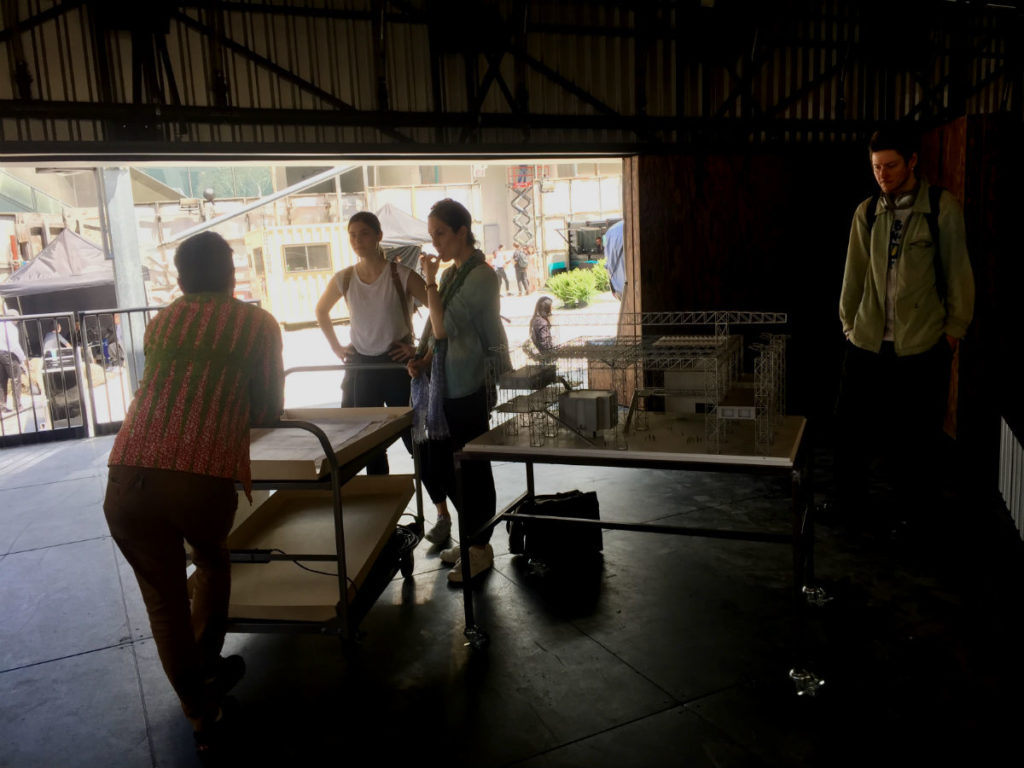
A model of Cedric Price's Fun Palace, in an experimental presentation organized by Hans Ulrich Obrist during the Prelude to the Shed. Image courtesy Ben Davis.
A model of Cedric Price’s Fun Palace, in an experimental presentation organized by Hans Ulrich Obrist during the Prelude to the Shed. Image courtesy Ben Davis.
The Fun Palace was to have been a giant space that could be infinitely reconfigured to host different events of all kinds, as needed. It is ludicrously ahead of its time, proposing amenities that include something that sounds very much like virtual reality, an information kiosk that prefigured the internet, and an “identity bar” where you could try on different personae, as well as sundry educational facilities and equipment for the public to make art and film of their own. All of these features could be expanded or reduced thanks to a system of cranes that could quickly reconfigure its mobile walls.
The notion was very much a product of Swinging London, in an era when old-school bourgeois cultural authority was ceasing to be the choice way to generate social distinction, being gradually displaced by the cachet of youth and fashion and general newness. The Fun Palace’s flexible architecture was meant as a tool that would practically enable popular, grassroots control over cultural space once deemed to be the province of a crusty elite. It was not just an abstract exercise in genre-blurring to provoke some kind of new sense of media-mixing “togetherness.”
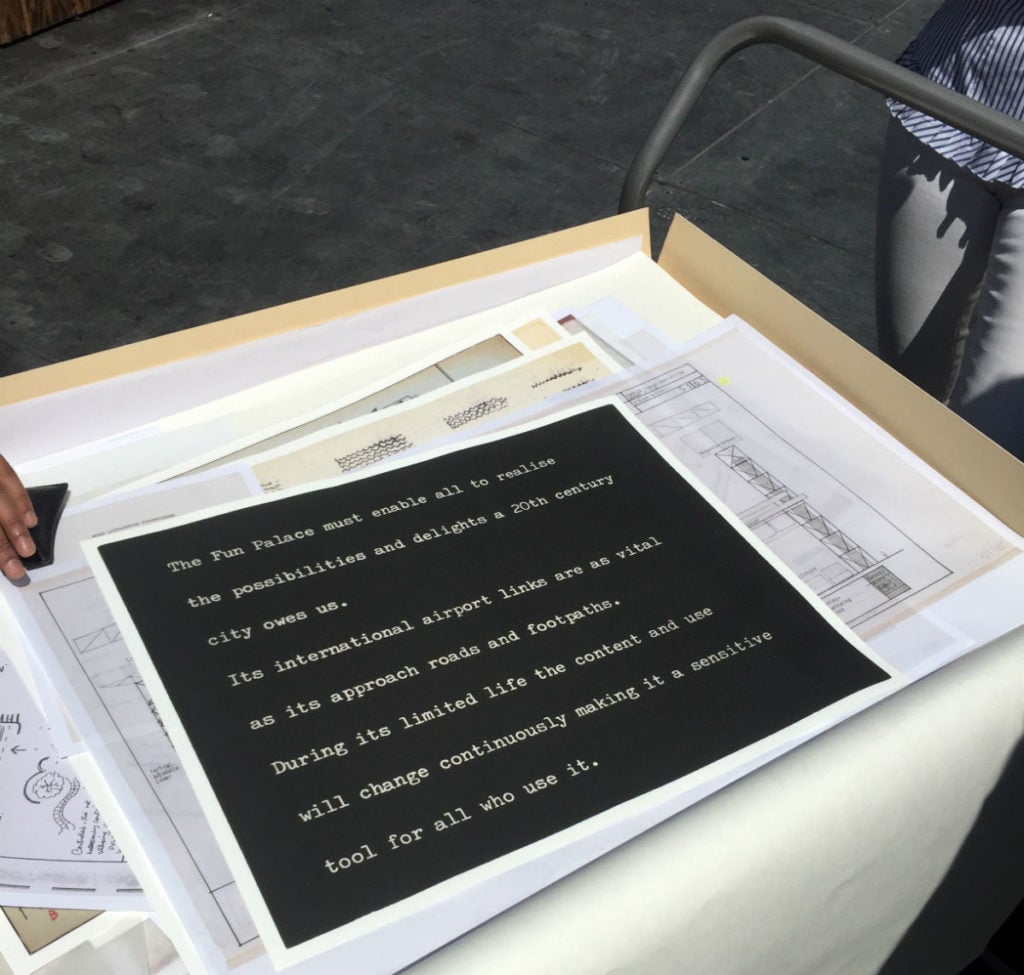
A presentation of documents related to the Fun Palace during the Prelude to the Shed. Image courtesy Ben Davis.
Yet, at the same time, class distinctions were not going away in postwar England. In fact, the Fun Palace very self-consciously took its raison d’être as working through the evolving class situation. As Price and his collaborator, theater director Joan Littlejohn, wrote of their mission:
Automation is coming. More and more, machines do our work for us. There is going to be yet more time left over, yet more human energy unconsumed. The problem which faces us is far more than that of the ‘increased leisure’ to which our politicians and educators so innocently refer. This is to underestimate the future. The fact is that as machines take over more of the drudgery, work and leisure are increasingly irrelevant concepts. The distinction between them breaks down. We need and we have a right, to enjoy the totality of our lives. We must start discovering now how to do so.
This proclamation is very ‘60s in its assumption of an “affluent society.” It was, however, prescient, even if the reality it augured was rather less “fun” than projected. They were in effect describing the rising prominence of the “creative class” (or “knowledge class”) in the image of the city, as the counterpoint to the incipient deindustrialization and technological disruption of the old industrial working class.
It is thus improper to call Price and Littlejohn’s architecture “utopian”—in the sense of an imagined but impossible ideal place—since its experimental proposal was not only completely practically worked out (it was only problems gaining the proper permits that killed it), but also rooted within the realities of an evolving capitalism. Price would go on, with Reyner Banham, Paul Barker, and Peter Hall, to co-sign the manifesto “Non-Plan: An Experiment in Freedom,” extending the Fun Palace’s critique of fixed architectural infrastructure to the rigidities of top-down social democratic government planning. This idea of non-planning spawned, via Peter Hall’s pragmatic evangelism, the idea of an urban policy centered on “free enterprise zones” that caught fire under Margaret Thatcher, and which has since pitted cities around the world against one another in slashing taxes and regulations to attract entrepreneurs and business, with non-utopianresults.
That takes us somewhat far afield from the actual Fun Palace plan though. The Palace itself was undoubtedly prophetic—but both in its positive ideas and in its hints of their darker underside. How would you, practically, create architecture that responded to a public’s needs, without the intermediation of bureaucrats or authorities? The answer, Price and Littlejohn decided, lay in the emergent discipline of cybernetics, and they brought in a key theorist, Gordon Pask, to help imagine the necessary technical systems.
Pask’s scheme for the Fun Palace was considerably less anarchic and dreamy in tenor, and much more a prefiguration of our own present-day algorithmic technocracy. As Stanley Matthews explains in an essay on the social context of the Fun Palace:
That the Fun Palace would essentially be a vast social control system was made clear in the diagram produced by Pask’s Cybernetics Subcommittee, which reduced Fun Palace activities to a systematic flowchart in which human beings were treated as data. The diagram produced by the committee described the Fun Palace as a systematic flowchart. Raw data on the interests and activity preferences of individual users was gathered by electronic sensors and response terminals, and then assigned a prioritized value. This data would then be compiled by the latest IBM 360-30 computer to establish overall user trends, which would in turn set the parameters for the modification of spaces and activities within the Fun Palace. The building would then relocate moveable walls and walkways to adapt its form and layout to changes in use. The process would constantly refine itself by feedback cycles which compared the responses of people coming in (‘unmodified people’) with those of people leaving (‘modified people’).
Essentially, the Fun Palace foretold a world of experience-generating machines relentlessly harvesting data about audience preferences, and optimizing themselves for the most popular content, in a feedback loop. In the cold light of the present, you could call this Buzzfeed architecture.

Something Gained, Something Lost

It makes sense that architects and thinkers would return to Price’s idea of a mutable architecture now, at a time when pop-ups and migrating structures are hot, and an infinitely remixable and responsive internet has made interactivity into the core value of culture. Still, it is worth chewing on the fact that Price himself saw his scheme as having exhausted its use as a progressive architectural ideal after 1975, at least according to Matthews: “Price regarded the Fun Palace as specific to its time and place, and adamantly opposed the idea of reviving the project, or revisiting it in light of contemporary practice.”
So, despite a lavish attempt at intellectual justification, in the Shed and its Prelude you are still left with revolutionary form and revolutionary promises that don’t exactly connect.
The fledgling super-institution is armed with lots of cash and the access to world-class talent that it conjures. The genre-blurring may even produce something great. It is already teasing an opening highlighted by a vast spectacle, staged by video artist turned Academy Award-winning film director Steve McQueen with the hit-making producer Quincy Jones, tracing the history of African American music. It has partnered on a program of “dance activism” with institutions across the city. It even promises to “provide space for protest and creative action through writing, storytelling, and visual art workshops” within the next-level-gentrified Hudson Yards/High Line corridor.
While these latter are fine things to do, it remains unclear why you needed a state-of-the-art Shed to do them. If you really want to talk cultural democracy or social mission, the City of New York has only just gone through the lengthy exercise of formulating a Cultural Plan, staging dozens of meetings with a reported 188,000 people cross the five boroughs—from dancers to art educators, from groups promoting Native American arts to organizations advocating for the advancement of diasporic African and Caribbean artists.
And the number-one demand, throughout that process, concerned the desperate need for affordable space for all the institutions that are already here, in a city given over to luxury amenities, where the immense majority of government cultural funding and private donations alike go to a tiny minority of mega-institutions.
Through that lens, I think that you can see the programmatic diversity of something like a Shed, aspiring to concentrate a lot of culture in one flashy crowd-pleasing project, as not the next and higher level of culture, but as the imaginary compensation for the real, grassroots diversity that is being left to malign neglect.

Follow artnet News on Facebook: 
 
Want to stay ahead of the art world? Subscribe to our newsletter to get the breaking news, eye-opening interviews, and incisive critical takes that drive the conversation forward.
SHARE


Ben Davis 

National Art 


Art World


The Shed Is Funding 52 Emerging New York Artists to Make New Work—Here They Are

A sweeping call for proposals garnered more than 900 applications.
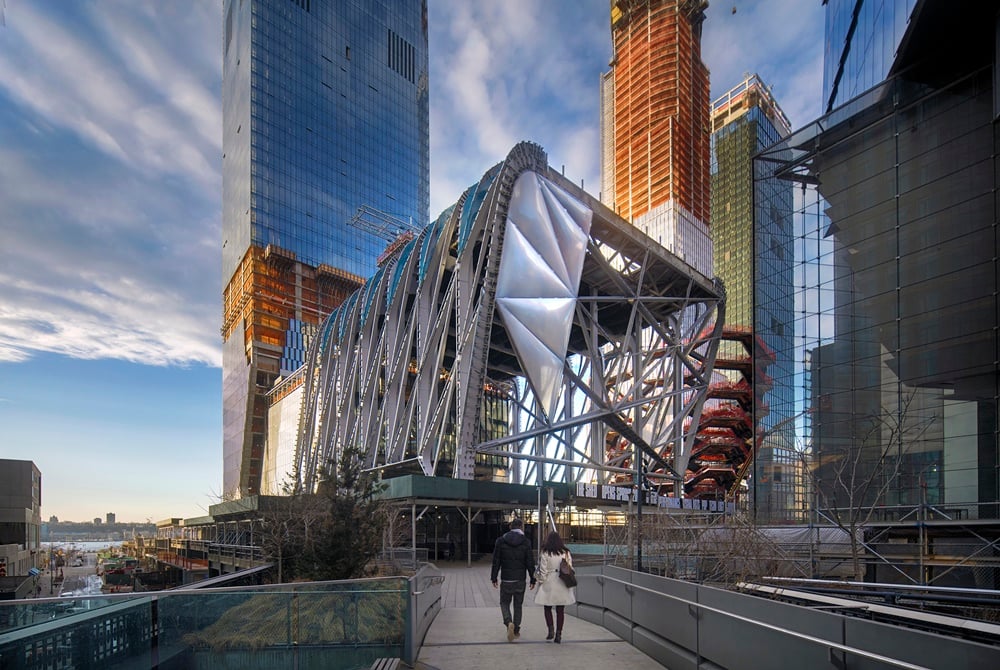
The Shed under construction as seen from the High Line, February 2018. Photo by Ed Lederman.
The Shed, the massive new arts center on Manhattan’s Far West Side, is finally shedding some light on its programming. A total of 52 emerging artists in New York City have been commissioned to create new work as part of the inaugural “Open Call” program that will debut in 2019 and continue through 2020.
“‘Open Call’ is a way to offer support and valuable resources to artists in New York City who are at pivotal stages of their careers,” Alex Poots, The Shed’s artistic director and CEO, said in a statement. The program, he said, was developed specifically for artists who have not yet had opportunities to create new work with full support from a large cultural institution. Each artist will receive a stipend of between $7,000 and $15,000, depending on the scope of the proposed project, as well as support and resources needed to develop their work.
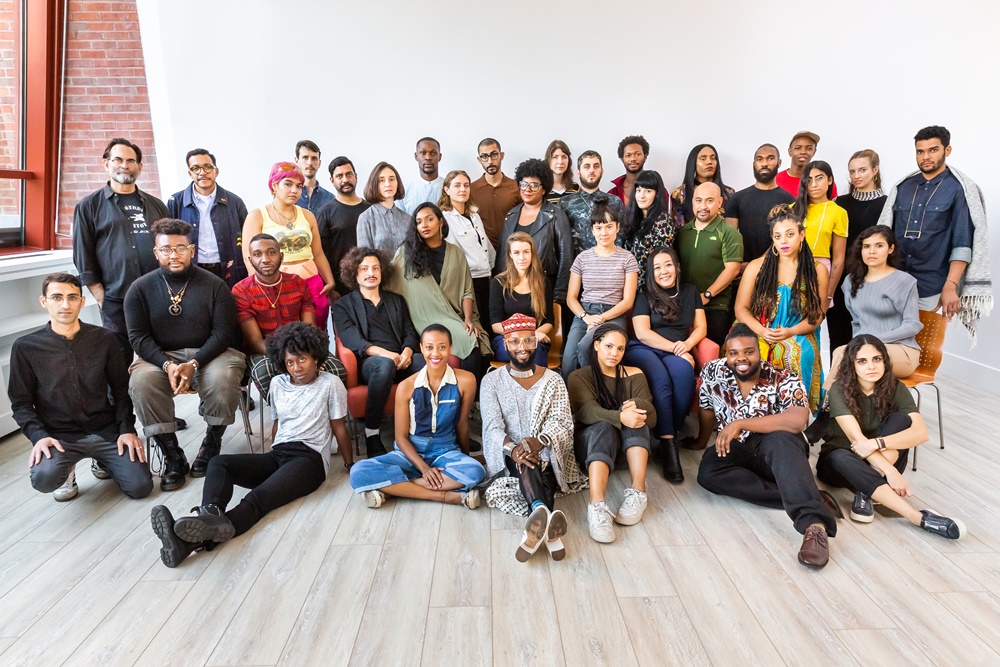
Thirty-two Open Call participants, with Shed staff.  <br /> Photo: Scott Rudd Events
Thirty-two Open Call participants, with Shed staff. Photo: Scott Rudd Events
“From the very beginning, the idea was to have many voices,” Tamara McCaw, The Shed’s chief civic program officer, told artnet News. “We also wanted to make sure to support artists through all stages of their careers. It’s not about age.”
To that end, McCaw said, the request for proposals encouraged projects that push the boundaries into multidisciplinary and collaborative realms across six creative disciplines: design, visual arts, music, performing arts, literary arts, and cinema. As a result, The Shed received more than 900 applications for “Open Call” over a three-month period.
The artist proposals were vetted by a committee of curatorial and production staff and the final selections were made by a convened panel of roughly 30 New York-based artists, producers, and academics known for their expertise and contributions to art and culture. “They were incredibly generous with their time,” McCaw said.
Rendering of The McCourt with standing room, courtesy of Diller Scofidio + Renfro in collaboration with Rockwell Group
Rendering of The McCourt with standing room, courtesy of Diller Scofidio + Renfro in collaboration with Rockwell Group.
The works will be presented in three spaces: The Shed’s black-box theater, the 12,500-square-foot, column-free gallery, and the 17,000-square-foot, open-air plaza in front of the building, (The plaza is created when its mobile steel outer shell—which can be rolled in or out to create a flexible indoor/outdoor space—is nested.)
Here is the complete list of artists and collectives chosen for “Open Call”:
Saint Abdullah
Tariq Al-Sabir
Justin Allen
Troy Anthony
Haley Elizabeth Anderson
Caitlin Blanchfield and Farzin Lotfi-Jam
Kim Brandt
Maia Chao
Daniel Chew and Micaela Durand
Onyedika Chuke
Gabriela María Corretjer-Contreras
nicHi douglas
The Extrapolation Factory
Avram Finkelstein
Fana Fraser
Moko Fukuyama
Ebony Noelle Golden
Yulan Grant
Hugh Hayden
Vicente Hansen and Mat Muntz
Prince Harvey
Madeline Hollander
Maryam Hoseini and Phoebe
d’Heurle
It’s Showtime NYC!
The Illustrious Blacks
Ayesha Jordan
Tahir Carl Karmali
Sam Lavigne
Maya Lee-Parritz
Richard Kennedy
Kyle Marshall
Asif Mian
Troy Michie
#MIPSTERZ
Tyler Mitchell
Neil Padukone
Kelsey Pyro
daaPo reo
Farideh Sakhaeifar
Rachika Samarth
Richard Sears, Clara Cullen, Yael
Ginosar, and Ethan Braun
Alice Sheppard and Kinetic Light
Harold “Fyütch” Simmons
Analisa Teachworth
Christopher Udemezue (Neon
Christina)
Mariana Valencia
Jon Wang
Julia Weist
Kiyan Williams
Nia O. Witherspoon
Thanushka Yakupitiyage
Yatta Zoker (YATTA)
The Shed was designed by Diller Scofidio + Renfro in collaboration with Rockwell Group. It opens to the public, at West 30th Street between 10th and 11th avenues in spring 2019.

Follow artnet News on Facebook: 
 
Want to stay ahead of the art world? Subscribe to our newsletter to get the breaking news, eye-opening interviews, and incisive critical takes that drive the conversation forward.
SHARE
Article topics