Friday, June 30, 2017

Here’s How Much Money Museum Employees Really Make


Here’s How Much Money Museum Employees Really Make

It's the first time the Association of Art Museum Directors has made their research public.

Shelley Paine, objects conservator at the Cleveland Museum of Art inspects the French National Treasure at Cleveland Museum of Art on November 8, 2010 in Cleveland, Ohio. Photo by David Maxwell/Getty Images for Cleveland Museum of Art.

It would be difficult, if not impossible, to find a museum professional who got into the arts for the money. But even curatorial assistants have to pay rent.
new survey conducted by the Association of Art Museum Directors (AAMD) provides hard data on the average salaries for curators, conservators, registrars, and other museum staff members—as well as which roles in this notoriously poorly paid field have seen the biggest salary bumps in recent years.
The AAMD teamed up with the consulting and analytics firm Stax, Inc., to survey 219 museums in the US, Canada, and Mexico about what they pay their employees. (Each response was completed by one representative from the museum—usually an HR coordinator.) The AAMD launched its first salary survey way back in 1918 and began collecting the data in a more formal way in 1991, but this marks the first time it has made its report free to the public.
Unsurprisingly, top administrative positions are the best compensated: The highest-paying museum gigs are director ($293,988 average annual salary), deputy director ($173,572 average salary), and chief operating officer ($172,872).
Chief curators ($143,412) and chief conservators ($118,271)—two roles that require either an advanced degree, lengthy training, or both—also fall towards the top of the salary hierarchy. The lowest-paid positions are: security guard ($33,974), education department assistant ($37,801), and curatorial assistant ($42,458).
PUBLICIDADE
These salaries—particularly for entry-level curators and educators—may not be enough to pay off hefty student loans, but they are higher than equivalent positions at many international institutions. Last year, for example, London’s Tate posted three jobs for assistant curators with salaries starting at £24,360 ($31,535).
Not everyone’s income is growing at the same rate, according to the survey. COOs saw the largest average annual increase: 5.5%. The survey’s authors attribute this growth to the increasing complexity of museum operations, which is driving institutions to offer more money to retain more qualified candidates. (Unlike art conservation, for example, operations management is a highly transferable skill: a COO could likely take her talent to another for-profit institution for a lot more money.)
The second fastest-growing salaried position? Curator.
Curators saw their salaries rise 4.6% per year, on average, between 2011 and 2016—in part because museums had rising demand for the position during that time. But don’t race off and enroll in a master’s degree program just yet: The number of curators is expected to grow 7% between 2014 and 2024, according to the Bureau of Labor Statistics, which is only average in terms of job growth. “Applicants should expect very strong competition for jobs,” the BLS remarks.
For their part, museum directors experienced only a 1.6% growth in median salary between 2015-2016—hardly greater than the rate of inflation. Don’t feel too sorry for them, though: Directors were also more likely than any other employee to receive vehicle and housing allowances.
Below, we’ve broken out all the job titles covered in the AAMD report, putting them in order by salary to give a sense of the museum hierarchy. The numbers represent the average (median) salary across the institutions in the survey. (When titles are broken up into As and Bs, such as with “Finance A” and “Finance B,” the As are the position within a department with more responsibility.)
  • Museum Director: $233,398
  • Chief Operating Officer/Administrator: $150,100
  • Deputy Director: $142,994
  • Chief Curator/Director of Curatorial Affairs/Curator A: $123,725
  • Director of Development/Development A: $120,000
  • Chief Conservator/Conservator A: $107,832
  • Director of Information Systems/Chief Information Officer: $106,692
  • Director of Finance/Finance A: $103,000
  • Senior Curator/Curator of Special Collections Area/Curator B: $102,500
  • Director, Planned Giving/Institutional Giving: $95,000
  • Director of External Affairs: $94,500
  • Human Resources Director: $92,830
  • Senior Conservator/ Conservator B: $83,771
  • Curator of Exhibitions/Curator C: $81,017
  • Systems Manager/Technology Director/Director of New Media: $79,000
  • Director of Education/Curator of Education/Education A: $77,030
  • Facilities Director/Building Manager/Operations Manager: $75,400
  • Marketing Director: $74,375
  • Director of Finance/Finance B: $73,917
  • Associate Curator/Curator D: $69,340
  • Editor/Director of Publications: $68,688
  • Engineering Manager: $67,009
  • Exhibition Designer: $66,955
  • Head Librarian/ Librarian A: $64,272
  • Associate Conservator/ Conservator C: $61,165
  • Web Manager: $60,600
  • Public Relations Officer: $60,458
  • Grant Manager/Institutional Giving Manager/Development B: $60,416
  • Chief of Security: $60,416
  • Photographer: $58,915
  • Assistant Curator/Curator E: $58,052
  • Registrar A: $55,973
  • Associate Librarian/Librarian B: $55,703
  • Graphic Designer: $55,620
  • Special Events Manager: $54,368
  • Assistant to Director: $53,960
  • Chief Preparator/Preparator A: $53,077
  • Museum Store Manager: $53,000
  • Associate Registrar/Registrar B: $52,755
  • Development Associate/Development C: $52,020
  • Associate Educator/Educator B: $52,000
  • New Media Manager: $50,000
  • Associate Librarian/Librarian C: $49,728
  • Associate Preparator/Preparator B: $45,127
  • Volunteer Coordinator: $43,722
  • Assistant Educator/Educator C: $43,000
  • Assistant Registrar/Registrar C: $41,787
  • Curatorial Assistant: $40,000
  • Membership Assistant: $39,100
  • Education Assistant: $36,025
  • Museum Security Officer/Museum Security Guard: $31,213
Follow artnet News on Facebook.
SHARE
Article topics

The Fallon vs. Colbert Fight for Late Night Is About More Than You Think

What’s the Path to Winning an Art Prize?

https://www.artsy.net/article/artsy-editorial-path-winning-art-prize


What’s the Path to Winning an Art Prize?
Around two years ago, a collector encouraged New York-based ceramic artist Jennie Jieun Lee to apply for an art prize. “I was a little bit scared. I’d applied to a few things in the past and been rejected, so I was bummed by that,” she admits. “I entered not thinking that I was going to win, but that it would be a good exercise to go through the process.”  
It paid off. She was among several artists in 2015 who won an Artadia Award—an unrestricted, merit-based prize of up to $10,000, which is given to visual artists working in certain U.S. cities. The winnings, as well as the experience, helped Lee push her career forward.
“That money enabled me to move into a bigger studio and buy a larger kiln,” she explains. “With that movement, I was able to make my career.” And the momentum continued: More recently, she won a Pollock-Krasner grant that she used to move cross-country and fund a residency in the ceramic department at California State University, Long Beach.
Lee is by no means alone. While we’ve all heard of the boldfaced awards, like the Turner Prize or the Hugo Boss Prize, which tend to anoint artists when they’re already well known to the art world, a wealth of awards are available for lesser-known and emerging artists.
While applying for these opportunities can be daunting and time-consuming, it’s rewarding in more ways than one (even if you don’t end up winning). Artist prizes can be a path to prestige and profits, as well as a way to land exhibitions, make influential contacts, and gain valuable feedback about your work.
Based on conversations with artists who have won several different prizes, we share guidance below on how to go about applying for these opportunities, navigating the process, and benefiting from the positive outcomes they can offer.

Finding the Prize That’s Right for You


Artists should seek out opportunities based on their eligibility and the kind of work they make. “Don’t change to accommodate prizes,” advises London artist Allyson McIntyre, who won the 2015 HIX Award, which gives artists £10,000 to go towards a solo show at the London gallery HIX ART. “Be authentic to your practice and find the prizes that work for what you do.”
It’s important to recognize the distinction between prizes and awards—which are generally given in recognition of past work—and grants, which typically serve to facilitate future projects. Many artists note that they apply to both types of opportunities based on recommendations by word-of-mouth; they find that peers, former teachers, or other art-world contacts can share valuable input. New Orleans-based artist Aron Belka, who won the BOMBAY SAPPHIRE® Artisan Series in 2015, advises artists to search for opportunities locally, through art schools, regional arts councils, art centers, and museums.  
For those who perhaps do not have a tight-knit network of artist peers, there are several open-call websites and listservs that aggregate information on prizes, grants, and juried exhibitions. These include Submittable and Call for Entry. On the latter, artists can create a profile, upload artwork images, and browse opportunities.

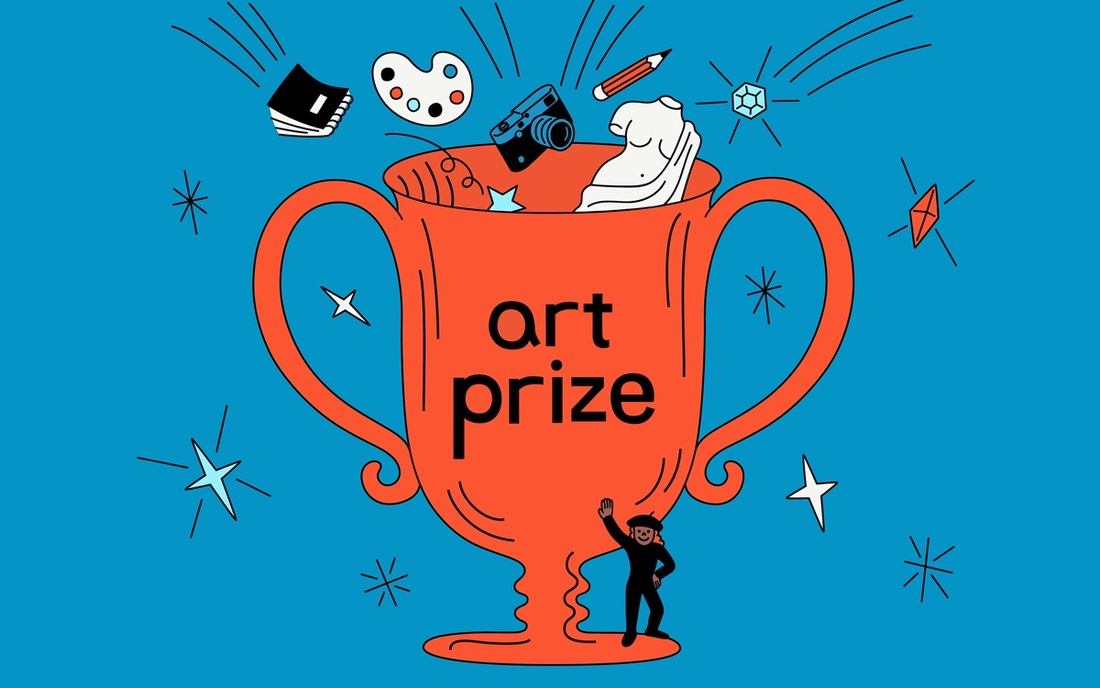
  • Illustration by Tomi Um for Artsy.

The Application Process


Most awards will require several images of your work, as well as a written artist statement to provide some context. With higher-stakes prizes, artists may be asked to submit recommendation letters from peers or professionals.
A somewhat obvious, though easily botched, element of the application process is following directions. “You have to be careful not to get lazy with how you submit, as it may lead to you being disqualified, which is just a waste of your time,” McIntyre explains. Be sure to read the fine print and adhere to all particulars regarding preparing, labeling, and submitting application materials.
Organizations administering prizes will allow artists to submit several—typically three to eight—images. They are generally interested in seeing recent work, created over the past two or three years. Some prizes may specify that artists create a new, original work to submit. Artists should be sure to send high-quality photographs; if resources allow, hire a photographer (or recruit a qualified friend) to have works shot professionally.
For those artists who work across mediums—perhaps printmaking one day, performance the next—know that it might not be advisable to try to include the full breadth of your practice in a single application. “Try to hone in on a single idea, or a couple of ideas,” says artist Alex Podesta, who won the BOMBAY SAPPHIRE® Artisan Series in 2013, and has also served as a juror for other awards. “I’ve been on the other side of this a number of times, and when you’re reviewing applications it’s confusing and not helpful to have an artist submitting sculpture, painting, and a video piece. Focus on one aspect of your work.”
In addition to images, a written artist’s statement that explains and contextualizes the artist’s work is important, too. Artists should get in the habit of updating their statements regularly, adapting their texts to accurately reflect their current practices. Artist Yevgeniya Baras, who won an Artadia Award in New York in 2015, notes that she rewrites or edits her artist statement every two years.  
For certain awards, artists may need to be able to speak about their work with jurors in person. If this is the case, be prepared to take full advantage of the opportunity. Baras notes that for Artadia, the panel of jurors visited her studio; she was careful to delve deeper into elements of her work that don’t come across through two-dimensional images or her online application. For the Meurice Prize for contemporary art, artists must give an oral presentation of their work. “While we don’t judge the artist on their ability to conduct a perfect verbal presentation of the work, we are of course interested to hear the artist speak of their work in a very intimate way, and that can actually be the decisive sector,” says Jennifer Flay, director of the art fair FIAC, and a juror for the Meurice Prize.

Application Fees


While it’s free to apply for some awards, it’s not uncommon to pay a fee in the range of $20 to $75—which can make a difference for artists looking to apply to multiple opportunites. Belka notes that if the stakes are high, an application fee may be worth it, but he advises that artists do their research before submitting said fees to avoid scams.
McIntyre recalls that she once applied to a competition that promised winners a show in Venice. “I was accepted, but they asked for an outrageous artist fee of €500,” she says. Later she learned that fellow artists had fallen for the scam and lost their money—and the works they had submitted. “Have discretion and awareness that your money may amount to nothing,” she counsels.

Set Expectations and Be Persistent


No one wins every award; there’s often a trail of rejections on the way to any prize. Baras, who landed the Rema Hort Mann Foundation Emerging Artist Grant in 2014 and the Artadia Award thereafter, notes that there’s been plenty of failure mixed in with those successes. (She estimates that she submits around 10 award or grant applications per year.)
“Assume that for nine out of every 10 applications that you send in, it’s not going to be the work they’re looking for,” Podesta says. “Younger artists, especially, shouldn’t get daunted. Remember that the work just isn’t resonating with the [specific] people reviewing it.”
It helps to go into the application process with an open mind, and reasonable hopes. “I went into it not expecting it to make my career, but rather for it to be an addition to it,” says Kristine Mays, who won the BOMBAY SAPPHIRE® Artisan Series in 2014. Artists, she adds, should simply stay true to their craft, and keep working away.
Remember that rejection, while disappointing, can be a learning experience. “Without this kind of risk, you can’t really put yourself out there,” Baras says. “Most applications, for many amazing awards, just take a few days. It’s a way to see a new community, to seek new eyes, and I think that’s a necessary and healthy risk for an artist to take.”
Lee advises fellow artists to cast a wide net and apply to as many opportunities as possible, developing a thick skin as they do. “If you get rejected one year, apply again the next,” she says, simply. “It’s about being persistent and not taking anything personally.”

  • Illustration by Tomi Um for Artsy

Make the Most of Winning


Depending on the prize, artists may be awarded a stipend to create new work for a show or unrestricted funds to further their careers. In both cases, artists report that these funds have gone towards keeping their art practices up and running, be it through realizing new works and shows or for subsidizing rent, bills, and the costs of production and supplies.  
For example, the Meurice Prize, which supports artists under the age of 45 who show with French galleries, awards €20,000, which is split between the artist and their gallery. This year, the BOMBAY SAPPHIRE® Artisan Series (which is only open to entrants from North America) awards a grand prize winner a stipend of $10,000 to create a public artwork.
In some cases, like Lee’s, a sizable prize could help an artist move into a bigger studio, relocate to another city, or participate in a residency. “Before, I never even thought about moving out of New York,” she says. “The Pollock-Krasner grant gave me the freedom to possibly move cross-country to explore this residency. I feel like it’s completely changed my life, and now I’m not sure when I’m coming back.”

It’s More Than Just Money


Baras notes that even if she hadn’t won the Artadia Award it would’ve been a rewarding experience due to the panel of jurors she encountered. “Whether you win or not, whoever’s on the panel remembers your work,” she says. “It’s beneficial regardless to put yourself out there because you really never know who might notice.”  
Other prizes similarly award artists with the opportunity to exhibit their work to a new audience. The Daiwa Foundation Art Prize, awarded each year to a British artist, serves to give that artist a solo gallery exhibition in Japan. And the Luxembourg Art Prize gives finalists the opportunity to show their work in a group exhibition in Luxembourg; the winner is awarded €25,000 to produce new work for a solo presentation at Galerie Hervé Lancelin for an exhibition the following year.
For Belka and Mays, who both won the chance to show their work at the Scope Art Fair in New York through the BOMBAY SAPPHIRE® Artisan Series, winning led to important exposure and networking opportunities. “Overall, the most positive outcome was being able to put myself in arenas I’d never been in before,” Mays says of her experience. She saw it as a “jump start” for her career; she’s been busy making and showing her work steadily since her Scope debut.
“I made a point of greeting and speaking to everyone that came to the space,” Mays adds. Both artists recommend being prepared with business cards and following up with the contacts you make via email. Belka notes that he made an important collector contact that he maintains today. “Come prepared to talk about your work, have cards, spread your name, and get yourself out there,” says Belka.
Mays was also inspired by the feedback she received from viewers of her work. “Many times we overlook the value of feedback from people, the ideas that can come out of conversation with people,” she says.

Building Confidence


Most artists agree that one of the most impactful parts of winning a prize is the vote of confidence that it provides. Formal recognition can be a sign of assurance that they were right to pursue a career as an artist, and can inspire them to get back in the studio.  
“It’s a nice confirmation to know that you can communicate to people you don’t even know, and just continue along the path of making your work,” Baras muses. “I see it as a kind of hug. Generally, you’re sort of hugging yourself as an artist—but once in awhile, you get an acknowledgment from the outside world.”

—Casey Lesser

Header animation: Illustration by Tomi Um for Artsy. Animation by Ale Pixel Studio.

SHARE ARTICLE

What’s the Path to Winning an Art Prize?
The BOMBAY SAPPHIRE® Artisan Series is a search to discover top emerging artists from North America. The Grand Prize winner will receive a cash stipend and collaborate with Artsy to create a public installation. Submissions for this exciting opportunity are now open through August 3, 2017.


BE BRILLIANT AND INSPIRED. DRINK RESPONSIBLY!
©2017. BOMBAY SAPPHIRE AND ITS TRADE DRESS ARE TRADEMARKS. IMPORTED BY THE BOMBAY SPIRITS COMPANY U.S.A., CORAL GABLES, FL. GIN - 47% ALC. BY VOL.
PRESENTED IN PARTNERSHIP WITH