Tuesday, July 23, 2024

Golf: neuroscience better putting


Golf: neuroscience reveals the secrets of better putting – new study

The world’s best golfers make playing look so effortless, it’s hard to imagine what’s going on inside their minds. But modern neuroscience allows us to do exactly that. My team’s new study shows how different parts of an expert golfer’s brains are activated when they putt their ball into the hole.

Putting is a crucial part of golf. Using their putter when the ball is on (or just off) the green, golfers gently roll their ball towards the hole. Good putting distinguishes the most successful players in any tournament, as it can make up 40-50% of the total number of strokes on each round (on average, around 1.8 putts per hole). Winning a tournament can often come down to holing a final, dramatic putt.

Our team focused on what makes golfers good at putting, particularly the mental processes required to do it consistently well. Putting’s structured routine makes it easy to study and analyse. Before each putt, golfers enter a preparation phase where they stand still with the putter just behind the ball (a position called the “address”). This period can provide insights into the mental and physical processes involved in preparing to putt.

To explore these mental processes, we measured brain activity using electroencephalography (EEG), which measures electrical activity in the brain. This offers an accurate way to measure the timing of brainwaves as they happen, making it ideal for sports research.

A weekly email for Europeans by European scholars

Scientists categorise brainwaves based on their frequency ranges (measured in Hertz), which are associated with different functions. The brainwaves researchers mainly explore in putting are the theta band (4 -7 Hz: associated with concentration and error detection in motor tasks), the alpha band (8-12 Hz: attention and arousal control), and the beta band (12-30 Hz: associated with motor preparation).

In our study, published in the Journal of Frontiers in Psychology, myself and colleagues tried to see if there were differences in brain activity between successful (when the ball goes into the hole) and unsuccessful putts.

Successful putts show distinct brain patterns

We recruited 28 expert-but-amateur golfers (20 of whom were men) with an average age of 24.2 years to participate in a testing session. These participants each made 140 putts while wearing an EEG head system to record their brain activity.

We used two methods to analyse their brain activity. The first was “time-frequency analysis”, which examines how signal frequencies change over time. This allowed us to measure what was happening in the brain in the final three seconds before the player made contact with the ball for each putt.

The second was “movement-related cortical potentials”, which helps us understand how the brain plans, prepares and executes movements. In our case, the movement was the golfer beginning their the putting action.

Our study reveals that successful golf putts show distinct patterns of brain activity.
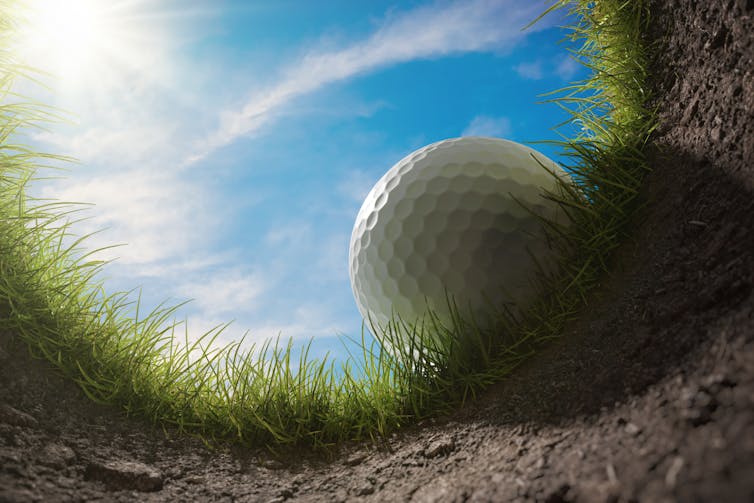
Golf ball just on the tipping point of the hole.
A good putt can win a tournament. vchal/Shutterstock

From the time-frequency analysis, we found successful putts were associated with changes in beta and theta brainwaves in the final three seconds before putting. Successful putts showed a more pronounced decrease in beta activity during preparation than unsuccessful ones. This suggests these golfers had better preparation when they went on to putt the ball into the hole.

Based on this finding, we would advise players to commit to their stroke and have a clear plan in mind, so they can experience the earlier onset of beta suppression. Crucially, they should not alter their plans just before putting the ball.

If they are not sure of what strategy to use – in other words, what direction they should aim the ball and how hard to hit it – we would recommend stepping away, then re-starting the process of hitting the putt with a clearer plan.

Commit to your stroke

In our study, successful putts also tended to show lower theta activity in the frontal region of the brain, especially just before contact between putter and ball. The higher theta activity during unsuccessful putts may indicate hesitation or the need to adjust the motor plan before execution.

Our findings emphasise the importance of committing to your stroke when putting. It’s common coaching advice, but now we have data to back up why it’s so crucial.

Our analysis of the movement-related cortical potentials also found differences in brain activity. Successful putts were associated with more efficient processing and less energy expenditure, compared with unsuccessful ones. So, successful putts cost the players less brainpower.

Many golfers report knowing what it “feels like” to putt well. It’s hard to replicate this feeling consistently, though. If you want to putt better, practise your skills so you can dependably perform the motor action and handle the pressure of competition.

This finding supports the “neural efficiency” theory in sports research, which says that experts have less neural activity when they complete a task related to their profession.

Across different sports, from archery to tennis, researchers have found experts are simply more efficient in their mental processing, which allows them to activate different parts of their brains when they play. In other words, practising a sport doesn’t just change your body – it can literally alter your mind.

For Europeans who want to be informed

We have a weekly email, which I help curate. It brings you a selection of the latest news, views and analysis, straight from the world’s leading experts. Sign up and we’ll deliver it to your inbox every Thursday.


Claudia Lorenzo Rubiera
Culture Editor, The Conversation España
0 Comments
  1. There are no comments on this article yet.
    Have your say, post a comment on this article.


Monday, July 22, 2024

This Open is not for everyone


This Open Championship is not for everyone. That’s a good thing

South Africa's Thriston Lawrence putts on the 18th green during his third round, on day three of the 152nd British Open Golf Championship at Royal Troon on the south west coast of Scotland on July 20, 2024. (Photo by Paul ELLIS / AFP) / RESTRICTED TO EDITORIAL USE (Photo by PAUL ELLIS/AFP via Getty Images)
By Brody Miller
Jul 20, 2024

45

Save Article

TROON, Scotland — Thriston Lawrence’s voice cracked as he recalled the path here. How the South African flew overseas to test his level against the best in America, only to make one cut in six weeks. How the doubt that this cold, unforgiving game creates can permeate even the strongest of wills.

“This game is not easy,” Lawrence said, holding back tears that arrived nonetheless.

Lawrence had just won the BMW International Open in Germany, coming from four shots behind to beat Joost Luiten. It was a win in June 2023 that ultimately gave Lawrence the points to qualify for The Open Championship this week at Royal Troon. His thoughts in that moment were as much about the man who lost as his own career moment, because he’d been there before. “I feel sorry for Joost,” he said. “I know how tough this game is.”

Thirteen months later, hours before leaders even teed off at the 152nd Open Championship, Lawrence played the front nine at Royal Troon in 30 shots to shoot up the leaderboard and jump into the final group of a major. This golfer you had never heard of before the week somehow made his way to 3 under par, one back of leader Billy Horschel. That kind of grind is the story of this week’s Open.

As professional golf attempts to limit opportunities and close off signature events by catering to the sport’s biggest names, this is not a major championship being dominated by the superstars. This isn’t Pinehurst. This isn’t Valhalla. This is ugly, windy, rainy links golf off the Firth of Clyde. It is not to be won by golfers who strike majestic shots only on sunny days, the data nerds playing probabilities, or even the distance kings.

You might call them underdogs, but in reality, it is an Open for the real ones, the ones to whom this means the most. The ones who relish playing Saturday in the pouring rain with their hats turned backward and every grip soaked. The ones who live for this.

That is why you look up at the leaderboard and see, yes, Scheffler and Schauffele, but far more names you did not expect. Horschel. Lawrence. Henley. Rose. Brown. Jordan.

“Links golf is a different facet, different style of golf,” said Justin Rose, the 43-year-old Englishman in that six-way tie for second. “I think form can be not as important. It’s sort of how you feel it on the week. There’s so much — there’s very few stock shots that you hit on the golf course this week.”

By that, Rose means you can’t be a pampered golfer to win The Open. As Royal Troon’s back nine played out to what Dustin Johnson called “the hardest nine holes I think you could ever play in golf,” it was those grinders who saved par from horrible bunkers and weathered the conditions.

Among the pack of golfers within a shot of the lead is Dan Brown, the son of a pig farmer, who nearly quit the game before the COVID-19 pandemic. He missed six consecutive cuts before coming to Scotland last week and had never played in a major, but he earned a spot in the field through final qualifying thanks to a 20-foot putt on the final hole at West Lancashire. Thursday, the 29-year-old Englishman took the solo lead with an opening-round 65. Before an unfortunate double bogey on 18 to close out Saturday, he had the solo 53-hole lead.

There’s Rose, who said he dreamed of winning this event as a kid and played in his first when still one, a 17-year-old prodigy earning his way through qualifying. Twenty-six years later, Rose looked up one day and realized he had to qualify again. The 2013 U.S. Open champ made it through a qualifier at Burnham & Berrow, and he opened 69-68, playing in the tougher wave both days. He was the only player in morning-afternoon waves in the final groups.

“Probably just a bit more gratitude just to be here, from that point of view,” Rose said. “Twenty years probably-ish, ballpark, where you make your schedule in December and you go, ‘OK, Masters, Open, U.S. Open, PGA — how do we plan around that?’ And this year it’s like, ‘Hang on a second. I’m not guaranteed in The Open or the U.S. Open at that point, either.’ Had to do a little bit of extra hard work just to make sure I was here.”

Justin Rose celebrates a par putt on 18 on Saturday at Royal Troon. (Paul Ellis / AFP via Getty Images)

Or there’s Horschel, another 37-year-old veteran who ranks 96th on tour in driving distance and was thought to have his best days behind him. Two years removed from winning the Memorial, Horschel wasn’t even in the Masters field this year. In more than a decade of major golf — 45 attempts — he has finished top-15 just twice. So, how did he get in The Open? Because he likes this style of golf so much, he plays the DP World Tour swing in the fall and won the BMW PGA Championship in London in 2021. That win gave him a three-year exemption into The Open.

“I get tired of golf where you’re making full swings and you lean into a certain number and it stops,” Horschel said. “I like when you have to be creative and find a way to get around the golf course, and I think I’ve always done that well, for the most part.”

The Open is just different.

It’s never been about distance or pedigree. It’s about smarts and mental discipline, creativity and versatility. Royal Troon has played difficult most of the week, with 20 mph winds and cold rain flying in players’ faces and those winds changing directions to confuse the best in the world. You need to be able to control ball flights and spin and know how to hit from strange lies and ugly shrubbery. It might be the lone major that somebody like Brian Harman (2023) can win, or Francesco Molinari (2018) before him, or Darren Clarke (2011) or Todd Hamilton (2004) or a 42-year-old Ernie Els (2012). The cynics might say that’s undeserved randomness. The educated would say it’s a way to test golfers in a way they hardly ever are.

go-deeper

GO DEEPER

Bryson DeChambeau’s superpower isn’t distance. It’s raging self-assurance

Golf is better when it lives by the late USGA chairman Sandy Tatum’s famous line: “We’re not trying to humiliate the best players in the world. We’re simply trying to identify who they are.” And playing only certain types of tournaments doesn’t achieve that. Variety does.

Sometimes it confirms the best are who we thought they were. Like how Scottie Scheffler and Xander Schauffele, the reigning Masters winner and PGA champ, respectively, rose to the occasion Saturday as conditions reached their worst. While the field dropped shots, Schauffele went out in 33 and jumped up to T2. Scheffler, the world No. 1, hit sensational, creative shots with low line drives or 239-yard 3-woods into the wind on a par 3 for birdie.

Whether it’s a star who wins Sunday or somebody like Brown, it is OK. Because the best player in the field will be identified. The winner will be real.

(Top photo of Thriston Lawrence: Paul Ellis / AFP via Getty Images)

Get all-access to exclusive stories.

Subscribe to The Athletic for in-depth coverage of your favorite players, teams, leagues and clubs. Try a week on us.

Brody Miller

Brody Miller covers golf and the LSU Tigers for The Athletic. He came to The Athletic from the New Orleans Times-Picayune. A South Jersey native, Miller graduated from Indiana University before going on to stops at the Pittsburgh Post-Gazette, the Indianapolis Star, the Clarion Ledger and NOLA.com. Follow Brody on Twitter @BrodyAMiller

COMMENTS

Sort By:

45 Comments
Subscribe to join the conversation.

S

Sam R.

· Sat

Brilliant to see players think, be tested, be creative. Not the target golf we see so often.


A

Aaron P.

· Sat

Best tournament because it routinely plays on courses and in elements that are truly challenges the best golfers in the world. Love to see a leaderboard so close to par


P

Patrick H.

· Sat

My favourite tournament to watch for the reasons you identified.