A special screening tour of Yama — Attack to Attack offers a chance to see this extremely rare Japanese film, which was intended to be used in perpetuity to agitate on behalf of the working class.
Dan Schindel
Hyperallergic is a forum for serious, playful, and radical thinking about art in the world today. Founded in 2009, Hyperallergic is headquartered in Brooklyn, New York.
The Labor Rights Film That Got Both of Its Directors Murdered by the Yakuza
A special screening tour of Yama — Attack to Attack offers a chance to see this extremely rare Japanese film, which was intended to be used in perpetuity to agitate on behalf of the working class.
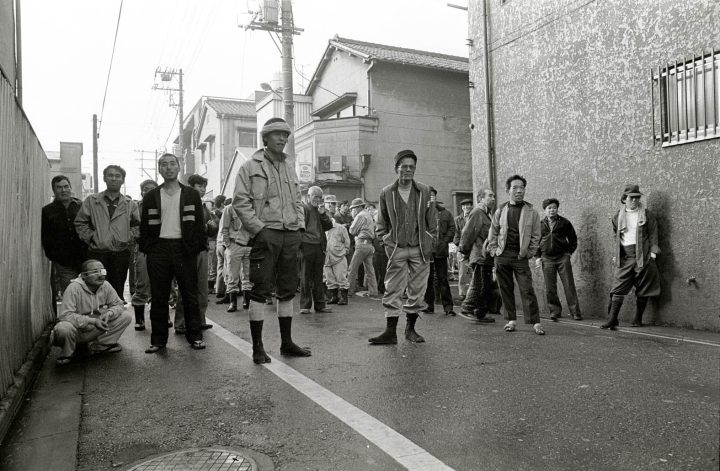
Day laborers standing together against yakuza intimidation (all images courtesy “YAMA” Production and Exhibition Committee)
Yama — Attack to Attackopens with footage of Mitsuo Sato,its director, lying mortally wounded in the street, and it only gets more raw from there. The film is less an art object than a weapon, intended to be used in perpetuity to agitate on behalf of the working class. Itexists only in the form of three 16mm copies, unavailable on any home media or for streaming (a few DVDs exist, but solely as safeguards). Yama can only be seen via special screenings, similarly to how political films once traveled between different union and activist meetings during the ’70s and ’80s. An upcoming screening tour of various locations around the US makes for an exceptionally rare chance to see the documentary. A harrowing vérité survey of labor rights in 1980s Japan, the film has lost none of its power over the years.
Sato and his crew had been filming for less than a month when he was attacked and stabbed by members of a yakuza gang in December 1984, no doubt because the Yama project sought to expose the conditions of Japanese day laborers, particularly in Tokyo’s historically impoverished Sanya district. Then and now, yakuza have a direct hand in the exploitation of these workers, managing the middlemen connecting laborers to work, and also tempting or gouging anyone with a fresh paycheck through gambling operations. More dangerously, yakuza with ties to nationalist organizations would act as muscle, putting down public protests and silencing activists, never hesitating to stoop to murder. Such was the fate not just of Sato, but also the director who replaced him, Kyoichi Yamaoka, who was assassinated in January 1986, not long after the film premiered.
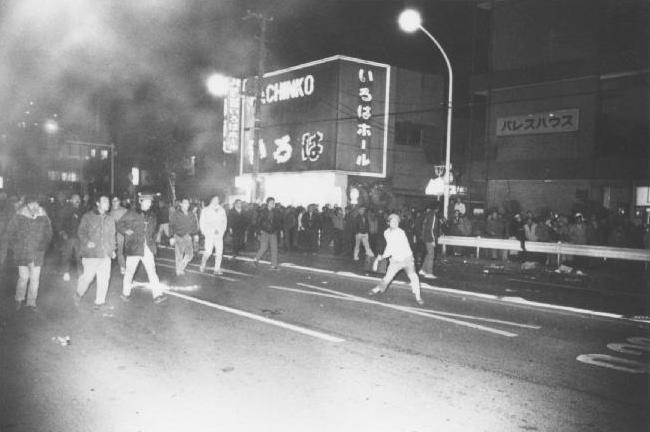
Riot in December 1984, following the assassination of the film’s first director, Mitsuo Sato
The filmmakers madetheir intention to avoid the usual tropes of labor films clear from the beginning. During shooting, members of the “YAMA” Production and Exhibition Committee lived among their subjects in the Sanya yoseba (a slum-like housing complex for day laborers, part of a system dating back to the 1800s in Japan). In his personal appeal for cooperation to the people of the neighborhood, Sato wrote:
It is not our intention to film you with an irresponsible attitude. Even a moviemaker like me has such a sense of shame that I will try not to make a big speech as to why we will make this film, but I will tell you about some of my personal concerns for it. By involving myself with this project, I want to wash off all the dirt I have accumulated on myself as a moviemaker for the past fifteen years and then hopefully be born again … The film definitely differs in character from those produced by the bourgeois mass media — which we accuse of being the accomplice of the capitalists — in that this documentary is to be used to stop them from messing around with us.
Yama thus looks at its characters not from a vantage of middle-class pity but through the lens of solidarity. It follows the workers of Sanya as they attempt to organize and hold strong against all manner of intimidation. Though the police and yakuza are supposed to be enemies, here they found common cause over their mutual loyalty to monied interests threatened by labor organization. The film is an instructional on Marxist principles and analytical frameworks without a single line of lecture in it, demonstrating the unfair structure of the system entirely through raw observation. Crucially, the film makes sure to explore the place which migrants from Korea and Taiwan have in this underclass — even today, minority groups are often left out of discourse on these issues in Japan, and are essentially invisible in media coverage.
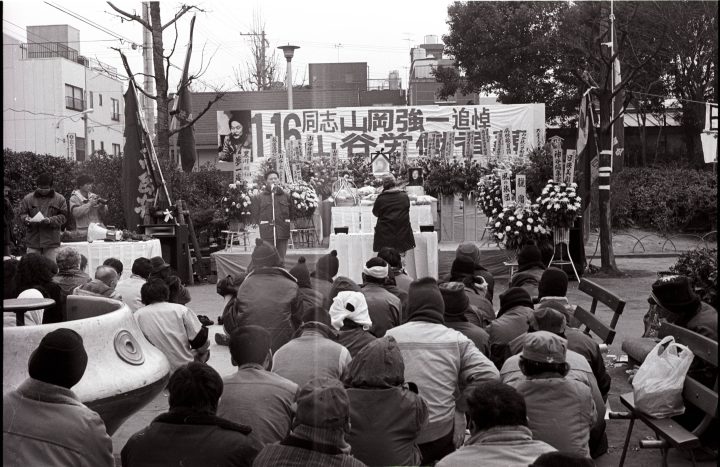
The January 16, 1986 laborers’ funeral for director Kyoichi Yamaoka
Yama — Attack to Attack unflinchingly refutes any notion of separation between organized crime, nationalism, and the exploitation of workers, understanding these issues instead as inseparable elements of a capitalist system. It’s no wonder that this system reacted so violently to try to silence the filmmakers. But they failed. The “YAMA” Production and Exhibition Committee has refused to duplicate the movie not out of fear, but out of a refusal to allow it to be commercialized in any form. It has kept the documentary and its spirit alive for decades, which is vital, because its message remains eternally relevant.


No comments:
Post a Comment