VANTAG galeria

|\| ART BLOG HUMOR BLOG PHOTO BLOG CULTURE BLOG |:| FOR THE RENAISSANCE MAN & THE POLYMATH WOMAN |/|

Friday, November 8, 2024

gain clubhead speed


Most amateur golfers crave as much clubhead speed as possible, treating it as the holy grail when it comes to smashing their tee shots for more yardage. While swinging harder can be beneficial, like all things in the golf swing, if it’s not done with control, the results could be worse than before.

So instead of just gripping the driver, biting your lower lip, and trying to swing out of your shoes, you’ve got to understand how to implement more clubhead speed to still keep everything in sequence.


That’s where practicing the right drills come in — and thanks to PGA Golf Pro Brendon R. Elliott, you can learn the right fundamentals to incorporate more speed in your swing.

The best part? Instead of packing up and heading to the driving range to smash ball after ball, Elliott says the drills below can all be done from your home — so there’s no excuse not to try them out.


Driving

3 unique ways to gain clubhead speed (all from the comfort of home!)

By: Brendon R. Elliott, PGA Golf Professional , Nick DimengoNovember 6, 2024
Every golfer seeks more clubhead speed, so top teacher Brendon Elliott shares three unique ways to do so with some easy at-home drills

Get more clubhead speed by incorporating these unique at-home drills into your daily routine.

Getty Images

Most amateur golfers crave as much clubhead speed as possible, treating it as the holy grail when it comes to smashing their tee shots for more yardage. While swinging harder can be beneficial, like all things in the golf swing, if it’s not done with control, the results could be worse than before.

So instead of just gripping the driver, biting your lower lip, and trying to swing out of your shoes, you’ve got to understand how to implement more clubhead speed to still keep everything in sequence.

Instruction
Erika Larkin hits a drive
5 driving keys to hit longer, straighter tee shots
By: Maddi MacClurg

That’s where practicing the right drills come in — and thanks to PGA Golf Pro Brendon R. Elliott, you can learn the right fundamentals to incorporate more speed in your swing.

The best part? Instead of packing up and heading to the driving range to smash ball after ball, Elliott says the drills below can all be done from your home — so there’s no excuse not to try them out.

Scroll down to see what Elliott suggests, and try adding the unique drills into your training routine to get the clubhead speed that you’ve been seeking.

This weight shifting drill can help increase swing speed and gain distance

CLOSE
00:00
00:28

GOLF Teacher to Watch Jake Thurm demonstrates a drill that explains when, where, and how much you should shift weight in your swing.

Use these easy at-home drills for more clubhead speed

“As a seasoned golf teacher with nearly three decades of swinging, teaching, and coaching, I’ve learned a thing or two about this game — and one of those things is the importance of clubhead speed,” Elliott says. “Let’s face it, who doesn’t love the feeling of striking the golf ball with a little bit of extra juice behind it, then watching it soar down the fairway?”

So if you’re one of the millions of golfers who are on the hunt for more clubhead speed, Elliott suggests the following at-home drills to try and hit your goals.

1. The towel snap drill

Contrary to what you might imagine, this is not a drill where you twirl around a bath towel in your bathroom, so hear me out.

Grab a small towel, twist it up, and hold it like a golf club. With your normal stance, simulate your swing, with the goal to be to snap the towel at the bottom of your downswing. This exercise promotes the feeling of increasing speed at the right moment, while also helping you get the sense of proper wrist hinge and release. Plus, it gives a satisfying “snap” without having to call for drywall repairs when you attempt to do this with a club in your living room.

2. Resistance band training

Most people only associate resistance bands with physical therapy or recovery, but they can be a great resource when you’re looking for more clubhead speed, too. They’re also really inexpensive, and can be used anywhere from your living room or garage to a hotel room when you’re traveling.

So here’s what you need to do with this drill.

Secure a band to something sturdy, like a door handle or a bed post. Now get into your normal golf posture and pull the band as if you’re swinging a golf club. By using this drill, it’ll develop strength in the muscles involved in your swing, which, in turn, amps up your swing speed. But the best part? The drill’s versatile enough to do between TV commercials, so there’s no reason not to try it out.

3. Speed stick training

You’ve likely seen playing partners or golfers on the practice range use one of a variety of swing speed training systems — and they’re not just hype!
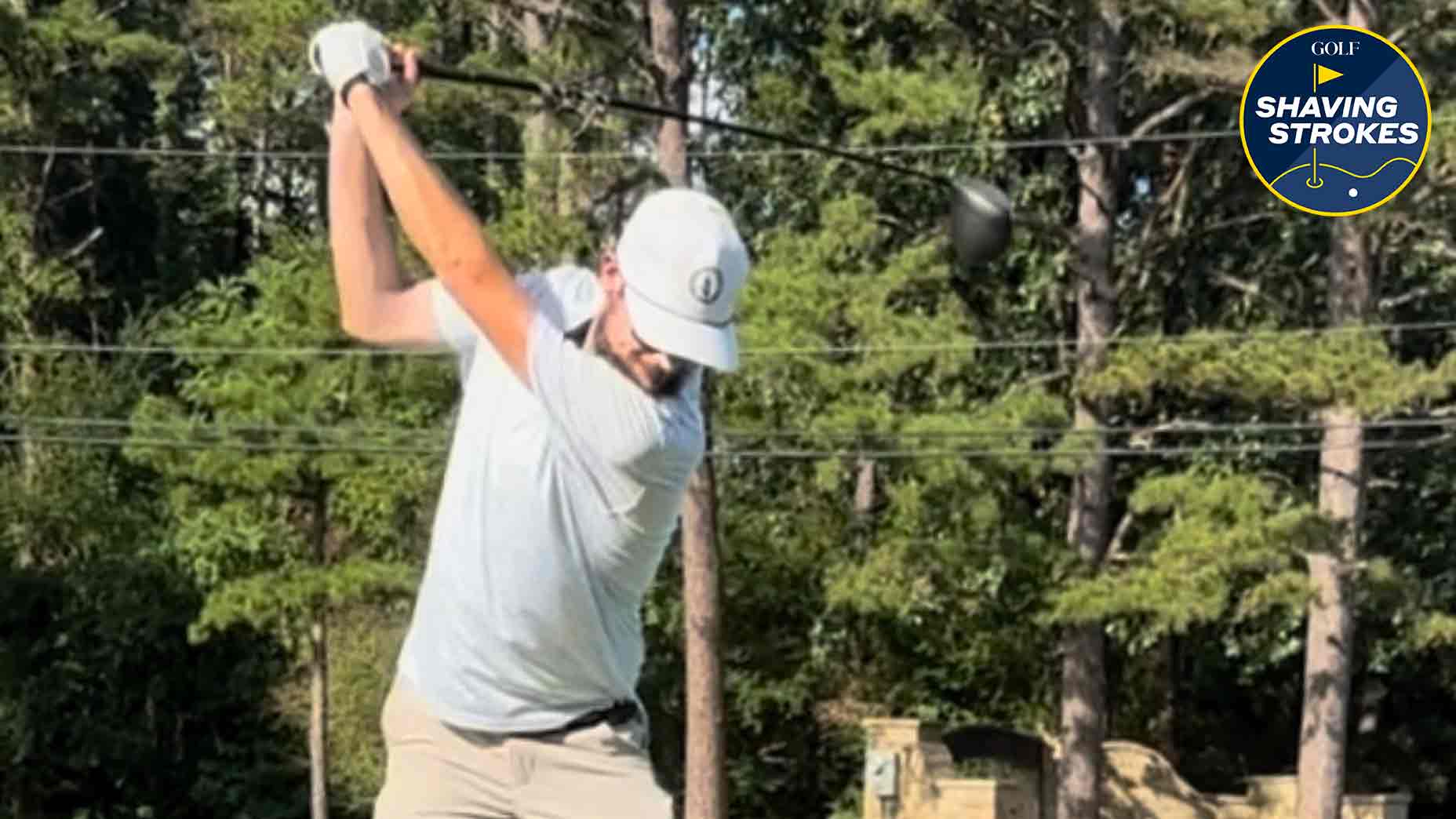
Driving
GOLF Teacher to Watch Lucas Wald shares the steps he used to help a high school teacher increase his swing speed and shave 6.9 strokes
How this science teacher added 19 mph of swing speed and dropped 7 strokes
By: Lucas Wald, GOLF Teacher to Watch , Nick Dimengo

While there are many to choose from, I personally like The Stack System, which gives you access to personalized training programs that are proven to increase clubhead speed straight through their app. With some commitment to the program, you’ll see solid results.

I’ve had a handful of my teen students use The Stack System, with each experiencing unbelievable results. My student Emil gained over 25 yards off the tee in just a few months — which will change anyone’s game, given that added distance with the driver.

Remember, increasing clubhead speed is a journey, not a sprint. By consistently using these home-based drills, you’ll start to see the improvements you want, all without putting too much strain on your body by swinging a club over and over with extreme force.

TheStack Swing Speed Trainer (Hardware + App Bundle)

TheStack Swing Speed Trainer (Hardware + App Bundle)

$314 (was $349)

  TheStack Hardware 5 milled Stack weights enable 30 weight combinations between 0g and 300g Dual-purpose weight case / phone stand Highly engineered training club – Adult (41.5″) or Junior (38.5″) version (see Fitting Juniors) Speed radar not included. View all compatible devices here.  We recommend the PRGR TheStack App Training 2-year License included, accessible on iOS only. Dynamic speed training formulated by Dr. Sasho MacKenzie Guided workout timer for reps, sets, and rest intervals Custom speed metrics to track your gains Hands-free data entry using voice entry technology Includes access to Stack Putting (Beta) – Learn more Includes Single User License – Enables training and tracking for up to five local (i.e. family) users under one login. Multi-user Coaches License license sold separately. Access TheStack App from the App Store when your order arrives. Requires iOS 15.0 or later.
View Product

Latest In Instruction

3 hours ago

6 simple steps to master the bump and run shot

20 hours ago

How a high schooler shot 59(!) and shaved 3 strokes off his index

22 hours ago

How far golfers *really* hit their drives, according to data

24 hours ago

How do pros tackle short wedge shots? Here's Will Zalatoris' method

generic profile image

Brendon R. Elliott, PGA Golf Professional

Golf.com Contributor

Nick Dimengo

Golf.com Editor

Related Articles


Cabecilha at 6:11:00 PM No comments:
Share

Rory’s method can


How Rory’s method can help you

Anyone who’s made a swing change knows the process can be discouraging. When you first start, even finding the ball with the clubface can feel like a challenge. When you struggle at first, your brain will start to fall back on old habits in order to hit the ball.

If this sounds familiar, don’t worry — even the pros struggle with it.

“I’m terrible at if I’m trying to make a certain swing or a certain swing change, and I start to mis-strike it or not hit the shots that I want, I’ll just revert back to what I was doing because it’s comfortable,” McIlroy said. “When there’s sequences to the shots that you hit, you’re always going to revert back to what’s comfortable.”

That struggle is why McIlroy decided to practice for weeks without seeing where the ball was going. In order to block his brain from reverting to bad (but comfortable) habits, he eliminated any sort of feedback. Only after the new swing was fully ingrained — and the old habits completely eradicated — did he go out to the course and hit shots.

If you’re trying to make a swing change yourself, this method can be extremely beneficial. By eliminating all feedback and just focusing on the proper swing positions, your brain will have an easier time accepting the change. And by the time you get back out on the course hitting shots, the new feels should feel natural enough that you won’t fall back into bad habits.

Latest In Instruction

3 hours ago

6 simple steps to master the bump and run shot

20 hours ago

How a high schooler shot 59(!) and shaved 3 strokes off his index

22 hours ago

How far golfers *really* hit their drives, according to data

24 hours ago

How do pros tackle short wedge shots? Here's Will Zalatoris' method

Zephyr Melton

Golf.com Editor

Zephyr Melton is an assistant editor for GOLF.com where he spends his days blogging, producing and editing. Prior to joining the team at GOLF, he attended the University of Texas followed by stops with the Texas Golf Association, Team USA, the Green Bay Packers and the PGA Tour. He assists on all things instruction and covers amateur and women’s golf. He can be reached at zephyr_melton@golf.com.


How Rory McIlroy’s radical practice method can improve your ball striking

By: Zephyr Melton
November 6, 2024


Rory McIlroy has been using an unorthodox practice method lately.

Getty Images

Welcome to Play Smart, a regular GOLF.com game-improvement column that will help you become a smarter, better golfer.

Pros are meticulous in their practice routines. Go to any Tour event and you’ll see that there is no wasted rep when it comes to grooving the proper moves.

With so much technology available now (launch monitors, training aids, etc.) this has only enhanced the effectiveness of proper practice. When you can see data points for every shot, it takes the guesswork out of fixing the swing.

Sometimes, though, making swing changes requires radical means. Take Rory McIlroy’s recent practice methods, for example. At this week’s Abu Dhabi HSBC Championship, he explained that in the weeks leading up to the tournament, he hadn’t seen his ballflight on the range or simulator.

“The only way I was going to make a change or at least move in the right direction with my swing was to lock myself in a studio and not see the ballflight for a bit and just focus entirely on the movement,” he said.

McIlroy’s method is not what you’d typically expect from a top-ranked player. With so much tech available, not having any sort of feedback during practice can seem unorthodox. However, when making a swing change, it can be incredibly useful.

What did a lesson with Sam Snead look like? Perfect swings and even better roasts

Kostis & McCord
Full Episode Out Now!
Click Here!
00:00
00:40

On this live audience episode of "Kostis and McCord: Off Their Rockers," Peter Kostis tells a great story of how the famous Sam Snead roasted an amateur looking for a detailed swing lesson.

How Rory’s method can help you

Anyone who’s made a swing change knows the process can be discouraging. When you first start, even finding the ball with the clubface can feel like a challenge. When you struggle at first, your brain will start to fall back on old habits in order to hit the ball.

If this sounds familiar, don’t worry — even the pros struggle with it.

“I’m terrible at if I’m trying to make a certain swing or a certain swing change, and I start to mis-strike it or not hit the shots that I want, I’ll just revert back to what I was doing because it’s comfortable,” McIlroy said. “When there’s sequences to the shots that you hit, you’re always going to revert back to what’s comfortable.”

That struggle is why McIlroy decided to practice for weeks without seeing where the ball was going. In order to block his brain from reverting to bad (but comfortable) habits, he eliminated any sort of feedback. Only after the new swing was fully ingrained — and the old habits completely eradicated — did he go out to the course and hit shots.

If you’re trying to make a swing change yourself, this method can be extremely beneficial. By eliminating all feedback and just focusing on the proper swing positions, your brain will have an easier time accepting the change. And by the time you get back out on the course hitting shots, the new feels should feel natural enough that you won’t fall back into bad habits.

Latest In Instruction

3 hours ago

6 simple steps to master the bump and run shot

20 hours ago

How a high schooler shot 59(!) and shaved 3 strokes off his index

22 hours ago

How far golfers *really* hit their drives, according to data

24 hours ago

How do pros tackle short wedge shots? Here's Will Zalatoris' method

Zephyr Melton

Golf.com Editor

Zephyr Melton is an assistant editor for GOLF.com where he spends his days blogging, producing and editing. Prior to joining the team at GOLF, he attended the University of Texas followed by stops with the Texas Golf Association, Team USA, the Green Bay Packers and the PGA Tour. He assists on all things instruction and covers amateur and women’s golf. He can be reached at zephyr_melton@golf.com.


ly useful.

What did a lesson with Sam Snead look like? Perfect swings and even better roasts

01:12
01:25

On this live audience episode of "Kostis and McCord: Off Their Rockers," Peter Kostis tells a great story of how the famous Sam Snead roasted an amateur looking for a detailed swing lesson.

How R


Cabecilha at 6:07:00 PM No comments:
Share
‹
›
Home
View web version
Powered by Blogger.