
VANTAG galeria

|\| ART BLOG HUMOR BLOG PHOTO BLOG CULTURE BLOG |:| FOR THE RENAISSANCE MAN & THE POLYMATH WOMAN |/|

Monday, April 9, 2018

Tourists Could Be East Timor’s Lifeline. But Will They Ruin Its Reefs?


SKIP TO CONTENTSKIP TO NAVIGATIONVIEW MOBILE VERSION


The New York TimesThe New York Times


https://www.nytimes.com/2018/04/08/world/asia/east-timor-reefs-tourism.html?emc=edit_th_180409&nl=todaysheadlines&nlid=666716390409WORLD
  • Share


Cover Photo
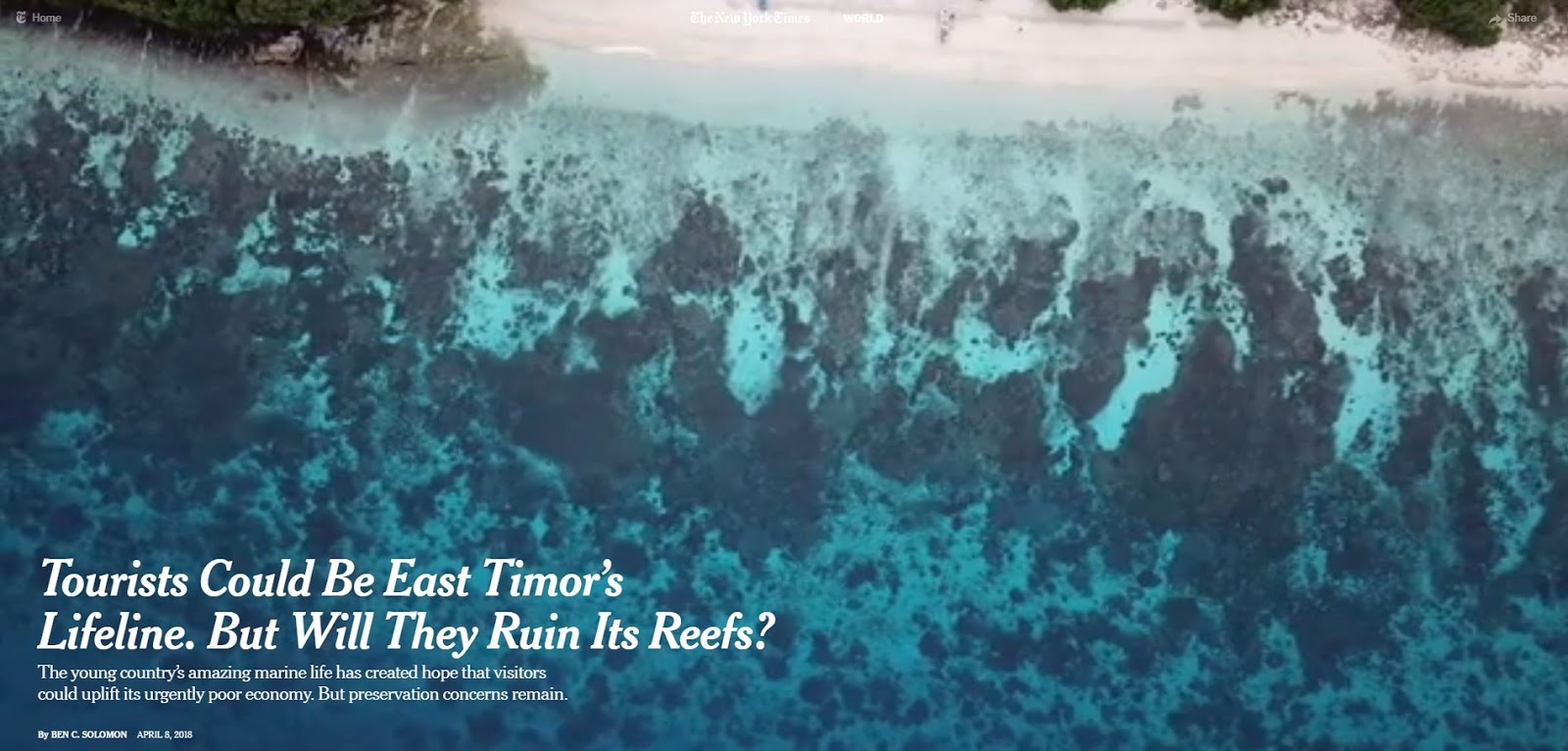
An aerial view of Jaco Beach, East Timor. On a calm day, the water is almost perfectly clear. CreditBen C. Solomon/The New York Times


Tourists Could Be East Timor’s
Lifeline. But Will They Ruin Its Reefs?

The young country’s amazing marine life has created hope that visitors
could uplift its urgently poor economy. But preservation concerns remain.
By BEN C. SOLOMONAPRIL 8, 2018


https://www.nytimes.com/2018/04/08/world/asia/east-timor-reefs-tourism.html?emc=edit_th_180409&nl=todaysheadlines&nlid=666716390409


COM, East Timor — On a rainy spring morning, Fizzy Moslim strapped on her weathered-chrome oxygen tank and slipped into the warm water.
Few visitors make it out to the sleepy fishing village of Com, a backbreaking seven-hour drive from the capital, and usually no one except the locals ever dives into its waters.
Below she found an underwater metropolis. Sea turtles swam beside hundreds of reef fish, feeding on the rich coral below. Two young dugong, a manatee-like sea mammal, sped away, and a blacktip reef shark swam along the ocean floor.
“This isn’t even nearly the best of what I’ve seen,” said Ms. Moslim, an instructor for Compass Diving tours, as she came up from the depths.
Continue reading the main story


Photo

Fizzy Moslim examining the reefs around Atauro Island in what scientists have called some of the most biodiverse waters in the world. CreditBen C. Solomon/The New York Times
In March, Ms. Moslim and a team of divers and conservationists set out on a mission to chart these sea sanctuaries in hopes of bringing in a new kind of species here: tourists.
“If these corals will stay strong, the people around them will need the money to keep them safe,” said Trudiann Dale, the East Timor country director for Conservation International. “Eco-tourism, if done right, could provide that.”
Continue reading the main story
The tiny country of East Timor is surrounded by some of the most magnificent and untouched marine life in the world. Off the island of Atauro alone, researchers have discovered 253 reef fish species, surpassing the world record.
Continue reading the main story


Continue reading the main story
Cristo Rey of Dili, the statue overlooking the East Timorese capital. 
Ben C. Solomon/The New York Times
But 16 years after gaining its independence after decades of bloody occupation, East Timor remains the poorest country in Southeast Asia. As politicians struggle to find new economic streams like oil pumping and coffee exports, none have proved powerful enough to raise the country out of poverty.
The question for conservationists and government officials is clear: How can the country both develop tourism and keep its pristine beauty?


ATAURO I.
Com
Dili
Savu Sea
EAST TIMOR
Timor Sea
INDONESIA
50 MILES
South China
Sea
PHILIPPINES
Pacific Ocean
MALAYSIA
INDONESIA
Jakarta
Java Sea
Area of
detail
Indian Ocean
BALI
AUSTRALIA
1,000 MILES
25
50
100
Miles
By The New York Times

“It’s a hard thing,” said Manuel Mendes, head of the Department of Protected Areas and National Parks for East Timor, noting his country’s susceptibility to climate change and drought. “We know that if we just leave it all alone, it will soon be gone.”
Around the world, coral is being wiped out. According to the conservation group W.W.F., almost a quarter of coral reefs worldwide are damaged beyond repair. The rest are under threat from rising sea temperatures, harmful fishing practices and vicious tourism.
“We don’t want to end up like Bali,” said Ms. Dale, referring to the nearby tourist center’s “garbage emergency” last year, when nearly 100 tons of garbage washed up on the island’s beaches.
Continue reading the main story


Photo

Xanana Gusmão, who has had stints as president and prime minister of East Timor, arriving in Dili after months of negotiations with Australia over a revised maritime border. CreditBen C. Solomon/The New York Times


Photo

Schoolchildren in Com, East Timor. Most of the country is younger than 25, and unemployment is rising.CreditBen C. Solomon/The New York Times


Photo

The town of Tutuala, East Timor. CreditBen C. Solomon/The New York Times
Since declaring independence in 2002, after suffering years of harsh occupation by the Indonesian military, East Timor has been struggling to find its feet.
“During the Indonesian time, soldiers would throw grenades in the reef to fish,” said Zanuari Marteans, a 60-year-old fisherman from Atauro Island. “We hid in the villages and watched them destroy. We could do nothing.”
In the years after independence, the country had one of the highest fertility rates in the region, with almost seven births per mother. Sixteen years later, most of the population is younger than 25, with unemployment on the rise.
Since 2004, almost 80 percent of East Timor’s gross domestic product has come from the oil field in the Timor Sea, where reserves are projected to run dry by 2023. In March, the ex-rebel leader and independence hero Xanana Gusmão led negotiations with Australia, expanding East Timor’s sea border and giving hopes for an extended deal worth billions more. But discussions on where the oil will be pumped continue, and East Timor is struggling to find jobs for the growing population.
Continue reading the main story


Continue reading the main story
The waters of East Timor teem with hundreds of reef fish species. 
Ben C. Solomon/The New York Times
The reef development here is no accident. For generations, local fishermen have safeguarded their supplies of fish by creating marine protected areas. Communities would agree on the boundaries, mark them off and ban fishing there: no nets being dragged around, no rumbling boat motors. In these areas, fish and coral develop untouched, so future generations have a chance to fish them.
In 2016, the East Timorese government started putting these practices into law. It created a budget and started paying rangers to help out. But the budget is minuscule and barely covers the enforcers’ salaries.
Accordingly, much of the day-to-day work around the reefs has remained with the fishing communities.
Inside a concrete shack to protect from the hot midday sun, Ms. Dale gathered a group of local fishermen and hotel owners together with Compass Diving, based in Dili, to share ideas for eco-tourism.
Their pristine reef, she explained, could bring in divers from around the world who would pay good money to explore them. The fishermen sat smoking cigarettes with their arms guardedly crossed.
“We don’t know where to start,” said Lucas Monteioro, 32, a jobless resident of Com. “The community is interested in tourism and making new money, but people here only have the sea.”
Continue reading the main story


Photo

Timorese fisherman in the waters near their village. “You’re never far from catching a good fish here” said Alberto Pacoti. Most fisherman have started splitting their time between fishing and acting as guides, renting out their rusty boats to bring tourists around the reefs. CreditBen C. Solomon/The New York Times


Photo

Hauling in the catch. For decades, communities have set up protected areas to prevent fishing and allow reefs to develop and new fish to spawn. CreditBen C. Solomon/The New York Times


Photo

Tourists watching the sunset in Dili. East Timor hopes to generate revenue by attracting more visitors, but so far, only about 5,000 arrive each year. CreditBen C. Solomon/The New York Times
The truth is that tourism has remained starkly low, with the Asia Foundation estimating that only about 5,000 tourists a year make it to East Timor. Roads are rocky and inaccessible, and flights to get in the country are sparse and expensive.
Given that, eco-tourism is still not a realistic priority for governmental leaders, though there is hope it will improve.
In parts of the country, big-money hotels have already started contracting developments. Government proposals have included turning East Timor into a Macau-like tax haven and casino destination.
But for the fishermen here, the weight of the preservation will remain a central part of their lives.
“These fish are our life, and the reef is their house,” said Mr. Marteans, sitting up from an afternoon nap in the warm sand and getting ready for an evening fishing run. “If someone has no house, how can they live?”
Continue reading the main story


Photo

Playing soccer on the beach in Dili. CreditBen C. Solomon/The New York Times


A version of this article appears in print on April 9, 2018, on Page A4 of the New York edition with the headline: Young Nation Seeks Tourists To Keep Reefs Unspoiled. Order Reprints| Today's Paper|Subscribe
Continue reading the main story


Cabecilha at 8:02:00 PM No comments:
Share

Deutsche Bank Replaces C.E.O. Amid Losses and Lack of Direction


BUSINESS DAY

Deutsche Bank Replaces C.E.O. Amid Losses and Lack of Direction

By JACK EWINGAPRIL 8, 2018
Continue reading the main storyShare This Page
  • Share
  • Tweet
  • Email
  • More
  • Save
Photo
John Cryan, left, and Christian Sewing at a news conference in Frankfurt in February. On Sunday, the bank’s supervisory board said that Mr. Sewing would replace Mr. Cryan as chief executive. CreditAndreas Arnold/Bloomberg
FRANKFURT — The banking crisis that began in 2008 seems like ancient history in much of the world, but not at Deutsche Bank. Never-ending turmoil at the bank — Germany’s largest lender — including three straight years of losses, a plunging share price, and a troubled investment bank, cost its chief executive his job on Sunday.
After holding an evening conference call, the bank’s supervisory board said it would replace John Cryan, the chief executive of Deutsche Bank since 2015, with Christian Sewing, a longtime insider who has been in charge of the bank’s wealth management division and its branch network in Germany.
“Following a comprehensive analysis, we came to the conclusion that we need a new execution dynamic in the leadership of our bank,” Paul Achleitner, the chairman of the supervisory board, said in a statement late on Sunday.
Mr. Sewing, 47, is the fourth person in four years to hold the title of chief executive or co-chief executive at Deutsche Bank. He represents a younger generation of managers but will face the same set of problems that have bedeviled his predecessors — problems that have roots going back years or even decades and stem largely from Deutsche Bank’s ambition to be a major investment bank.
The problems include a work force that is too big and too costly, dysfunctional internal computer systems and a large inventory of risky assets that are difficult to sell.
Continue reading the main story

RELATED COVERAGE

  • Mueller Wants Trump’s Business Records. What’s the Russia Connection? MARCH 17, 2018

  • China’s Biggest Deal Maker Spent Billions. Now the Bill Comes Due. MARCH 2, 2018

  • Settlements for 3 Wall Street Banks Hold a Silver Lining FEB. 1, 2018

  • Prosecutors Said to Seek Kushner Records From Deutsche Bank DEC. 22, 2017

ADVERTISEMENT
Continue reading the main story
One of Mr. Sewing’s main tasks will be to resolve Deutsche Bank’s ambivalence toward its investment banking unit, which has produced huge profits in some years and huge losses in others. The bank, based in Frankfurt, is one of the last European banks with a prominent outpost on Wall Street, but has struggled to keep up with its American rivals even as they have come back stronger than ever.
Marcus Schenck, the co-head of the investment bank, will also leave as part of the shake-up announced Sunday. Garth Ritchie, who shared leadership of the investment bank with Mr. Schenck, will assume sole responsibility.
Mr. Sewing (his name is pronounced “saving”) is not expected to radically change the bank’s direction, but he will face pressure to move more aggressively than Mr. Cryan, whose dismissal had been widely rumored in recent weeks.
During his three-year tenure, Mr. Cryan, a bookish Briton who speaks German fluently, helped Deutsche Bank begin to crawl out from under the legal problems that had weighed on the bank’s reputation and cost it billions of euros in fines and settlements. Late in 2016, for instance, Deutsche Bank reached a settlement with the United States government to pay $7.2 billion related to the sale of toxic mortgage securities before the 2008 financial crisis.
But new scandals have continued to appear. Last year, Deutsche Bank agreed to pay more than $600 million to authorities in New York and Britain to settle charges that it had helped Russian investors launder as much as $10 billion through branches in Moscow, London and New York. Regulators said the conduct took place from 2011 to 2015.
Mr. Cryan was also unable to return Deutsche Bank to profitability. The bank reported a loss of €735 million, or about $900 million, for 2017, its third consecutive annual loss.

Newsletter Sign Up

Continue reading the main story

Sign up for the all-new DealBook newsletter

Our columnist Andrew Ross Sorkin and his Times colleagues help you make sense of major business and policy headlines — and the power-brokers who shape them.
  • SEE SAMPLE
  •  
  • PRIVACY POLICY
  •  
  • OPT OUT OR CONTACT US ANYTIME
Investors have punished the bank’s shares, which have lost more than half their value since Mr. Cryan became co-chief executive in July 2015. Mr. Cryan initially shared the top job with Jürgen Fitschen and became the sole chief executive in 2016.
Unlike almost all of his recent predecessors, Mr. Sewing is not primarily an investment banker. He has worked at Deutsche Bank since 1989, spending time at bank offices in London, Singapore, Tokyo and Toronto. He held top positions in risk management at the bank and was its chief auditor until being named to the management board in 2015.
As a German and a Deutsche Bank lifer with a background in risk management, Mr. Sewing will reassure German regulators concerned that the bank has taken too long to pare down the risky assets accumulated by its London-based investment banking unit. With its zeal to remain in the Wall Street big leagues, Deutsche Bank was slower than its European rivals like Credit Suisse to scale back its investment banking operations after the financial crisis.
Mr. Sewing’s management portfolio has included Postbank, which offers banking services from German post offices. That background will most likely raise expectations that he will shift Deutsche Bank’s emphasis from investment banking back to its roots in the German domestic market.
Those expectations may be misplaced. The German banking market is overcrowded and profit margins are slim. Deutsche Bank has little prospect for growth without investment banking and international expansion. In a sign that the bank continues to have ambitions in investment banking, the supervisory board has nominated John Thain — former chief executive of Merrill Lynch and the New York Stock Exchange and a former co-chief operating officer of Goldman Sachs — as a new member. The nomination must be approved by shareholders at their annual meeting in May.
Mr. Cryan’s departure followed several weeks of media speculation that created the impression of intense infighting between him and Mr. Achleitner, a former partner at Goldman Sachs who has been chairman of the Deutsche Bank supervisory board since 2012.
On March 28, Mr. Cryan wrote a memo to Deutsche Bank employees in which he acknowledged the rumors but said, “I am absolutely committed to serving our bank and to continuing down the path on which we started some three years ago.”
Late Saturday, Deutsche Bank issued a one-sentence statement saying that the supervisory board would discuss the chief executive job, tacitly confirming that Mr. Cryan was on his way out. On Sunday evening, the 20 members of the supervisory board held a conference call, issuing a statement well after 11 p.m.
The public power struggle was reminiscent of previous management changes, and could also put pressure on Mr. Achleitner, who bears ultimate responsibility for the bank’s strategy.
A version of this article appears in print on April 9, 2018, on Page B1 of the New York edition with the headline: Amid Losses And Fines, A New Chief For Deutsche. Order Reprints| Today's Paper|Subscribe
Cabecilha at 2:07:00 PM No comments:
Share
‹
›
Home
View web version
Powered by Blogger.