VANTAG galeria

|\| ART BLOG HUMOR BLOG PHOTO BLOG CULTURE BLOG |:| FOR THE RENAISSANCE MAN & THE POLYMATH WOMAN |/|

Thursday, July 30, 2015

Chinese photobooks

In China, the Photobook
as Art and History

By Maurice Berger Jul. 30, 2015
 

On a fateful 2006 trip to a Beijing flea market, the photographers Martin Parr and Ruben Lundgren were fascinated by the Chinese photobooks they discovered. Soon, they became obsessed. Mr. Lundgren, who relocated there and became fluent in Mandarin, helped Mr. Parr make sense of the many volumes they began to systematically collect. By 2009, Mr. Lundgren’s Beijing apartment overflowed with books.
Their joint effort has resulted in “The Chinese Photobook” (Aperture), a rigorous exploration of the genre’s richness and diversity from the dawn of the 20th century to today...
 
http://lens.blogs.nytimes.com/2015/07/30/in-china-the-photobook-as-art-and-history/#


Cabecilha at 7:15:00 PM No comments:
Share

abertos em agosto || open in august

PORTO / Portugal

RUA MIGUEL BOMBARDA, 552 || GALERIA || VANTAG a: Loja || EDITORA

RUA MIGUEL BOMBARDA, 578 || GALERIA || ESTUDIO FOTO || EVENTOS

AVENIDA DO PARQUE, 346 || COLLECTORS SUITE

RUA DOM MANUEL II, 320 || BACKOFFICE
Cabecilha at 4:16:00 PM No comments:
Share

olha: + 1 paypal...

Technology

Stripe, Digital Payments Start-Up, Raises New Funding and Partners With Visa

By MIKE ISAAC JULY 28, 2015
 
Stripe is gaining more financial allies to help it take on the digital payments industry.
The start-up, based in San Francisco, said on Tuesday that it had raised new funding from investors like Visa, American Express and Sequoia Capital, among others, valuing the young company at $5 billion. That is a significant jump for Stripe, coming roughly six months after it garnered $70 million at a $3.5 billion valuation. Stripe declined to disclose the amount of new funding, except to say it was “less than $100 million.”
Founded five years ago, Stripe has quickly gained traction by offering simple software and services for online small and medium-size businesses. Similar to Square and PayPal, Stripe accepts credit and debit cards for merchants who have not taken them previously. Stripe charges a small fee per transaction.
 
 
http://www.nytimes.com/2015/07/28/technology/stripe-digital-payments-start-up-raises-new-funding-and-partners-with-visa.html?emc=edit_sb_20150729&nl=business&nlid=66671639


Cabecilha at 3:44:00 PM No comments:
Share

... 'bora snifar... café!?! :)

Style | Noted

Caffeine Inhalers Rush to Serve the Energy Challenged

By ALEX WILLIAMSJULY 22, 2015
 
An Eagle Energy Vapor caffeine inhaler for those too rushed to drink coffee. Credit Tony Cenicola/The New York Times        
 
In a culture that has already infused caffeine into everything including popcorn, cookies, lip balm, hot sauce, ice cream and, yes, personal lubricant, it’s not surprising that some people may find the simple act of sipping — coffee, tea, whatever — to achieve a buzz painstakingly backward.
 
The solution? Pass the vape, dude.
 
E-cigarettes have merged with triple-shot lattes in the form of caffeine inhalers. The new devices, with names like the Eagle Energy Vapor, promise to deliver a burst of caffeine to on-the-go college students and professionals who cannot spare the time, apparently, to pause for a Starbucks venti.
 
The active ingredients are guarana (the caffeine-rich Amazonian plant), taurine and ginseng. Think of it as a Red Bull for the lungs.
 
“It’s for when you’re on the chairlift skiing, when you’re hiking, when you’re driving in the car,” said Elliot Mashford, a Canadian entrepreneur behind the Eagle inhaler, which is being introduced at newsstands, drugstores and casinos across North America, he said.
 
http://www.nytimes.com/2015/07/23/style/caffeine-inhalers-rush-to-serve-the-energy-challenged.html?emc=edit_sb_20150729&nl=business&nlid=66671639


Cabecilha at 3:12:00 PM No comments:
Share

So Much Like Humans, Only Better

Fashion & Style | Optics

Fashion Finds a More Perfect Model: The Robot

By RUTH LA FERLA JULY 29, 2015
 
http://www.nytimes.com/2015/07/30/fashion/fashion-finds-a-more-perfect-model-robots.html?emc=edit_th_20150730&nl=todaysheadlines&nlid=66671639#

Continue reading the main story Slide Show    


Slide Show|10 Photos

So Much Like Humans, Only Better

Credit Steven Klein for W magazine
 
 
In a recent episode of the AMC drama “Humans,” Toby Hawkins, a randy adolescent, engages in a bit of unseemly groping, reaching for Anita, the humanoid family housekeeper. When she turns him away, he glowers, asking her sourly, “Why do you have to be so fit?”
Or for that matter, so adroit in anticipating her employers’ every whim and errant impulse? Given her uncanny sensitivity, you might even suspect that Anita has a mind of her own.


She is but the latest in a procession of weirdly competent and oddly seductive androids who have been marching onto our home screens, looming larger than life at the multiplex and, just as unsettlingly, insinuating themselves into the world of style.
Fashion has been especially quick to seize on the notion that robots are slicker, more perfect versions of ourselves. In the last few months alone, androids have filtered into the glossies and stalked the runways of designers as audacious as Thom Browne and Rick Owens, and of inventive newcomers like David Koma, who riffed on fembot imagery in his fall 2015 collection for Mugler, sending out models in frocks that were patterned with soldering dots and faux computer circuitry.


Formidable and preternaturally glamorous, those models and their synthetic pop-culture kin may well inspire envy and a covert urge to merge with the machine. But they also spawn the kind of dread that’s been rivaled of late only by the walking dead.
Sleeker, smarter and more coolly efficient than their human counterparts, these next-generation bots (played by flesh-and-blood humans) boast advanced motor skills, superhuman consciousness and even subtle facial tics that mimic those of their makers.
What’s more, they’re better looking. In “Humans,” the so-called synths were conceived to look like “almost-perfect humans,” said Vickie Lang, who created their hair and makeup. The fastidiously groomed synth women “never touch their hair,” she said. “Their skin is a little silicone-y.”


In contrast, their masters seem as chaotically thrown together as week-old bed linens. “We left them a little disheveled,” she said.
Hard-put to compete, a rumpled police detective in the series is driven to moan distractedly: “I’m an analog man in a digital age. I’m redundant.”
His remark encapsulates the persistent anxiety being mined by the filmmakers of “Ex Machina,” in which a comely android (Alicia Vikander) outmaneuvers her creator; “Terminator Genisys” and “Mad Max: Fury Road,” in which the fearsome Imperator Furiosa (Charlize Theron) vanquishes her enemies with a robotically wired prosthetic arm.


Similar fears, coupled with a rising fascination, have been tapped in a wave of young-adult fiction, notably “The Lunar Chronicles,” the Marissa Meyer fantasy series detailing the adventures of a cyber-Cinderella.
Pure sci-fi? Not necessarily. As Sidney Perkowitz, a physicist and the author of “Digital People: From Bionic Humans to Androids,” wrote in an email, “the new angle is the growing realization that robots could become more than barely smart enough to do simple tasks (remember when Roomba was a big deal, just for its ability to clean floors
without human guidance?)”


 These days, he added, “their chips meet a true cognitive challenge by solving complex and shifting situational problems in real time.” The upshot: “Artificial brains could become plenty smart enough to handle all of a robot’s physical actions.”
And usurp human functions, as well. In a sense, synthetics that look like people, think like people and even “feel” the way that people do, reading emotions and simulating human empathy, already exist.

Pepper, a silicone humanoid manufactured by SoftBank Robotics Corp., and billed as “the world’s first emotional robot,” is a novelty home companion with coin-dot eyes and articulated limbs, and carries a price tag of $1,600. The costly but friendly machine sold out within one minute of its introduction in Japan in June.
“Some people think robots will be better at basically everything, maybe even creativity,” said Martin Ford, the author of “Rise of the Robots, Technology and the Threat of a Jobless Future.”

In his book he speculates that rising up alongside a new generation of worker-bots overhauling the economy may be an army of artist-bots that can act or make music. “Humans,” he suggested in an interview, “seem destined not to be competitive at all.”
Some members of the fashion tribe have already assigned mere mortals a kind of B-list status. In a Steven Klein photo shoot in the current Vogue, drones hover overhead, seeming to spy on a party of human models cavorting in a field. For the March issue of W magazine, he portrayed the designer Jason Wu wrapped in the arms of a tin man.

In other images, Mr. Klein’s robots tended to be more lifelike, shown about to copulate or otherwise merge with their human partners in settings as alienating and austere as a surgery. They comment on fashion’s willful embrace of artifice, and as Mr. Klein said, on the dehumanizing aspects of digital manipulation in photography, which, he said, “has removed more and more the feeling of skin against skin.”
Fashion’s romance with synthetics has antecedents in the design output of Riccardo Tisci of Givenchy, Donatella Versace and Karl Lagerfeld, each of whom at various times has made reference to the 1927 science fiction spectacle “Metropolis,” that movie’s mechanized central figure whipping her followers into frenzied revolt. Other frequent points of reference include the 1982 movies “Tron,” which inspired Mr. Browne, among others, and “Blade Runner,” which continues to spawn scores of fashion shoots.

More whimsical interpretations of a resurgent trend include a Rodarte collection last year, in which a series of dresses was patterned with “Star Wars” robot stills.
A phalanx of giant techno tin men dominated an installation last spring in the windows of Bergdorf Goodman. Neither menacing nor particularly friendly, “they were oversize toys, really,” said David Hoey, the store’s senior director for visual presentation, “each with a different personality, disposition and story to tell his robot psychiatrist.”

The choreographer Blanca Li emphasized her automatons’ toylike aspects in a performance last spring at the Brooklyn Academy of Music. Featured players in her “Robots” show were toddler-size animatronic figures and dancers shod in, of all things, Louboutin pumps.
Fashion, said Ms. Li, who has collaborated in the past with the designer Azzedine Alaïa, was integral to the performance, expressive of the spirit of the hour.
“More and more we are interacting with all kinds of machines,’” she told a Style.com writer at the time. Her ultimate goal: “that we forget even for one second that this was a machine.”


A version of this article appears in print on July 30, 2015, on page D1 of the New York edition with the headline: So Human, Only Better.


Cabecilha at 1:26:00 PM No comments:
Share

Tuesday, July 28, 2015

Shigeko Kubota

 The New York Times            

   
Art & Design                                                               

Shigeko Kubota, a Creator of Video Sculptures, Dies at 77

By WILLIAM GRIMESJULY 27, 2015


http://www.nytimes.com/2015/07/28/arts/design/shigeko-kubota-a-creator-of-video-sculptures-dies-at-77.html?emc=edit_th_20150728&nl=todaysheadlines&nlid=66671639


Cabecilha at 6:18:00 PM No comments:
Share

super preço :)

https://www.facebook.com/photo.php?fbid=931805746884871&set=a.116145725117548.15962.100001663643798&type=1&theater


Cabecilha at 5:43:00 PM No comments:
Share

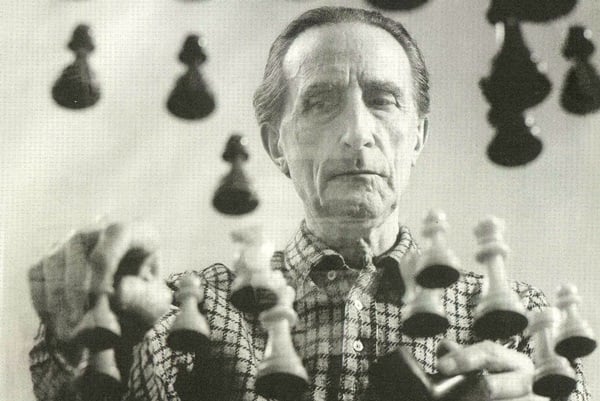
7 Reasons to Celebrate Marcel Duchamp on His Birthday

People

7 Reasons to Celebrate Marcel Duchamp on His Birthday

Rain Embuscado, Tuesday, July 28, 2015
 
490
Marcel Duchamp.
Photo: Courtesy of University of Southern Califórnia
 
Marcel Duchamp was a prankster, a rabble-rouser, and an envelope pusher. Over a century after he plunged a bicycle wheel into a four-legged stool, artists are still paying homage to his life and work.
At the time, however, not all collectors were happy with his readymades. According to Tout-Fait, the Marcel Duchamp Studies Online Journal, Dorothea Dreier commissioned Duchamp to create Why Not Sneeze, Rrose Selavy? (1921) for $300; when he submitted the work, she apparently hated it and gave it to her sister, who later sold it to collector Walter Arensberg without a profit. (It's now in the Philadelphia Museum of Art's permanent collection.)
The artist, who passed away in 1968, always had a sense of humor about his work and ensured that no one could map out his oeuvre without noticing his tricks. For example, his 1964 Fountain is a "hand-crafted, editioned, gallery-sanctioned, sort-of-signed simulation of the functional urinal" that Duchamp originally presented to the viewing public in 1917.
Here are seven reasons why we love the artist, on what would be his 128th birthday.
1. Duchamp on art: "I was very happy when I discovered that I could introduce humor into it."
2. Duchamp on his feminine alterego, Rrose Sélavy: "I decided that it didn't suffice me to be a lone individual with a masculine name, I wanted to change my name in order to change, for the ready-mades above all, to make another personality from myself."
3. Duchamp on influences:  "The first thing to know: one doesn't realize one is influenced. One thinks he is already liberated and one is far from it!"
4. Duchamp on "reverse readymades": "That would be to take a Rembrandt and to use it like an ironing board."
5. Calvin Tomkins on Duchamp: "He spoke about how he doubted everything and, in doubting everything, found ways to come up with something new."
6. Duchamp on his Impressionist stage: "When you are 15 and painting like the Impressionists, you are experimenting with yourself… It took me ten years or more to change the style [and] I tried to find something else."
7. Duchamp on Bicycle Wheel (1913): "I enjoyed looking at it, just as I enjoy looking at the flames dancing in a fireplace."
 
Duchamp plays John Cage in Toronto, 1968.Photo; zettelmagazine.com.
Duchamp plays John Cage in Toronto, 1968.
Photo: via zettelmagazine.com.


https://news.artnet.com/people/7-reasons-celebrate-marcel-duchamp-birthday-318147


Cabecilha at 4:26:00 PM No comments:
Share

concrete-cast ceramics || raised floor


http://www.frameweb.com/news/yusuke-seki-stacks-concrete-cast-ceramics-inside-the-maruhiro-flagship?utm_source=newsletter-28-jul-2015&utm_medium=email&utm_campaign=news&utm_content=news5image

Yusuke Seki stacks concrete-cast ceramics inside the Maruhiro flagship

For over four centuries, a rich history in the production of pottery and porcelain sustained Japan’s Hasami region’s reputation as the source of the traditional tableware. Charged with redesigning the flagship’s interior, architect Yusuke Seki literally elevates artisanal ceramics to a whole new level inside the Maruhiro flagship.

Sourced from the kiln disposal areas of local factories, nearly 25,000 ceramic pieces with imperfections made during the bisque and firing processes were collected and then cast into concrete. The cloned assortment of chipped cups and plates – known as 'Shinikiji' in their ceramic state – were stacked in a brick-like fashion to produce a platform reaching a half metre in height. Accessed with steps, the raised floor becomes the showroom, with impeccable versions of the authentic cups and bowls displayed upon freestanding wooden displays. Despite the tableware's individual fragility, the collective unit acts as a strong foundation – a symbolic message for the region's history as well as the Maruhiro brand.

Photos Takumi Ota

yusukeseki.com
hasamiyaki.jp


Logo
 
Cabecilha at 4:08:00 PM No comments:
Share
‹
›
Home
View web version
Powered by Blogger.